
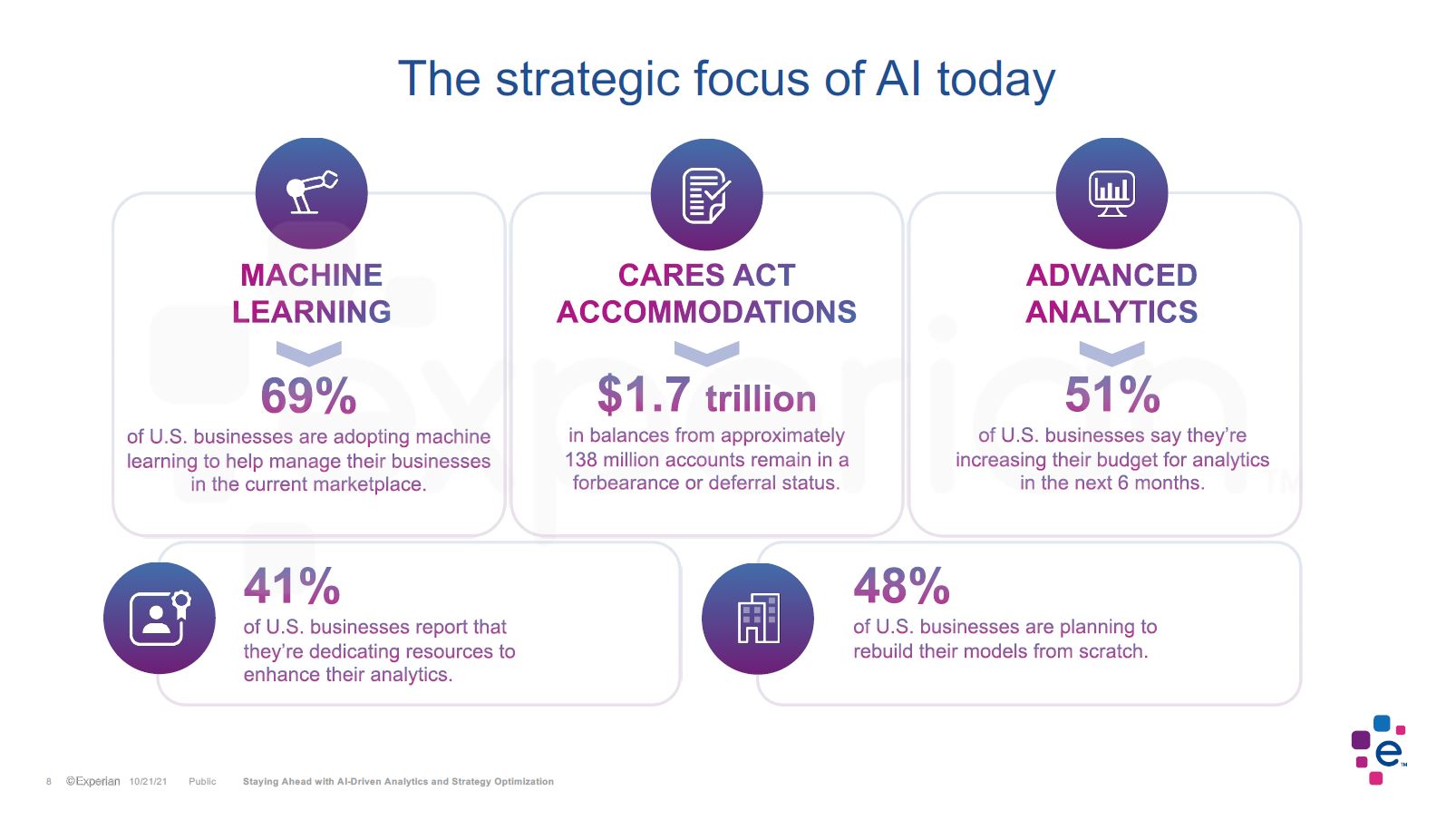
It is no news that businesses are increasing their focus on advanced analytics and models. Whether looking to increase resources or focus on artificial intelligence (AI) and machine learning (ML), growth is the name of the game. But how do you maximize impact while minimizing risk? And how can you secure expertise and ROI when budgets are strapped? Does your organization have the knowledge and talent in-house to remain competitive?
No matter where you are on the analytics maturity curve, (outlined in detail below), your organization can benefit from making sure your machine learning models solution consists of:
- Regulatory documentation: Documentation for model and strategy governance is critical, especially as there is more conversation surrounding fair lending and how it relates to machine learning models. How does your organization ensure your models are explainable, well documented and making fair decisions? These are all questions you must be asking of your partners and solutions.
- Integrated services: For some service providers, “integrated,” is merely a marketing ploy, but it is essential that your solution truly integrates attributes, scores, models and decisions into one another. Not only does this serve as a “checks and balances” system of sorts, but it also is a primary driver for the speed of decisioning, which is crucial in today’s digital-first world.
- Deep expertise: Models are a major component for your decisioning, but ensuring those models are built and backed by experts is the one-two punch your strategies depend on. Make sure your services are managed by data scientists with extensive experience to take the best approach to solving your business problems.
- Usability: Does your solution close the loop? To future proof your processes, your solution must analyze the performance of attributes, scores and strategies. On top of that, your solution should make sure the items being built are useable and can be modified when needed. A one-and-done model does not suit the unique needs of your organization, so ensure your solution provides actionable analysis for continual refinement.
Does your machine learning model solution check these boxes? Do you want to transform your existing system into a state-of-the-art AI platform? Learn more about how you can take your business challenges head-on by rapidly developing, deploying and monitoring sophisticated models and strategies to more accurately predict risk and achieve better outcomes.
More information: What’s the analytics maturity curve?
“Analytics” is the discovery, interpretation and communication of meaningful patterns in data; the connective tissue between data and effective decision-making within an organization. You can be along this journey for different decision points you’re making or product types, said Mark Soffietti, Director of Analytics Consulting at Experian, at our recent AI-driven analytics and strategy optimization webinar. Where you are on this curve often depends on your organization’s use of generic versus custom scores, the systems currently engaged to make those decisions and the sophistication of an organization’s models and/or strategies.
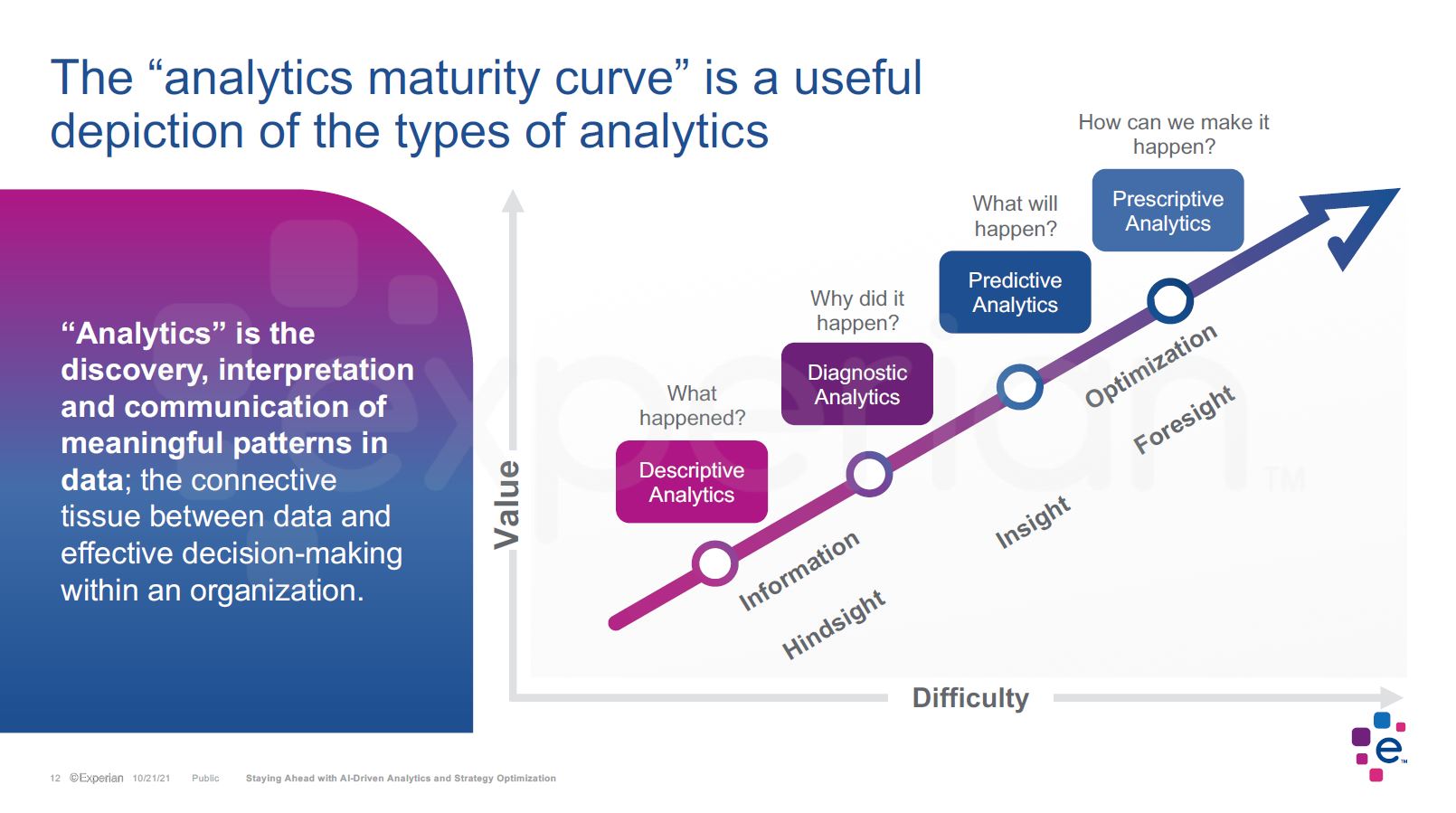
Here’s a breakdown of each of the four stages:
Descriptive Analytics – Descriptive analytics is the first step of the analytics maturity curve. These analytics answer the question “What is happening?” and typically revolve around some form of reporting. An example would be the information that your organization received 100 applications.
Diagnostic Analytics – These analytics move from what happened to, “Why did it happen?” By digging into the 100 applications received, diagnostic analytics answer questions like “Who were we targeting?” and “How did those people come into our online portal/branch?” This information helps organizations be more strategic in their practices.
Predictive Analytics – Models come into play at this stage as organizations try to predict what will happen. Based on the data set and an understanding of what the organization is doing, effort is put towards automating information to better solve business problems.
Prescriptive Analytics – Optimization is key for prescriptive analytics. At this point in the maturity curve, there are multiple models and/or information that may be competing against one another. Prescriptive analytics will attempt to prescribe what an organization is doing and how it can drive more desired behaviors.
For more information and to get personalized recommendations throughout your analytics journey, visit our website.