Industries
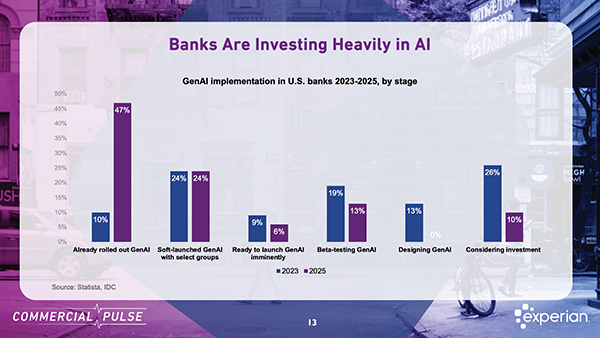
How Structural Shifts in Scale, Technology, and Customer Behavior Are Redefining Risk Leadership This week’s Experian Commercial Pulse report includes great insights on the banking industry, a sector that is not simply evolving, it's structurally transforming. The implications of banking transformation extend well beyond portfolio performance. Consolidation, digital acceleration, and aggressive investment in artificial intelligence are reshaping the competitive landscape and redefining risk management itself. Watch The Commercial Pulse Update While commercial credit performance remains relatively stable, the operating model of banking is changing quickly. The institutions that thrive in this environment will be those that modernize risk frameworks in parallel with ongoing structural change. This week's Pulse identified four major trends CRO's and risk teams should be watching closely. 1. Consolidation in the Banking Industry: Fewer Banks, Fewer Branches The number of FDIC-insured banks has declined to less than half of what it was in 2000. Decades of mergers and acquisitions, including several of the largest transactions occurring in just the past five years, have materially reshaped the competitive environment. At the same time, the physical footprint of banking has contracted. Total branch counts have fallen significantly from their 2008 peak, and branch availability continues to decline across many regions. For risk leaders, consolidation creates both opportunity and exposure. On one hand, scale can improve capital efficiency, risk diversification, and investment capacity in advanced analytics. Larger institutions may also benefit from deeper data pools and stronger enterprise risk infrastructures. On the other hand, concentration risk becomes more pronounced, geographically, sectorally, and operationally. As institutions grow through acquisition, integration risk, model harmonization challenges, and cultural alignment issues must be carefully managed. For CROs, consolidation is not just an industry headline, it is a structural variable influencing counterparty exposure, competitive pressure, and systemic interdependencies. 2. The Acceleration of Online Banking As physical branches decline, digital engagement has accelerated dramatically. In 2019, just over half of U.S. consumers used online banking. By 2025, that number rose to roughly 71%, and projections suggest it could approach 80% by 2029. Younger demographics in particular show a strong preference for online-only banking relationships, while older customers continue to rely more heavily on traditional channels. For small businesses, digital onboarding, online treasury management, mobile payments, and remote lending processes are no longer differentiators — they are expectations. For CROs, increased digital penetration changes the risk equation in several ways: Fraud vectors expand as digital interactions multiply. Identity verification and authentication controls become mission-critical. Real-time monitoring replaces periodic review. Data velocity increases, requiring scalable analytics infrastructure. Operational resilience also becomes more important. As customer engagement concentrates in digital channels, system uptime, cybersecurity, and third-party risk management move to the forefront of enterprise risk oversight. Digital adoption is not merely a distribution channel shift. It is a transformation in how risk manifests and must be measured. 3. Technology Trends: AI, Automation, and Real-Time Risk Intelligence Technology modernization has become central to competitive strategy across commercial banking. Artificial intelligence, machine learning, real-time fraud detection, and automated underwriting are moving from pilot programs into core production environments. Generative AI adoption in particular has accelerated rapidly, with nearly half of commercial banks now operating some form of GenAI solution in production. For a CRO, the opportunity is substantial. Advanced analytics can: Enhance early warning systems for credit deterioration. Improve fraud detection accuracy while reducing false positives. Refine borrower segmentation and pricing precision. Optimize collections prioritization and recovery strategies. Strengthen stress testing and scenario modeling capabilities. However, innovation introduces new forms of model risk. AI-driven decisioning must be explainable, auditable, and compliant with regulatory expectations. Governance frameworks must evolve to ensure transparency, fairness, and mitigating bias. Data lineage and model validation processes must remain rigorous even as deployment speeds increase. The challenge for risk leaders is achieving balance, leveraging technological advantage without compromising control discipline. 4. Investment in AI: Strategic Imperative, Not Experimentation AI investment in commercial banking is accelerating at a notable pace. Industry forecasts indicate that AI spending in the Americas banking sector could exceed $54 billion by 2028 — nearly tripling from 2024 levels. This level of capital allocation signals a fundamental shift: AI is no longer viewed as an incremental enhancement. It is considered foundational infrastructure. Executives report that AI initiatives are focused on: Cybersecurity enhancement Fraud detection and prevention Operational efficiency Customer engagement personalization Credit risk modeling improvement For CROs, this scale of investment demands disciplined oversight. Key considerations include: Are AI initiatives aligned with defined risk appetite statements? Is governance keeping pace with deployment velocity? Are internal teams sufficiently trained to interpret AI outputs? Is the institution prepared for heightened regulatory scrutiny around automated decisioning? The strategic sweet spot lies in controlled acceleration — modernizing the risk stack while reinforcing control frameworks. Final Perspective for CROs Commercial credit performance today remains relatively stable. Yet the true story in banking is not short-term performance, it is long-term transformation. We are operating in an environment defined by structural consolidation, digital-first customer behavior, rapid AI adoption, expanding data ecosystems, and increasing regulatory complexity. For Chief Risk Officers, the mandate is clear: safeguard portfolio quality while modernizing risk infrastructure. The institutions best positioned for sustainable growth will not simply extend capital efficiently, they will integrate advanced analytics, strengthen governance, and proactively manage emerging digital risks. Transformation is underway. The question is not whether it will continue. The question is whether risk organizations will lead it — or react to it. Learn more ✔ Visit our Commercial Insights Hub for in-depth reports and expert analysis. ✔ Subscribe to our YouTube channel for regular updates on small business trends. ✔ Connect with your Experian account team to explore how data-driven insights can help your business grow. Download the Commercial Pulse Report Visit Commercial Insights Hub Related Posts

For many Chief Risk Officers, credit portfolio management can feel like a constant exercise in damage control. A spike in delinquencies is reported in the monthly update. A sector suddenly underperforms. The board asks whether the risk appetite still holds, after the fact. This reactive posture isn’t the result of poor risk discipline. It’s the result of portfolio management approaches built for a slower, more predictable credit environment. Today’s commercial and small business portfolios move faster, fragment across industries, and respond quickly to macro and behavioral shifts. To stay ahead, CROs must evolve credit portfolio management from firefighting to forecasting. Why Traditional Credit Portfolio Management Keeps CROs in Reaction Mode Many portfolio management programs still rely on legacy practices: - Lagging indicators such as delinquency and charge-off trends- Static, periodic reporting rather than continuous insight- Limited segmentation that masks pockets of emerging risk- Manual analysis that slows decision-making The result is a cycle CROs know well: risk becomes visible only once it has already materialized. By then, options are fewer, and corrective actions are more disruptive to growth and customer relationships. In volatile economic conditions, especially within small business portfolios, this approach exposes institutions to unnecessary risk and earnings volatility. The CRO’s Mandate Has Changed Modern CROs are no longer measured solely on loss avoidance. They are expected to: - Enable profitable growth while maintaining discipline- Translate risk appetite into day-to-day decisions- Anticipate risk before it shows up in losses- Communicate forward-looking insights to executives and boards That requires a fundamentally different approach to credit portfolio management; one that emphasizes early signals, segmentation, and scenario analysis, not just historical performance. What “Forecasting” Looks Like in Credit Portfolio Management A forecasting-oriented portfolio management framework rests on four pillars: Risk Appetite That Is Operational, Not Theoretical Effective forecasting starts with a clearly defined risk appetite that is embedded into portfolio segmentation, exposure limits, score bands, and monitoring thresholds. CROs move beyond static policy statements to measurable guardrails that guide growth and risk-taking in real time. Granular, Dynamic Portfolio Segmentation Rather than viewing the portfolio as a single aggregate, CROs segment by:Industry and geographyBusiness size and lifecycle stageCredit score bands and blended risk profilesProduct, tenure, and exposure concentrationThis level of segmentation allows risk leaders to spot early deterioration in specific pockets, before it becomes a portfolio-wide issue. Early-Warning Signals and Ongoing Monitoring Forecasting depends on identifying changes in behavior, not just outcomes. Shifts in payment performance, utilization, score trends, or public records provide valuable signals that risk is evolving. When these signals are monitored continuously and tied to clear action thresholds, CROs gain time, the most valuable asset in risk management. Scenario Analysis and Forward-Looking Analytics True forecasting requires asking “what if?”• What happens if rates stay higher for longer?• What if a key sector experiences a sudden demand shock?• How would losses and capital needs change under stress?Forward-looking portfolio analytics allow CROs to test assumptions, model outcomes, and guide strategic decisions before conditions deteriorate. Turning Portfolio Data Into Predictive Insight One of the biggest challenges CROs face is not a lack of data, but a lack of integrated analytics that turn data into insight. Portfolio forecasting requires: Access to high-quality commercial and small business data The ability to blend internal performance data with external risk indicators Flexible analytics environments where teams can test, validate, and refine models Dashboards that surface trends and outliers without weeks of custom reporting This is where modern analytics platforms become essential. How Experian Supports Predictive Credit Portfolio Management Experian’s Ascend Commercial Suite™ is designed to help risk leaders move beyond static portfolio reviews toward continuous, insight-driven portfolio management. Ascend Commercial Suite is an integrated analytics platform that brings together data, modeling, benchmarking, and portfolio analysis in a single environment. Key capabilities that support forecasting-oriented portfolio management include: Portfolio Performance Monitoring and DashboardsAscend enables risk teams to create interactive dashboards that are directly connected to portfolio and market data. This allows CROs to: Monitor portfolio performance continuously Identify emerging areas of strength or concern Reduce reliance on manual, recurring reports Advanced Analytics and Model Development With access to Experian’s proprietary commercial and small business data, along with client-owned data, risk teams can: Develop and validate new credit and risk models Monitor existing models for performance and stability Meet regulatory expectations for ongoing model validation Blended and Small Business Risk Analysis For portfolios that rely on personal guarantees or serve small and micro businesses, Ascend supports blended analysis using both commercial and consumer credit data. This provides a more complete view of risk and supports more accurate segmentation and forecasting. Benchmarking and Peer Analysis Ascend’s benchmarking capabilities allow CROs to compare portfolio performance against peer populations and market segments, helping to contextualize risk trends and identify opportunities for adjustment before performance diverges materially. Together, these capabilities help CROs replace reactive portfolio reviews with proactive, data-driven risk steering. "Looking at how similar businesses performed across the broader market helped us move from reactive decisions to forward-looking ones, especially when evaluating new segments and understanding expected loss rates before expanding."Arun Narayan, Chief Product Officer From Firefighting to Confidence When credit portfolio management is built around forecasting rather than reaction, CROs gain: Earlier visibility into emerging risk Smoother, more deliberate policy adjustments Greater confidence in growth strategies Stronger, more credible communication with boards and regulators The goal isn’t to eliminate risk, that’s impossible. The goal is to see risk forming early enough to manage it on your terms. Talk with Experian’s commercial risk experts about strengthening your credit portfolio management strategy with forward-looking analytics and insights. Get In Touch Learn more about how Experian Ascend Commercial Suite can help you monitor, analyze, and forecast portfolio risk with confidence. Learn more Related Posts
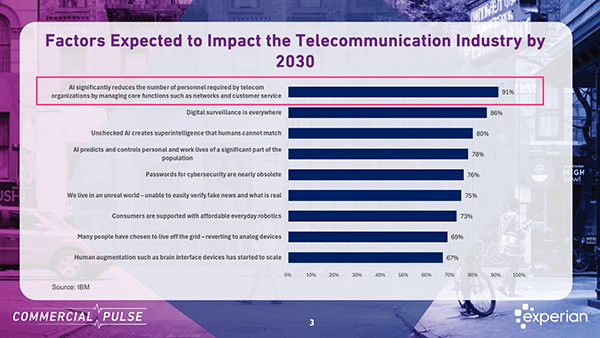
Is AI about to disrupt the telecommunications industry? In this week's Commercial Pulse Report, we explore potential AI disruption in the Telecommunications industry as the transition from analog to digital plays out, and industry consolidation takes hold. Watch The Commercial Pulse Update In 1979, a British new wave band called The Buggles released a song that would become an unlikely cultural landmark. Video Killed The Radio Star wasn’t just catchy—it was prophetic. The lyrics mourned the decline of radio as television and music videos began to dominate how audiences consumed content. Just a few years later, MTV launched, and the shift from audio to visual media was complete. Radio didn’t disappear, but it was permanently changed. One line from the song captures the unease of that moment perfectly “In my mind and in my car, we can’t rewind, we’ve gone too far,pictures came and broke your heart, put the blame on VCR.”The Buggles, 1979 It’s a lament about progress—about technology moving faster than society can comfortably absorb. And it’s a reminder that once disruption takes hold, there’s no rewinding the tape. Fast forward more than four decades, and the irony is hard to miss. MTV itself—once the symbol of disruption—has faded from cultural relevance, ending as it started by playing "Video Killed The Radio Star" on December 31st, 2025. That same cycle defines today’s telecommunications industry disruption, as AI, automation, and consolidation reshape how companies operate and compete. A Familiar Pattern of Disruption Telecommunications has lived through repeated waves of technological upheaval. The shift from analogue to digital fundamentally altered how networks were built, how services were delivered, and how companies competed. That transition drove efficiency, reduced headcount, and accelerated consolidation across the industry. Now, artificial intelligence represents the next inflection point. As highlighted in this week’s Commercial Pulse Report, AI is no longer a future concept for telecom—it’s a near-term operational reality. Industry research shows that a majority of telecom executives expect AI to materially reshape their organizations by automating core functions such as network management, customer service, and fraud detection. Just as video once replaced radio as the dominant format, AI is poised to redefine how telecom companies operate—faster, leaner, and increasingly software-driven. And as history has shown, efficiency gains often come with structural consequences. Consolidation, Scale, and Survival Disruption rarely happens in isolation. It tends to accelerate industry consolidation, and telecom is no exception. Over the past decade, mergers and acquisitions have reshaped the competitive landscape. In wireless, consolidation has resulted in three dominant players controlling the majority of the market. At the same time, the total number of private telecom establishments in the U.S. has declined sharply from its historical peak. This mirrors what happened in media. MTV consolidated attention, then streaming consolidated distribution, and now a handful of platforms dominate content delivery. Each wave reduced the number of viable players while raising the cost of participation. In telecom, AI may lower operating costs—but it also raises the bar for capital investment, data sophistication, and technological capability. Smaller firms face increasing pressure to either specialize, scale, or exit. What the Credit Data Is Telling Us One of the most telling insights from this week’s Commercial Pulse Report comes from telecom credit behavior. Telecom businesses tend to seek credit more frequently than companies in other industries, reflecting ongoing investment needs. However, the average size of credit lines has steadily declined, even as utilization rates have returned to pre-pandemic levels. In other words, telecom firms are doing more with less. This dynamic suggests that businesses may be turning to alternative funding sources, reallocating capital internally, or operating under tighter credit constraints—despite stable demand for connectivity and data services. For risk leaders and growth strategists, this creates a more complex environment. Traditional indicators alone may not fully capture resilience or vulnerability. Understanding industry-specific behavior becomes critical. We Can’t Rewind—But We Can Prepare The line from “Video Killed The Radio Star” still resonates because it captures a universal truth about disruption: We can’t rewind—we’ve gone too far. AI will not undo itself. The telecom industry will not revert to its pre-digital or pre-automation state. Just as radio adapted rather than disappeared, and MTV faded as new platforms rose, telecom companies will continue to evolve—some faster and more successfully than others. The question is not whether disruption will occur, but who is prepared for it. This week’s Commercial Pulse Report explores that question through the lens of macroeconomic conditions, small business credit health, and telecom-specific insights. Together, they offer a clearer picture of how innovation, consolidation, and credit trends are intersecting in early 2026. Because while technology may break hearts along the way, understanding the data helps businesses stay ahead of the next verse. Learn more ✔ Visit our Commercial Insights Hub for in-depth reports and expert analysis. ✔ Subscribe to our YouTube channel for regular updates on small business trends. ✔ Connect with your Experian account team to explore how data-driven insights can help your business grow. Download the Commercial Pulse Report Visit Commercial Insights Hub Related Posts
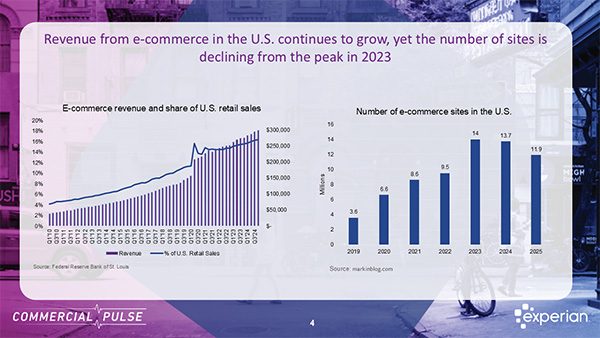
Experian Commercial Pulse Report reveals decline in total number of ecommerce businesses, strong revenue, and fewer credit inquiries.

Explore how the rapid rise in new business formation presents a unique opportunity for firms to expand digital relationships, automate small business credit processes, and stay ahead in a transforming economy.

Get the latest Commercial Insights from Experian's October 2024 report—covering inflation, job growth, and why 75% of small businesses remain underinsured.
Discover how business identity theft threatens B2B firms and learn effective strategies to protect your business and clients. Stay informed and secure.
Explore effective marketing strategies for insurance agents and brokers to boost ROI and client engagement.
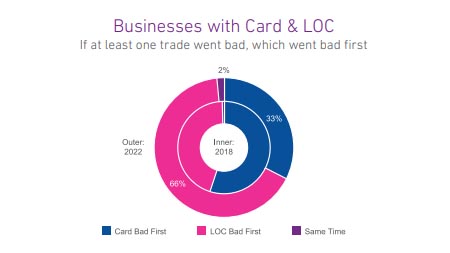
Since January 2021, a seasonally adjusted average of 444K new businesses opened each month, 52% higher than the pre-pandemic 2018-2019 monthly average. In light of the influx of new businesses, and in a higher-interest rate environment, the goal of this week’s analysis was to evaluate if commercial credit usage and payments by product shifted pre- and post-pandemic. Businesses with two different trade types were evaluated as of 2018 (prepandemic) and 2022 (post-pandemic). The two-trade-type combinations observed were Card + OECL (open ended credit line), Card +Term Loan, Card Lease, and Card + LOC (line of credit). Despite more younger businesses entering the market and lenders tightening credit policies over the past two years, businesses with two-trade types had higher lines/loans post-pandemic. Delinquencies also increased post-pandemic for all the two-trade type combinations except businesses with a Card & OECL. Commercial Cards are the most prevalent type of credit for businesses. As businesses grow, they seek additional credit for business needs such as expansion, new facilities, and acquisitions. When businesses seek additional credit, it is most often in the form of commercial loans, leases and credit lines which compared to cards, generally provide higher levels of funding, longer terms and higher monthly fixed payments. For businesses that had two types of accounts, including a commercial card with another commercial credit product, the commercial card stayed current longer and more often the non-card product went delinquent first. Businesses rely on commercial cards for day-to-day operating expenses and lower dollar financing needs. Furthermore, commercial card balances are significantly lower than any of the other commercial trade types allowing for a lower monthly minimum payment to keep the card in good standing. What I am watching: Federal Reserve Chairman Powell stated in last week’s Congressional hearings that the Fed will act slowly and cautiously in terms of cutting interest rates. With inflation declining but still persistent and the labor market still robust, rate cuts may not occur until the second half of the year. Download Report Download the latest version of the Commercial Pulse Report here. Better yet, subscribe so you'll get it in your inbox every time it releases, or once a month as you choose.