Loading...

Crossovers Continue to Grow in Popularity

by Guest Contributor 4 min read March 20, 2019

Happy couple looking a new car in car dealership saloon

When it comes to new vehicle registration, there is one segment that stands out from the pack: crossover vehicles.

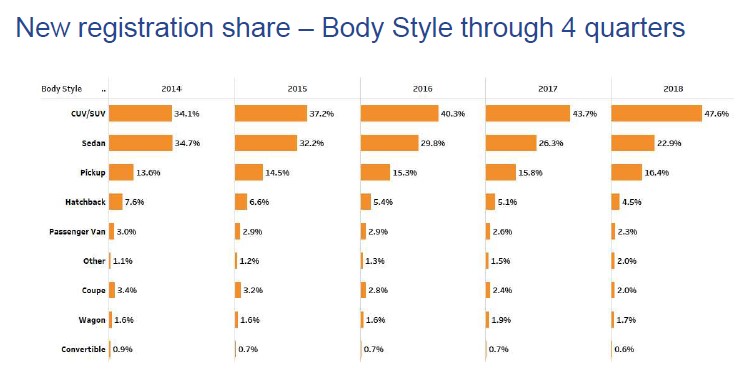
According to Experian’s Q4 2018 Automotive Market Trends Analysis, over the last four years, crossovers (CUVs) have spiked in popularity, representing about a third of new vehicle registrations in 2014 (34.1 percent), but growing to nearly half the new vehicle market in 2018 (47.6 percent).

In fact, the large growth in CUVs isn’t limited to just the last four years – there was a large volume of growth year-over-year compared to 2017; the share has grown nearly 4 percent.

Sedans and hatchbacks, meanwhile, have seen their share decrease year-over-year. The charts below detail this change in market, based on Experian’s latest 2018 quarterly findings.
Source: Experian Automotive VIO as of December 31, 2018 (light duty registered vehicles only)

What’s driving this growth?

Across the board, the number of light-duty vehicles on the road continues to increase, up to 275.3 million in the U.S. market, at the end of 2018, compared to 271.4 million a year prior.

The growth in CUVs isn’t entirely unprecedented, as it’s been going on for a number of years.  CUVs continue to grow in popularity for a variety of reasons including:

  • Greater visibility, as the driver sits higher than in a sedan/coupe
  • Larger storage capacities for passengers or cargo
  • Number of varieties available, such as size, engines, and manufactures
  • Higher fuel efficiency than a full-size SUV or minivan

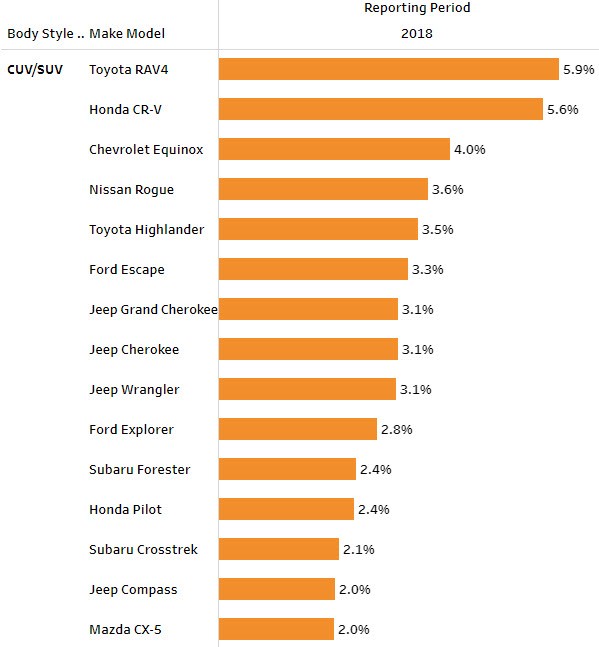
Currently, there are over 130 different CUV/SUV Make/Model combos offered, and of those, the different engines, options, etc. drive that volume even higher.
Source: Experian Automotive VIO as of December 31, 2018 (light duty registered vehicles only)

Potential for growth

Currently, there are only two CUVs among the top vehicles in the aftermarket “sweet spot.” Vehicles in the sweet spot are 6 to 12 model years old, and typically aged out of general OEM warranties for any repairs. These vehicles likely require more part replacement services, which may be performed by aftermarket service shops using parts from aftermarket part manufacturers.

According to Experian data, the sweet spot has stopped falling and has settled for now. But, there is expected growth of the number of vehicles that fall into the sweet spot over the coming years. One of the segments where the aftermarket industry can begin to focus on will be CUVs.
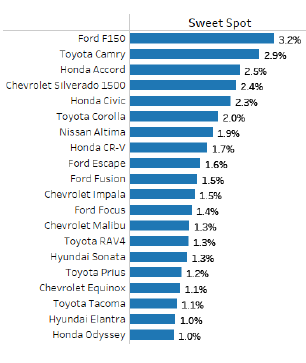
Graph shows top vehicles in the aftermarket sweet spot

Source: Experian Automotive VIO as of December 31, 2018 (light duty registered vehicles only)

The aftermarket can use this data to make more informed product decisions, specifically, around the high volume of CUVs expected to come into the sweet spot.

With the number of vehicle options available on the market today, CUVs will continue to stand out as a segment to watch within the auto industry. There’s a greater story beyond the numbers and understanding how to leverage the data at hand can provide the industry with a greater understanding of CUVs and its potential for even greater growth.

To learn more about CUVs/SUVs and total vehicles in operation, view the full Q4 2018 Automotive Market Trends Analysis.


Related Posts

As the market finds its footing, evolving consumer demand is driving changes in new and used vehicle registrations. In response, manufacturers are balancing affordability and production efficiency to protect their market share. According to Experian’s Automotive Market Trends Report: Q4 2025, new vehicle registrations slightly decreased to 3.8 million, from 4 million this time last year. On the used side, registrations ticked up slightly year-over-year, going from 9 million to 9.1 million. With elevated new vehicle pricing and higher interest rates likely playing a role in new vehicle registrations dipping, buyers seem to be gravitating toward lower-cost alternatives in the used market. Familiar OEM leaders remain steady at the top of market share Despite shifts in vehicle registrations, leaders in new vehicle manufacturer market share have remained consistent. For instance, data through the fourth quarter of this year reveled General Motors (GM), Toyota, and Ford continue to hold the top three positions in new vehicle market share, with GM coming in at 17.4% share, followed by Toyota (16.5%), and Ford (12.6%). At the make level, Toyota held the top position for the fourth consecutive year in new vehicle market share, coming in at 14.1% through Q4 2025; they were followed by Ford (11.9%) and Chevrolet (11%). Sustained leadership in today’s market isn’t just about scale, it relies on how quickly manufacturers can respond and adapt to shifting consumer preferences and industry changes. Those that adapt their portfolios and go-to-market approaches will be best positioned not just to protect their share, but to grow it as the market continues to evolve. To learn more about vehicle market trends, view the full Automotive Market Trends Report: Q4 2025 presentation on demand.

by John Howard 4 min read March 26, 2026

We’re excited to share that Experian Automotive’s client Hamlin & Associates and Honda World have been named winners of the 2025 Automotive News / Ad Age Global Automotive Marketing Award for Best Use of Data — an honor that celebrates meaningful, measurable impact. Why this work stood out Hamlin & Associates' client, Honda World of Louisville, KY, faced a clear challenge: re-engage customers and recover declining service revenue, particularly for vehicles with open recalls. Hamlin & Associates approached the problem with a simple belief: clean, accurate data leads to better outcomes for customers and dealerships alike. They began with data hygiene, then enriched each vehicle record using Experian Automotive’s Recall VIN Verification solution. This created a precise view of who owned which vehicles, which recalls were still open, and when repairs could be completed — all essential to a smooth customer experience. A smarter, more human outreach strategy Over the course of a year, Hamlin delivered four waves of direct mail designed to cut through the noise. Each letter: Spoke directly to the customer Highlighted their specific vehicle Explained the recall in clear language Showed how easy it was to book a free repair The result was a data-driven communication plan grounded in trust and simplicity — and it worked Results that show what’s possible 26% response rate 1,953 repair orders $811,834 in service revenue Thousands of customers are now driving safer vehicles These outcomes reflect more than campaign performance. They demonstrate what happens when dealers, agencies, and data partners collaborate to guide individuals toward safer, more informed decisions. In their words John Hamlin, Hamlin & Associates:“Clean data builds trust. When we combine our hygiene process with Experian Automotive insights, dealers uncover opportunities they never knew they had.” Mike Porro, Honda World:“They keep it simple, and data-driven ‘simple’ gets done. We follow the process, train our staff, and see the results.” Looking ahead We’re proud to celebrate Hamlin & Associates and Honda World for showing what’s achievable when data, insight, and clear communication come together. Their work helps people stay safe, strengthens customer relationships, and sets a new standard for recall outreach. Congratulations to the entire team — and here’s to helping even more drivers move forward Learn more about how to enrich your first-party data with Recall VIN Verification insights!  

by Trish Radaj 4 min read December 18, 2025

From the vehicles we drive to the way we purchase them, everything in the automotive industry is evolving as new technologies, shifting incentives, and changing consumer expectations continue to develop. As electrified vehicles continue to grow their presence on the road, Experian’s Automotive Market Trends Report: Q3 2025 took a deep dive into this segment and found that 5.5 million electric vehicles (EVs) and 11.7 million hybrids were in operation this quarter. Furthermore, data through the third quarter of this year found that 73.8% of EV owners returning to market replaced their EV with another EV and only 16.5% switched to a gas-powered vehicle. The significant EV loyalty among consumers signals that the ownership experience is delivering on core expectations. While some owners continued to opt for an EV because they’ve grown accustomed to certain conveniences such as charging stations at home or workplace to avoid traditional fueling and the perks of lower maintenance needs, others took advantage of the EV tax credits before they expired at the end of September. However, as these motivations shift, it will be important to monitor how the EV market unfolds over the next six months. Notably, 11.7% of gas-powered vehicle owners replaced their vehicle with a gas-hybrid vehicle this quarter, suggesting that hybrids are acting as an effective bridge toward deeper electrification. In fact, drivers may see hybrids as the ‘happy medium’ vehicle that offers improved fuel efficiency without requiring full reliance on charging infrastructure. Why this matters for the aftermarket As the majority of consumers replace their EVs with another one and some switch their gas-powered vehicle for an electrified one, these trends signal potential long-term commitment to alternative fuel segments. This is important to monitor for aftermarket professionals as the EV service volume continues to grow, requiring different parts and technician training. With consumers increasingly turning to the aftermarket for cost-effective support, professionals who adapt to diverse powertrains will be best positioned to navigate this evolving wave of post-warranty demand. To learn more about EVs and other vehicle market trends, view the full Automotive Market Trends Report: Q3 2025 presentation on demand.

by John Howard 4 min read December 18, 2025

Subscribe to our Auto blog

Enter your name and email for the latest updates.

This site is protected by reCAPTCHA and the Google Privacy Policy and Terms of Service apply.