The AdTech industry is undergoing rapid changes as it adjusts to the impacts of data deprecation and ever-changing privacy regulations. At the same time, there are fears of a potential economic downturn. How should you handle marketing in a recession? What should your marketing mix look like? In this blog post, we’ll cover how to navigate this uncertainty and three essential ingredients for your marketing mix.
First, we’ll look at the complexity and uncertainty facing marketers.
Turbulence with Twitter
After Elon Musk’s Twitter takeover in October 2022, half of Twitter’s top 100 advertisers left the platform and started to seek out alternatives.
The retail media boom
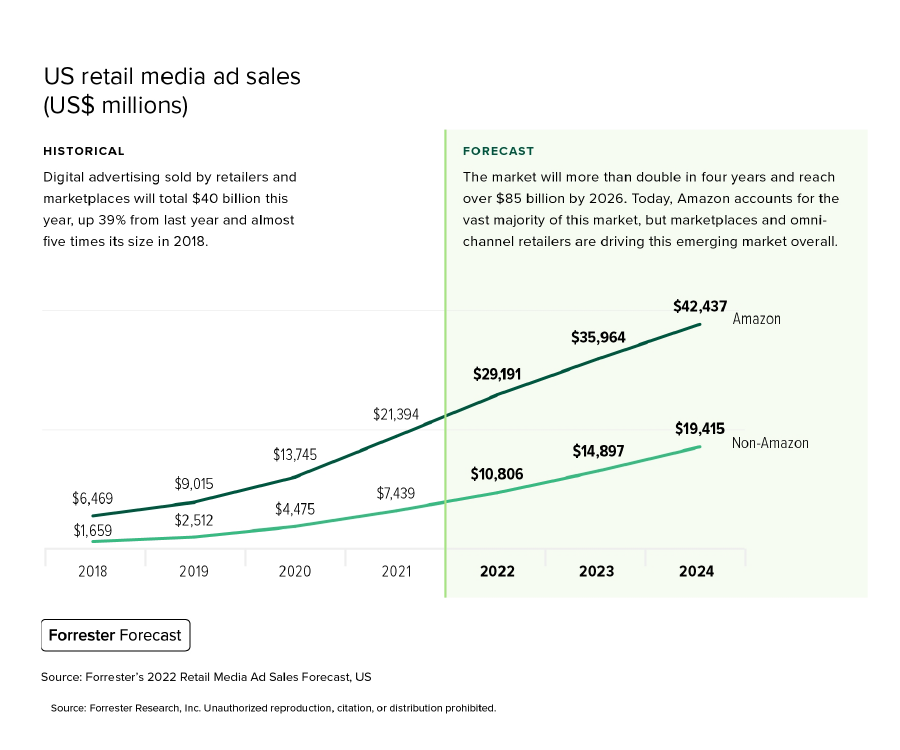
In the next four years, Forrester Research projects that U.S. retail media ad sales will double to reach 85 billion by 2026.1
Most of this growth is catalyzed by CPG and consumer electronic brands that have a scarcity of zero- and first-party data; they need more media closer to the point of purchase, especially as CFOs are scrutinizing budgets.
Consumption continues to fragment
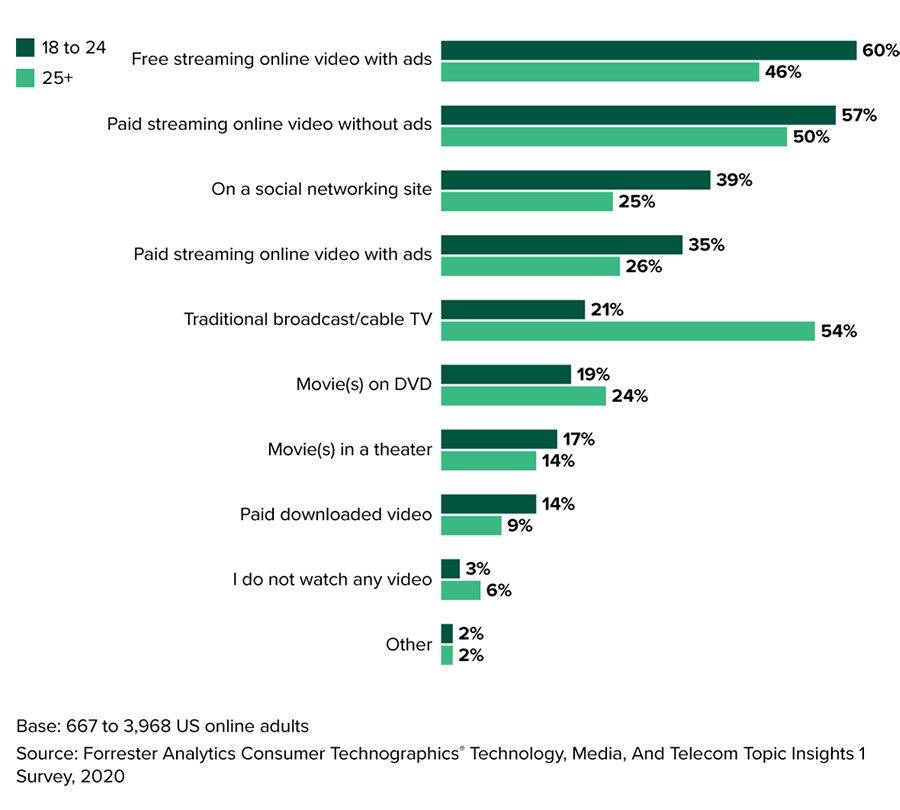
It’s becoming harder than ever to reach the right person, at the right time, predict their intent, and get a 360-degree view of your customer.2
Data deprecation is top of mind
According to Forrester Research, updating their data strategy to address data deprecation is the number one priority for marketers. Addressing data deprecation is also a priority for consumers, who increasingly feel that audience targeting is more intrusive than beneficial.3
Data deprecation affects identity solutions
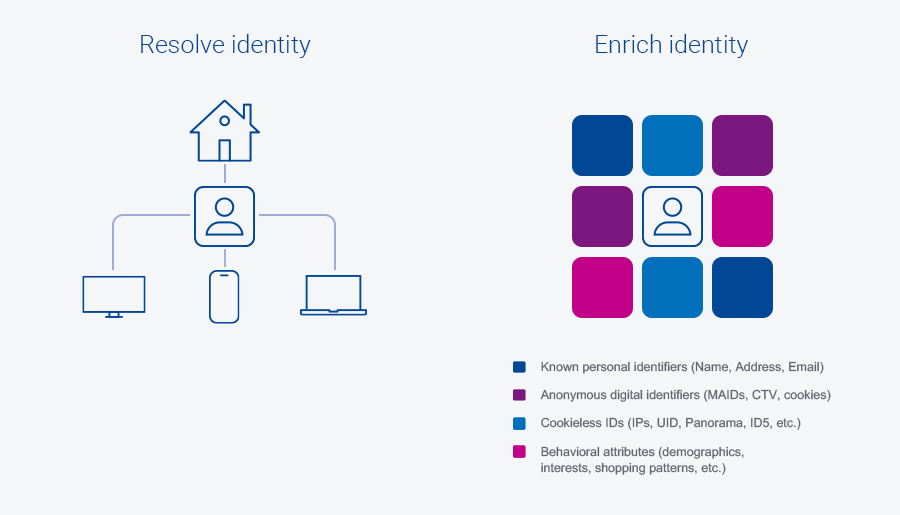
Third-party data and mobile ad IDs (MAIDs) are the connective tissue for identity solutions. As we see those signals go away, there are fewer linkages to resolve identity and it’s leading to a rise in fragmented, duplicated, and shallow identity.
Recession fears
In addition to everything happening in AdTech, there are also fears of a possible recession. According to Forrester, 40% of Gen Z and 41% of Millennials believe fears of an upcoming recession are greatly exaggerated. On the other hand, only 24% of Gen X and 12% of Baby Boomers agree.4
Navigate uncertainty and marketing in a recession
With the current macroeconomic conditions, data deprecation, and fragmented consumption in mind, what should your strategy look like for marketing in a recession? Forrester recommends three strategies:
- People-led planning
- Test creative
- Optimize for marginal costs
People-led planning
Planning doesn’t have to be fragmented. Map offline and online media exposures to consumer decision journeys. Strategies like lifetime value (LTV) driven audience segmentation to correlate awareness at top of the funnel layered with demand generation exposures harvested later in the funnel. To do this, it’s crucial to work with providers that give you visibility into the audience buyer’s journey to awareness, intent, consideration, and purchase, all the way through to loyalty.5
Test creative
Make your creative work harder for you. Apply the same rigor with your creative that you applied to segmentation. Utilize multivariate testing to identify creative that is winning or losing. When you understand how each variable performs, you can scale the variables with creative optimization to have a material impact on performance.
Optimize for marginal costs
Optimize for marginal costs of acquisition, not just the average. Adjust for incrementality – what is the cost to acquire one more customer, rather than the average cost of acquisition.
Find the right marketing mix in a recession
With these changes in mind, how can you find the right marketing mix in a recession? We can show you the way.
You can create the right marketing mix with three key ingredients:
- Audiences
- Identity
- Activation
Let’s explore each ingredient to start you down the path toward marketing campaign success.
Audiences: Know your customer
The first ingredient to add to your marketing mix in a recession is your audience. Knowing your customer is key to targeting the right audiences successfully. Data-driven targeting can help you find your best audiences based on demographics, modeled lifestyles, and behaviors to improve marketing campaign performance.
Not sure where to start when it comes to developing your target audience strategy? We can help. We track digital usage of our data used by advertisers and identified the top four digital audiences that advertisers purchased over the last four years.
Four digital audiences to consider
Marketing strategies are only as strong as the data foundation they’re built on. The top four digital audiences that advertisers are purchasing from Experian include:
- Demographics
- Behavioral
- Modeled Lifestyles
- Custom Audiences
Demographics
Examples include age, gender, relationship status, living situation, life experience, and employment.
Behavioral
This audience allows marketers to identify households that are more likely to engage in certain activities or belong to certain groups.
Modeled Lifestyles
Experian’s Mosaic® USA segmentation. This is a household-based consumer lifestyle segmentation system that classifies all U.S. households and neighborhoods into 71 unique types and 19 overarching groups, providing a 360-degree view of consumers’ choices, preferences, and habits.
Custom Audiences
This is an audience blended from multiple sources or derived from first-party look-alike modeling.
Changes in digital audience strategies
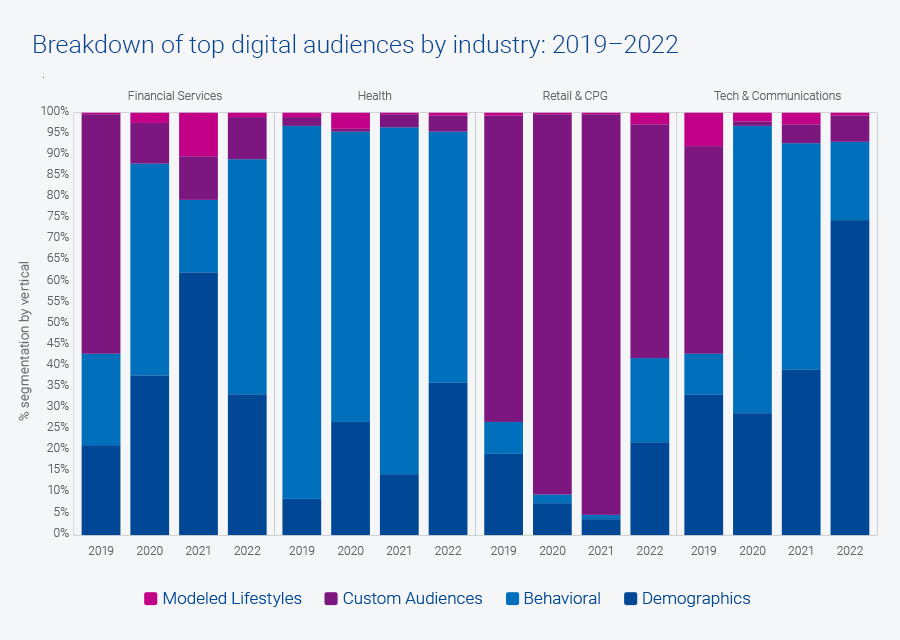
Over the last four years, Modeled Lifestyles and Custom Audience purchases represented the smallest share of digital activation, while Behavioral and Demographic segments were more popular with advertisers.
When the U.S. rolled out the COVID-19 vaccine, consumers became more active. People were shopping in stores, returning to the gym, and taking trips that they had postponed during the height of the pandemic. Marketers turned to higher compositions of Demographic and Modeled Lifestyles to reach these audiences between April and December of 2021.
Sustained growth in Demographic audience activation could suggest a move back to tried and true audience strategies as signals continue to decline and amid evolving regulation. With economic uncertainty, marketers return to what they know. Traditional targeting methods like Demographics and Modeled Lifestyles are the baseline of many marketing strategies and we predict that we will continue to see marketers activating against these data sets.
Download our 2023 digital audience trends and predictions report to discover our full insights on how digital activation has changed and where we’re headed.
Identity: Understand the customer journey
Identity resolution is the next ingredient that you should add to your marketing mix in a recession. It should be a foundational element of every marketer’s strategy.
What is identity resolution? In the simplest terms, identity resolution is the process of matching different devices, IDs, and touchpoints back to a single person. Identity resolution expands marketers’ addressability and reach of their target audience and helps inform and measure accurate customer journeys.
Identity resolution challenges
Identity resolution faces two main challenges:
- Making the data actionable. Humans are complex. We have behaviors that change based on our current social groups and life events, we use dozens of internet-connected devices in a single day, and we exhibit distinct behaviors that happen online and in the physical world. This means marketers have mounds of data being collected from different channels based on that dynamic behavior of people, making it feel impossible to organize the data in a way that makes it feel actionable, know how it ties back to real humans, and ensure they’re doing it in a responsible and compliant way.
- Signal loss. Marketers continue to lose important signals that they’ve previously been able to rely on to inform their next move. Signals are being lost as our industry places more privacy regulations and restrictions on what can be tracked and as consumers themselves change behaviors to protect their privacy.
As consumer behaviors continue to change and signals disappear, identity resolution gets exponentially harder.
Expand addressability and reach with identity resolution
Data deprecation adversely affects identity solutions, but identity resolution should be a key ingredient in your marketing mix. Identity resolution ensures that consumers experience more relevant products, offers, and messaging – allowing you to reap the ROI benefits of hitting consumers at the perfect point in their journey.
Finding an identity resolution partner
When selecting an identity resolution partner, you should understand the data and processes that are implemented behind the scenes. It’s important to know:
- What makes up their consumer database?
- How fresh is their data?
- What identifiers can they match?
- How do they protect consumer privacy?
At Experian, we’re rooted in deterministic offline data which creates a stable foundation. We then layer in digital and behavioral touchpoints. We have decades of experience managing consumer data safely. We have insights on 250 million individuals, three billion devices, and one trillion device signals. Our databases evolve as quickly as the human behavior powering them does.
Our approach to identity resolution is open and agnostic. This means we can collect and ingest nearly all available offline and online identifiers. We can do this in all types of environments, including connected TV (CTV), mobile, and cookieless. We have two types of identity resolution:
- Offline
- Digital
This ensures we control how known and anonymous data points are connected for consumer privacy purposes.
Identity resolution in action
Our depth of data gives our clients access to see the whole human and gain the context around singular data points.
Let’s walk through an example of our identity resolution capabilities.
Challenge
Our TV media platform client needed to measure the effectiveness of an ad campaign they were running on behalf of a leading consumer electronics brand. The TV platform wanted to be able to accurately report on which consumers made a purchase after seeing the brand’s TV commercial on their platforms.
Solution
Using our digital identity resolution services, our client could capture online purchases made on the brand’s website and link them back to a consumer profile. In addition to online transactions, our client used our offline resolution services to resolve email addresses of consumers that purchased offline, using warranty registration details.
With online and offline purchase data now resolved back to an individual ID, we also performed identity resolution on viewers in their TV subscriber files that had also been exposed to the TV commercial. This allowed us to identify subscribers that had both seen the ad and purchased a product.
We provided our client with a packaged report that they could white-label and pass along to the brand.
Results
By providing this attribution reporting to the brand, the TV platform could validate the ROI spent on their platform. The brand was extremely satisfied with the results, and they transitioned the one-off TV commercial into an ongoing campaign and purchased quarterly measurement. This led to solid recurring revenue for the TV platform.
Activation: Experiment and measure the impact
The third and final ingredient to finding the right marketing mix in a recession is activation. Experimentation is the best way to determine which channels work best for your business and provide the most ROI.
Demand-side platforms (DSP), video platforms, and sell-side targeting are three important activation channels that you should consider experimenting with.
Demand-side platforms
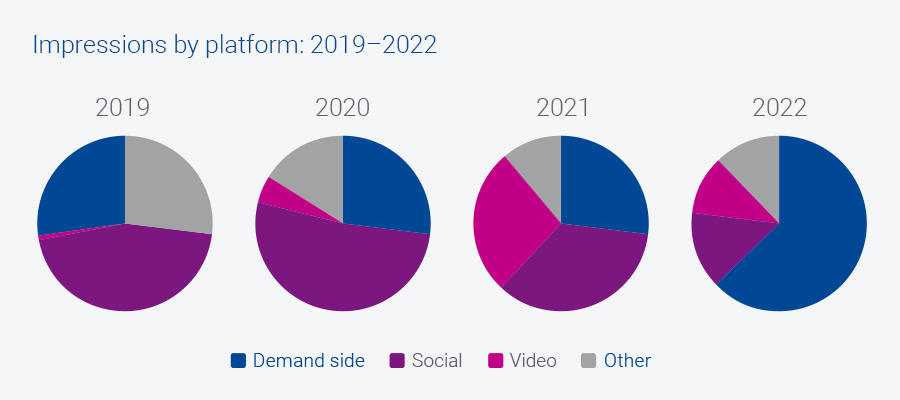
We continue to see increased demand for environments where alternative identifiers are being transacted (like DSPs and video). Social channels are decreasing; this can be attributed to changes in privacy, security, and concerns around brand safety.
Amazon’s DSP is catching up with Google and Meta to become a top ad platform.
Video platforms
Digital video and other video channels like over-the-top (OTT) and CTV will continue to grow. Digital video will capture the most ad spend in 2023 (22.4% in 2023 vs 19.3% in 2022). Because of this, advertisers are placing bigger bets on the combination of addressable and CTV.
Sell-side targeting
Data sharing relationships will become strongest on the sell-side as we move toward consented first-party data. Ad dollars are shifting to channels that use the sell-side approach, like retail media and CTV.
Sell-side targeting enables brands to access large amounts of inventory across publishers and retailers. By getting closer to the ad inventory, advertisers can future-proof their strategies by having more access to better data signals. Direct relationships like these will be necessary as privacy regulations increase and signal loss continues.
We can help you find the right marketing mix in a recession
Now is the time to be opportunistic. Gaining share of voice during a downturn is cost-effective. Proactive marketing builds pent-up demand.
Delivering the right message in the right place at the right time means truly knowing your prospects and customers as individuals. At Experian, we bring you the highest-resolution picture of people, so you and your customers can connect with confidence.
You can turn prospects into customers with the right audience. By understanding your customers better, you can find more like them. Together we can power better results.
Find the right marketing mix
Check out our webinar, “Find the right marketing mix with rising consumer expectations.” Guest speaker, Nikhil Lai, Senior Analyst from Forrester Research, joined Experian experts Erin Haselkorn and Eden Wilbur. Watch the recording to learn:
- New data on the complexity and uncertainty facing marketers
- Consumer trends for 2023
- Recommendations on finding the right channel mix and the right consumers
Get in touch
Sources
- 2022 Retail Media Ad Sales Forecast, US. Forrester Research, Inc. 2022.
- Forrester Analytics Consumer Technographics® Technology, Media, and Telecom Topic Insights 1 Survey. Forrester Research, Inc. 2020.
- CMO Pulse Survey. Forrester Research, Inc. July 2021.
- Forrester’s Consumer Energy And Retail Online Survey. Forrester Research, Inc.
- People-Led Planning Solves Customer Problems to Drive Growth. Forrester Research, Inc. August 2, 2021.
Latest posts
When people shopped in 2023 We also saw notable shifts in how, when, and where people shopped on Black Friday. One significant trend noted in our 2023 Holiday spending report was the increasing preference for early holiday shopping, particularly online. Consumers quickly responded to early discounts and promotions, which caused a surge in spending during October. Cyber Week, encompassing Black Friday through Cyber Monday, also played a significant role, accounting for 8% of total consumer holiday spending. 2023 trends we expect to see in 2024 As you gear up for the holiday season, understanding Black Friday trends from 2023 will be vital, as Black Friday 2024 is expected to see a continuation of several key trends alongside emerging ones: Mobile shopping will continue its growth trajectory. Consumers will keep seeking early deals. Marketers will prepare promotions sooner than ever. Flexible payment arrangements like “buy now/pay later” (BNPL) will drive conversions amid continued inflation. Channel switching will become more common. Paid search will drive the most sales. Let’s talk about what past trends and future predictions mean for your marketing strategy and how you can use them to inform your 2024 holiday campaigns. Emerging consumer behaviors Consumer behaviors and preferences have been changing and reshaping the Black Friday shopping landscape over the last few years. Looking ahead to Black Friday 2024, several trends from last year are likely to continue shaping the shopping experience. Early shopping The early holiday shopping trend will continue to become more pronounced. Many consumers now begin their end-of-year shopping well before Halloween, seeking to take advantage of early deals and discounts, enjoy more time to compare prices and products, avoid crowds, secure popular items early, and spread out their budget. In 2023, Gallup found that one in four holiday shoppers even starts as early as September. This means your business must begin planning sales and promotions earlier in the season and roll them out sooner. The value of experiences We’re seeing an interesting shift toward gifting experiences over physical items among consumers with more disposable income. In a 2023 survey, one in five respondents said they’d prefer to get an experience as a gift over an item. Those in higher income brackets are allocating more of their holiday budgets to experiences that create lasting memories, such as theme park passes, art classes, concert tickets, and so forth. This trend will require retailers to get creative, potentially: Hosting giftable in-store events Enhancing the in-store experience Using experiential marketing to make deeper consumer connections Partnering with other companies to provide bundled gift/experience packages Preference for digital channels Media consumption habits and preferred engagement channels are also undergoing significant changes. Consumers increasingly turn to digital channels like streaming TV and connected TV (CTV) for entertainment and information. CTV ad spending, in particular, is expected to grow by 20% in 2024 and by low double digits into 2027. This shift will influence how retailers reach and engage with consumers, and it underscores the importance of digital marketing strategies and personalized online experiences. Mobile vs. desktop online spending The preference for mobile over desktop for online transactions is growing; in 2023, mobile devices comprised 54% of online sales, with online purchases up 10.4% from 2022 on Black Friday. More and more, consumers are using mobile devices to research, browse, and buy online. Marketers need to optimize their mobile and website experience to make the shopping experience seamless across all devices. Key products and categories Research has shown that the most popular in-store purchases of Black Friday weekend in 2023 included clothing/accessories and electronics. 82% of shoppers bought clothing in-store to inspect colors, material, and fit 73% said they would buy electronics in store to compare quality These categories were followed by: Health and beauty (49%) Household appliances (44%) Sports/leisure (32%) Interestingly, the same categories were also the top sellers online during Cyber Week 2023, with 79% of buyers seeking clothing/accessories and 66% intending to purchase electronics. Amazon was one of the most popular shopping destinations for Cyber Week 2023, with over a billion items sold. Some of the top-selling items included the Amazon Fire TV Stick and Ring Video Doorbell. This indicates a consistent consumer preference across different shopping channels and suggests shoppers are comfortable buying a wide range of products online, even during traditional in-store shopping events. Looking ahead, retailers can reasonably anticipate continued demand for clothing/accessories and electronics, both in-store and online. Marketing strategies that worked Last year was a year of growth, albeit slow growth, despite economic uncertainty. Here are some of the marketing strategies deployed that contributed to this growth. Influencer collaborations Data from a 2023 Black Friday report showed that seven of every 10 shoppers acknowledged an influencer’s role in their purchase decision. Partnering with influencers to promote Black Friday deals and hosting live streaming sessions with influencers showcasing products helped reach new audiences and build credibility. Influencers' recommendations resonated strongly with their followers, which drove traffic and increased sales. Cross-channel marketing campaigns Black Friday gives marketers a unique opportunity to engage audiences across touchpoints. Using a mix of channels, such as social media, email, websites, SMS, in-store promotions, and print media, tends to create more impactful campaigns. Last year proved to be diverse in terms of marketing channel mix. Marketers embraced a cross-channel approach to connect with their users during holiday sales, which was evident in the increased usage of channels like email, SMS/MMS, web push notifications, and emerging channels like Roku messages. Using multiple channels to promote Black Friday deals increased visibility and reached a wider audience. This comprehensive approach ensured marketing messages reached customers wherever they were. To maximize sales during the Cyber Five holiday season, activate Experian audiences as part of your omnichannel campaign. Our offerings include meticulously curated behavioral segments based on discount indicators such as Black Friday, Cyber Monday, and Coupons/Sales. These segments help you target shoppers who are ready to take advantage of your promotions and are primed for early conversion. Our marketing data was ranked #1 in accuracy by Truthset, which means you can power smarter marketing initiatives, like insights, targeting, and measurement, using the highest-rated data. App-only deals In 2023, mobile app sales increased by 2% from 2022, generating a 12% increase in app purchases and $2 billion more in revenue than the year before. Businesses offering exclusive deals through their mobile apps incentivized customers to download and use the app for their purchases, which helped boost sales through a dedicated channel. Limited-time offers Time-limited offers are the essence of Black Friday and Cyber Week, giving shoppers a timeframe for getting the lowest prices of the year on certain products. Creating urgency is a highly effective way to get people to make a faster purchase decision. Bath & Body Works is exemplary at using limited-time offers; once a year around Black Friday, they run a “Buy 3, Get 3” sale on the whole store for a single day, which encourages customers to stock up while getting their holiday shopping done. Flash sales and hourly deals are shorter limited-time promotions that generate excitement, traffic, and sales. By highlighting specific products with steep discounts, retailers encourage customers to make instantaneous purchases. Amazon is known for these, which they refer to as Lightning Deals or product discounts available for only a few hours. Early-bird discounts and exclusive previews Retailers wanting to avoid overcrowded stores or website crashes can reward those who shop early with exclusive discounts or sneak peeks into Black Friday deals. This creates a feeling of urgency and privilege that leads to a purchase. Best Buy offers its Best Buy Plus and Best Buy Total members exclusive savings during a sale period just for them. They get early access to discounts toward the end of October, after which they open up their early bird deals to the public. Predictions for Black Friday 2024 Based on what we’ve seen in 2023, we expect the following trends to shape consumer behavior on Black Friday and beyond in 2024. Consumers will use their phones to shop more often than they already do Mobile shopping is easy and discreet, allowing customers to shop from anywhere while staying on top of sales. Black Friday mobile orders increased from 2022 to 2023, with over 50% of all Black Friday sales occurring on smartphones. This indicates a growing trust in smartphone transactions among shoppers, which is why 2024 will likely reflect this trend. As a marketer, this means you should ensure your website is optimized for smartphones and tablets. Ensure load speed is quick, navigation is simple, designs are intuitive, and mobile payment options are available. You also have an opportunity to invite your customers to sign up for SMS or push notifications so they can shop deals immediately after they’re rolled out. While mobile should be a priority, we still recommend investing in multiple channels to capture online shoppers everywhere they’re buying. Our Graph can help you unify data, capture user activity, and view your target audience holistically to optimize ad spend, allocate resources effectively, and improve ROI. Marketers will start preparing their Black Friday campaigns earlier than ever With increasing market competition and pressure to accommodate early bird deal seekers, marketers will likely start preparing their discounts, inventories, and promotional materials earlier in the summer. Data enrichment can help you prepare early Black Friday promos by providing deeper insights into your customers and what they want. Enriching your existing data with behavioral, financial, and demographic information can help you create precise audience segments and personalized content, anticipate customer preferences, optimize channel placement, and tailor your promotions effectively. On average, Experian has 250 behavioral and demographic marketing attributes per individual, which means we can decorate households and people with marketing data to get a full customer profile and fill in any gaps you have on your audience. You can also consider implementing sell-side targeting to help your promotions reach the right people. If you plan to run early promotions, try not to create deal fatigue among your consumers. Focus on building a few high-quality promotions that will attract your target customers. BNPL arrangements will become more common for conversion Given lingering inflation in the U.S., consumers will still be looking for ways to stretch their money this year, and many shoppers may seek out BNPL arrangements. With so many shoppers wanting the financial convenience of making large purchases without the immediate financial burden, marketers can use data enrichment to identify their target segments most likely to use BNPL and create personalized offers and promotions for them. Your strategy should include high-value offers and messaging that appeal to budget-conscious shoppers and a checkout optimized for BNPL options. Channel switching will surge Black Friday and Cyber Monday sales are starting to become channel-agnostic, with consumers browsing online, on mobile apps, in physical stores, and on social media. As such, they expect a unified experience wherever they browse. Any inconsistency can disrupt the purchase journey and deter potential buyers. As the shopping experience becomes more connected, consumers are moving between channels more frequently, which means integrating data from various touchpoints will be crucial to understanding and predicting customer behavior. Marketers must develop cohesive omnichannel strategies with consistent messaging and promotions across channels. Your campaigns should span multiple channels so customers can engage with your brand in various ways. We work with major platforms, marketers, and agencies, which means we have existing partnerships across the ecosystem for you to connect with and bring your consumer data to life to meet your needs. Paid search will drive the most sales Research from Adobe shows paid search as the top sales driver of Cyber Week 2023, comprising nearly 30% of all online sales. Due to the high-intent customers captured by paid search and the surge in shopping on mobile devices, we expect to see paid search drive much of the Black Friday sales in 2024 — especially as advances in data analytics and AI allow marketers to optimize paid search campaigns more effectively. They can analyze vast amounts of data to refine keywords, ad copy, and bidding strategies for higher ROI and better targeting. In 2024, it's essential to prioritize paid search strategies and focus on using relevant, high-performing keywords for your campaigns. You can continuously refine your strategies using AI and data analytics to target high-intent customers. Additionally, integrating insights from customer behavior data will help you create more personalized, impactful ad copy and heighten the effectiveness of your paid search efforts. Experian can help you win Black Friday 2024 Want your marketing campaigns to stand out and reach your audiences on Black Friday this year? Partner with Experian to create data-driven, targeted, impactful 2024 holiday campaigns. Download our 2024 report here Download our 2025 report with GroundTruth here Our data empowers you to gain valuable insights and optimize your holiday marketing strategies. We can connect online and physical transactions to our Experian household ID for a holistic view of customer behavior, connect ad exposure with foot traffic, or employ control group lift analysis to measure campaign effectiveness. By activating our purchase-based holiday audiences, like last-minute and one-stop holiday shoppers, you can reach the segments most likely to spend with you. Integrating with over 150 channels, we’ll help your campaigns reach your audience wherever they are. You can even utilize our connections to various digital platforms and partners to expand your reach. With Experian’s measurement offerings, you can make data-driven decisions about your activation strategies. Engage the right audiences and drive exceptional results this holiday season with Experian. Get started Latest posts

At Experian, we power data-driven advertising through connectivity. Today, we're excited to introduce our newest offering, which helps drive that connectivity: Experian's Collaboration in clean rooms. This offering is now generally available in InfoSum, AWS Clean Rooms, and others. Experian can now facilitate successful data collaboration across multiple secure environments, such as at Experian, through crosswalks, and now in clean rooms. Whether you are a marketer or partner, introducing Experian’s signal-agnostic offline and digital identity graphs into your clean rooms lets you run identity resolution directly in the clean room. This means your data remains secure, while you and your partner experience higher match rates and you maximize your clean room investment, leading to: More resolved data More valuable insights and smarter activation More accurate and complete measurement A leap forward in data collaboration Backed by Experian’s Global Data Principles, Experian's deep roots in identity and data security offer the most effective and trusted ways to match data and protect consumer privacy. Our signal-agnostic approach means we can resolve all types of offline and digital identity signals, which is valuable now and will become even more valuable as third-party cookies go away. Additionally, data hygiene is built right into our collaboration offering, helping to improve match rates. The benefits of working with Experian’s rich identity data in a clean room environment are obvious so it is no surprise to see that 55% of data clean room users are using identity solutions in data clean rooms. What are data clean rooms? Data clean rooms are a tool typically used for data sharing, built on top of cloud providers such as AWS clean rooms. They protect data privacy while facilitating data collaboration among clients, marketers, businesses, and their partners. As the industry places greater emphasis on data security, clean rooms have emerged as secure environments that allow companies to: Enhance user privacy protection Minimize the impact of cookie deprecation Secure collaboration with data partners The industry has quickly realized that, for what clean rooms offer by way of privacy and security, they lack resolution capabilities, typically yielding subpar match rates. Benefits of Experian's Collaboration in clean rooms offering Built upon Experian’s rich offline and digital identity foundation, with support for various identifiers across platforms, Collaboration in clean rooms helps clients maximize the value of their data and meet the diverse needs of modern business. Through Experian's Collaboration in clean rooms offering, you can: Collaborate with partners for richer data insights Achieve higher match rates Improve audience building Produce more accurate and complete reports Ensure data privacy Regardless of the identifier type you are looking to collaborate on, Experian has the identity data to support you and your partner. This leads to higher match rates and more resolved data for you to use to benefit your media initiatives. Get started with Collaboration in clean rooms today Get the most out of your first-party data with Collaboration in clean rooms, which is essential for businesses that want to compete in a fast-paced market and connect with consumers in today’s data-driven world. We understand the importance of data collaboration and make seamless, secure data sharing possible between partners. Connect with us today to find out how Experian's Collaboration in clean rooms offering ensures privacy while allowing you to extract valuable data insights for smarter data-driven advertising. Start collaborating Latest posts

It’s been one week since the highly anticipated Cannes Lions 2024—the event of the year for advertising and creativity. We are excited to present our top five takeaways from the event, revealing the industry's priorities for the year ahead. Navigating the post-cookie era One of the pivotal discussions at Cannes Lions 2024 centered around signal loss and identity resolution. The industry is grappling with the impact of third-party cookie deprecation, driving a move toward alternative identifiers such as Unified I.D. 2.0 (UID2) and ID5, and contextual targeting. This shift aims to uphold accurate audience targeting while addressing privacy concerns through authenticated forms of identity. Brands and agencies are actively exploring these new strategies to replace traditional cookie-based methods with stable, privacy-compliant solutions. First-party data providers are also seeking data onboarding solutions to navigate this transition. They need streamlined integration processes, comprehensive ID-matching capabilities, and transparent pricing structures. Fortified by our roots in offline data and significant investments in our Graph, and our newest offering, Third-Party Onboarding, you can count on Experian's solutions to maintain strong signal coverage in a cookieless world so you can have uninterrupted, effective marketing. Unifying targeting across TV platforms Another focal point at Cannes Lions 2024 was the challenge of navigating TV fragmentation. Advertisers strive for unified targeting across diverse TV platforms, including connected TV (CTV) and traditional linear TV. They emphasize integrating data sources and ad servers to reach audiences across these platforms. CTV continues to stand out in conversations as a crucial and expanding area for advertising, offering new opportunities for targeted campaigns and broader audience engagement. We're fueling the expansion of CTV advertising through our signal-agnostic Graph, which seamlessly integrates CTV IDs, universal identifiers such as UID2, IP addresses, and mobile ad IDs (MAIDs) for targeted campaigns. Our newest offering, Third-Party Onboarding, also provides connectivity to more than 10 TV destinations. Transforming marketing with AI We would be remiss not to mention the hottest topic at Cannes Lions 2024, the transformative power of AI within data and identity. Discussions highlighted AI's pivotal role in revolutionizing marketing strategies by enhancing campaign planning, dynamic optimization, measurement, and analytics. AI is not just a tool; it enables marketers to work smarter and faster. With real-time data enrichment, AI will empower marketers to manage large-scale campaigns with unprecedented efficiency and precision. Marketers envision a future where AI seamlessly integrates into every aspect of their strategy, from understanding and predicting consumer behavior to automating personalized engagement. They see AI as the key to unlocking new levels of precision and efficiency, allowing them to adjust real-time campaigns based on consumer interactions and preferences. This vision includes using AI for deeper audience insights, ensuring that every marketing touchpoint is relevant and impactful. Striving for strategies for proven ROI Discussions on measurement at Cannes Lions 2024 focused on how measurement metrics are evolving to keep pace with industry changes. Cross-device, multi-touch attribution, and outcome-based metrics like consumer lifetime value and conversion rates are becoming more important. Accurate measurement is critical for demonstrating campaign impact and optimizing future marketing efforts. These developments reflect a shift toward more sophisticated measurement practices to optimize marketing strategies and prove tangible ROI. Through our Consumer Sync solutions, you can improve your attribution quality to understand the true path to conversion by linking all digital touchpoints to a single person. Creating integrated consumer experiences with retail media networks Retail media networks (RMNs) are becoming more integrated and connected. Their goal is to provide consumers with a unified online and physical store experience and create a comprehensive marketplace where retailers can work together and use shared data to better reach and engage with their audiences. "Throughout the conversations, it's been clear that there's a lot of demand and interest in building and growing retail media networks. What strikes me is that Experian products, both across identity and data, can be a big support to help grow and fill in these gaps."budi tanzi, vp, product Discussions at Cannes Lions 2024 emphasized how collaborations with technology providers and industry groups can help set measurement standards and ensure transparency. These partnerships can enable RMNs to expand their reach and compete with larger advertising platforms, driving industry growth and innovation. Experian offers comprehensive solutions for RMNs. Our Profile Insights and Enrichment tools offer valuable customer behavior insights, driving smarter inventory management. We enhance ad targeting beyond item-level purchases with accurate data and syndicated audiences, aligning with broader media strategies. Third-Party Onboarding enables expansion beyond owned and operated inventory, supported by our Graph for enhanced connectivity. "Data providers are excited to eliminate digital hops in their data flow using Experian Third-Party Onboarding. Third-Party Onboarding is uniquely set up to reduce friction for third-party data and the ecosystem in general."adam kobus, director of data partnerships Experian events at Cannes Lions 2024 This year, we hosted a kick-off happy hour, content studio, and members of our team joined various panels across the Croisette. Here’s a recap of our week at Cannes. Experian's kick-off event with Audigent and LG Ad Solutions To kick off the week, we co-hosted a happy hour with Audigent and LG Ad Solutions. At our sold-out event, attendees enjoyed a live performance from St. Lucia. Content studio We interviewed 27 thought leaders across the industry in our content studio. Our interviews covered topics like:• Signal loss• Connected and linear TV• Data collaboration• Future of addressability and personalization• Retail media networks• And more We'll be sharing more from our content studio over the coming months. Follow us on LinkedIn or sign up for our email newsletter for the latest updates. Panel participation The Experian team participated in four panels throughout the week across the Croisette: Scott Kozub, VP, Product Management, joined the Brand Innovators panel, "Future of media,” where he discussed how media companies can adapt their content and distribution strategies to cater to changing consumption habits as media becomes more fragmented across devices and platforms. Kimberly Gilberti, Chief Product Officer, joined OpenX's panel, "Unlocking addressability: Navigating the post-cookie era,” to discuss the prevailing strategies for achieving addressability in a cookieless world. Budi Tanzi, VP, Product, participated in Audigent's panel, "Curation in regulated industries,” where they talked about why curation is effective in regulated markets like finance and health. Rachael Donnelly, Chief Marketing Officer, joined The Female Quotient in the Equality Lounge for their panel "Emotional agility: Leading beyond the double standard," where they explored the power of diverse storytelling and its impact on audience engagement, brand building, and the bottom line. Let's keep the momentum going As we wrap up another exciting week at Cannes Lions, the discussions have shown us the potential for innovation in signal loss, TV fragmentation, AI, measurement, and retail media networks. These topics pave the way for a more connected future in advertising. Which trends are you most excited about? Let’s continue the conversation! Reach out to us, and let's dive deeper into these topics together. Stay connected We understand that customers may be experiencing uncertainty with their marketing strategies with Oracle’s exit from advertising. Experian is one of Oracle’s primary data providers powering their audiences. We can help marketers easily make the switch from Oracle audiences to Experian audiences without changes in advertising effectiveness or efficiency. We have mapped Oracle audiences to Experian audiences to make it easy for you to switch your campaign targeting to Experian. Reach out to your account representative or our audiences team for information about audience mapping and finding the most relevant Experian audience for your campaigns. Connect with our audiences team Latest posts