At A Glance
Commerce media is blurring the line between first- and third-party data as retailers make their first-party audiences available to outside advertisers. This article explains how each data type is used and onboarded, when first-party onboarding becomes third-party onboarding, and how Experian supports both models.In this article…
Key takeaways
- First-party data comes from direct audience relationships; third-party data comes from outside them.
- Data onboarding connects offline audience records to digital identifiers and platforms for activation and measurement.
- First-party onboarding activates a brand’s own data; third-party onboarding helps data providers distribute and monetize audiences for outside advertisers.
- The same data can be first-party to its provider and third-party to an advertiser. Ownership doesn’t change, but permissions, governance, and responsibilities expand.
- Experian supports First-Party Onboarding and activation through Audience Engine and audience distribution and monetization through Third-Party Onboarding, with identity resolution, platform integrations, and complementary measurement capabilities.
In the past, first-party onboarding focused on activating a brand’s own customer data, while third-party data helped advertisers reach external audiences. But the rise of commerce media networks (CMNs) — which now influence over 14% of all digital ad spend — has blurred those once-clear lines.
CMNs, retail media ecosystems, and brand partnerships are reshaping how data is shared, accessed, and activated. Today, the question isn’t just who owns the data but why it’s being used. Whether to strengthen customer relationships or create new revenue opportunities, intent now shapes how data must be governed, shared, and measured.
If you have strong first-party data, this shift creates opportunities to deliver more personalized, privacy-safe campaigns to your own audiences and to extend that data’s value by enabling partners to reach new segments.
In this connected ecosystem, data onboarding helps brands activate their own customer data and helps data providers scale, distribute, and monetize audiences responsibly. We provide the identity and activation capabilities that support both models across the advertising ecosystem.
What is data onboarding?
Data onboarding moves offline consumer data — like CRM records, loyalty details, or transaction histories — into digital environments for activation and measurement. It connects real-world insight with digital engagement across display, social, search, connected TV (CTV), and commerce media. Data onboarding can help you manage signal fragmentation, disconnected data, and rising privacy expectations.
How the data is used — and the relationship between the data provider and the party activating it — determines which onboarding model applies:
- First-party onboarding: A brand activates its own customer data across digital platforms.
- Third-party onboarding: A data provider makes its audiences available to outside advertisers, often for monetization.
We help you succeed in both models. With AI-driven identity resolution, persistent identifiers, and privacy-first infrastructure, we make onboarding accurate, compliant, and scalable, regardless of who owns the data.
Why do marketers need data onboarding?
Even the most data-rich brands often have a limited view and reach when it comes to their audiences. They’re confined to the data they collect directly and to the owned channels they use to engage those people. Customer files may reveal who’s already in the ecosystem, but not always where those people spend time, how they behave across channels, or why they make certain decisions.
Onboarding bridges that gap. It transforms offline data into digital activation power, helping you connect insight with action. We make this possible at scale with trusted identity resolution, audience modeling expertise, and seamless data integration across platforms, helping you activate confidently and compliantly.
With our onboarding solutions, you can achieve:
- Unified customer identity across devices, channels, and touchpoints.
- Cross-channel personalization with consistent, relevant messaging wherever customers engage.
- Scaled, privacy-compliant reach beyond owned channels without sacrificing control or consent.
- Better insights and audience creation by blending first-party and Experian Marketing Data for a deeper understanding.
- Cross-channel activation with deep integrations into the advertising ecosystem.
What is first-party data?
To understand how onboarding creates these benefits, it helps to distinguish the types of data you prepare for activation. First-party data is the information you collect directly through your own interactions with customers, prospects, or website and app visitors. It can include purchase history, CRM records, email signups, loyalty-program activity, survey responses, and digital behavior across your owned channels.
Because first-party data comes from your direct relationship with your audience, you typically have visibility into how it was collected, what permissions apply, and how accurately it reflects your customers. This context helps you assess its quality, provenance, and consent status in line with your organization’s data practices. Although outside technology providers may help you collect, store, or activate the data, its first-party status comes from your audience relationships.
First-party data forms the foundation of personalization and first-party data marketing. It helps you tailor messages, strengthen existing customer relationships, and complement external audience strategies with insights from your direct interactions.
What is third-party data?
Third-party data comes from outside your direct customer relationships. It’s typically collected or aggregated from multiple sources and made available to you by an external provider. Depending on the provider, those sources may include permitted public records, transaction-based insights, surveys, research panels, and other verified data sets.
In commerce media, however, classification can also depend on how the data is used. A retailer’s shopper data is first-party data to the retailer, but it can function as third-party data when made available to you as an outside advertiser. This crossover makes data ownership, permitted use, and transparency especially important in CMNs.
Third-party data can extend your reach, provide insight into prospective customers, and fill gaps that your first-party data can’t cover alone. Its quality and value depend on responsible sourcing, clear data provenance, appropriate permissions, and transparent governance. Used alongside first-party data, it can support a more complete audience strategy.
Although their ownership, permissions, and use cases differ, first- and third-party data move through many of the same foundational onboarding steps. Knowing those steps makes it easier to see how identity resolution, governance, and activation come together.
Core steps in the onboarding process
While onboarding can vary across use cases, the foundational process is broadly consistent. Our AI-enhanced identity infrastructure streamlines every stage of data migration and activation, making each step safer and faster:
- Data ingestion: Securely transfer data into the onboarding environment using appropriate safeguards, with applicable permissions and intended uses documented from the start.
- Transformation: Cleanse, standardize, and format records to align with digital identifiers. This reduces inconsistencies and makes every record easier to recognize and activate later.
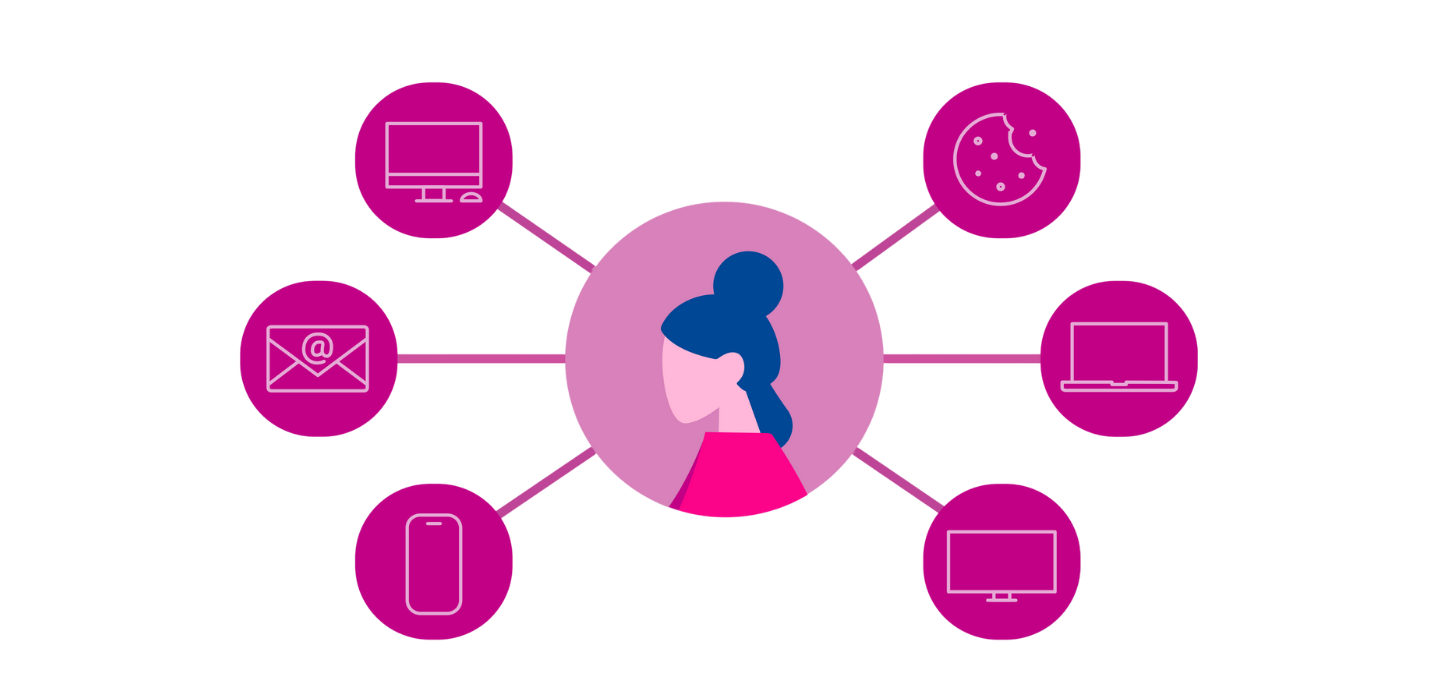
- Identity resolution: Connect offline identifiers (names, emails, addresses) with digital identifiers (hashed emails, mobile advertising IDs (MAIDs), CTV IDs, and universal IDs) through our Offline and Digital Graphs. This connects customer records with addressable digital identities while limiting the exposure of raw personal information.
- Audience matching: Translate the resolved audience into the identifiers supported by each selected activation partner to maintain consistent reach across demand-side platforms (DSPs), social, CTV, and other platforms.
- Activation: Deliver the resolved audience to selected DSPs, social, CTV, TV, or commerce media destinations. In first-party onboarding, a brand activates its own audience. In third-party onboarding, a data provider makes its audience available for outside advertisers to activate.
Behind this flow is our Digital Graph, which links 250 million U.S. individuals and 4.2 billion digital identifiers refreshed weekly. It’s the foundation that keeps onboarding accurate as the signal landscape shifts.
First-party vs. third-party data onboarding
Every digital marketing data point has a story, but whose story it tells depends on who’s using it. That relationship helps determine whether data is onboarded for the provider’s own activation or made available to outside advertisers. Both models support modern marketing, but they carry different expectations for control, consent, and accountability.
First-party onboarding: Activate your own data responsibly and strategically
First-party onboarding takes the customer data you already have and prepares it for identity resolution and activation across digital platforms. You’ll use that data to build and reach your own audiences instead of making it available for use by outside advertisers. This turns existing customer insight into an addressable marketing resource while preserving your control over how the data is activated.
How first-party onboarding works
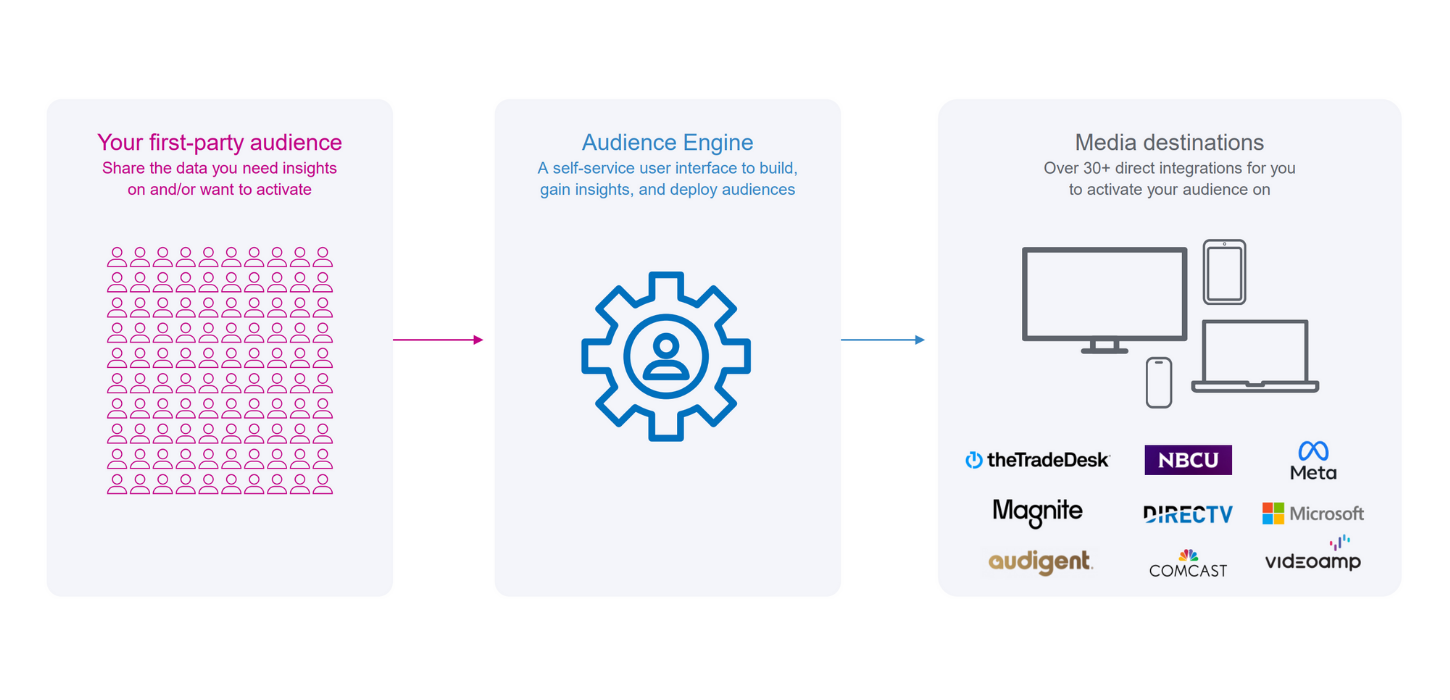
A credit card company, for example, might securely upload a CRM file containing hashed email addresses to Experian’s Audience Engine. Our identity graph connects those records with addressable digital identifiers, and the company can then activate the resulting audience across DSPs, CTV, social, and display without sending raw personally identifiable information (PII) to those platforms.
Why control and responsible use matter in first-party onboarding
First-party onboarding gives you control over how your customer data is prepared and activated. You decide which records to onboard, where the resulting audiences can be used, and how permissions are carried through the process. Because those permissions are tied to your direct customer relationships, they provide important context for assessing data provenance and permitted uses.
Responsible first-party data use still depends on thoughtful governance, especially when outside technology and activation partners are involved. First-party data should be managed according to applicable permissions, privacy requirements, and permitted uses.
When managed responsibly, first-party onboarding can help you:
- Personalize messages for known customers
- Re-engage lapsed buyers or loyalty members
- Suppress existing customers from prospecting campaigns
- Build more accurate audience segments and targeting strategies
- Measure performance using closed-loop attribution
Experian First-Party Onboarding puts these principles into practice by helping your brand securely prepare and activate data collected through direct customer relationships. We use privacy-focused identity resolution and controlled activation across selected destinations to keep data encrypted, help you maintain control, and support compliant use. This foundation can support more relevant campaigns, effective measurement, and stronger customer trust over time.
Third-party onboarding: Share and monetize data responsibly
Third-party onboarding begins when a data provider makes its audiences available for use by outside advertisers. It helps data providers, publishers, retailers, and CMNs turn audience insights into addressable, privacy-safe segments that advertisers can activate across digital channels.
How third-party onboarding works
With Experian Third-Party Onboarding, a data provider can securely send syndicated or custom audiences, connect them to our identity foundation, organize and price them, and choose where they’re available. Once those audiences are distributed to selected destinations, reporting shows usage by segment, advertiser, and destination.
Let’s say a retailer collects first-party shopper data like product purchases, loyalty card usage, and store visits. Then, they partner with us to make that audience available to outside advertisers, such as a consumer packaged goods (CPG) brand.
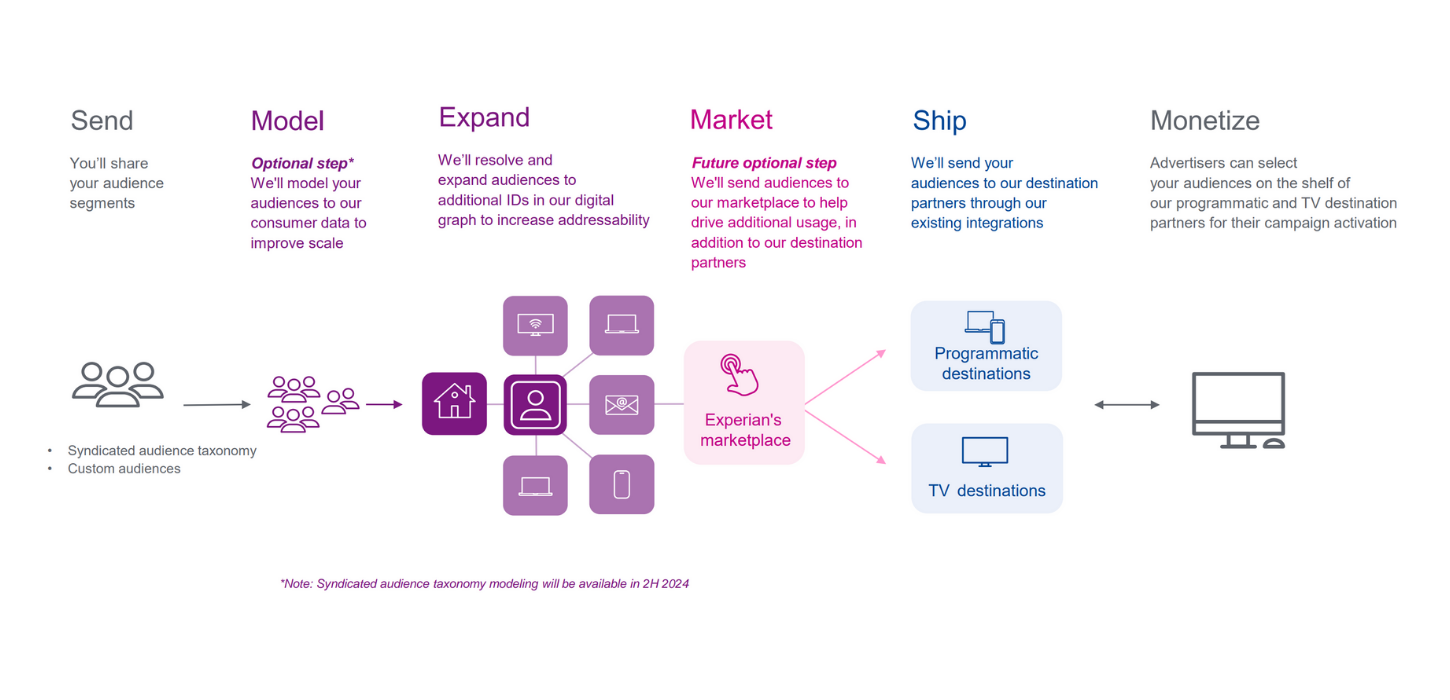
Through Experian Third-Party Onboarding, those audiences are resolved, privacy-protected, and distributed to integrated destinations such as The Trade Desk, Magnite, or NBCUniversal for activation.
- To the retailer, it’s their first-party data.
- To the CPG, it’s third-party data they can use for targeted campaigns.
- To us, it’s an opportunity to ensure the entire exchange is accurate and compliant.
Why scale and responsible data sharing matter in third-party onboarding
Scale is one of the primary benefits of third-party onboarding, but it creates value differently depending on your role:
- If you’re a data provider, third-party onboarding expands the addressability and distribution of syndicated audiences or custom audiences across more activation destinations, giving you new opportunities to monetize those insights.
- If you’re an advertiser, those audiences provide access to insight and reach beyond your own first-party data, helping you fill audience gaps, connect with segments underrepresented in your own first-party data, and enter new markets.
This exchange supports CMNs, commerce media, and the data-sharing economy overall.
Sustainable scale depends on responsible data sharing, including transparent data sourcing, appropriately documented permissions and permitted uses, and processes that support consumer choices. That responsibility is shared among data providers, onboarding providers, activation platforms, and advertisers.
Experian’s ethical enablement role in third-party onboarding
Our enablement role is both technical and ethical. Our deep expertise enables us to partner with brands and support their monetization efforts, helping them derive new value from their data while maintaining the highest standards of privacy and compliance. Meanwhile, our infrastructure ensures third-party data onboarding happens securely and transparently:
- Identity resolution expands reach without overexposing identifiers.
- Data verification and governance ensure partners meet strict privacy standards.
- Revenue-share structures maintain fairness without hidden costs.
- Cross-channel integrations enable you to onboard your data once and distribute it for activation across programmatic, CTV, and social through our 30+ direct and 200+ indirect destination partnerships.
When first-party onboarding turns into third-party onboarding
When data is made available beyond the provider’s direct use, privacy expectations change, and the rules of onboarding start to look a little different. This stage can feel complex, but with the right approach, the crossover becomes clear. It’s a natural evolution that helps you connect data more effectively and collaborate confidently.
Here’s what that can look like. A retailer uses first-party onboarding to connect its loyalty records with digital identifiers and reach its own customers across digital channels, while managing the data according to the applicable permissions. Then comes collaboration. The retailer makes that audience available to a brand, such as a CPG company, that wants to reach those shoppers across connected TV or the open web.
At that moment, the retailer’s first-party data becomes the CPG’s third-party data. Ownership doesn’t change, but responsibilities expand to additional participants, along with new privacy and compliance considerations.
This “crossover moment,” when first-party onboarding turns into third-party activation, is a small shift with big potential that can lead to new reach, deepen collaboration, and strengthen customer connections across the marketing ecosystem when managed responsibly.
Why clarity matters in the crossover between first- and third-party onboarding
When data starts flowing beyond owned channels, questions naturally come up. You may want to know:
- Who “owns” the audience once it’s shared with a partner or DSP?
- Whose privacy notice applies — the retailer’s, the brand’s, or both?
- How do we keep match accuracy without overexposing PII?
- Who’s responsible for opt-outs and suppression compliance downstream?
These are the right questions to be asking, and they’re signs of a mature, data-driven strategy. Asking them is what helps you strengthen governance, build trust, and get more value from collaboration. With the right framework in place, what could feel complicated becomes clear, opening the door to more confident growth across CMNs and other shared-data environments.
How Experian brings clarity and control to the first- and third-party onboarding crossover
As a neutral, privacy-first partner, we provide the infrastructure designed to support secure, compliant data handling. Given the blurring lines between data ownership and activation rights, our connected, AI-enhanced data and identity foundation helps retailers, brands, and platforms move from onboarding to activation responsibly. For CMNs, it supports deeper shopper insights, off-site addressability, contextually aware activation, and transparent measurement.
Our onboarding solutions help both retailers and advertisers maintain trust through:
- Clear data controls and consent management: We apply data-handling controls designed to respect each party’s permissions and use requirements.
- Accurate, privacy-safe identity resolution: Our Offline and Digital Graphs connect offline and digital identifiers across individuals, households, and devices, supporting accurate matching while protecting consumer information.
- Connected curation, activation, and measurement: We support activation across leading programmatic, social, and TV platforms. Experian Curation packages high-intent audiences with premium inventory into activation-ready Curated Deals, helping you simplify media buying and reach audiences across channels. Activity Feed connects event-level digital activity to identity, while Experian Outcomes connects media exposure with actions such as sales, visits, and website activity.
This is how we transform complex data challenges into seamless, scalable collaborations that give you the confidence to expand responsibly into commerce media and commerce ecosystems.
Why choose Experian’s onboarding solutions?
The value of data onboarding depends on accurate identity, responsible data handling, flexible activation, and the ability to apply what you learn. We connect these capabilities to help brands activate their own data and help data providers distribute their audiences across the advertising ecosystem.
1. Trusted data and identity foundation built on our Offline and Digital Graphs and enriched with Experian Marketing Attributes
When incomplete or siloed customer records limit reach and understanding, we connect data and identity to create a clearer, more consistent view of your audience.
Our Offline and Digital Graphs play distinct but complementary roles. Offline Graph connects offline identifiers such as names and addresses, while the Digital Graph unifies digital identifiers across individuals, households, and devices. Experian Marketing Attributes adds demographic, lifestyle, spending, and behavioral insights that can enrich audience understanding and inform segmentation.
These capabilities help you improve match rates, understand audiences more fully, and maintain consistent audience definitions from onboarding through activation and measurement.
2. Privacy-first and compliance-led onboarding
Given tightening regulations and growing consumer expectations, responsible data handling must be built into every stage of onboarding. We bring decades of experience as a data steward to the way data is sourced, resolved, shared, and activated.
Our approach is guided by the Experian Global Data Principles, which center on security, integrity, fairness, transparency, and inclusion. We evaluate data sources and permissions, apply privacy-focused controls, and help clients support their own privacy and consent obligations while protecting data integrity throughout the onboarding process.
3. Audience onboarding and activation with Audience Engine
Audience Engine brings audience onboarding, insight, creation, and activation into one connected self-service platform. You can upload your first-party data and match it to our identity graph, explore audience insights, build custom or lookalike audiences, and access third-party audiences through our data marketplace.
Once an audience is ready, you can distribute it across more than 200 programmatic, social, connected TV, and TV destinations. Building an audience once and activating it across multiple platforms helps reduce fragmented workflows while keeping audience definitions and configurations consistent.
4. Platform flexibility and contextual activation across the AdTech ecosystem
Different onboarding goals require distinct workflows. Brands can use Audience Engine to onboard and activate their own first-party data, while data providers, publishers, retailers, and commerce media networks can use Experian Third-Party Onboarding to distribute and monetize syndicated or custom audiences. Both solutions connect audiences with leading programmatic, social, and TV destinations.
We also support privacy-safe activation in signal-limited environments through Contextually-Indexed Audiences. Using real-time analysis and machine learning, this solution identifies websites and apps that over-index for specific audience segments, allowing you to reach relevant environments without relying on cookies or user identifiers.
This flexibility allows brands to choose where they activate and data providers to choose where their audiences are made available, supported by our identity foundation and onboarding expertise.
5. Connected audience insight and measurement
Onboarding creates more value when you can understand an audience before activation and evaluate its performance afterward. We connect onboarding with complementary data and analytics capabilities across the campaign lifecycle.
Marketing Attributes can enrich your understanding of customers and prospects with demographic, lifestyle, and behavioral insight. After activation, Experian Outcomes connects media exposure with actions such as sales, visits, and website activity to show what drove performance.
These capabilities help you move from audience understanding to activation and measurement, then apply what you learn to refine future audience and media strategies.
6. Human-centered innovation
Marketing should strengthen relationships and build trust. Our AI-driven identity systems are designed to protect privacy, respect individuals, and create real human value — helping you connect with people meaningfully. They aren’t built to collect more data but to make better use of the data you already have by connecting insights responsibly and ethically.
Every innovation at Experian is guided by the principle of balancing personalization with compliance.
Top use cases for Experian’s onboarding solutions
Our onboarding solutions are transforming how brands operate across industries every day. Whether you’re deepening loyalty, expanding reach, or proving performance, we help connect data responsibly to drive measurable results.
Here’s where we make the biggest impact:
- Automotive: Connect purchase intent data with digital identifiers for more efficient targeting.
- Commerce media: Use First-Party Onboarding to activate owned customer data and Third-Party Onboarding to distribute and monetize audiences for outside advertisers, all while supporting compliance and accurate attribution.
- CPG: Activate shopper data through retailer partnerships to drive off-site reach and stronger brand collaboration.
- Data providers: Monetize audience segments across our programmatic and TV integrations.
- Financial services: Deliver compliant, personalized cross-channel offers with unified identity.
- Healthcare: Use National Provider Identifier (NPI) onboarding to reach healthcare professionals compliantly.
- Retail: Power loyalty personalization, partner monetization, and CMN audience activation.
Across each use case, our privacy-first identity foundation turns data onboarding into a trusted driver of growth and stronger customer relationships.
Navigate the new data economy with Experian
Data onboarding has come a long way, mirroring the changes in marketing itself. We’ve moved from relying on third-party cookies to empowering first-party data, and now to building collaborative ecosystems like CMNs.
At Experian, we’re right in the middle of that evolution. With decades of data expertise, privacy leadership, and AI-driven activation, we help you connect more responsibly, measure what matters, and grow with confidence.
Want to see what that looks like for your brand? Let’s build safer connections together.
Start connecting responsibly
Data onboarding FAQs
First-party data is information you collect directly from your customers or audiences, such as CRM records, purchase history, loyalty activity, and website or app behavior. It doesn’t rely on third-party cookies, though external partners may help collect or activate it. First-party onboarding links these records to digital identifiers so you can activate known audiences across channels.
Third-party data is information sourced outside your direct customer relationships, typically collected or aggregated by an external provider. It helps extend reach and fill audience gaps not covered by your first-party data. In commerce media, a retailer’s first-party audience can also serve as third-party data for advertisers, with onboarding enabling responsible activation and distribution.
Data onboarding is the process of connecting offline customer and audience data, including first-party records, to digital identifiers for activation, personalization, and measurement. Experian supports onboarding through first-party and third-party solutions.
First-party onboarding through Experian Audience Engine lets brands upload and match their customer data to our identity graph to build and activate audiences across digital channels. Experian Third-Party Onboarding enables data providers, publishers, and commerce media networks to distribute and monetize audiences across programmatic, social, and TV channels.
Both approaches are powered by our data and identity foundation, which enables accurate, privacy-safe matching of offline and digital identifiers.
The difference between first- and third-party onboarding is the relationship between the data provider, the audience, and the party activating it. First-party onboarding means a brand is activating its own customer information, while third-party onboarding means a data provider is making audiences available for use by outside advertisers or partners.
First-party onboarding becomes third-party onboarding most often in CMNs or commerce media. When a retailer monetizes its first-party shopper data for use by CPGs or advertisers, the use case shifts to third-party onboarding.
First-party onboarding allows brands to activate their own customer data, while third-party onboarding helps data providers distribute and monetize audiences so outside advertisers can access them. Retailers and commerce media networks may use both models when they market to their own customers and make audiences available to partners.
Latest posts

Brands can leverage non-clinical factors, like the social determinants of health, to gain a holistic view of their patients and increase access to care.

Next up in our Ask the Expert series, we hear from Sarah Ilie and Lauren Portell. Sarah and Lauren talk about the internet’s value exchange – what we gain and lose when it’s so easy to share our information. Is convenience hurting or helping us? The age of connectivity Today, it’s almost unimaginable to think about how your day-to-day life would look without the convenience of the internet, smartphones, apps, and fitness trackers; the list goes on and on. We live in the age of connectivity. We have the convenience to buy products delivered to our homes on the same day. We can consume content across thousands of platforms. We also have watches or apps that track our health with more granularity than ever before. The internet’s value exchange In exchange for this convenience and information, we must share various kinds of data for these transactions and activities to take place. Websites and apps give you the option to “opt in” and share your data. They also often let you know that they are collecting your data. This can feel like an uncomfortable proposition and an invasion of privacy to many people. What does it mean to opt-in to a website or app’s tracking cookies? What value do we exchange? What opting in means for you Opting in to cookies means that you are allowing the app or website to track your online activity and collect anonymous data that is aggregated for marketing analytics. The data provides valuable information to understand users better to create better online experiences or offer more useful products and content. Granting access to “tracking” offers several benefits to users such as a customized, more personal user experience or advertising that is more likely to be relevant. For example, let’s imagine you have recently been using an app or website to plan a camping trip. By sharing your data, the website or app has visibility into what is interesting or useful to you which can lead to related content suggestions (best campsites) or relevant advertising and product recommendations (tents and camping equipment). It’s important to know that the marketing data collected when you opt in is extremely valuable. The revenue that advertising generates is often very important to websites and apps because this is how they make money to continue providing content and services to consumers. Data privacy practices Privacy concerns regarding how companies and developers use tracking information have risen over the last couple of years and have resulted in additional protection for consumers’ privacy while still allowing companies to improve their products and advertising. One big step in this direction has been simply making people aware that their data is being collected, why it’s being collected, and providing users with the option to share this data for marketing analytics through opting-in or not. Other important steps to maintain online privacy include formal legal legislation and self-regulation. The right to privacy is protected by more than 600 laws between individual states and federal legislation and the U.S. House Committee on Energy and Commerce recently voted to pass the American Data Privacy and Protection Act. Additionally, marketing organizations such as the Interactive Advertising Bureau and Association of National Advertisers regulate themselves with codes of conduct and standards given there is so much attention on privacy issues. Is the internet’s value exchange worth it? The data that we choose to share by opting in has a lot of benefits for us as consumers. There are laws in place to protect our data and privacy. Of course, it’s important to be aware that data is collected and used for marketing purposes, but it’s also reasonable to share a certain amount of data that translates into benefits for you as well. The best data unlocks the best marketing. Contact us to tap into the power of the world’s largest consumer database. Learn how you can use Experian Marketing Services’ powerful consumer data to learn more about your customers, drive new business, and deliver intelligent interactions across all channels. Meet the Experts: Lauren Portell, Account Executive, Advanced TV, Experian Marketing Services Sarah Ilie, Strategic Partner Manager, Experian Marketing Services Get in touch

While the weather outside is frightfully hot this summer, it’s never too soon to start thinking about the holidays – and consumers are more likely to start their holiday shopping early this year. To get you ready for the 2022 holiday shopping season, we looked back at consumer shopping trends from 2019-2021. What did we learn and what trends do we expect to see this year? Let’s look back. A look back Over the last three years, average consumer spending has increased. Record 2021 holiday sales came amidst a wave of COVID-19 cases, rising inflation, labor shortages, and supply chain problems. Despite these challenges, consumers continued to let it snow when it came to spending during the holiday season. 2022 has been a year with its own economic roadblocks – the war in Ukraine, rising gas prices, and recession concerns. Yet 2021 was a banner year for holiday sales despite its obstacles, and we predict similar trends in the 2022 holiday shopping season. What trends do we expect to see for the most wonderful time of the year? 2022 predictions While consumer spending remains strong, changing economic conditions continue to shape shopper behavior. To develop our predictions for 2022 holiday shopper behavior, we focused on four key areas: When consumers shop Where consumers shop What consumers purchase Consumer media preferences Now, let’s make our holiday campaign planning checklist and check it twice. When consumers shop Chestnuts roasting on an open fire. Jack Frost nipping at your nose. Those aren’t the only ways to know when the holiday season has begun. Shoppers tend to spread out their holiday purchases across multiple months and were more likely to start shopping earlier. To understand holiday retail sales trends from 2019-2021, we identified four shopper segments: Early Shoppers Traditional Shoppers Late Shoppers Random Shoppers What differences did we see between our four shopper segments? Early shoppers made almost half of their holiday purchases in October Random shoppers spread out their holiday purchases evenly across multiple months Late shoppers made almost half of their holiday purchases in December Traditional shoppers made almost half of their holiday purchases in November While December continues to dominate holiday sales, October has started to gain traction over the last three years, and November remains a core shopping month. Everybody knows a turkey and a mistletoe help to make the season bright but knowing when your consumers are most likely to shop will help deck your campaign planning halls. Jingle bell rock your way to holiday sales that shine bright with our tips to prepare for earlier shoppers: Offer targeted promotions earlier in the shopping season Target your ads based on the shopping habits of your customers throughout the season Where consumers shop There’s no place like home for the holidays but most consumers aren’t shopping from home. Despite the rise in online shopping, brick and mortar locations continue to dominate holiday sales. October is the most popular month to take a one-horse open sleigh to a store, and consumers gather around the fire to online shop in November and December. With most shoppers preferring to shop in-store, and e-commerce popularity growing, it’s critical to think about bridging the gap between your online and offline presence for the consumer. Are you offering multiple paths to purchase with solutions such as BOPIS (Buy Online, Pickup In-Store)? Go down in history like Rudolph with our tips to prepare for more in-store shopping: Focus on in-store shopping experience technology (self-checkout, VR, QR codes, scan to pay, etc.) Offer multiple paths to purchase to connect your online and physical presence through methods such as BOPIS (Buy Online, Pickup In-Store), BORIS (Buy Online, Return In-Store), and ROPO (Research Online, Purchase Offline), etc. What consumers purchase When it comes to holiday gifts, for some, only a hippopotamus will do. Compared to pre-pandemic, shoppers are spending more at apparel stores and mass retailers. Spending at specialty retailers, warehouse clubs, and on office, electronic, and games is almost the same across holiday and non-holiday shopping months. Time for toys and time for cheer may be year-round, but are there any correlations between where consumers shop (online vs. in-store) and what they purchase? Our data found that shoppers who bought from mass retailers were more likely to shop online, while shopping for apparel and warehouse clubs was done at a physical store location. Put this insight to the test by thinking through how you can target your consumer based on where they shop in-store and online. You just might find that hippopotamus at a brick and mortar mass retailer location! Consumer media preferences Do you see what I see? While we are seeing a shift to digital media channel preference, consumers still engage with traditional media channels like direct mail and the traditional newspaper. Successfully connecting with your customers involves capturing their attention through the right channel. We found that our four shopping groups prefer a mix of traditional and digital media channels. What does your media channel mix look like? Hark! The herald angels sing of ways to adapt to the change in holiday spend and media preferences: Align your activation efforts to digital, but don’t forget about traditional channels Expand your targeting and activation focus beyond in-store vs. online Download our new 2025 report For a deeper dive into our predictions and actionable insights you can use to take your holiday campaign planning home for the holidays, download our new 2025 report, in collaboration with GroundTruth. Experian data can help you refine your content and creative strategy to achieve maximum ROI for each campaign across all your channels. Download now Get in touch