At A Glance
Agentic AI is changing programmatic advertising from something you tweak after the fact into something that learns and improves while campaigns are running. Instead of guessing what might work, marketers can use data, identity, and context to reach the right people in the right places and adjust in real time. Experian connects everything behind the scenes, from data and audiences to activation and measurement, so campaigns feel more coordinated, relevant, and easy to manage while staying compliant and grounded in strong data practices.In this article…
Programmatic advertising has become much more sophisticated over the years. As capabilities have expanded, so has complexity. Marketers are now working across more platforms, with more signals and opportunities to optimize. Despite performance improvements, it can take time to fully understand what’s driving results and how to scale them.
Agentic artificial intelligence (AI) is closing that gap. Instead of just automating tasks, it introduces systems that can interpret signals, suggest next steps, and enable action within defined parameters — helping live campaigns adapt, and your marketing feel more human-centered.
In this article, we’ll break down what agentic AI looks like in programmatic advertising, how it’s changing campaign planning and activation, and where it’s delivering the most impact.
What is programmatic advertising in the agentic AI era?
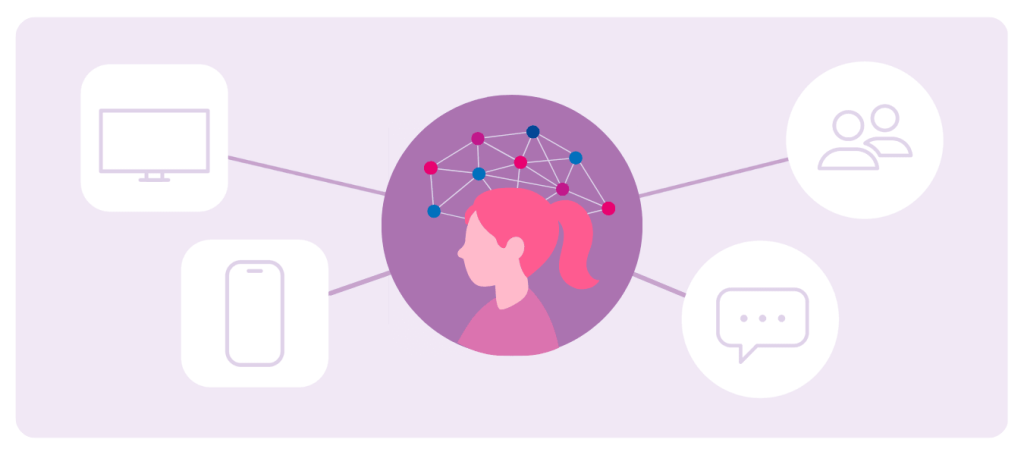
Programmatic advertising is the automated, cross-channel buying and selling of digital media across channels like display, video, and connected TV (CTV). In the age of agentic AI, marketers can identify and act on opportunities while campaigns are live, as agentic AI functions less as a passive tool and more like a dynamic teammate.
With AI-powered programmatic marketing, your team can now proactively anticipate what’s likely to work next, simplify fragmented channels into a more unified strategy, and focus campaigns on outcomes that move your business forward with support from predictive insight and real-time intelligence.
Machine learning now processes and analyzes massive volumes of data in milliseconds, allowing systems to decide which impression to buy, what it’s worth, and where it’ll deliver the most impact in real time.
How is agentic AI reshaping programmatic marketing?
Programmatic advertising has always been about automation, but agentic AI is pushing it into something more adaptive. AI-driven processes now analyze the marketplace and enable autonomous media activation with human oversight, grounded in responsible automation.
As you integrate agentic AI into your advertising, it helps automate time-intensive, day-to-day tasks so your team can focus more on strategy, planning, and performance. Marketers still define the goals, set the guardrails, and oversee how AI is applied, which keeps decisions aligned with business objectives, compliance requirements, and overall campaign strategy.

Here’s how marketers can benefit from agentic AI:
- AI accelerates and improves how fragmented signals across identity, behavior, and context are connected into a usable customer view.
- Optimization happens continuously, not in reporting cycles, as bids, audiences, and spend adjust in real time.
- Decisioning moves beyond static rules toward adaptive, data-driven prioritization.
- Predictive models help reduce waste by identifying low-value impressions before allocating spend.
- Personalization becomes more accurate while still grounded in privacy-safe, identity-first data.
How is AI transforming media curation and supply optimization?
Programmatic advertising has traditionally relied on open exchange buying, optimizing across large volumes of inventory. As AI becomes more embedded in programmatic marketing, the focus is shifting toward more intentional activation, prioritizing environments that are more likely to perform from the start.
Dynamic curation and supply optimization
With dynamic curation, AI aligns predictive audiences with contexts where engagement is strongest, using real-time signals to determine who to reach and where they’re most likely to engage. Campaigns are guided toward higher-probability environments upfront, rather than relying on post-impression optimization.
This moves programmatic marketing away from broad open exchange buying and toward more curated, intentional activation, with continuous adjustments as signals evolve.
Emerging agentic workflows
Emerging agentic workflows introduce systems that analyze performance, recommend changes, and activate them within defined guardrails. Instead of waiting for reporting cycles, campaigns continuously evaluate signals and adjust in real time.
AI handles day-to-day decisions like shifting spend or refining audiences, while marketers retain strategic control and accountability.
Generative and analytical AI applications
Not all AI in programmatic advertising is about activation. Many gains are happening behind the scenes, especially in analytics.
Generative and analytical AI support tasks like attribute development, description creation, and insight acceleration. This reduces time spent on reporting and helps teams focus on understanding performance, surfacing patterns, and identifying what to scale.
Experian’s curation capabilities
At Experian, we combine identity-based predictive data with contextual AI models to better align audiences with available supply. With Audigent now part of Experian, audiences are indexed to the live bidstream and contextual signals, helping campaigns activate in environments where they’re more likely to perform.
Experian Curated Deals package high-quality inventory, such as streaming and premium lifestyle content, with predictive audience data. When layered with our #1-ranked data accuracy by Truthset, these deals become predictive and help you activate greater confidence in campaign placement and performance.
Practical use cases of AI in complex and regulated markets
The value of AI in programmatic advertising becomes clearer in environments where complexity is highest, such as industries with strict regulations, fragmented data, and significant financial stakes tied to every impression. Financial services, healthcare, and retail all require approaches that balance accuracy, compliance, and measurable outcomes, built on privacy-first data and human-centered activation.

The following shows how programmatic advertising can come to life in practice.
Financial services
In financial services, performance only matters when it’s compliant. AI helps marketers reach qualified consumers without crossing regulatory lines.
Your team can:
- Activate identity-based audiences for lending, credit, and financial products within defined compliance guardrails.
- Use predictive financial attributes (where permitted) to prioritize prequalified and high-intent consumers.
- Support responsible offer prioritization and budget allocation based on eligibility and likelihood to respond.
- Operate within transparent, auditable environments designed for regulated activation.
Healthcare
Healthcare marketing requires accuracy without ever exposing sensitive data. AI enables more relevant engagement while maintaining strict privacy standards.
With AI-powered programmatic marketing, you can:
- Activate privacy-safe, compliant health-interest segments without relying on protected personal data.
- Deliver campaigns without exposing sensitive identifiers or violating regulatory requirements.
- Optimize delivery based on region, timing, and contextual alignment with patient research behavior.
- Maintain controlled, privacy-forward environments that prioritize trust and compliance.
Commerce media
In commerce media, programmatic performance is measured by its impact on transactions and revenue. AI helps unify signals into a more connected, outcome-driven strategy.
It empowers marketers to:
- Connect household-level insights to activation across CTV, display, and commerce media networks.
- Use AI-powered identity resolution to maintain continuity as consumers move across devices, channels, and purchase journeys.
- Enable dynamic curation by aligning predictive audiences with more effective inventory in real time.
- Adjust spend toward environments and segments that actively drive purchase behavior.
As these use cases expand across industries, so does the need to ensure AI is applied responsibly.
Trust, transparency, and ethical challenges in AI-powered AdTech
As AI takes on a larger role in programmatic advertising, the focus is shifting from what it can do to how it does it. Marketers need to validate results and the data behind them to ensure every decision stands up to regulatory and consumer scrutiny.
AI systems now influence audience selection, media investment, and measurement at scale. But those decisions are only as reliable as the data behind them. Without clear governance, it becomes difficult to answer basic but critical questions, such as, “What data informed this decision? Was it compliant?” Or, “Could bias be influencing the outcome?”
This is why trust in AI starts with the data rather than the model.
AI governance and data stewardship
Rather than governing our clients’ AI systems, Experian helps govern the data those systems depend on. Our guiding principle is simple: responsible automation begins with governed data. We ground our AI approach in strict data governance frameworks, ensuring the data entering any model is compliant, consented to, and accurate before it’s used.
We treat AI and machine learning as advanced modeling technologies operating within contractual and privacy-first guidelines, with controls for data quality, consent validation, and compliance applied upfront. In the end, you’ll have confidence that your AI outputs are not only performant but also explainable, auditable, and aligned with regulatory expectations from the beginning.
Clear usage restrictions
Strong governance only works when it’s paired with clear boundaries. To protect data integrity, privacy, and compliance, Experian enforces strict controls on how data is used across AI and programmatic workflows.
- Data is used only within defined contractual, legal, and regulatory guidelines.
- Sensitive information is protected and restricted from use in unauthorized environments.
- Data access is limited to approved, compliant systems and workflows.
- Data is not shared, exposed, or repurposed beyond its intended use.
- AI processing occurs within controlled environments that meet privacy and security standards.
- AI use cases are subject to appropriate review, governance, and oversight.
These guardrails give you the assurance that innovation moves forward without compromising trust.
Bias mitigation and responsible modeling
As AI plays a larger role in audience creation and activation, models must be continuously monitored for fairness. At Experian, models are continuously reviewed and refined to reduce bias and ensure outputs align with responsible marketing practices and changing regulations.
Consent and consumer control
Consumer consent and control are central to responsible AI usage in programmatic advertising. Data must be sourced through compliant, transparent mechanisms, with controls that allow consumers to access, manage, and opt out of how their data is used.
This aligns with regulatory frameworks such as the California Consumer Privacy Act (CCPA), the General Data Protection Regulation (GDPR), and the Health Insurance Portability and Accountability Act (HIPAA) (where applicable).
How Experian enhances every stage of the agentic AI programmatic workflow
AI in programmatic advertising only works if the system behind it is connected. When data, activation, and measurement are fragmented, optimization lags.
Experian brings those pieces together. By connecting identity, data, activation, and measurement into one workflow, AI can continuously turn first-party data into predictive audiences, help you activate them across channels, and measure outcomes in a single, connected system.
AI-ready data foundation
Everything in AI programmatic advertising starts with the data. Experian transforms first-party data into a predictive asset by onboarding and enriching it with Experian Marketing Data, ranked #1 in accuracy by Truthset, and unifying it through our Digital and Offline Graph.
This creates a high-integrity data layer that improves audience quality, extends reach, and supports activation across channels while maintaining privacy-forward standards.
Predictive intelligence
Predictive intelligence helps you understand what’s likely to work before activation begins. Experian applies behavioral modeling and signal analysis to identify high-potential audiences and generate identity-based lookalikes based on shared characteristics and patterns.
As campaigns run, AI surfaces next-best opportunities so teams can adjust activation strategy in real time.
Audience discovery and creation
Experian simplifies audience creation by bringing everything into one place. First-party data is combined with Experian Audiences and expanded through access to Partner Audiences in our data marketplace. Instead of stitching together multiple inputs, you’re working from a more complete, connected view upfront.
Our platforms and audience teams then help identify, build, and refine segments based on relevant attributes, reducing manual setup, accelerating activation, and enabling scalable, persona-based audience creation.
Identity-rooted activation
After you’ve defined your audiences, identity becomes critical in consistently reaching them across channels.
Partner with Experian for agentic AI-driven programmatic campaigns
Experian helps you turn first-party data into marketing that feels more connected, relevant, and accountable, bringing together identity, AI, and privacy-first data to support better decisions from planning to outcomes. Speak to an Experian expert about enabling agentic AI in your programmatic advertising strategy today.
Click here to view Experian’s U.S. Consumer Data Privacy Notice.
This site is protected by reCAPTCHA and the Google Privacy Policy and Terms of Service apply.
FAQs
AI in programmatic advertising uses machine learning to improve how media is bought, targeted, and optimized. It enhances audience discovery, activation, and measurement by analyzing large volumes of data in real time, allowing campaigns to adapt continuously instead of relying on static rules.
Experian supports programmatic advertising across the full workflow, from identity resolution and audience development to contextual indexing and outcome-based measurement. Through a combination of Experian’s platforms, data, and audience teams, marketers can turn fragmented signals into more connected, performance-driven campaigns.
Agentic AI in advertising refers to systems that can analyze performance, recommend changes, and activate optimizations within defined guardrails. Unlike traditional automation, these systems adapt in real time while marketers maintain strategic oversight and control.
Experian supports privacy-first AI through strict data governance frameworks, compliant data sourcing, and transparent modeling practices. Identity resolution and activation are designed to meet regulatory requirements while maintaining consumer trust and control.
AI improves audience discovery through predictive modeling, inferred attributes, and lookalike techniques to identify high-potential audiences. It also surfaces next-best segments, reducing manual effort and accelerating time to activation.
AI supports media curation by aligning predictive audiences with high-performing environments in real time. Through dynamic curation and Experian Curated Deals, campaigns activate in more relevant contexts rather than relying on broad open exchange buying.
Latest posts

OpenAudience promises the targeting capabilities of a walled garden but without the restrictionsOpenX has lifted the lid on a targeting solution it claims will offer people-based advertising opportunities outside of the industry’s walled gardens such as Facebook and Google. Dubbed OpenAudience, the supply-side programmatic player claims the new offering is powered by proprietary data assets and is supplemented by data partnerships with partners such as LiveRamp and Tapad, a part of Experian. Initially available in the U.S., OpenAudience has a user graph of 240 million monthly users and is currently being tested with multiple marketers with a general rollout planned for the third quarter of 2019. Speaking with Adweek, OpenX CEO Tim Cadogan said the rollout would help differentiate it among its peers as for the most part ad exchanges have marketed themselves based on their impression count, not necessarily addressable audiences. Compare this with Google and Facebook, both of whom account for almost 60% of U.S. ad spend, although this is disproportionate to the amount of time spent with their properties, according to Cadogan. “The thing that has given Facebook and Google so much power is that they have people-based systems [for ad targeting] that are simple to use and operate with a massive scale that are effective, and programmatic hasn’t kept pace with that,” he said. Cadogan cited the findings of a further study by eMarketer, which indicated that marketers are increasingly reliant on such walled garden players for their online inventory supply with the latest launch geared towards capitalizing on that. The latest launch is the culmination of the California-based company’s recent strategic overhaul, namely its attempts to get to grips with an identity-based solution that provides options outside of the walled gardens. Also speaking with Adweek was Todd Parsons, OpenX’s chief product officer, who offered further insight into how OpenAudience operates including how it uses its recently sealed relationship with Google Cloud Platform and machine learning to ape the efficacy of walled garden advertising solutions. “We had to build a matching technology, which made it possible for us to talk about monthly active users instead of talking about cookies or devices,” he explained. “And it took several quarters of staffing up with the right people from the consumer data and identity space.” OpenAudience’s matching technology works by using the identity and cookie matching capabilities of cross-device specialist Tapad and data onboarder LiveRamp to formulate a persistent, deterministic ID which can then be used to match advertisers with audiences on its ad exchange. “So, the idea isn’t for us as a company to put our future into one provider,” added Parsons. “It is to provide a matching technology that uses the best of several.” OpenAudience will also include involve additional tie-ups to offering further demographic information on the 240 million monthly U.S. users such as location, etc., which is currently in testing. “We felt like we needed to be very different about enabling marketers and publishers to activate against that data,” added Parsons. He further added that OpenX wants to rival Facebook’s levels of service when it comes to helping publishers monetize audiences on the social network, except this time on the open web. “No one has actually pushed identity and consumer data into the hands of publishers in a way that you might unify the view of audiences across many websites.” OpenX’s Cadogan summed up the OpenAudience offering and how it may look to advertisers when he said, “Imagine the open web is one publisher, and this lets buyers look at it as a single entity and market to them accordingly.” Contact us today
Everyone knows that it’s important for businesses to have a clearly defined brand. In the modern world, the personal brand has become just as important, and many professionals are trying to build up their public reputation, expertise and industry authority. In the digital age, there are many different methods and channels you can use to build your personal brand, but some are more efficient than others. According to Forbes Agency Council, here are some of the most effective ways to develop an authentic personal brand.1. Give More Than You Receive Whatever you do, always aim at giving more than you receive. When you build your network, try to bring value to each new person that you meet. When you get featured in some media, see what you can do for them in return. This is the best strategy because actions speak louder than words. People will remember you for what you are, not what your website is. – Solomon Thimothy, OneIMS 2. Define What You Stand For, Then Align Your Actions Define your mission. What is your purpose? What do you want to accomplish, and what is your key message? Once you have answers to those questions, use that mission as a guiding North Star to consistently reinforce your personal brand every day. This will come across in how you lead, how you interact with employees and peers, how you communicate, and how you give back to the community. – Preethy Vaidyanathan, Tapad 3. Develop A Creative Positioning Statement It’s all about positioning your company. You need to have creative positioning statements about who you are and what your company is doing to benefit its clients. Clients want resolutions to their problems, and that’s where you come to the rescue. It’s either sold or ignored. – Cagan Sean Yuksel, GRAFX CO. 4. Speak At An Event Becoming a keynote speaker gives you access to the things you need to elevate your brand: influencer status, large audiences and media profile. But access doesn’t equal attention. While speaking gives you the platform, you need to have something compelling to say. You’ll need a differentiated message, unique presentation style and a great agent to make this strategy successful. – Andrew Au, Intercept Group 5. Focus On A Specific Audience The most effective way to build your personal brand is to create content specifically for a very specific group of people. Create relevant content that details solutions to the unique needs of this audience so that it spreads quickly due to its hyper-relevance. This creates authority and credibility for your personal brand and helps you stand out as being the most relevant expert in your field. – Adam Guild, Placepull 6. Be Ruthlessly Consistent Developing a personal brand requires ruthless consistency in your subject matter and how you present yourself to the world. I go back to the early days of marketing blogs. In those days, some bloggers were all over the map with content. The ones who were consistent with their audience and their goals are the ones who had staying power. They became the authors, speakers and consultants. – Scott Baradell, Idea Grove 7. Follow Through Just like a traditional brand, the quality of your offering helps to build your brand. If you are clear on what you can and cannot deliver and always follow through on your word, your personal brand reputation will precede you and will be lifted by the recommendations of others. – Kieley Taylor, GroupM 8. Build A Solid Reputation “Personal brand” is just a new-age name for reputation. Doing your job exceptionally well, going above and beyond, treating people with respect and kindness, having a point of view—essentially any action that builds a solid professional reputation does the very same for your personal brand. – Jess Cook, TMV Group 9. Define Your Voice Establish your unique voice and personal point of view and stick to it in all you do and all you say. Personal brands must be consistent and have consistency in messaging, attitude and behavior. Express your personal brand through comments on articles, at significant events and important platforms where it can best showcase and support your personal point of view and brand persona. – Pat Fiore, FIORE 10. Create And Share Video Content Video is hard for many people. That’s why it can be your competitive advantage if you do it. Video allows you to be seen, heard and felt emotionally in a way that no other medium can. You may say, “That’s not for me” and that’s fine, but good luck competing with those who embrace it. Barriers to video are so low that building a personal brand without it seems as if you are hiding something. – A. Lee Judge, Content Monsta 11. Share Your Point of View In Everything You Do There are a finite number of topics that make for interesting discussion in our industry, so having a point of view and sharing it through crafted content is vital for building your personal brand. You don’t have to be controversial, necessarily, but considering themes and topics and providing honest commentary that demonstrates experience is the quickest way to build your reputation. – David Harrison, EVINS 12. Stay True To You The most effective way to build your personal brand is to be true to who you are. If you are wildly creative and outgoing, show that in your branding! Don’t hold back in your content; post that crazy Instagram picture that shows the world how you think. If you are conservative, then own that. This passion for who you really are—and what your company really is—authentically shines through. – Katy Boos, Remix Marketing Inc. Contact us today
OpenAudience™ will provide marketers the ability to easily plan and buy advertising for every digitally addressable consumer across the open web LOS ANGELES, May 2, 2019 /PRNewswire/ — For the past decade, the most effective way to advertise in digital media has been on Facebook and Google. Marketers in the U.S. now spend two-thirds of all digital ad spend on the “walled gardens”, despite the fact that they receive less than 36 percent of total consumer time spent online. According to eMarketer, addressing this massive asymmetry in advertising – where tens of billions of dollars are over allocated to the walled gardens – is the top concern of marketers in 2019. While programmatic technology has become the primary monetization system for the open web, it has lacked the simplicity and efficacy of walled gardens. Today, OpenX is changing that paradigm by bringing true people-based marketing to the open web for the first time with the introduction of OpenAudience. OpenAudience will provide marketers and publishers with an unprecedented, unified level of knowledge about consumer audiences – through a platform built on privacy by design principles that brings the efficiency and efficacy of walled garden advertising to the open web. OpenAudience is powered by a comprehensive proprietary data asset and supplemented by integrated partnerships with recognized leaders in data and identity like LiveRamp, Tapad, a part of Experian, and more. For marketers, OpenAudience will provide the ability to plan and buy people-based marketing campaigns that combine the impact and ease of use of Facebook advertising with the scale of the open web. OpenAudience is currently in active partner testing with multiple marketers in the U.S., including Fortune 500 financial service and consumer personal care companies, along with one of America’s largest online entertainment outlets, and will be generally available to the broader market in Q3 of 2019. For publishers, OpenAudience will deliver user-based knowledge that empowers them to value and sell advertising with unparalleled precision. With the ability to automatically place consumers into high-value audience segments drawn from the more than 240M U.S. Monthly Active Users OpenX reaches across the open web, OpenAudience allows publishers to maximize revenue like never before. “OpenAudience is a natural evolution of programmatic advertising, combining the unified knowledge of people-based audiences with the transactional power of programmatic to create a planning, buying and advertising experience that is unlike anything else in the market today,” said Todd Parsons, chief product officer at OpenX. “No exchange in the market today has enabled a unified view of publisher audiences,” said Travis Clinger, vice president of strategic initiatives, LiveRamp. “Now, OpenX is democratizing identity across all publishers on the open web, helping marketers to plan and buy audiences the way they do inside walled gardens. We are thrilled to be a key component of OpenAudience.” For more information, or to request a place in the private testing phase of OpenAudience, visit: http://www.openx.com, or contact your OpenX account representative today. About OpenX Nobody understands the open web better than OpenX. As the world’s largest independent advertising exchange, OpenX makes the efficient people-based marketing buying experience of the walled gardens available to all marketers across the open web. OpenX works with more than 30,000 advertisers across every screen and device, reaching nearly one billion consumers – including a quarter billion unique consumers in the US – and processing more than one trillion transactions globally each day. To date, OpenX has helped deliver more than $3 billion in total monetization to publishers. That’s the Power of Open™. Contact us today