At A Glance
-Experian’s 2026 State of advertising report shows that advertising trends in 2026 will be defined by how well organizations connect data, identity, and measurable outcomes. Leaders across the ecosystem point to five themes: AI that reshapes workflows, measurement that guides decisions earlier, identity and privacy as strategic inputs, channels aligning around outcomes, and identity connecting planning, activation, and measurement.What advertising trends does Experian’s 2026 State of advertising report highlight?
2026 State of advertising report
Experian’s 2026 State of advertising report shows that advertising trends in 2026 will be defined by how well organizations connect data, identity, and measurable outcomes. Our 2026 State of advertising report brings together perspectives from 14 leaders operating across key parts of the advertising ecosystem to show how these shifts are taking shape in practice.
Who’s featured in Experian’s 2026 State of advertising report?
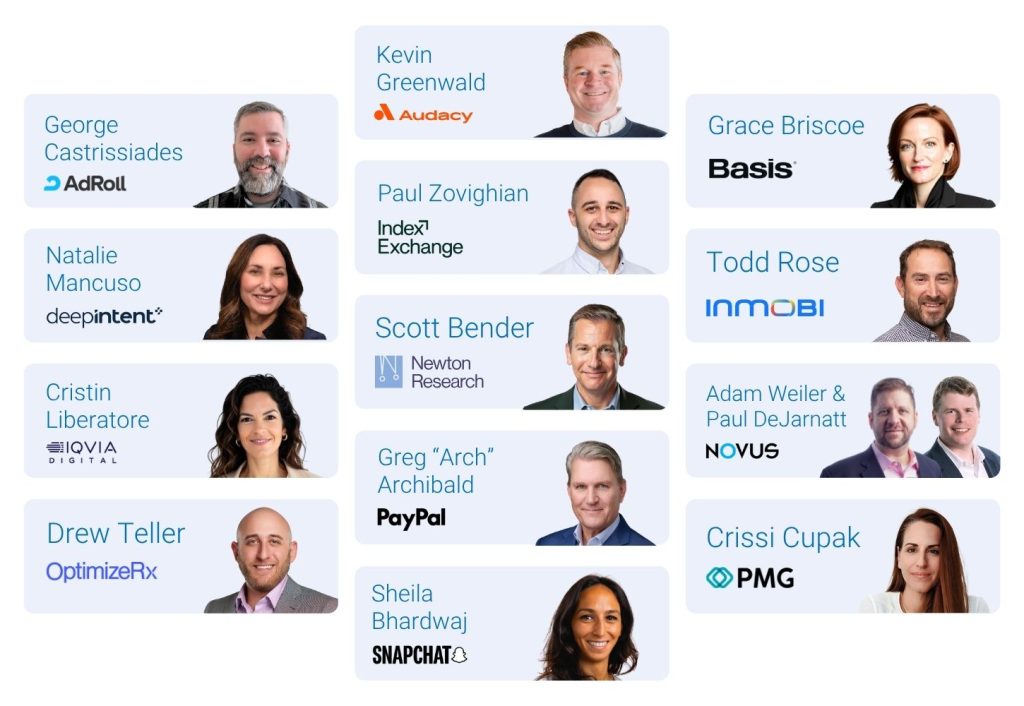
Our 2026 State of advertising report includes perspectives from 14 leaders across the ecosystem covering a variety of topics including:
These perspectives reflect directional signals from leaders across the ecosystem. They are not exhaustive views of any one vertical. They are operational insights from teams navigating change in real time.
In addition to the written analysis, you can watch the full one-on-one Q&A conversations with each partner here.
What signals are shaping advertising trends in 2026?
Five signals are shaping advertising trends in 2026. Together, they explain why advertising trends in 2026 center on clarity, connection, and measurable outcomes. Across every conversation with our partners, five themes stand out:
Below, we spotlight three perspectives from our report.
Scott Bender’s perspective on AI-driven workflows
Scott Bender, Head of Publisher & Platform Partnerships at Newton Research, is a media and AdTech veteran who has led go to market and revenue teams across traditional media, retail media, consulting, andearly stagestartups, helping organizations translate data and product strategy into scalable commercial growth.
How is AI moving upstream into planning and measurement?
AI is changing how teams work before campaigns run. Teams apply AI to planning and measurement first, then scale into activation with clear rules and human oversight.
AI’s first impact is operational
Teams are applying AI to planning and measurement before activation. The early gains are showing up in analytics, forecasting, and workflow compression, especially in areas constrained by time and data science resources.
Automation works when humans define the rules
Repeatable, rules-based processes are where AI performs best today. Strategy, guardrails, and judgment remain human-led. AI scales execution without removing accountability.
The biggest barrier in AI is rethinking workflows
AI adoption slowswhen teams try tolayer automation onto legacy playbooks.Progress happens when workflows are redesigned for agentic execution,rather thanhuman-only processes.

“The workflows we’ve built for humans don’t always make sense for AI. Progress comes when teams redesign how work gets done, not when they simply add automation.”
Newton ResearchScott Bender, Head of Publisher & Platform Partnerships
If advertisers fix one thing in 2026
Focus on data context. Not perfect data, but a clear semantic layer that defines what data means and how it should beinterpreted andused.
Watch our agentic media panel at CES 2026
Greg “Arch” Archibald’s perspective on commerce media’s expansion
Greg “Arch” Archibald is VP, Global Ad Sales at PayPal. A sales leader fornearly 25years,Arch has worked at some of the largest AdTech companies in the world. Now with PayPal Ads, he is helping build the foundation upon which advertisers can use true intent-based signals to inform advertising campaigns.
How is commerce media expanding beyond retail?
Commerce media is extending into more ecosystems and more purchase moments. Commerce media is defined through transactions that show what people buy, not intent signals that imply what people might buy.
Commerce media is defined bytransactions,not intent
Commerce media is fundamentally powered by transactional data. Unlike retail media, which is often intent-led and vertically confined, commerce media spans horizontally across merchants, payment platforms, and ecosystems,providinga clearer view of the full consumer purchase journey.
Transactional data is the true differentiator
As basic targeting and inventory become commoditized, the ability to activate transactional signals at scale is what separates effective commerce media strategies. These signals help brands connect upper-funnel investment to conversion and prove measurable outcomes.
On-site validates performance,off-site drives reach
Effective commerce strategies balance both on-site and off-site, focusing less on where ads run and more on who is being reached based on real purchase behavior.

“Transactional data is a powerful signal that helps brands reach consumers more effectively and connect upper-funnel investment to measurable outcomes.”
PayPalGreg “Arch” Archibald, VP, Global Ad Sales
If advertisers fix one thing in 2026
Prioritize transactional signals over intent proxies to connect spend to outcomes.
Cristin Liberatore’s perspective on healthcare marketing
Cristin Liberatore, Sr. Director, Commercial Strategy for Pharma, IQVIA Digital, has over a decade of experience leading commercial and product strategy for data‑driven healthcare solutions, developing frameworks at IQVIA Digital that connect data, analytics, and omnichannel execution to drive meaningful business results.
How do identity and privacy work together in regulated markets like healthcare?
Healthcare marketing uses a dual approach that reflects distinct audiences and data environments. Teams succeed when they connect identity and privacy through governance that supports personalization and outcome measurement.
Healthcare requires two playbooks: HCP and consumer
On the healthcare professional (HCP) side, personalization benefits from deterministic identity and high-fidelity signals that enable “read, respond, act” marketing. On the consumer side, data is more disparate, making identity resolution and privacy-safe connection across data sets essential for relevant personalization.
Timeliness is the difference between insight and impact
Healthcare data varies widely in latency. The most effective marketing is powered bytimelysignals. Fresh signals influence whether brands respond in meaningful moments along diagnostic and treatment pathways.
Sustainable identity depends on governance
An identity spine paired with de-identification methodology and strong compliance frameworks allows exposure to connect to outcomes such as script lift, without compromising privacy.

“Across data, activation, and measurement, healthcare marketing works best when privacy and personalization are balanced, as that push pull is ubiquitous with consumer marketing in healthcare.”
IQVIA DigitalCristin Liberatore, Sr. Director, Commercial Strategy for Pharma
If advertisers fix one thing in 2026
Invest in a connected identity spine that balances timeliness, personalization, and privacy across the full care journey.
Watch our healthcare marketing panel at CES 2026
What do 2026 advertising trends mean for advertisers?
In 2026, success will be shaped by how well advertisers connect data, decisioning, and outcomes across an increasingly complex ecosystem. The leaders featured in this report consistently point to connection as the defining factor for progress.
The shifts advertisers must act on
- Audiences, not channels, define strategy. Planning anchored in identity and behavior scales more effectively across screens, platforms, and formats.
- Measurement moves upstream. Outcomes now inform optimization in real time, rather than serving a post-campaign validation.
- First-party data becomes infrastructure. Activation, data governance, and interoperability matter more than ownership alone.
- AI accelerates decisions, not accountability. Automation works best when paired with clear rules, transparency, and human oversight.
- Privacy is a growthlever.Consent-driven, privacy-first design enables durable performance at scale.
Advertisers that lead in 2026 will:
- Connect planning, activation, and measurement into a single operating framework
- Invest in data and identity foundations beforeexpanding intonew channels
- Work withpartners that reduce fragmentation, not add to it
To see how these signals play out across AI, commerce media, healthcare, and more, download our 2026 State of advertising report and watch the Q&A videos with our partners.
FAQs
A CMO should treat advertising trends in 2026 as a shift in how teams plan, activate, and measure, not a channel shift. Teams get stronger performance when they connect data, identity, and measurement into one decision loop that guides planning, activation, and optimization.
Measurement moves closer to the moment of decision when teams use outcomes to steer optimization in real time. That approach turns measurement into a planning input that shapes budget allocation, audience strategy, and creative decisions across the lifecycle of a campaign.
Experian helps marketers connect identity, data, and measurement so teams plan and activate with consistency across platforms. Experian’s data and identity foundation supports audience connection and privacy-forward activation, and Experian’s measurement approach links media exposure to outcomes for clearer decisioning.
Latest posts

CPG companies often base marketing decisions on custom market positioning studies, surveys and generic consumer personas. There’s a better way…

Study reveals that brands with more mature identity programs were significantly more likely to be successful in achieving their key objectives Tapad, a part of Experian, a global leader in cross-device digital identity resolution and a part of Experian, has commissioned Forrester Consulting, part of a leading research and advisory firm, to conduct a new study that evaluates the current state of customer data-driven marketing and explores how marketers can use identity solutions to deliver privacy safe and engaging experiences, in an evolving data landscape. The study highlights the changing ground rules for digital marketing and the threat that poses to marketers’ ability to deliver against long standing KPIs and campaign goals. Nearly two-thirds (62%) of respondents said that the forces of data deprecation will have a significant (40%) or critical (21%) impact on their marketing strategies over the next two years. Among those surveyed, identity resolution strategies have surfaced as an opportunity to create more powerful customer experiences, with 66% aiming to have it help improve customer trust and implement more ethical data collection and use practices, while nearly 60% believe it will point the way to more effective personalization and data management practices. Although organizations are eager to implement identity resolution strategies, a complex web of solutions and partners makes execution a challenge. For example, respondents report using at least eight identity solutions on average, across nearly six vendor partners, and they expect that fragmentation to persist in the ‘cookieless’ future. Additionally, brands’ identity resolution technologies typically represent a patchwork of homegrown and commercial solutions. Eighty-one percent of respondents use both in-house and commercial identity resolution tools today, and 47% use a near-equal blend of the two. Despite the challenges, many brands have the foundation for a strong identity resolution strategy in place, and they are thriving as a result. Specifically, more mature brands were 79% more successful at improving privacy safeguards to reduce regulatory and compliance risk, 247% more successful at improving marketing ROI, and over four times more effective at improving customer trust compared to their low-maturity peers. Additional insights include: Marketers Are Increasingly Playing a Key Strategic Role Within the Organization, But There is a Mandate to Demonstrate Value. Nearly three-quarters of respondents in our study agree the marketing function is more strategically important to their organization than it used to be, while almost two-thirds agree there’s more pressure than ever to prove the ROI or business performance of their activities. Consumers Expect Brands to Deliver Engaging Experiences Across Highly Fragmented Journeys: Tapad, a part of Experian found that 72% of respondents agree that customers demand more relevant, personalized experiences at the time and place of their choosing. At the same time, 67% of respondents recognize that customer purchase journeys take place over more touchpoints and channels than ever, and 59% of respondents agree that those journeys are less predictable and linear than they once were. Marketing Runs on Data, But the Rules Governing Customer Data Usage are Ever-Evolving: According to the study, 70% of decision-makers agree that consumer data is the lifeblood of their marketing strategies – fueling the personalized, omnichannel experiences customers demand. At the same time, 69% of respondents recognize that customers are increasingly aware of how their data is being used. At least two-thirds agree that data deprecation, including tighter restrictions on data use (66%), as well as operating system and browser changes impacting third-party cookies (68%) means that legacy marketing strategies are unlikely to remain viable in the long-term.“ Our latest survey findings give us a better understanding of how our customers and other companies around the world are trying to master the relationship between people, their data and their devices,” said Mark Connon, General Manager at Tapad, a part of Experian. “This research shows why it's fundamental for the industry to continuously work to develop solutions that are agnostic. Tapad, a part of Experian has worked tirelessly to deliver on this with our Tapad Graph, and by introducing solutions like Switchboard to help the evolving ecosystem and in turn helping customers reap the benefits of better identity in both short and long-term.” The study is founded on an online survey of over 300 decision-makers at global brands and agencies, which was fielded from March to April, 2021. Data deprecation and identity are fast-developing, moving targets, so this study delivers targeted insights and recommendations for how to prepare for coming shifts in customer data strategies – whether they manifest tomorrow or a year from now. Get in touch

With the recent announcement of delaying third-party cookie deprecation to 2024, the industry has more time to rethink how to identify and communicate with consumers.