At A Glance
Experian’s 2026 State of advertising report shows that advertising trends in 2026 will be defined by how well organizations connect data, identity, and measurable outcomes. Leaders across the ecosystem point to five themes: AI that reshapes workflows, measurement that guides decisions earlier, identity and privacy as strategic inputs, channels aligning around outcomes, and identity connecting planning, activation, and measurement.What advertising trends does Experian’s 2026 State of advertising report highlight?
2026 State of advertising report
Experian’s 2026 State of advertising report shows that advertising trends in 2026 will be defined by how well organizations connect data, identity, and measurable outcomes. Our 2026 State of advertising report brings together perspectives from 14 leaders operating across key parts of the advertising ecosystem to show how these shifts are taking shape in practice.
Who’s featured in Experian’s 2026 State of advertising report?
Our 2026 State of advertising report includes perspectives from 14 leaders across the ecosystem covering a variety of topics including:
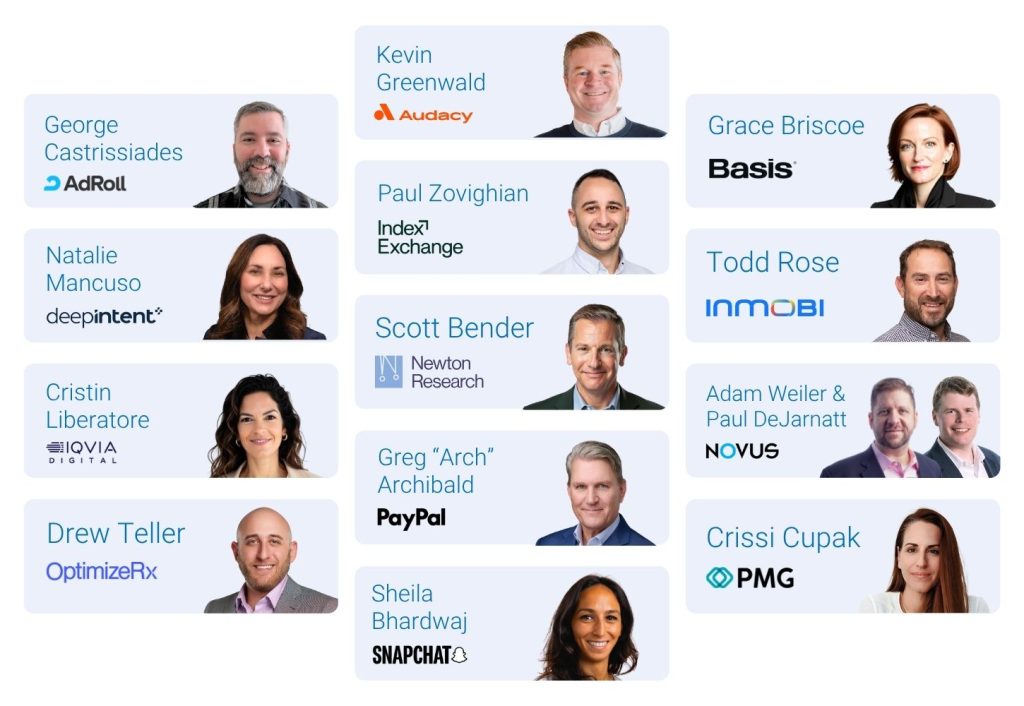
These perspectives reflect directional signals from leaders across the ecosystem. They are not exhaustive views of any one vertical. They are operational insights from teams navigating change in real time.
In addition to the written analysis, you can watch the full one-on-one Q&A conversations with each partner here.
What signals are shaping advertising trends in 2026?
Five signals are shaping advertising trends in 2026. Together, they explain why advertising trends in 2026 center on clarity, connection, and measurable outcomes. Across every conversation with our partners, five themes stand out:
Below, we spotlight three perspectives from our report.
Scott Bender’s perspective on AI-driven workflows
Scott Bender, Head of Publisher & Platform Partnerships at Newton Research, is a media and AdTech veteran who has led go to market and revenue teams across traditional media, retail media, consulting, andearly stagestartups, helping organizations translate data and product strategy into scalable commercial growth.
How is AI moving upstream into planning and measurement?
AI is changing how teams work before campaigns run. Teams apply AI to planning and measurement first, then scale into activation with clear rules and human oversight.
AI’s first impact is operational
Teams are applying AI to planning and measurement before activation. The early gains are showing up in analytics, forecasting, and workflow compression, especially in areas constrained by time and data science resources.
Automation works when humans define the rules
Repeatable, rules-based processes are where AI performs best today. Strategy, guardrails, and judgment remain human-led. AI scales execution without removing accountability.
The biggest barrier in AI is rethinking workflows
AI adoption slows when teams try to layer automation onto legacy playbooks. Progress happens when workflows are redesigned for agentic execution, rather than human-only processes.

“The workflows we’ve built for humans don’t always make sense for AI. Progress comes when teams redesign how work gets done, not when they simply add automation.”
Newton ResearchScott Bender, Head of Publisher & Platform Partnerships
If advertisers fix one thing in 2026
Focus on data context. Not perfect data, but a clear semantic layer that defines what data means and how it should be interpreted and used.
Watch our agentic media panel at CES 2026
Greg “Arch” Archibald’s perspective on commerce media’s expansion
Greg “Arch” Archibald is VP, Global Ad Sales at PayPal. A sales leader for nearly 25 years, Arch has worked at some of the largest AdTech companies in the world. Now with PayPal Ads, he is helping build the foundation upon which advertisers can use true intent-based signals to inform advertising campaigns.
How is commerce media expanding beyond retail?
Commerce media is extending into more ecosystems and more purchase moments. Commerce media is defined through transactions that show what people buy, not intent signals that imply what people might buy.
Commerce media is defined by transactions, not intent
Commerce media is fundamentally powered by transactional data. Unlike retail media, which is often intent-led and vertically confined, commerce media spans horizontally across merchants, payment platforms, and ecosystems, providing a clearer view of the full consumer purchase journey.
Transactional data is the true differentiator
As basic targeting and inventory become commoditized, the ability to activate transactional signals at scale is what separates effective commerce media strategies. These signals help brands connect upper-funnel investment to conversion and prove measurable outcomes.
On-site validates performance, off-site drives reach
Effective commerce strategies balance both on-site and off-site, focusing less on where ads run and more on who is being reached based on real purchase behavior.

“Transactional data is a powerful signal that helps brands reach consumers more effectively and connect upper-funnel investment to measurable outcomes.”
PayPalGreg “Arch” Archibald, VP, Global Ad Sales
If advertisers fix one thing in 2026
Prioritize transactional signals over intent proxies to connect spend to outcomes.
Cristin Liberatore’s perspective on healthcare marketing
Cristin Liberatore,Sr. Director, Commercial Strategy for Pharma, IQVIA Digital, has over a decade of experience leading commercial and product strategy for data‑driven healthcare solutions, developing frameworks at IQVIA Digital that connect data, analytics, and omnichannel execution to drive meaningful business results.
How do identity and privacy work together in regulated markets like healthcare?
Healthcare marketing uses a dual approach that reflects distinct audiences and data environments. Teams succeed when they connect identity and privacy through governance that supports personalization and outcome measurement.
Healthcare requires two playbooks: HCP and consumer
On the healthcare professional (HCP) side, personalization benefits from deterministic identity and high-fidelity signals that enable “read, respond, act” marketing. On the consumer side, data is more disparate, making identity resolution and privacy-safe connection across data sets essential for relevant personalization.
From onboarding to outcomes
Pharma marketing teams need identity workflows that can support accurate audience creation, governed activation, and partner-enabled measurement without combining DTC and HCP identity paths.
Download our pharma marketing playbook to help your team:
- Evaluate audience quality, usable reach, and governance
- Plan DTC and HCP identity strategies with clearer separation
- Prepare audiences for activation across approved channels and partners

Timeliness is the difference between insight and impact
Healthcare data varies widely in latency. The most effective marketing is powered by timely signals. Fresh signals influence whether brands respond in meaningful moments along diagnostic and treatment pathways.
Sustainable identity depends on governance
An identity spine paired with de-identification methodology and strong compliance frameworks allows exposure to connect to outcomes such as script lift, without compromising privacy.

“Across data, activation, and measurement, healthcare marketing works best when privacy and personalization are balanced, as that push pull is ubiquitous with consumer marketing in healthcare.”
IQVIA DigitalCristin Liberatore, Sr. Director, Commercial Strategy for Pharma
If advertisers fix one thing in 2026
Invest in a connected identity spine that balances timeliness, personalization, and privacy across the full care journey.
Watch our healthcare marketing panel at CES 2026
What do 2026 advertising trends mean for advertisers?
In 2026, success will be shaped by how well advertisers connect data, decisioning, and outcomes across an increasingly complex ecosystem. The leaders featured in this report consistently point to connection as the defining factor for progress.
The shifts advertisers must act on
- Audiences, not channels, define strategy. Planning anchored in identity and behavior scales more effectively across screens, platforms, and formats.
- Measurement moves upstream.Outcomes now inform optimization in real time,rather than serving a post-campaign validation.
- First-party data becomes infrastructure. Activation, data governance, and interoperability matter more than ownership alone.
- AI accelerates decisions, not accountability. Automation works best when paired with clear rules, transparency, and human oversight.
- Privacy is a growthlever.Consent-driven, privacy-first design enables durable performance at scale.
Advertisers that lead in 2026 will:
- Connect planning, activation, and measurement into a single operatingframework
- Invest in data and identity foundations before expanding into new channels
- Work withpartners that reduce fragmentation, not add to it
To see how these signals play out across AI, commerce media, healthcare, and more, download our 2026 State of advertising report and watch the Q&A videos with our partners.
FAQs
A CMO should treat advertising trends in 2026 as a shift in how teams plan, activate, and measure, not a channel shift. Teams get stronger performance when they connect data, identity, and measurement into one decision loop that guides planning, activation, and optimization.
Measurement moves closer to the moment of decision when teams use outcomes to steer optimization in real time. That approach turns measurement into a planning input that shapes budget allocation, audience strategy, and creative decisions across the lifecycle of a campaign.
Experian helps marketers connect identity, data, and measurement so teams plan and activate with consistency across platforms. Experian’s data and identity foundation supports audience connection and privacy-forward activation, and Experian’s measurement approach links media exposure to outcomes for clearer decisioning.
Latest posts

Buyers can now put Experian’s audience and contextual intelligence to work in Google Ad Manager Curation in two ways: through off-the-shelf solutions available directly in Google Ad Manager, or through Custom Curation packages that Experian builds using Google Ad Manager’s inventory supply. Together, these options bring Experian’s consumer data foundation closer to the Google supply agencies already buy, with the flexibility to choose between a ready-to-use solution and an Experian package tailored to specific campaign goals. Why targeting at the source matters Many audience strategies still apply targeting on the buy side, which means signals pass through multiple systems before an impression is evaluated. Each step can shrink the pool of requests where the audience is still recognizable, so a carefully built strategy can reach the auction at a fraction of the scale it started with. Google Ad Manager Curation moves segment evaluation closer to the ad request. When a request matches the selected Experian segment, Ad Manager sends the bid request with the associated Deal ID to the buyer’s DSP. This more direct path can support stronger match and deal-transaction rates, more accurate forecasting, and better access to the audience defined in the strategy. As AI shapes more media decisions, the quality and provenance of the data feeding those systems matter more. Evaluating audience or contextual criteria closer to the source helps preserve the connection between the strategy and the impression being considered. Two ways to get started The right entry point depends on how much customization the campaign requires. Buyers can access Experian solutions off-the-shelf directly in Google Ad Manager or work with Experian to build a Custom Curation package using Google Ad Manager inventory supply. Start off-the-shelf For buyers who want direct, self-service access to Experian audience and contextual solutions. Experian solutions are available off-the-shelf in Google Ad Manager, giving buyers a straightforward way to select the data or contextual strategy that fits their campaign and create packages through Google Ad Manager’s Curation capabilities. Experian Audiences Experian Audiences draw on a deterministic offline identity foundation that represents more than 250 million U.S. consumers and 126 million U.S. households. Buyers can choose from Experian’s Audiences spanning demographics, lifestyle, financial signals, media habits, and household characteristics. That depth adds real-world consumer context beyond digital behavior alone. Contextual Experian contextual solutions give buyers a way to reach relevant environments without relying on identity. Buyers can select contextual audiences aligned to specific interests, categories, and content to inform where media appears. Experian also offers Predictive Indexed, which uses Experian audiences to predict the contextual categories and pages to target based on the likelihood that consumers visiting those environments fall within the selected audience. This gives buyers an audience-informed way to approach contextual activation without requiring identity at the point of activation. Build a Custom Curation package For buyers who need a strategy tailored to specific audience, contextual, and inventory requirements. Experian can build Custom Curation packages using Google Ad Manager’s inventory supply based on the targeting criteria that matter for a campaign. Where off-the-shelf solutions draw on Experian data, custom packages can also incorporate partner audiences and a brand’s own first-party audiences. Packages can combine Experian audiences, partner audiences, a brand’s own first-party audiences, contextual signals, and inventory or site criteria. Experian applies those criteria against Google Ad Manager inventory supply and brings the data, targeting, and inventory together into a single curated deal. This gives buyers a way to combine audience and supply decisions rather than managing each component separately. The approach can be tailored to the campaign. A buyer might start with a defined audience and add contextual or inventory criteria, bring a brand’s established first-party audience into the strategy, or build around specific supply and audience-quality requirements. Choose the path that fits the campaign Both paths do the same underlying thing: they move the audience or contextual decision closer to the ad request, before signal loss builds across the path. Whether a campaign calls for something ready to use or a package built to spec, the result is a more direct line from strategy to impression. Ready to get started? Explore Experian solutions available off-the-shelf in Google Ad Manager or contact your Experian representative to request a Custom Curation package. Latest posts

See how Experian helped FanThreeSixty clean, match, and enrich 7.6 million fan records through data enrichment and identity resolution.
What commerce media networks should look for in commerce media data partners, and how to test a provider’s structural neutrality.