Understanding Gift Card Fraud Part 1: Their prevalence in modern society

by Guest Contributor 4 min read March 5, 2015

Gift card fraud

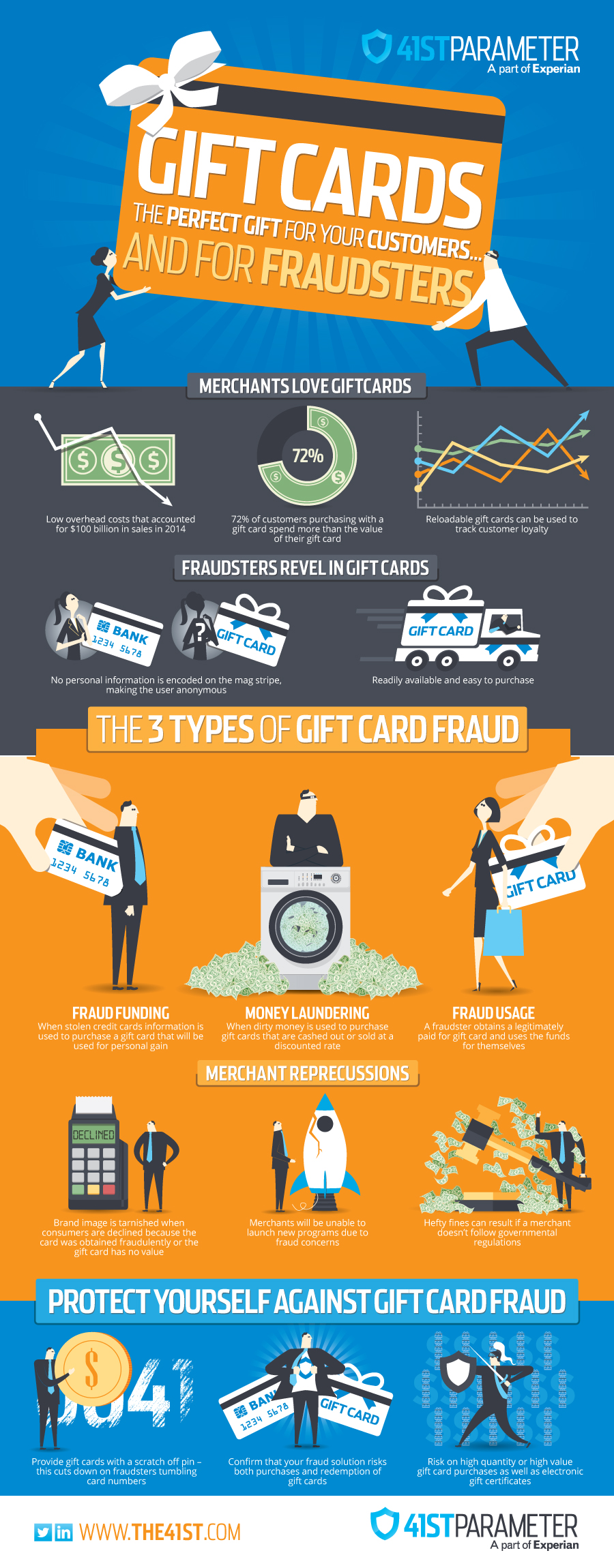
41st_GiftCard_Fraud_InfographicGift cards have risen in popularity over the last few years— National Retail Federation anticipated more than $31B in gift card sales during the 2014 holiday season alone. Gift cards are the most requested gift item, and they have been for eight years in a row. Total gift card sales for 2014 were anticipated to top $100 Billion.

Gift cards are a practical gift–the purchaser can let the recipient pick exactly what they want, eliminating the worry of picking something that doesn’t fit right, that is a duplicate, or something that the recipient just might not want. They are also incredibly convenient, quick, and easy to purchase. The stigma behind gift cards is starting to fade, and it no longer seems as though they are an impersonal gifting option.

Additionally, the type of gift cards available has expanded greatly in the last few years. If you are of the procrastinating nature, there are eGift Cards or eCertificates, which can be emailed in a matter of minutes to the recipient. If you are truly unsure what to purchase altogether, you can give an open-loop card, which are usually branded by Visa, MasterCard, and American Express, and can be used anywhere their logo appears.

It also seems like a quick win for merchants to carry gift cards. The overhead cost to store them is extremely low because a small box of gift cards takes up very little space. When customers come in to redeem their GC, they usually spend more than the original value of the card itself, thus allowing for additional revenue capture.

Something else that merchants have started doing in this big data world we live in is tying gift cards to consumer loyalty programs. Reloadable cards are now linked to a specific customer, who can also tie their credit card to the account, which is automatically charged once their account is below a pre-defined threshold. These new consumer loyalty accounts can be used to track spending history, tailor offers to the specific customer, and continue to expand on the immersive brand experience.

Recently, a certain Mexican-themed fast food establishment launched their new mobile app; in the app, you could pre-order food, send and redeem eGCs, and find the nearest location. I don’t even eat at this establishment, but the innovation of their app was so enticing that I installed it the morning it came out, purchased an eGC for my husband, and pre-ordered breakfast. It was extremely easy and convenient, and I got a free taco! Now they have my soul. Okay, maybe not my soul, but they have my credit card data, purchasing preferences, device information, and location, which is almost the same thing at this point. After the experience I found myself asking why other merchants haven’t already done this or why it hasn’t taken off yet. This is a great example of how gift cards and emerging technology are being used as a marketing tool to entice consumers to build up a customer base.

In the rare instance that a gift recipient does not actually find value in their gift card (the horror!) there’s a multitude of options for trading them in or redeeming for cash. Some well-known websites for trade-in are Giftcard Granny, Card Hub, and raise.com; it’s also incredibly common to find discounted GCs for sale on eBay, Craigslist, and Facebook groups. A couple familiar names that have recently entered into the mix are Wal-Mart and CoinStar. You can now exchange your physical gift card for cash at a specific CoinStar machines, and if you don’t feel like leaving your home, you can exchange your card online with Wal-Mart, and they will provide you with a Wal-Mart gift card that can be redeemed online or in stores. It’s such common practice that you can find articles on this topic on local, national, and 24-hour news websites.

This tremendous revenue booster does not come free of risk, however. We know that fraudsters are clever and opportunistic. They will penetrate every weakness possible and take advantage of programs that are being used to enhance the consumer experience. But are they really stealing all these gift cards for personal gain and taking all of their friends out to their favorite local coffee shop for free drinks? Stay tuned for the second part of this blog that talks more about the fraud risks associated with gift cards and what you can do to mitigate them.

Please note: *The use of GC/eGC is used interchangeably.
Related Posts

Cash Flow Insights: Powering the Next Evolution in Lending

For decades, credit data has given lenders a trusted foundation for assessing risk. Now, consumer-permissioned cash flow data is adding another layer of insight into consumers’ financial lives, including income, spending, liquidity and changing financial obligations. The opportunity is significant. Nearly one in five consumers lacks access to or has damaged credit. New Experian research also shows that 60% of consumers who have previously been denied credit or received less favorable terms than expected believe the outcome would have been different if lenders had considered their recent income and banking activity alongside their credit history. 1,2 For lenders, cash flow insights can provide additional context about a consumer’s financial capacity and support more informed underwriting decisions. The next challenge is making those insights easier to use consistently and responsibly at scale. What are cash flow insights? Cash flow insights are derived from consumer-permissioned banking data and provide visibility into how money moves into and out of a consumer’s accounts. Depending on the information available, cash flow data can provide insight into financial behaviors such as: Income and income stability: Regular and irregular income streams and changes over time Spending and recurring expenses: Everyday spending patterns and ongoing financial obligations Account balances and liquidity: Available funds and changes in account balances Debt obligations: Loan payments and other recurring debt commitments Cash flow patterns: How money moves into and out of accounts over time Traditional credit information provides a rich history of how consumers have managed credit. Cash flow insights add context about their current financial activity and capacity, providing lenders with a more complete view of financial health. Cash flow insights can also add predictive value to risk assessment. Experian analysis shows Cashflow Score can deliver up to a 25% lift in predictive performance over conventional credit scores when tailored to targeted risk tiers.3 How lenders can put cash flow insights to work at scale As interest in cash flow insights grows, the conversation is moving beyond what the data can reveal to how financial institutions can use it consistently and responsibly. That requires standardized consumer reporting, clear governance and decision-ready insights that can work within established lending processes. The launch of Experian Cashflow Data Bureau at Vision 2026 reflects this shift from access to adoption. The new consumer reporting agency operates under the Fair Credit Reporting Act (FCRA) and is designed to help financial institutions adopt consumer-permissioned cash flow insights at scale. A key part of that foundation is the cash flow consumer report, which organizes consumer-permissioned banking information into a standardized consumer report regulated under the FCRA. This gives lenders a consistent foundation for incorporating cash flow information into lending decisions while providing consumers with access to the information in their report. Turning greater visibility into better decisions The next evolution in credit isn’t about choosing between traditional credit and cash flow data. Each provides a different perspective. Traditional credit information offers deep insight into how consumers have managed credit over time. Cash flow insights can add context about financial activity and capacity. Bringing those perspectives together can give lenders greater visibility into consumers’ financial health and help them better distinguish between risk and resilience, support more informed decisions and identify opportunities to responsibly expand access to credit. As cash flow adoption continues to grow, its value will come from how effectively it complements the information lenders already use. The opportunity isn't simply to see more data. It's to turn that additional visibility into smarter, more informed decisions. Explore how Experian Cashflow Data Bureau is helping financial institutions put consumer-permissioned cash flow insights into practice at scale. Learn more [1] Federal Reserve Bank of New York, The Market for Credit Building: Demand, Product Characteristics and Consumer Uses, 2026. [2] Experian commissioned Atomik Research to conduct an online survey of 2,000 U.S. adults age 18+. Fieldwork took place July 16–21, 2026. Margin of error: +/- 2.2 percentage points at a 95% confidence level. [3] Based on Experian analysis when Cashflow Score is compared with conventional credit scores, tailored to targeted risk tiers. Predictability based on KS.

October 14, 2026 by Julie Lee
The Three Onboarding Fraud Pain Points That Slow Growth (And How to Solve Them) 

Effective fraud prevention is critical to balancing security and customer experience during onboarding. Learn more!

October 12, 2026 by Charles Hunter
How Rental Data Is Expanding Financial Opportunity for Millions of Renters 

Discover how rental payment reporting can expand credit access, strengthen credit profiles and improve risk assessment for renters and housing providers.

October 8, 2026 by Manjit Sohal

Subscribe to our Newsletter

Enter your name and email for the latest updates.

This site is protected by reCAPTCHA and the Google Privacy Policy and Terms of Service apply.

Subscribe to our Newsletter

Don't miss out on the latest industry trends and insights!
Subscribe