The Email Address as Your Most Powerful Identity Signal

by Zohreen Ismail 4 min read August 6, 2026

At A Glance

Experian acquired AtData — together our capabilities help businesses strengthen fraud prevention, improve identity and credit decisions and engage customers more effectively.

The why behind Experian’s acquisition of AtData

What happens when a comprehensive email intelligence database joins a global leader in data, analytics and fraud prevention? The acquisition of AtData adds 25+ years of building a complete view of email as an identity signal. Financial institutions can recognize, engage and protect customers unlocking a new standard for the way their teams work and the customer experience.

That’s what Experian’s acquisition of AtData delivers.

How we got here

Not all email addresses tell the same story. Some are newly created. Some exhibit bot-like patterns. Some are inconsistent with every other signal you have about that person.

Imagine a real customer. You have a job. You shop online. You have a primary email from your employer, a personal Gmail you’ve used for 15 years, and an old Yahoo address you still use for shopping because you’ve been using it since college.

You’re an engaged customer who interacts with brands, makes purchases and pays bills on time. But each system sees a different version of you. When you apply for credit, the lender sees one email. When you shop, the retailer sees another. When you sign up for a service, you might use the third.

For financial institutions: You slow down the approval process to manually verify identity or approve applicants without the full picture.

For retailers: You can’t tell which version of “customer” is the most engaged, so you either over-mail or under-serve.

For fraud systems: Sees a new account created under one email and flags it as suspicious because it doesn’t have the history.

This was the original problem AtData was built to solve in 1999. Twenty-five years later, that problem didn’t go away, it became more complex. Email fragmentation and device sharing are more common, and identity theft is more sophisticated.

Capabilities that now work together

Experian has built sophisticated identity and fraud solutions backed by consumer data resources and decades of expertise in credit and risk. AtData brought the ability to assess whether an email address is trustworthy, reachable and consistent—at scale, in real time.
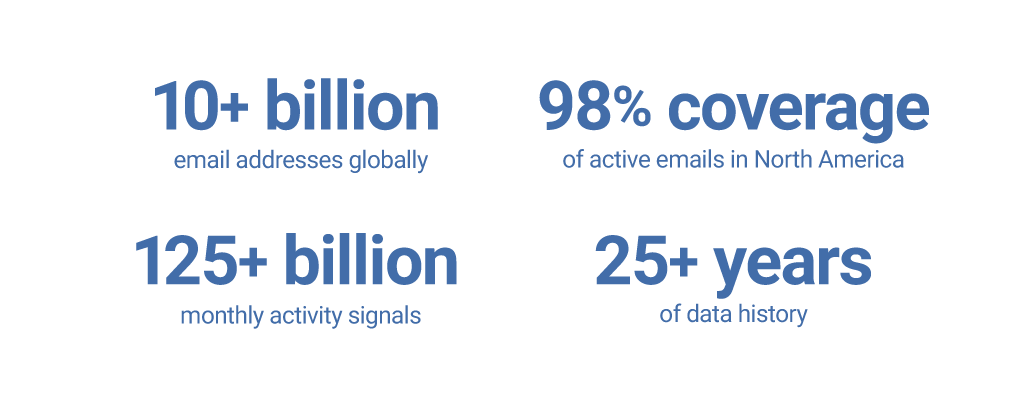
AtData email intelligence includes 10+ billion email addresses globally, 98% coverage of active emails in North America, 125+ billion monthly activity signals and 25+ years of data history.

Experian is now making email intelligence foundational, not optional.

This matters for:

  • Fraud prevention and risk management: Distinguishing a returning customer from a new threat. Knowing whether an email is newly created, exhibiting bot-like patterns or inconsistent with other identities is crucial.
  • Compliance: Building audit trails that can explain identity decisions. Email data history and behavioral signals create the documentation needed to defend your decisions.
  • Credit: Verifying identity in a world where traditional signals are shifting. Email signals provide a persistent, durable identifier that confirms who someone actually is.
  • Marketing: Reaching the right person across email, mail and digital channels. Email intelligence reveals which addresses are actively engaged and reachable.

Research shows email remains one of the highest-ROI marketing channels outperforming paid search and social advertising1. The problem every marketer faces: You end up burning budget on addresses that bounce, are unmonitored or are associated with users who never open mail. For credit marketing specifically, email enables faster, more targeted delivery of firm offers across channels, something that’s increasingly important in a post-cookie world.

“Email is a persistent identifier in a fragmented world. It’s what connects a person’s postal address, phones, devices, behaviors—the full picture of who they are. By embedding that into our infrastructure, we’re not just adding another data point. We’re fundamentally improving how businesses understand who their customers are.”

– Ashley Knight, Senior Vice President, Financial Services and Data

Why now?

AI is reshaping how decisions are made in every industry. Models are getting faster, more automated and more embedded in core workflows. But AI is only as effective as the data behind it.

Fragmented data + fast models = faster, larger-scale misclassifications.

In an era of synthetic identities, AI agents, deepfakes and AI-generated activity, the value of durable, persistent, real-world data signals has increased dramatically. Deloitte’s Center for Financial Services projects that generative AI could drive fraud losses in the U.S. up to $40 billion by 2027, a 32% growth rate since 2023. And email sits at the center of it with business email compromise already being one of the most common and costly fraud types.

People change phones, move homes and swap devices, but they often hold onto their email for years. That’s the signal that protects your business, and the one we’ve built into the core of how we help you make decisions with confidence.


Related Posts

Are Fraudsters Building Better Identities Than Your Customers?

Fraudsters are getting surprisingly good at onboarding. Sometimes, better than your customers. Legitimate customers treat onboarding like an errand. They start an application between other tasks, get distracted, forget a password, switch devices, upload a document or come back later to finish. Their digital lives aren’t always linear, because real life isn’t either. Fraudsters approach onboarding differently. For them, opening an account is the objective. Every interaction is designed to increase the odds of success. The difference raises an uncomfortable question hanging over onboarding: What exactly are we rewarding? When smooth becomes suspicious Digital onboarding has traditionally rewarded experiences that feel smooth, consistent and complete. The challenge is that legitimate customers rarely behave that way. Most people approach onboarding somewhere between mildly distracted and mildly annoyed. They pause halfway through because dinner is burning. They reopen an old account only to realize everything is attached to an email they made in college and, somehow, still use for airline receipts. Digital life accumulates history unevenly, because ordinary life does too. Fraudsters have every reason to eliminate those inconsistencies. Applications may be rehearsed. Identity attributes are assembled deliberately. Contact points are prepared in advance. Every interaction is optimized to make the application appear credible. Ironically, the qualities organizations often associate with confidence — clean submissions, steady progression and few corrections — can also describe applications that have been carefully engineered to pass inspection. The challenge isn't that smooth onboarding is meaningless. It's that smooth onboarding, by itself, doesn't tell the whole story. Context changes interpretation A smooth onboarding experience should be the beginning of the evaluation, not the end. Behavior provides important context. How someone moves through an application can reveal whether the experience feels naturally human or unusually orchestrated. Do they interact naturally? Do they hesitate, correct mistakes or navigate in ways that resemble ordinary human behavior? Or does the session appear unusually scripted, automated or repetitive? Identity verification adds another layer. Matching information across trusted sources, validating identity details and strengthening confidence in account creation remain important, particularly when onboarding decisions carry financial, fraud or customer experience consequences. But verification largely answers a point-in-time question: Does this information match right now? A third layer comes from digital history. An inbox attached to years of airline receipts, loyalty accounts, subscription renewals, account recovery, financial notifications and familiar digital routines introduces a different kind of confidence. Legitimate digital identities leave behind patterns of persistence and engagement that develop gradually over time. Fraudsters can assemble convincing identity attributes, but creating years of ordinary digital life is much harder. Building confidence in an identity requires more than verifying information submitted during a single onboarding session. It requires understanding whether the identity reflects a broader history that supports what the application suggests. A multilayered approach builds stronger identity confidence No single signal can provide a complete view of identity risk. Organizations need multiple sources of confidence that reinforce one another. That's the thinking behind our approach: combining behavioral intelligence, identity verification and digital identity continuity into a more complete view of risk. We bring these complementary layers together through: • NeuroID adds behavioral context during onboarding and account creation, helping identify interaction patterns that may indicate automation, manipulation or coordinated fraud. • Precise ID® strengthens identity verification and resolution by comparing applicant information with trusted identity data. • AtData, recently added to our portfolio, contributes email-centered intelligence based on persistence, engagement and long-term digital history. Together, these capabilities help organizations move beyond evaluating a single moment in time to understanding whether an identity is supported by consistent behavior, trusted identity data and an established digital history. The future of fraud prevention isn't about rewarding the smoothest application. It's about recognizing the most trustworthy identity. Fraudsters can rehearse an application. They can optimize an onboarding journey. They can even assemble convincing identity attributes. What they can't easily manufacture is years of ordinary digital life. That's why digital identity continuity has become an important layer of modern fraud prevention. Combined with identity verification and behavioral intelligence, it helps organizations distinguish between identities that simply look convincing and those supported by a history that is much harder to fake. Learn more Contact us

September 2, 2026 by Julie Lee
From Hybrids to Refinancing: Consumers are Finding New Roads to Vehicle Affordability

For today’s automotive consumers, considering a vehicle purchase isn’t just about the price they see on the window, it’s about finding the right combination of their vehicle preference and monthly payment. In fact, data from Experian Automotive’s State of the Automotive Finance Market Report: Q2 2026 highlighted how affordability continues to shape the automotive finance market. For instance, hybrids offered the lowest average new vehicle loan payment across all fuel types, coming in at $646 in Q2 2026, compared to electric vehicles (EVs) at $692, and gasoline-powered vehicles at $721. This led to considerable growth in new vehicle market share for hybrids this quarter, accounting for 16.80%, from 12.99% last year. While the automotive market continues to offer consumers an expanding mix of fuel types, the combination of growing hybrid share and comparatively lower monthly payments is something worth watching. Affordability isn’t just about what consumers drive, it’s how they finance it While hybrid vehicles are continuing to pave their way in the vehicle market, consumers who already have an auto loan are finding greater savings through refinancing. In the second quarter of 2026, automotive refinancing reached approximately 140,000 loans. More notably, the financial benefit associated with refinancing has grown. Consumers who refinanced this quarter reduced their average interest rate by more than 2.4%, with the average rate moving from 10.40% on the original loan to 7.97% on the refinanced loan. Those rate reductions translated into meaningful monthly savings, especially when refinancing through particular lenders. In Q2 2026, refinancing saved consumers an average of $83 per month, compared to an average monthly savings of $64 this time last year. However, credit unions delivered the largest average payment difference among lender types at $102 this quarter, followed by banks ($65), and finance companies ($38). It’s important for automotive professionals to acknowledge that affordability is not a single moment in the vehicle journey. It can influence the vehicle a consumer chooses, the financing they opt for during that transaction, and the decisions they make years after driving off the lot. Understanding and leveraging those different moments can help professionals identify opportunities to better serve consumers throughout the vehicle ownership lifecycle. To learn more about automotive finance trends, view the full State of the Automotive Finance Market Report: Q2 2026 presentation on demand.

August 27, 2026 by Melinda Zabritski
AI Agent Identity Verification: How to Verify AI Agents in Digital Transactions

AI agents are changing the way consumers interact with businesses online. Learn how you can establish greater confidence in AI transactions.

August 26, 2026 by Laura Burrows

Subscribe to our Newsletter

Enter your name and email for the latest updates.

This site is protected by reCAPTCHA and the Google Privacy Policy and Terms of Service apply.

Subscribe to our Newsletter

Don't miss out on the latest industry trends and insights!
Subscribe