Tag: consumer credit behavior
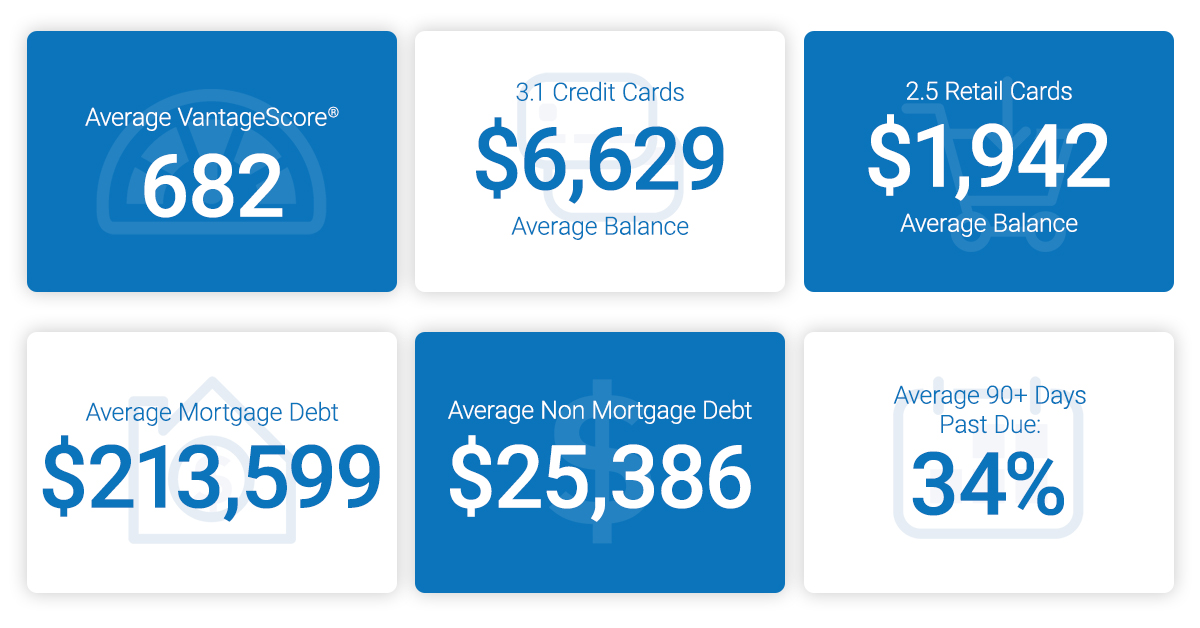
As look forward to the next decade, things are looking up. The 10th annual State of Credit Report highlights consumer credit scores and borrowing behavior.

We’ve rounded up what it takes for consumers to have a good credit score, in addition to some alternative considerations. Read more!

Consumer credit scores A recent survey* released by the Consumer Federation of America and VantageScore Solutions, LLC, shows that potential borrowers are more likely to have obtained their credit score than nonborrowers. 70% of those intending to take out a consumer or mortgage loan in the next year received their credit score in the past year, compared with 57% of those not planning to borrow. Consumers who obtained at least one credit score in the past year were more likely to say their knowledge of scores is good or excellent compared with those who haven’t (68% versus 45%). While progress is being made, there’s still a lot of room for improvement. By educating consumers, lenders can strengthen consumer relationships and reduce loss rates. It’s a win-win for consumers and financial institutions. Credit education for your customers>

In 2017, a meaningful jump in consumer sentiment bolstered spending, and caused the spread between disposable personal income and consumer spending to reach an all-time high. This increase in spread was mostly financed through consumer debt, which according to the Federal Reserve Bank of New York has brought total consumer debt to a new peak of $12.8 Trillion surpassing the prior peak in 2008. The Experian eighth annual State of Credit report greatly supported the consumer behavior trends observed for the past year. Spanning the generations It is no surprise that generation Z (the “Great Recession Generation”) is conservative and prudent in their approach to credit because they are the most familiar with the post financial crisis economy. Results showed Millennials experienced a drop in overall debt, and an increase in mortgage debt reflects the national homeownership affordability challenge facing this generation. As first time homebuyers, millennials have to relatively tighten their spending as they dedicate an ever-growing portion of their income to housing. On the other end of the spectrum, the results of the study showed that Baby Boomers’ had sizable debt (including mortgage debt), which reflects the generation’s intent to stay active in their communities and in their homes much longer than prior generations have done. A recent Harvard study reported that by 2035, one out of three American households will be headed by an individual 65 years of age or older, compared to current ratio of one out of five households. What’s on the horizon? It is reasonable to assume that these trends may continue into 2018, as the underlying conditions continue to persist. A closer eye should be kept on student and auto loans due to the significant increase in portfolio size and increasing default rates compare to other debt. Editor’s note: This post was written by Fadel N. Lawandy, Director of the C. Larry Hoag Center for Real Estate and Finance and the Janes Financial Center at the George L. Argyros School of Business and Economics, Chapman University. Fadel joined the George L. Argyors School of Business and Economics, Chapman University after retiring as a Portfolio Manager from Morgan Stanly Smith Barney in 2009. He has two decades of experience in the financial industry with banking, credit management, commercial/residential real estate acquisition and financing, corporate finance, mergers and acquisitions, quantitative and qualitative analysis and research, and portfolio management. Fadel currently serves as the Chairman of the Board and President of CFA Society Orange County, and is an active member of the CFA Institute.

The economy is accelerating at a sluggish pace, and world headlines cause business leaders to swing between optimism and pessimism daily. Risk managers must look more closely and much more frequently at their customers' behavior to stay ahead of emerging credit problems. Some tips: Use all customer information when making decisions. Combining both internal and external data can paint a clearer picture of your customers. Identify the customer relationships that have value and should be retained. Apply resources accordingly. Implement daily triggers so you have the latest customer information around bankruptcy, repossession or loan delinquency, as well as positive information such as payments made to other financial institutions. Spend more time examining consumers who are delinquent on their home mortgage payments to determine their behavior on your portfolio. Use next-generation collections software to keep collectors up to date on account-level strategies. Download our white paper on how changes in the economy have impacted consumer credit behavior and what risk managers should analyze in order to determine portfolio strategies. Source: Experian News