
3 ways to enhance your credit marketing efforts

by Kyle Matthies 4 min read January 19, 2017

3-pillars-of-comprehensive-credit-marketing

When you think of criteria for prescreen credit marketing, what comes to mind?

Most people will immediately discuss the risk criteria used to ensure consumers receiving the mailing will qualify for the product offered. Others mention targeting criteria to increase response rates and ROI. But if this is all you’re looking at, chances are you’re not seeing the whole picture.

When it comes to building campaigns, marketers should consider the entire customer lifecycle, not just response rates. Yes, response rates drive ROI and can usually be measured within a couple months of the campaign drop. But what happens after the accounts get booked?

Traditionally, marketers view what happens after origination as the responsibility of other teams. Managing delinquencies, attrition, and loyalty are fringe issues for the marketing manager, not the main focus. But more and more, marketers must expand their role in the organization by taking a comprehensive approach to credit marketing.

In fact, truly successful campaigns will target consumers that build lasting relationships with the institution by using the three pillars of comprehensive credit marketing.

Pillar #1: Maximize Response Rates

At any point in time, most consumers have no interest in your products. You don’t have to look far to prove this out. Many marketing campaigns are lucky to achieve greater than a 1% response rate. As a result, marketers frequently leverage propensity to open models to improve results. These scores are highly effective at identifying consumers who are most likely to be receptive to your offer, while saving those that are not for future efforts.

However, many stop with this single dimension. The fact is no propensity tool can pick out 100% of responders. Layering just a couple credit attributes to a propensity score allows you to swap in new consumers. Simultaneously, credit attributes can identify consumers with high propensity scores that are actually unlikely to open a new account. The net effect is even higher response rates than can be achieved by using a propensity score alone.

Pillar #2: Risk Expansion3-pillars-of-comprehensive-credit-marketing-chart
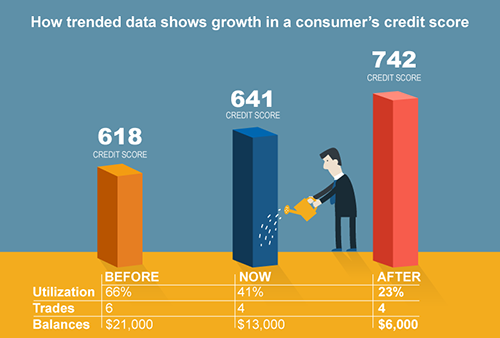
Credit criteria are usually set using a risk score with some additional attributes. For example, a lender may target consumers with a credit score greater than 700 and no derogatory or delinquent accounts reported in the past 12 months. But, most of this data is based on a “snapshot” of the credit profile and ignores trends in the consumer’s use of credit.

Consider a consumer who currently has a 690 credit score and has spent the past six months paying down debt. During that time, utilization has dropped from 66% to 41%, they’ve paid off and closed two trades, and balances have reduced from $21,000 to $13,000. However, if you only target consumers with a score greater than 700, this consumer would never appear on your prescreen list. Trended data helps spot how consumers use data over time. Using swap set analysis, you can expand your approval criteria without taking on the incremental risk. Being there when a consumer needs you is the first step in building long-term relationships.

Pillar #3: Customer profitability and early attrition

There’s more to profitability than just originating loans. What happens to your profitability assumptions when a consumer opens a loan and closes it within a few months? According to recent research by Experian, as many as 26% of prime and super-prime consumers, and 38% of near-prime consumers had closed a personal loan trade within nine months of opening. Further, nearly 32% of consumers who closed a loan early opened a new personal loan trade within a few months.

Segmentation can help identify consumers who are likely to close a personal loan early, giving account management teams a head start to try and retain them. As it turns out, many consumers use personal loans as a form of revolving debt. These consumers occasionally close existing trades and open new trades to get access to more cash. Anticipating who is likely to close a loan early allows your retention team to focus on understanding their needs. If you don’t, you’re competition will take advantage through their marketing efforts.

Building the strategy

Building a comprehensive strategy is an iterative process. It’s critical for organizations to understand each campaign is an opportunity to learn and refine the methodology. Consistently leveraging control and test groups and new data assets will allow the process to become more efficient over time. Importantly, marketers should work closely across the organization to understand broader objectives and pain points. Credit data can be used to predict a range of future behaviors. As such, marketing managers should play a greater role as the gatekeepers to the organization’s growth.


Related Posts

What Is AI Decisioning?

Every business makes decisions about people and transactions all day long. Should we approve this loan? Is this purchase fraud? Which customer should get this offer, and what should it be? For a long time, those decisions were made in one of two ways: a person reviewed each case by hand, or the company wrote fixed rules, like "approve anyone with a credit score above 700." Both work. Both also leave value on the table. The manual review is slow and hard to scale. The fixed rule can turn away good applicants and is slow to adapt when the market shifts. AI decisioning is a third way. What makes AI decisioning work Instead of relying on a single reviewer or a rigid rule, automated decisioning uses models that learn from data — studying how thousands of past cases turned out, finding the patterns that predict an outcome, and applying them to each new decision, often in real time. The result is faster, more consistent decisions. But a model on its own isn't the whole story. Getting real value from AI decisioning takes good data to learn from, AI analytics to generate insights, the tools to act on it and the governance to keep it compliant. What we've found is that the pieces only pay off when they work together, and that is where we're built differently. A model is only as good as what it learns from, and we pair your data with one of the deepest views of consumer and commercial credit: decades of full-file history and vetted attributes. Then we give you the tools to act on it. Use cases across your business Whether you're trying to grow your customer base, reduce fraud, manage lending risk, or improve collections, automated decisioning brings all the pieces together to make more accurate, consistent and explainable decisions at scale. Fraud and Identity A fraudulent transaction that slips through costs money and erodes trust. Rules are static, and fraudsters move fast. They'll probe boundaries, find the blind spots and move to the next scheme. By the time the rules are updated, they're already three steps ahead. How AI decisioning changes this: AI fraud detection with real-time risk scoring and decisioning across transactions and customer interactions Intelligence that continuously learns from results to help adapt fraud strategies as threats evolve Reduced false positives and less friction for customers at account opening and checkout Identity verification tools that confirm someone is who they say they are without slowing down the experience Credit and Lending Loan approval is where the relationship begins. Credit risk decisioning helps lenders find that delicate balance between approving enough people to grow, but carefully enough to manage risk. Missing that balance means turning away good customers or taking on losses that are difficult to absorb. How AI decisioning changes this: Increased approval opportunities for creditworthy applicants without increasing overall risk Models you can update and deploy quickly as market conditions change, rather than waiting months Ability to run "what-if" scenarios to test how a new strategy would have performed on your historical data before putting it live Collections Which customer should your team reach out to today? Through which channel? What kind of message? If you reach out too aggressively, you push someone who might have recovered into default. If you wait too long, you lose them. If you call someone at work, they resent you; if you text, they might ignore it. If you offer a payment plan, they might accept it, but only if the terms make sense to their financial situation. How AI decisioning changes this: Optimized next-best-action and contact-channel strategies for each individual customer Improved recovery potential through better targeting Less time spent on accounts with a lower propensity to pay, freeing your team for higher-impact cases Ability to segment and test new strategies before rollout Customer Acqusition Finding the right customers is about reaching the right people with the right offer at the right time. To stay competitive, it’s now a requirement to balance growth with risk while creating a seamless experience converting prospects into customers. How AI decisioning changes this: More precise prospect targeting using credit, behavioral, and alternative data, where permitted, to identify consumers most likely to respond Personalized offers delivered in real time Dynamic decision strategies that can be updated quickly as market conditions and customer behavior change Ongoing testing and optimization of acquisition strategies to improve campaign performance and support customer lifetime value Driving results with AI decisioning Every customer interaction is a decision. Businesses that can adapt quickly will be better positioned to grow, manage risk, and deliver the experiences customers expect. The technology will continue to evolve, but the goal remains the same: making informed decisions that balance business objectives, risk, and customer experience. Learn more about our decisioning software

July 27, 2026 by Zohreen Ismail
Why Innovation Matters for Members First Credit Union

Learn how Members First Credit Union uses innovation and data-driven insights to better serve members and expand financial opportunity.

July 24, 2026 by Scarlet Nickel
Ask the Expert: Unlocking the ROI of alternative data with Natasha Madan and Julius Heim

A visibility gap lenders can't afford to ignore Alternative data is often associated with thin-file or credit invisible consumers. But its value extends far beyond those segments. Experian's Clarity Services database includes approximately one in five credit-active consumers, including one in four consumers with prime-and-above credit profiles. That means lenders may be missing important signals, not only for emerging borrowers, but also for applicants who appear well qualified using traditional bureau data alone. Consider two consumers with the same credit score. Based on traditional credit data, they may appear equally creditworthy. But when Clarity data is added, one consumer may demonstrate stable repayment behavior while another shows recent defaults on alternative finance products. The credit score hasn't changed, but the decisioning context has. That's where alternative data creates value: helping lenders distinguish between consumers who look similar on paper but represent very different levels of risk and opportunity. In this Ask the Expert session, Experian’s Julius Heim, Vice President of Analytics Product Build, Innovation and Scores, and Natasha Madan, Senior Director, Analytics Consulting, explain how different alternative data assets solve different business challenges and why the greatest return comes from using them together throughout the credit lifecycle. What that visibility gap is really costing lenders Better visibility matters because every lending decision carries consequences. Without alternative data, lenders may approve applicants whose repayment behavior suggests elevated risk but isn't reflected in a traditional credit file. Without cash flow insights, they may decline consumers who appear thin file on bureau data despite demonstrating strong income and responsible financial management. The result is a two-sided cost: avoidable bad debt on one side and missed growth opportunities on the other. But ROI extends beyond approvals alone. It also appears through stronger marketing strategies, improved conversion, reduced friction and more precise risk segmentation throughout the lending lifecycle. "ROI can mean many things ... marketing to the right people, achieving better approval rates, reducing risk, getting less friction and overall profitability."Julius Heim, Vice President of Analytics Product Build, Innovation and Scores Where alternative data creates ROI Improve approval strategies Use additional consumer signals to recover creditworthy applicants while avoiding unnecessary declines. Reduce portfolio risk Identify elevated repayment risk earlier through enhanced visibility beyond traditional bureau data. Improve portfolio performance Increase conversion, reduce friction and strengthen profitability across the credit lifecycle. Different data. Different jobs. Not all alternative data solves the same problem. Clarity Services can help lenders strengthen decisions early in the customer journey. It provides additional visibility during prospecting and acquisition, helping identify potential risk before an application moves through the underwriting process. Cash flow insights can provide value in a different way. When traditional credit information offers part of the picture, consumer-permissioned cash flow data can provide greater insight into income, spending patterns and financial capacity. That makes it especially valuable as a second look during underwriting. Together, these complementary data assets help lenders improve decisioning throughout the credit lifecycle. They can support acquisition, underwriting, account management and collections while building on the trusted foundation of traditional bureau data. Research also continues to demonstrate measurable lift when cash flow insights are combined with traditional credit information. "I recently did a study with a client where we actually saw a 20% lift in KS [Kolmogorov-Smirnov] above and beyond credit bureau data. Again, the bureau data itself was very predictive. But even from the cash flow data, we still got a 20% lift, which is an amazing stat." Julius Heim, Vice President of Analytics Product Build, Innovation and Scores The greatest value comes from using these data sources together for a more holistic consumer view. Start with proof, then build Adopting alternative data doesn't have to begin with a large transformation. A practical first step is a data study. By comparing current decision strategies with enhanced data, lenders can identify where additional visibility creates measurable lift within their own portfolios. This approach allows institutions to validate results before making broader operational changes. Every lender has different workflows, technology environments and business priorities. A flexible implementation strategy helps organizations incorporate new data in ways that support existing processes rather than disrupting them. Three ways to get started Run a data study Benchmark current decision strategies and quantify potential lift. Start simple Begin with targeted data attributes or proven scores before expanding to more advanced use cases. Build with confidence Scale implementation based on measured business outcomes and organizational priorities. This approach allows lenders to validate results, build confidence and expand their strategy over time. Explore alternative data with a trusted partner Every lending decision benefits from better consumer insight. Experian helps lenders combine trusted credit data with alternative data, cash flow insights and advanced analytics to strengthen decisioning, improve portfolio performance and uncover new opportunities for growth. Whether you're evaluating alternative data for the first time or expanding an existing strategy, Experian can help you identify where additional consumer insight can create measurable business value. Learn more Contact us About our experts Julius Heim Vice President of Analytics Product Build, Innovation and Scores, Experian Julius Heim works at the intersection of financial services, analytics and innovation. He focuses on leveraging data to drive smarter decision-making and support more inclusive financial ecosystems. Julius brings a practical perspective on how organizations can translate insights into real-world impact, with particular interest in emerging trends across fintech, credit, and the use of alternative data, such as cash-flow data, across the credit lifecycle. Previously, he served as Head of Analytics on the lender side and held roles in insurance analytics earlier in his career. Natasha Madan Senior Director, Analytics Consulting, Experian Natasha Madan partners with lenders to drive smarter, data-driven credit and risk decisions. She specializes in leveraging alternative data and advanced analytics to help organizations improve portfolio performance, optimize customer acquisition, and expand responsible access to credit. During her 15 years at Experian, Natasha has held leadership roles spanning data analytics, product analytics and consulting, giving her a broad perspective of how data can be leverage to solve complex business challenges. She has worked with a diverse range of lenders – including banks, credit unions, fintechs and specialty finance companies to develop analytics strategies that optimize customer acquisition, underwriting and portfolio management. Natasha is passionate about helping organizations unlock the full potential of data to improve both business outcomes and consumer financial inclusion.

July 24, 2026 by Julie Lee

Subscribe to our Newsletter

Enter your name and email for the latest updates.

This site is protected by reCAPTCHA and the Google Privacy Policy and Terms of Service apply.

Subscribe to our Newsletter

Don't miss out on the latest industry trends and insights!
Subscribe