The New World. Every Minute Counts.

by Michael Bruemmer 3 min read May 24, 2022

As we navigate a new way of living, working, and handling the unpredictability of COVID-19 and other potential health concerns worldwide, now is not the time to ease up on data breach preparedness. I’ve said it many times before, and I’ll repeat it, every minute counts in today’s fast-breaking data breach response environment. As pointed out in the foreword of the8th Annual Experian® 2022 Data Breach Response Guide,

“Almost everything is done and undone with a screen touch, keystroke, password, or pin.”

It is a convenient reality for consumers looking to make quick, returnable digital purchases, as it is for hackers who can cause irreversible financial and reputational harm to companies and organizations. In this world, it’s not an option to put data breach preparedness on the back burner. Every employee in your organization, from the C-suite to the call center, must stay ready.

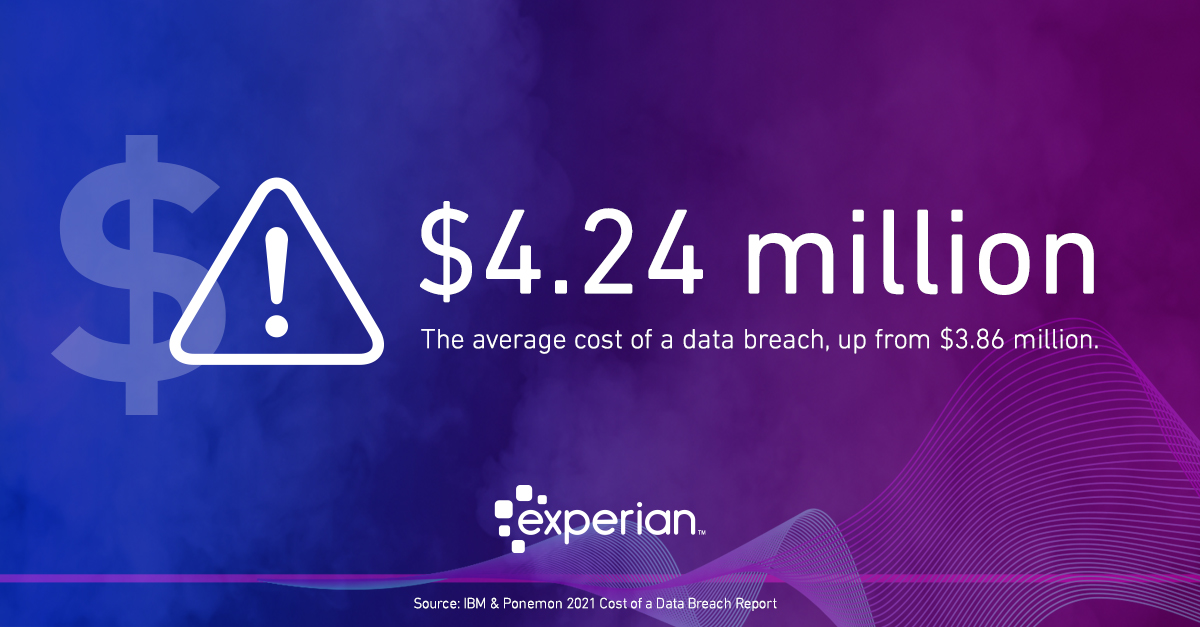
In 2021, the average cost of a data breach was $4.24 million.[1]
Industry Perspectives, Current Data, Consumer Response

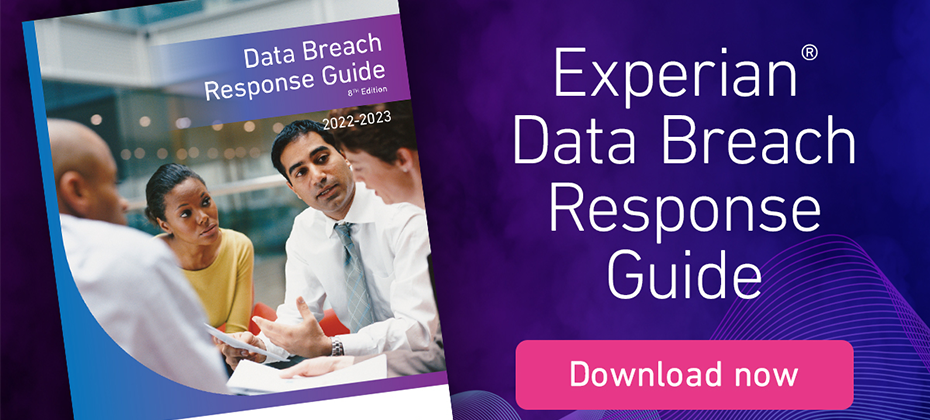
New and improved for 2022-2023, our latest Data Breach Response Guide is an in-depth preparedness page-turner, complete with predictions, trends, experienced-based advice from Experian experts, and real-world incident insight informed by servicing breaches over 15 years.

The Highlights

I’ve managed the roll-out of this guide for years, and I have to say, this guide is the most comprehensive and data-dense one yet. It has everything you need to learn how to prepare, plan, practice, audit, and manage your crisis response. You’ll get details on:

  • The Rise of Ransomware—one happened every 11 seconds in 2021[2]
  • What do businesses think about response plan drills?—84% agree their plans could be more effective with drills[3]
  • Why hackers’ top industry target is still healthcare) and why
  • How Experian® Crisis Solutions helps companiesrecover strong, much more

Cyberattack Preparation is Paramount

Cybersecurity and data breach preparedness is changing by the minute. Experian is expanding its product offerings, staying on top of rising threats, and relying on our deep experience to support partners when they need us most.

Ready to learn more about how to stay ready for a data breach?

Download the Experian® Data Breach Guide now. For additional preparedness insights,sign upfor our free resource hub.

[1]IBM & Ponemon 2021 Cost of a Data Breach Report

[2]Cybersecurity Ventures, Cybercrime to Cost the World $10.5 Trillion Annually by 2025

[3]Experian and Ponemon. 2022. Ninth Annual Study: Is Your Company Ready for a Big Data Breach

Related Posts

The Email Address as Your Most Powerful Identity Signal

The why behind Experian's acquisition of AtData What happens when a comprehensive email intelligence database joins a global leader in data, analytics and fraud prevention? The acquisition of AtData adds 25+ years of building a complete view of email as an identity signal. Financial institutions can recognize, engage and protect customers unlocking a new standard for the way their teams work and the customer experience. That's what Experian's acquisition of AtData delivers. How we got here Not all email addresses tell the same story. Some are newly created. Some exhibit bot-like patterns. Some are inconsistent with every other signal you have about that person. Imagine a real customer. You have a job. You shop online. You have a primary email from your employer, a personal Gmail you've used for 15 years, and an old Yahoo address you still use for shopping because you've been using it since college. You're an engaged customer who interacts with brands, makes purchases and pays bills on time. But each system sees a different version of you. When you apply for credit, the lender sees one email. When you shop, the retailer sees another. When you sign up for a service, you might use the third. For financial institutions: You slow down the approval process to manually verify identity or approve applicants without the full picture. For retailers: You can't tell which version of "customer" is the most engaged, so you either over-mail or under-serve. For fraud systems: Sees a new account created under one email and flags it as suspicious because it doesn't have the history. This was the original problem AtData was built to solve in 1999. Twenty-five years later, that problem didn’t go away, it became more complex. Email fragmentation and device sharing are more common, and identity theft is more sophisticated. Capabilities that now work together Experian has built sophisticated identity and fraud solutions backed by consumer data resources and decades of expertise in credit and risk. AtData brought the ability to assess whether an email address is trustworthy, reachable and consistent—at scale, in real time. Experian is now making email intelligence foundational, not optional. This matters for: Fraud prevention and risk management: Distinguishing a returning customer from a new threat. Knowing whether an email is newly created, exhibiting bot-like patterns or inconsistent with other identities is crucial. Compliance: Building audit trails that can explain identity decisions. Email data history and behavioral signals create the documentation needed to defend your decisions. Credit: Verifying identity in a world where traditional signals are shifting. Email signals provide a persistent, durable identifier that confirms who someone actually is. Marketing: Reaching the right person across email, mail and digital channels. Email intelligence reveals which addresses are actively engaged and reachable. Research shows email remains one of the highest-ROI marketing channels outperforming paid search and social advertising1. The problem every marketer faces: You end up burning budget on addresses that bounce, are unmonitored or are associated with users who never open mail. For credit marketing specifically, email enables faster, more targeted delivery of firm offers across channels, something that's increasingly important in a post-cookie world. "Email is a persistent identifier in a fragmented world. It's what connects a person's postal address, phones, devices, behaviors—the full picture of who they are. By embedding that into our infrastructure, we're not just adding another data point. We're fundamentally improving how businesses understand who their customers are."- Ashley Knight, Senior Vice President, Financial Services and Data Why now? AI is reshaping how decisions are made in every industry. Models are getting faster, more automated and more embedded in core workflows. But AI is only as effective as the data behind it. Fragmented data + fast models = faster, larger-scale misclassifications. In an era of synthetic identities, AI agents, deepfakes and AI-generated activity, the value of durable, persistent, real-world data signals has increased dramatically. Deloitte’s Center for Financial Services projects that generative AI could drive fraud losses in the U.S. up to $40 billion by 2027, a 32% growth rate since 2023. And email sits at the center of it with business email compromise already being one of the most common and costly fraud types. People change phones, move homes and swap devices, but they often hold onto their email for years. That's the signal that protects your business, and the one we've built into the core of how we help you make decisions with confidence. View the press release here

August 6, 2026 by Zohreen Ismail
Building Financial Opportunity Through Purpose-Driven Partnership

Discover how the National Urban League and Experian partner to expand financial literacy and create economic opportunity.

August 6, 2026 by Scarlet Nickel
2026 U.S. Identity and Fraud Report 

Explore key findings and insights from our newly released 2026 U.S. Identity and Fraud Report. Read more now!

August 5, 2026 by Laura Burrows

Subscribe to our Newsletter

Enter your name and email for the latest updates.

This site is protected by reCAPTCHA and the Google Privacy Policy and Terms of Service apply.

Subscribe to our Newsletter

Don't miss out on the latest industry trends and insights!
Subscribe