
Do You Know Which of Your Online Units Have an Open Recall?

by Kirsten Von Busch 2 min read December 21, 2021

There are over 280M cars and light duty trucks on the road and over 25% have at least one open recall. Do you know which of your online units have an open recall? Would it be helpful to your business if you had up-to-date recall information available every day—automatically?

AutoCheck® dealerships can receive an emailed daily Open Recall Inventory Check Report as part of their AutoCheck subscription. The report (PDF format) will show dealers which of their online listings have an open recall. The report will list inventory that has open recall(s) based on pre-owned vehicles the dealer has listed on AutoCheck.com. Having an easily reviewable report delivered to your Inbox is a great way to stay on top of internal recall policies and procedures.
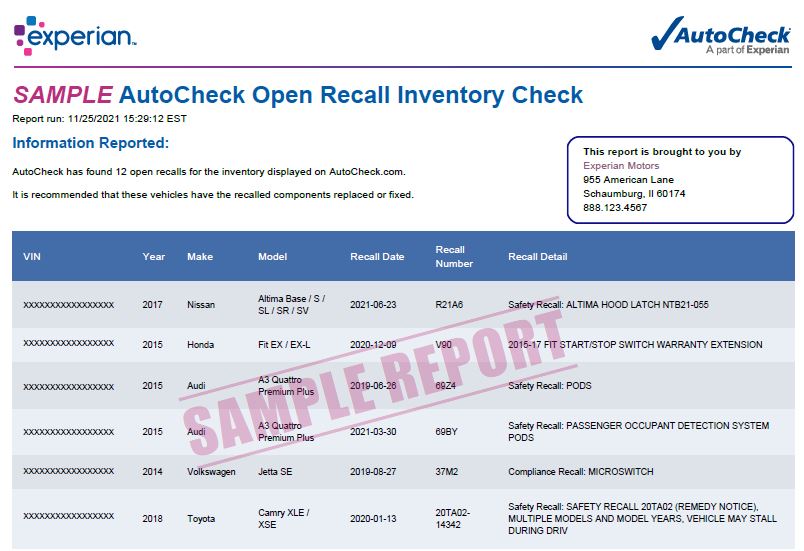
Taking care of open recalls is good for business

Taking action on recalls is also good for business. Consumers searching your online inventory want transparency from their dealer and running across a vehicle that has an open recall may not be in the dealer’s best interest. Taking care of that recall and ensuring that a consumer doesn’t stumble across it during the purchase process is good for consumer loyalty.

Another AutoCheck dealer benefit is the option to list pre-owned inventory on CarZing and AutoCheck.com for no additional fee. AutoCheck is the exclusive vehicle history report provider on CarZing.com, so the CarZing vehicle details page will display both AutoCheck data elements and provide a link to the full AutoCheck report.
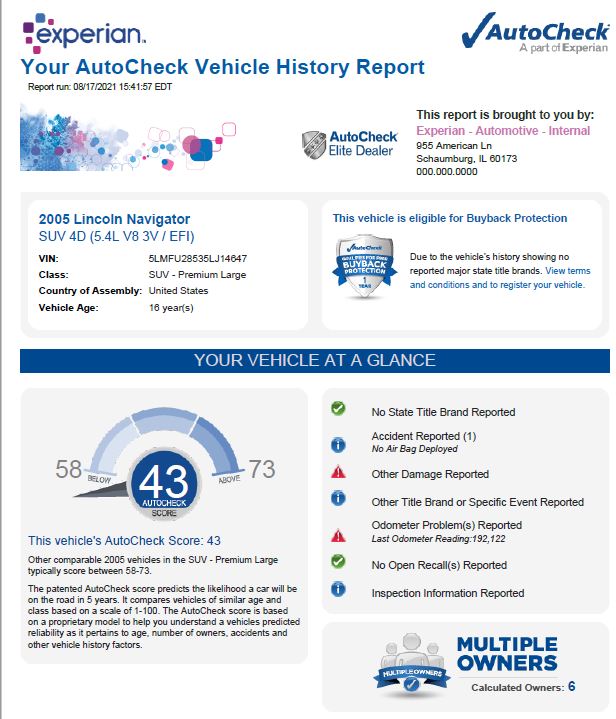
Any AutoCheck dealer displaying their inventory on CarZing will automatically have their inventory available via the “Finding Vehicles” search features on AutoCheck.com. (Yes, you read that correctly – dealers can list their inventory on CarZing and AutoCheck.com for NO additional fee – it’s part of their AutoCheck subscription!)

In addition, any dealer listing their inventory on AutoCheck.com can also receive the AutoCheck Open Recall Inventory Check report.  Please note that Experian provides the AutoCheck Open Recall Inventory Check Report based upon recall information reported and made available to Experian by the applicable automotive manufacturer(s). Clients should check the automotive manufacturer’s website for the most current recall information for all inventory vehicles.

For dealers with an AutoCheck subscription, you can activate your vehicle listings for free on AutoCheck.com and CarZing.com, by calling client
services at 1 888 409 2204.

For dealers that are not yet subscribers, here’s a few other things you may not know about AutoCheck Vehicle History Reports. We do not re-market to shoppers, resell VDP leads or offer your competitors inventory for consideration on AutoCheck.com. Our goal is to help your dealership sell your inventory.

For dealers who are interested in learning more about the benefits of becoming an AutoCheck subscriber contact us today.


Related Posts

Cash Flow Insights: Powering the Next Evolution in Lending

For decades, credit data has given lenders a trusted foundation for assessing risk. Now, consumer-permissioned cash flow data is adding another layer of insight into consumers’ financial lives, including income, spending, liquidity and changing financial obligations. The opportunity is significant. Nearly one in five consumers lacks access to or has damaged credit. New Experian research also shows that 60% of consumers who have previously been denied credit or received less favorable terms than expected believe the outcome would have been different if lenders had considered their recent income and banking activity alongside their credit history. 1,2 For lenders, cash flow insights can provide additional context about a consumer’s financial capacity and support more informed underwriting decisions. The next challenge is making those insights easier to use consistently and responsibly at scale. What are cash flow insights? Cash flow insights are derived from consumer-permissioned banking data and provide visibility into how money moves into and out of a consumer’s accounts. Depending on the information available, cash flow data can provide insight into financial behaviors such as: Income and income stability: Regular and irregular income streams and changes over time Spending and recurring expenses: Everyday spending patterns and ongoing financial obligations Account balances and liquidity: Available funds and changes in account balances Debt obligations: Loan payments and other recurring debt commitments Cash flow patterns: How money moves into and out of accounts over time Traditional credit information provides a rich history of how consumers have managed credit. Cash flow insights add context about their current financial activity and capacity, providing lenders with a more complete view of financial health. Cash flow insights can also add predictive value to risk assessment. Experian analysis shows Cashflow Score can deliver up to a 25% lift in predictive performance over conventional credit scores when tailored to targeted risk tiers.3 How lenders can put cash flow insights to work at scale As interest in cash flow insights grows, the conversation is moving beyond what the data can reveal to how financial institutions can use it consistently and responsibly. That requires standardized consumer reporting, clear governance and decision-ready insights that can work within established lending processes. The launch of Experian Cashflow Data Bureau at Vision 2026 reflects this shift from access to adoption. The new consumer reporting agency operates under the Fair Credit Reporting Act (FCRA) and is designed to help financial institutions adopt consumer-permissioned cash flow insights at scale. A key part of that foundation is the cash flow consumer report, which organizes consumer-permissioned banking information into a standardized consumer report regulated under the FCRA. This gives lenders a consistent foundation for incorporating cash flow information into lending decisions while providing consumers with access to the information in their report. Turning greater visibility into better decisions The next evolution in credit isn’t about choosing between traditional credit and cash flow data. Each provides a different perspective. Traditional credit information offers deep insight into how consumers have managed credit over time. Cash flow insights can add context about financial activity and capacity. Bringing those perspectives together can give lenders greater visibility into consumers’ financial health and help them better distinguish between risk and resilience, support more informed decisions and identify opportunities to responsibly expand access to credit. As cash flow adoption continues to grow, its value will come from how effectively it complements the information lenders already use. The opportunity isn't simply to see more data. It's to turn that additional visibility into smarter, more informed decisions. Explore how Experian Cashflow Data Bureau is helping financial institutions put consumer-permissioned cash flow insights into practice at scale. Learn more [1] Federal Reserve Bank of New York, The Market for Credit Building: Demand, Product Characteristics and Consumer Uses, 2026. [2] Experian commissioned Atomik Research to conduct an online survey of 2,000 U.S. adults age 18+. Fieldwork took place July 16–21, 2026. Margin of error: +/- 2.2 percentage points at a 95% confidence level. [3] Based on Experian analysis when Cashflow Score is compared with conventional credit scores, tailored to targeted risk tiers. Predictability based on KS.

October 14, 2026 by Julie Lee
The Three Onboarding Fraud Pain Points That Slow Growth (And How to Solve Them) 

Effective fraud prevention is critical to balancing security and customer experience during onboarding. Learn more!

October 12, 2026 by Charles Hunter
How Rental Data Is Expanding Financial Opportunity for Millions of Renters 

Discover how rental payment reporting can expand credit access, strengthen credit profiles and improve risk assessment for renters and housing providers.

October 8, 2026 by Manjit Sohal

Subscribe to our Newsletter

Enter your name and email for the latest updates.

This site is protected by reCAPTCHA and the Google Privacy Policy and Terms of Service apply.

Subscribe to our Newsletter

Don't miss out on the latest industry trends and insights!
Subscribe