Loading...

The Demand for Electric Vehicles Boils Down to the Right Market

Published: October 31, 2018 by Brad Smith

Depending on who you talk to, the electric vehicle (EV) market will significantly impact the automotive industry for years to come. There are some industry pundits who wholeheartedly believe EVs have altered consumer buying behavior, while others believe the trend is drastically overstated. Two very contrasting opinions.

The reality is, both can be right – it just depends on perspective. And frankly, it comes down to geography. While EV market share for the entire country during the first half of 2018 was only 0.9. percent, 3.6 percent of all new registrations in California were EVs. If we dig a bit deeper, the blossoming vehicle segment made up 7.9 percent of the San Francisco/Oakland market.

In fact, six of the top 10 DMAs* for EV market share are in California and not a single top 10 DMA is east of the Rocky Mountains. By comparison, EVs may seem somewhat of a myth in the Midwest. The only DMAs east of the Mississippi River cracking the top 20 for EV market share are Charlottesville, Virginia, Washington D. C. and Atlanta.

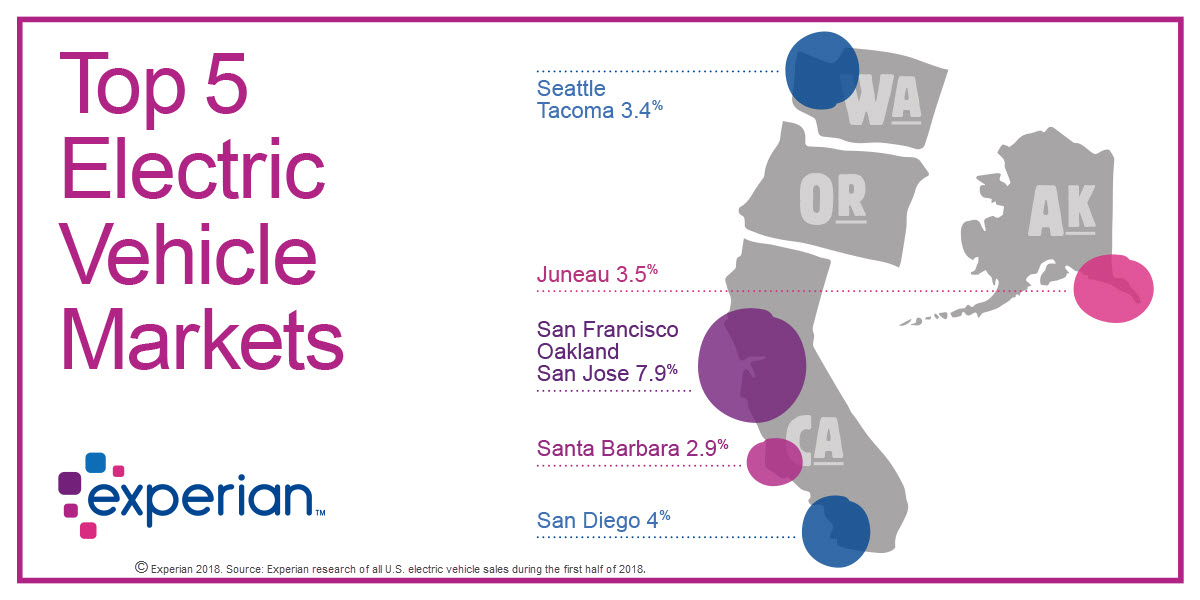
Top 10 DMAs by Electric Vehicle Market Share

  • San Francisco, Oakland, San Jose: 7.9% share
  • San Diego: 4% share,
  • Juneau: 3.5% share,
  • Seattle Tacoma: 3.4% share
  • Santa Barbara: 2.9%
  • Monterey Salinas: 2.9%
  • Los Angeles: 2.8% share
  • Honolulu: 2.2% share
  • Portland: 2% share
  • Sacramento, Stockton, Modesto: 1.8% share
Local Market Knowledge Key to Success With EVs

At the end of the day, are there specific implications for dealers and manufacturers? It comes down to understanding the local market to determine how much emphasis should be placed into EVs. Some in the industry may not view Juneau, Alaska as a hotbed for EVs, but the data tells a different story.

Dealers and manufacturers cannot rely solely on “feel” and “pre-conceived notions.” They need to dig deep into the data to make the right decisions. It’ll provide a better sense of where they can focus inventory, as well as marketing campaigns.

*DMA® is a registered service market of The Nielsen Company. Used under license.

Related Posts

From the vehicles we drive to the way we purchase them, everything in the automotive industry is evolving as new technologies, shifting incentives, and changing consumer expectations continue to develop. As electrified vehicles continue to grow their presence on the road, Experian’s Automotive Market Trends Report: Q3 2025 took a deep dive into this segment and found that 5.5 million electric vehicles (EVs) and 11.7 million hybrids were in operation this quarter. Furthermore, data through the third quarter of this year found that 73.8% of EV owners returning to market replaced their EV with another EV and only 16.5% switched to a gas-powered vehicle. The significant EV loyalty among consumers signals that the ownership experience is delivering on core expectations. While some owners continued to opt for an EV because they’ve grown accustomed to certain conveniences such as charging stations at home or workplace to avoid traditional fueling and the perks of lower maintenance needs, others took advantage of the EV tax credits before they expired at the end of September. However, as these motivations shift, it will be important to monitor how the EV market unfolds over the next six months. Notably, 11.7% of gas-powered vehicle owners replaced their vehicle with a gas-hybrid vehicle this quarter, suggesting that hybrids are acting as an effective bridge toward deeper electrification. In fact, drivers may see hybrids as the ‘happy medium’ vehicle that offers improved fuel efficiency without requiring full reliance on charging infrastructure. Why this matters for the aftermarket As the majority of consumers replace their EVs with another one and some switch their gas-powered vehicle for an electrified one, these trends signal potential long-term commitment to alternative fuel segments. This is important to monitor for aftermarket professionals as the EV service volume continues to grow, requiring different parts and technician training. With consumers increasingly turning to the aftermarket for cost-effective support, professionals who adapt to diverse powertrains will be best positioned to navigate this evolving wave of post-warranty demand. To learn more about EVs and other vehicle market trends, view the full Automotive Market Trends Report: Q3 2025 presentation on demand.

Published: December 18, 2025 by John Howard

The pickup truck market is shifting gears, and hybrids are emerging as a driving force behind the change. As more drivers prioritize fuel efficiency while still expecting towing power, hybrid models are stepping in to redefine the segment. According to Experian’s Automotive Consumer Trends Report: Q3 2025, gas-hybrid and plug-in hybrid pickup trucks accounted for nearly one-in-five new light-duty trucks sold, coming in at 17.8% this quarter. This signals a major shift in a historically ICE-dominated category. Hybrids are likely gaining traction because they offer the best of both worlds. While their systems provide fuel efficiency by combining gas or diesel engines with electric motors to avoid range anxiety, they’re also meeting most towing and hauling requirements that accompany the traditional gas-powered trucks. Overall pickup truck market trends fueling hybrid growth When looking at the market from a broader perspective, there were 55.3 million light-duty trucks on U.S. roads in the third quarter of 2025, representing 20.10% of all vehicles in operation. Furthermore, as of Q3 2025, 34% of U.S. households with one-or-more vehicles also own a light-duty pickup truck, giving this segment a strong foothold in transportation options. The widespread presence underscores the pickup truck’s influence in the automotive industry as they set the pace for consumer expectations and steer market trends. The increased momentum for hybrid trucks can also help OEMs and dealers capitalize on growing their presence in an increasingly competitive space. It’s important for automotive professionals to consider aligning sales strategies with evolving buyer preference to elevate consumer engagement as this trend offers benefits today and even greater potential ahead. To learn more about pickup truck insights, view the full Automotive Consumer Trends Report: Q3 2025 presentation.

Published: December 16, 2025 by Kirsten Von Busch

Many across the industry have been waiting to learn how EV activity has changed now that the EV tax credit has been eliminated. According to Experian’s State of the Automotive Finance Market Report: Q3 2025, the EV market saw a sharp uptick in transactions as many locked in these benefits before they disappeared, though it remains to be seen what the market will look like in the fourth quarter. With the EV market expanding and more models entering the lineup, shoppers also benefited from various options across a wider range of price points within their budget. Even so, many opted to lease a new EV rather than purchase it. More than 56% of consumers leased an EV in Q3 2025, up from 46.43% last year. The gap between the number of EV leases and purchases reflects several underlying factors, one of them being this option likely offered lower upfront costs and monthly payments. For instance, the average monthly payment for a lease was $172 lower than a loan for an EV in Q3 2025. Where EV performance stands in the broader market When looking at the data from a larger perspective, EVs made up 25.31% of the total new lease market, compared to 17.69% a year ago. The alternative fuel type also comprised four of the top ten leased models, with Tesla Model Y (4.35%) and Tesla Model 3 (2.58%) as the top two. They were followed by the Honda Prologue (1.78%) as the fifth most leased model and the Hyundai IONIQ 5 (1.49%) as the ninth. EVs making up nearly half of the top ten leased models in the overall market underscores how quickly consumer preferences can shift and how incentives play a role in purchasing behavior. Consumers’ comfort with EV technology continuing to grow paired with the steady expansion of compelling models across segments also highlights the momentum that is being brought to the overall automotive industry. As the market continues to move forward, the interplay of expiring incentives, more model availability, and a strong desire for leasing shows how EVs have steadily become a more prominent consideration. Leveraging these insights will help automotive professionals best position themselves to support consumers navigating an increasingly dynamic landscape. To learn more about EVs and other automotive finance trends, view the full State of the Automotive Finance Market Report: Q3 2025 presentation on demand.

Published: December 4, 2025 by Melinda Zabritski

Subscribe to our Auto blog

Enter your name and email for the latest updates.

This site is protected by reCAPTCHA and the Google Privacy Policy and Terms of Service apply.