
Taking your credit marketing strategy from direct mail to digital

by Guest Contributor 3 min read January 17, 2017

blog-digital-offers

As we enter 2017, it’s no surprise people are buying and selling online and using their mobile devices more than ever.

At the close of November, Adobe released its online shopping data from Black Friday, Cyber Monday, and the overall holiday season. According to the data, the major November holiday shopping season was driving close to $40 billion in online and mobile revenue alone — a 7.4% increase year-over-year!

Every year, we see tremendous growth in spending through online and mobile channels. Interestingly, this pattern is not just indicative of consumer spending and overall market confidence. The consumer pattern also illustrates a clear change in communication preferences — with the ever-present shift toward digital.

In general, consumers are interacting more and more through both online and mobile channels for all of their personal needs, including banking and financial services; and the lending community is anxious to continue connecting to consumers where they need them most. No longer is digital communication the “cool thing to do,” but rather it is essential.digital.banking
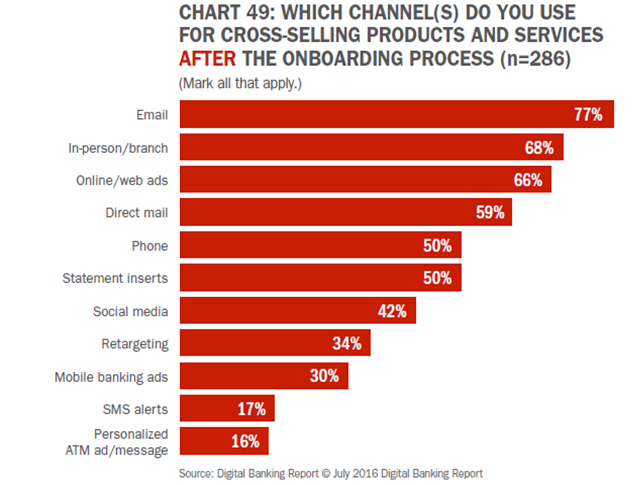
While Experian’s lending customers still find tremendous success in direct mail prospecting, many financial institutions are preparing to implement an enhanced acquisition strategy in 2017. This strategy includes multi-channel prospecting initiatives to present consumers with preapproved credit offers. In addition to direct mail, our customers are evaluating digital channels such as email, mobile, and other online channels to improve the overall consumer experience and responsiveness. In the latest Digital Banking Report, published in July 2016, email is the top channel financial marketers are turning to for cross-channel marketing after the initial onboarding process (as illustrated in chart 49), but you can see social media and retargeting are rising in the ranks.

In Sept., 2016, Experian was named one of the top 100 most innovative companies for a third year by Forbes magazine. A key part of that success was driven by investments in Experian’s Data Lab and Experian Marketing Service’s Audience Engine, which is an audience management platform that changes the way the advertising industry buys and measures media. We are focused on meeting our customers and the consumer where they need us most.

Bottom line? As you refine your goals for 2017, the financial services sector should dig deeper when making connections. They must reach consumers where they want to connect – and that means a successful credit marketing strategy will be one that includes both direct mail and digital communications.

A new year is the perfect time to re-evaluate those same-old, same-old marketing and acquisition tactics. We’re not saying you need to abandon direct mail, but it is certainly time for lenders to complement their direct mail efforts with a savvy digital plan as well. Resolve to do it better in 2017.


Related Posts

How Union Credit Expands Access to Credit Unions with Experian

Discover how Union Credit and Experian help credit unions reach younger consumers through personalized digital lending experiences.

Published: July 1, 2026 by Scarlet.Nickel@experian.com
Faster Decisions, Better Outcomes: Experian Verify™ Now Available Through Centro, Mezzo’s Orchestration Engine 

Explore how Experian Verify™ and Mezzo’s Centro orchestration engine are helping mortgage lenders modernize income and employment verification, reduce workflow complexity, and make faster, more confident lending decisions at scale.

Published: July 1, 2026 by Lizel Ferrer
Used EV Growth Signals a New Phase of Consumer Purchasing Behavior

The electric vehicle (EV) revolution isn’t slowing down, it’s changing lanes. While recent conversations have seemingly focused on softening demand for new EVs, the used segment has been gaining momentum. According to Experian Automotive’s 2025 EV Year in Review Report, new retail individual EV registrations fell 35.9% year-over-year. Meanwhile, the used retail individual EV registrations grew 25.4% from a year ago. As affordability and growing model availability reshapes consumer behavior, buyers are increasingly turning to pre-owned EVs, which has shown an interesting market divergence that is redefining how consumers are adopting this segment and what it can mean for automakers, dealers, and the overall industry. Key players behind rising used EV demand Notably, Tesla accounted for over half (60.5%) of used retail individual EV registrations in 2025, followed by Chevrolet at 6.4% and Nissan (5.5%). Diving a bit deeper, Tesla made up the top three models of the used individual registrations last year, with the Model 3 coming in at 27.2%, Model Y at 21.7%, and Model S (6.6%). The Chevrolet Bolt EV followed at 4.8% and the Nissan Leaf was at 4%. Tesla’s position as the leading make in the used EV market is a natural extension of its long-standing dominance in new EV sales. The brand’s leadership over the years created a large fleet of vehicles that are now entering the pre-owned market. What the used EV boom means for automotive professionals The growing demand for used EVs can present more opportunities for automotive professionals. Dealers that provide a healthy supply of pre-owned EVs can increase accessibility and play a role in adoption for consumers who are actively looking to purchase, while marketers can emphasize value and ownership benefits. As the market continues to evolve, automotive professionals who understand and respond to these changing dynamics will be best positioned to capitalize on the expanding pool of used EV shoppers. To learn more about EV insights, visit Experian Automotive’s EV Resource Center.

Published: June 30, 2026 by Kirsten Von Busch
