We explore what businesses are doing today in the application of available data, advanced analytics and innovative technologies.

Since the Pandemic began consumers have been scammed more than ever before. From phishing emails, fake websites, and other scams intended to steal personal and financial information, to fake pharmaceutical goods or goods that never arrived, to account takeovers, multiple ways to defraud people have emerged or re-emerged at an alarming rate. It's an understatement to say that now more than ever customers need to be protected and it's the right time for businesses to improve some of their capabilities and offer their clients the secure experience that they expect. The results from our recent global research study of changing behaviors and priorities throughout the pandemic show us just how important online security has become for consumers: Half of the consumers surveyed say they are very/somewhat concerned about conducting activities online; with the concern being most significant in India (69%) 4-in-10 consumers express increased levels of concern about online activities since C-19. The level of concern about consumer online activities and transactions has increased significantly since C-19 in India (61%), Brazil (57%), Singapore (53%), and US (44%) – one-fifth of consumers in the US and Brazil say that their level of concern has increased significantly. 42% feel that they are more of a target for online fraud now than before COVID-19, while only 25% feel safer about sharing personal information now than they did before COVID19 The largest sources of concern among consumers are credit card information being stolen (36%), online privacy (34%), identity theft (33%), and phishing email (32%). Consumers in India, Singapore, the US, and Brazil show generally more concern. Consumers have become increasingly positive towards more security measures One positive tendency that's been observed due to the increased security concerns is that consumers have become more comfortable with security measures being added online in order to protect them better: 55% percent of consumers expect more security steps when they are online and 49% want to have more visible security measures in place while on websites 47% of all consumers are expecting business to place strong security measures that they cannot see with another 40% expecting integration of features that recognize them during online purchasing without requiring them to share their personal data In fact, US consumers have increasing expectations on strong invisible securities (increased from 50% to 59% from June 2020 to January 2021) as well as identity authentication without sharing personal data (increased from 33% to 40% from June 2020 to January 2021) Consumers are accepting of biometrics and businesses should consider using it It is not a surprise that fraud prevention methodologies such as physical biometrics (which is visible) and behavioral biometrics (which is invisible) have become more popular with the public. Both can be added as an extra layer in order to improve the authentication process by increasing its trustworthiness and efficacy. What’s also vital is that none of the two is compromising the user experience too much when compared with other more traditional authentication methodologies such as passwords or knowledge-based authentication: 74% of consumers are feeling very secure while using physical biometrics with another 16% feeling somewhat secure 66% of consumers are feeling very secure when being protected by behavioral biometrics with another 24% feeling somewhat secure So, as over half of businesses (55%) expect to increase their fraud management budgets in the next 6 months, it's recommended that they take notice of these trends and act now. What's even more important is that companies that invest in advanced customer authentication methods benefit from improved customer opinion, which feels like a win-win scenario for both parties involved: When physical biometrics are used, 57% of global consumers indicate that this enhances (somewhat/very much) their opinion of the organization When behavioral biometrics are used, 53% of global consumers say that they have a better opinion (somewhat/very much) about the organization implementing them Related stories: Global Insights Report Wave 3 (February 2021) Global Insights Report Wave 1 (June/July 2020) What your customers say about opening new accounts online during Covid-19

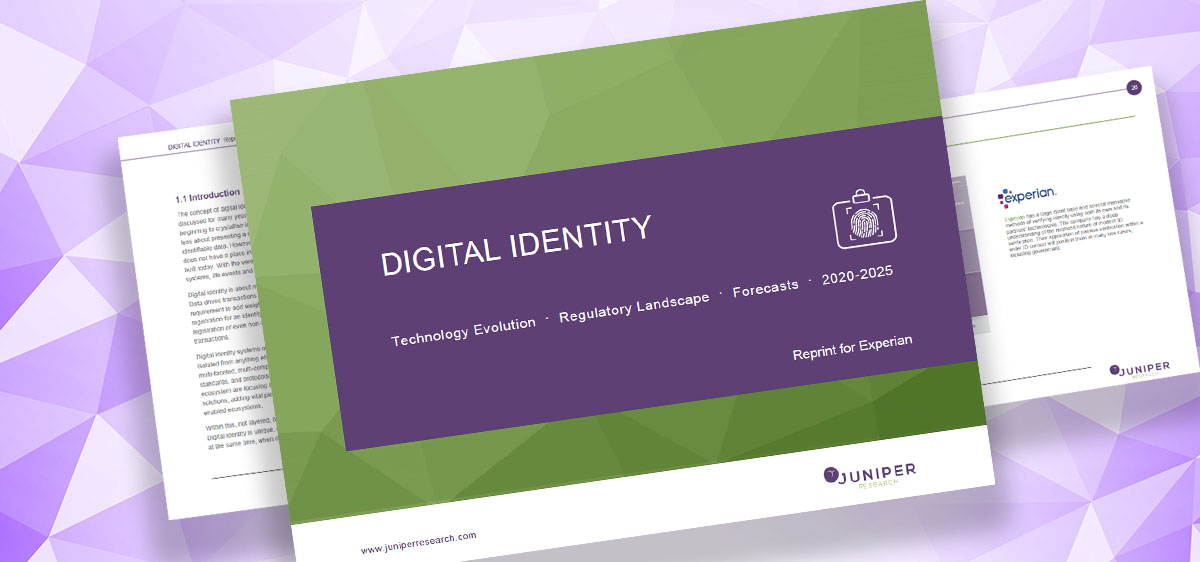
The concept of digital identity and the ways it can be applied has been discussed for many years. While this has traditionally been more of a philosophical discussion, this notion has beginning to shape over the past twelve months, making waves across markets and driving, making many in the industry wonder what has changed to prompt that shift. In a recent episode of the Insights in Action series, Nick Maynard from Juniper Research and David Britton from Experian Decision Analytics explored the pandemic’s transformative effect on the prospects of digital identity. Over the past year, reliance on e-commerce has increased significantly increased globally, boosted by new consumer and business needs and efforts to observe social distancing and cope with the side-effects of lockdowns. Nick and David review Juniper Research’s Digital Identity 2020-2025 Report’s findings and explain how, since the pandemic started, people have needed to remotely use those services that they'd normally use in person. Access to banking, buying groceries, or ordering food, for example. In such a context, defined by tight restrictions imposed to curb the advance of coronavirus, being able to represent your identity and verify that you are who you say you are so you can access certain digital activities safely has become absolutely critical. Indeed, it has become the way people can participate in society now, digitally. Defining digital identity in the covid era But, how to define digital identity these days? Against an ever-changing environment, identity must now be more than just traditional personally identifiable data like a name or an address. It must incorporate other components such as device identifiers, device intelligence, network information, the way you hold your phone, or even the speed you type at. All in all, digital identity is about emulating what we have all done naturally in the physical world for so long; that’s it bringing together a series of distinctive attributes that make each individual unique. In terms of how the industry is looking at this evolving concept of digital identity, Nick and David point out that a growing number of regulators are engaged with the concept of digital identity, addressing the need for modern, adaptative frameworks, guardrails, and protocols. Identity industry players have realized that identity works best when there's a network. Identity networks or systems bring together all those different stakeholders who hold identity details and have the ability to verify or use those identity details to provide greater benefit for consumers. Listen to the full podcast Access all episodes of Insights in Action on Soundcloud, Spotify, Google Podcasts

As the world witnessed, the Covid-19 pandemic led to a swift and dramatic digital explosion. As lockdowns began, our day-to-day quickly shifted to a virtual environment. Now, on the back of this widespread response, businesses are forced to rethink their customer engagement model. And, with new digital-first customer journeys, there must be a shift to recognize customers in a predominantly digital way as well. The concept of identity – even digital identity – must evolve. Digitally observable information Recently, I spoke with Juniper Research about this imperative. After analyzing the global digital identity market, they’ve offered insights on current dynamics and trends shaping its future in their Digital Identity Report 2020-2025. Importantly, as we progress digital identities, we must consider more than what a user might typically provide about themselves. We must include digitally observable information, which forms part of a consumer's digital identity. This data includes their device (what they use), and behavioral insights (how they use the device or interact with an app or website). It even includes the specific context of their efforts (what they are doing), such as signing up for an account, moving money, making a payment, virtual window shopping, etc. Related story: View digital identity market trends infographic Intelligent data processing Of course, pulling these kinds of observations together in a meaningful and useful way requires intelligent data processing. This need leads to the use of technologies such as advanced analytics and machine learning to help make sense of the broad streams of data. The double benefit of understanding how to use this aggregated data is that, given the transparent and passive nature of observing data of this nature, it can be used without requiring the consumer to "do" anything other than going about their business. So, businesses can achieve multiple benefits by adopting a forward-looking stance to identity, including reduced risk of fraud, improved customer experience, and stronger consumer/business relationships, which ultimately leads to increased top-line growth. Consumer privacy preferences Finally, to maintain consumer trust as we progress, it's important to acknowledge consumer privacy preferences. Given consumers' concerns around privacy and security, this is an important element within the path forward. Businesses that are transparent around the use of data have been shown to garner greater consumer trust than those that don't offer that transparency. So, any reimagining of digital identity must also have "privacy by design" as a foundation to the approach – not only to meet growing regulatory demands – but, more importantly, to manage consumer expectations. “[It’s] estimated that in 2024 over $43 billion will be lost due to online payment fraud. As we carry on into an unknown future, disrupted by the pandemic, this interwoven nature of identity-security-privacy will play a vital part in making sure our internet, workplace, government services, and banking are safe havens.” -Digital Identity Report 2020-2025, Juniper Research Learn more about: Importance of the evolution of digital identities, including the ability to manage and access the growing volume of online accounts. Advancement of the identity space occurring through the simplified transmission of information via APIs, but the challenge remaining to ensure data is valid, authentic, and from an authorized person. Government attempts at digital identities have faced many challenges, but these use cases continue to progress the development of the digital identity landscape. Benefits to fraud management through the adoption of digital identities can be tremendous – decreasing risk by decoupling identities from transactions, making them more secure from both ends. Usability is king – a good customer experience underlying the use of digital identities will be critical to adoption, and therefore success. Maturation of identity offerings is currently occurring and what’s likely to be successful includes solutions that simplify identity services and those that rely on broader ecosystems. Remote working changes the enterprise approach, with the adoption of Zero Trust Architectures and relevant supporting technologies continuing to emerge to create a safe, yet flexible working environment. The digital identity competitive landscape is evaluated, including vendor analysis and Juniper’s leaderboard. Related stories: Fraud trends during a very pandemic holiday Digital Identity and Blockchain: What lenders need to know Why consumer trust in the digital experience is so important in a pandemic era

Get the latest from our global experts with these top December headlines, including meeting the demand for digital, increasing consumer expectations, women leading artificial intelligence, and protecting against fraudsters over the holiday shopping season. Investment priorities to meet consumer demand for digital banking In this BAI Banking article, Chris Fletcher, SVP Decision Management & Cloud Services, explores the investment required of financial institutions to transform their use of data and analytics and deliver on credit risk strategies. What’s the proper path for better payments? In context to consumers’ digital expectations post-Covid-19, Progressive Grocer considers the future of payments in food retail and beyond – with contactless payment options already rolling out at a large drug store chain. Wisdom from the women leading the AI industry, with Laura Stoddart of Experian Authority Magazine speaks with Laura Stoddart, Data Scientist, about her career path, her experiences working on ethical AI and using emerging datasets to evaluate risk as well as her thoughts on the future of this industry. #TradeTalks: Increasing consumer demands and expectations Steve Wagner, Global Managing Director of Decision Analytics, joins Nasdaq’s Jill Malandrino to discuss recent research findings on increasing consumer demands and digital expectations, and ongoing considerations for a post-Covid-19 world. A holiday season like no other: What to know to guard your company against fraud Itay Levy, Forbes Councils member and CEO and Co-Founder of Identiq, provides his perspective on the increased preference for online shopping and the need to strike the right balance between customer experience and efforts to mitigate fraud. Stay in the know with our latest insights:

The rise of digital decisioning software enables organizations to scale a similar level of personalization, offering customers what they need at the exact right time. And organizations that do it well dramatically improve the customer experience and drive loyalty and revenue in the process. But realizing this promise takes the right tools. The most effective decisioning platforms include a powerful combination of data, analytics, and technology. Equally important, the software must allow non-technical users to update and change strategies to better meet customer and organization needs without burdening IT. Good versus great From a credit risk perspective, there's a vast difference between good decisions and really great decisions. For many organizations, the current status quo still involves decisions made in silos, with business groups sitting in different locations (now even more so, given the prevalence of work-from-home). Creating usable predictive models and then putting them to use can take weeks or even months. What's more, changing the model often requires that business users make requests of perpetually overloaded IT teams. To be sure, the process eventually yields decisions. However, from the customer's POV, they may be slightly irrelevant or feel less than personal. On the business side, the model may lack essential data from across the organization or not yet include critical factors in a rapidly changing landscape. A great decision, on the other hand, benefits the customer and organization alike. Robust analytics enable the decisioning process to reflect the most relevant customer data, from websites they've recently browsed to purchases they've made. The decisions, as a result, reflect that thoughtfulness. They're immediately useful and relevant to customers, putting forth guidance and products when customers need it most. Exponential organizational value Improved customer experience is a key objective for many organizations. Digital decisioning can help further that goal while also providing returns in multiple other ways. For instance, an advanced digital decisioning platform enables organizations to pivot quickly in the face of crisis. Organizations can add new data sources and explore new models in rapid fashion, tailoring them to immediate demands. In doing so, they not only improve predictive power, but they also produce better decisions. The process allows companies to discover and launch new products, reach new markets, and surface early signs of trouble within customer segments. This past year, we witnessed first-hand how organizations leveraged digital decisioning to deftly navigate a challenging environment. For instance, one of our customers, a large bank, used the software to run simulations of new strategies it was considering in response to the pandemic. In doing so, the bank gleaned a better understanding of how the plan would impact its portfolio. The company was also able to identify areas of overlapping services and take proactive measures to eliminate duplication and reduce expenses at a critical time. The cumulative result of improved digital decisioning is an increased ability for companies to differentiate themselves from the crowd. This is true across industries and verticals, from innovating consumer financing for automotive companies to helping healthcare organizations better manage patient debt. That secret sauce Like the friend that really gets you, a great decisioning platform is invaluable. But what makes a platform rise to the top? As noted above, the ability to incorporate and integrate lots of high-quality data is essential. Timely customer data helps identify customer trends and fuels more accurate predictions of future behavior. Platforms should also take regulatory obligations, business constraints, and changing risk factors into account. Solutions that leverage advanced analytics can then transform an ever-growing body of data into decision insights. The software should capture the data used in making those thousands or millions of decisions and make it available real-time to business users, creating a continuous feedback loop. The latter ensures that businesses can stay relevant and nimble. Notably, leading digital decisioning platforms also prioritize the business user along with IT expertise. At a moment that demands quick responses and near real-time solutions to customer needs, business users also need the ability to design, build, test, and deploy strategies. The democratization of the software ensures that the organizations can experience a digital decisioning platform's full potential. In this new era, the organizations that deliver value across the customer journey will be the ones that thrive. Digital decisioning empowers organizations to manage costs and risk while keeping the focus on the customer. They can do this even as they grow, building healthier, more responsive companies with customers at the core of every decision. Related stories: Cloud-based decision management is a must for re-imagining the customer journey Impact of technology on changing business operations Digitally managing your at-risk customers most impacted by Covid-19

The need for advanced technologies, such as artificial intelligence, has surged in the wake of Covid-19. The strain of the pandemic on businesses and economies has created tension in operational models requiring a quick and dramatic response to this digital disruption. As transformation efforts continue, there are several considerations for the growing field of AI – including ethical AI, the need for diversity and gender balance, and striving to be consciously unbiased. This final post in our “Game Changers: Women in AI” series takes a deep dive into AI careers. Our experts share important lessons on how to thrive, including having mentors and sponsors, staying relevant with new related skills, understanding problems to be solved, believing in yourself and actively seeking growth opportunities. New to the Game Changers: Women in AI series? Read Part 1 - Game Changers: Women in AI Read Part 2 - Game Changers: Women in AI Q: What advice would you give to help other women in AI thrive? He: "I would suggest being brave. Don't be afraid of trying new things. Sometimes we fear we cannot do something, but once you try it you find it’s not very difficult, you can do it. You can do it very well. So, I think the first thing is just try it. Don’t be afraid of making mistakes. If you go this route, be confident. Women are very smart and competitive, but they may not recognize how good they are. Also, if you find that you may be interested in this area, find resources and see if this is something you want to dedicate yourself to. There are a lot of options online. Even a lot of the universities now offer their courses online. People also share code online, so there are lots of good resources to help you explore and start learning. Overall, remember to believe you can do it." Kazmi: "For everyone that wants to try AI, or if you’re already working here and want to remain in the industry and do good work, you have to keep yourself relevant — learning and keeping yourself updated with the newest research that's happening. There is no end to learning in this field. At the same time, you need to have business knowledge to truly understand a business problem statement and convert that to a data science problem statement, and then start developing solutions for it. I really think that women can be strong contributors in this regard by leveraging their management and analytical skills to bridge the gap between the two areas." Kung: "I think we all need to be ourselves and respect ourselves. You need to have a goal and work hard for it. I think it is the same for anyone who wants a successful career. You need to set a goal and work hard for it and you will achieve it. Really, it's all about working hard. Also, my experience in AI has included a lot of brilliant women, so I never really felt like this is a job for men vs. women. The truth is we want more people to understand what we are doing – that there are many great things we can do with data. It is not something to fear. It’s not this magical thing. It is statistics. It is computing. It's coding. It's everything good." Peters: "It's so important to reach out and look for both mentors and sponsors, and this can be at any age. Mentors are our sounding boards to help with career development. There's some overlap with sponsors, who are opening the doors and speaking about you on your behalf in order to accelerate the track to the next place that you want to be. Mentors and sponsors are good starting from a very young age – and I think that’s a critical aspect of bringing more women along. Find these folks, make those connections, nurture those relationships, and have those mentors and sponsors. I really think that's a key aspect. Also, women do not necessarily need their network to be all women. You need to find the best people positioned to help you in your journey." Stoddart: "Having a mentor is good, especially someone who's more senior in your target field. And, it doesn't necessarily have to be somebody who you're working with or somebody who's your boss. They can be from academia or a different company. It's nice to have the outside perspective. It’s also helpful to network – I’m using virtual events now. I’ve met a lot of women in data science through activities outside of my current role. There are so many opportunities beyond your day to day job. I try to have a few things going at once -- I'll mentor somebody, I'll have a side project or volunteering, and my full-time job as well. For example, for the social enterprise I'm working with, I'm getting experience forecasting. It's nice to give back, but it also makes you a stronger data scientist to work on these different projects." Q: Is there a person or experience you are grateful towards that helped set you on the path to where you are today? He: "First, after graduation, I got a job in transaction analytics, detecting fraud transactions in credit cards. Essentially, it has the same goal as other projects, understanding human behavior from large amounts of data. That's what amazed me and kind of drove me into this direction. After that, I got the job here at Experian and I was exposed to a lot of great innovations and projects." Kazmi: "In the eight and a half years I’ve been in the AI industry, I’ve had the opportunity to work with multiple organizations across different domains. Through this diverse experience, I’ve met and worked with women from different backgrounds both as leaders, as well as colleagues. I’ve seen successful women leaders from all walks of life – from different educational backgrounds, whether from computer science, engineering, mathematics, or economics management, et cetera, or even differing nationalities and ethnicities. It has been impactful to see successful women leaders cutting across industries and localities." Kung: "Professionally, the person that I'm grateful to is my first boss. He was a teacher for me and taught me a lot. Everything that I am today, everything that I do at work, professionally, he was who trained me for it. When I think of the professional Jennifer, I always think of him. I think in my whole career, everyone who was part of my path, they helped me somehow. Maybe in little ways, and maybe in some big ways, they all helped me." Peters: "There are so many people I am grateful to in my career. Overall, where I am today comes down to the opportunities I was given. I had the opportunity earlier on in a prior role to be exposed to big data and frameworks, an exciting precursor to my work with AI. Today, when I think about my work with fraud and identity, AI is such a critical piece of that. And it's becoming increasingly important as we apply these concepts into financial services. I’ve been able to join collaborative and innovative colleagues, fraud experts, in a unified quest to solve the fraud challenge." Stoddart: "I am grateful to the person who brought me into this department. He saw something in me, he understood that I really wanted to learn, and he created a position for me. They were not hiring for a data analyst at the time, so that was really energizing. Also, I don't look for positions that already exist, because if everybody applies for positions that exist, it’s limiting your scope. A lot of the things that I've obtained in my life, it's because I've been a bit brave and asked for it. Even if it's not there on a plate, here I am." Related stories: New Podcast from AI in Business: The evolution of the data business in the age of AI Game Changers: Women in AI (part 1) Game Changers: Women in AI (part 2) Yi He Yi He works as a data scientist in the Experian NA DataLab. She is dedicated to using machine learning and AI to extract information from large amounts of data to identify, understand and help people, and prevent fraud. She aims to bridge online and offline worlds by linking identity data from these unique sources. With a focus on minimizing friction to customers, Yi’s work helps organizations identify synthetic identities to avoid fraudulent applications. Recently, she contributed to a Covid Outlook & Response Evaluator (CORE) Model – a “heat map” of geographic populations across the U.S. most susceptible to severe cases of Covid-19. Deeba Kazmi In her role as a data scientist at the Experian APAC DataLab, Deeba Kazmi is focused on solving business problems with analytics, including the development of consumer and small to medium enterprise credit risk models that leverage alternative data. Deeba is passionately focused on leveraging AI to create solutions that can help address issues faced by developing markets. Most prominently, this work includes her data science leadership contributions to solving a crucial economic and societal problem – financial inclusion. This effort is helping disadvantaged socio-economic consumer groups gain access to vital credit and financial services by leveraging the power of technology to deliver better outcomes. Jennifer Kung Jennifer Kung is an analytics consultant for Serasa Experian Decision Analytics, where she combines her knowledge of financial services with her data analysis expertise. Jennifer aims to harness the power of data through robust, descriptive and predictive analytical solutions to help clients realize the benefits of the massive amounts of data available to them. She recognizes the magnificence in powering discoveries through data analysis and enjoys revealing these capabilities to businesses who can benefit from these robust, yet approachable solutions. Jennifer enjoys knowing that her work helps to simplify and accelerate decisions that consumers rely on at important times in their life. Kathleen Peters Kathleen Peters leads innovation and business strategy for Decision Analytics in North America. As the prior Head of North America Fraud & Identity business, Kathleen is well-recognized as an identity industry innovator, being named a “Top 100 Influencer in Identity” by One World Identity the last two years. As of 2020, Kathleen was named Chief Innovation Officer for Decision Analytics. Kathleen and her team rely on the power of AI to continuously find new ways to solve customer challenges by defining product strategies, new paths to market and investment priorities. Underlying these efforts is a key focus on the ethical use of technology and the need to be consciously unbiased. Laura Stoddart Laura Stoddart is a physicist turned data scientist who works at the Experian DataLab in London. From her first exposure to AI, she recognized how quickly it can have an impact on the world, which has driven her to get and stay involved in the industry – both professionally and personally. Laura’s recent work has focused on ethical AI, having recently contributed to her first paper addressing the removal of bias from models. In addition, she is concentrated on leveraging emerging datasets to evaluate risk. Outside the DataLab, Laura also volunteers her data science skills to good causes such as Bankuet and helps expose others to the world of AI through mentoring.

In this episode of Insights in Action, we talk about currently available technology used in machine learning, including APIs, SaaS and IaaS. Businesses of all sizes can leverage these methods to build the right cloud ecosystem and accelerate their AI operations. Experian Global Decision Analytics experts Mark Spiteri, SVP of Software Engineering, and Srikanth Geedipalli, SVP of Analytics & AI Products, share practical advice to help businesses identify core capabilities needed to get MLOps right. Get useful insights about: Ways for businesses to leverage AI and machine learning to drive greater impact and ultimately improve the lives of consumers How to use AI and advanced analytics to help manage your business in the current marketplace Setting business goals and strategic plans to operationalize and deploy your machine learning models at scale The 4Cs of a successful MLOps framework Real-life examples of businesses set for success with MLOps Listen now: Related stories: New Tech Talks Daily Podcast: Machine learning and AI in business — investment trends pre- and post-pandemic Impact of technology on changing business operations Game changers: Women in artificial intelligence

In this Tech Talks Daily podcast, Shri Santhanam, Executive Vice President and General Manager of Global Analytics and AI, speaks with podcaster Neil C. Hughes. Santhanam discusses trends based on data from our recent Global Insights Report, which found that nearly 70% of businesses have used either machine learning or AI in business management and almost 60% of businesses are increasing their budget for analytics and customer creditworthiness in the next 12 months. Here are highlights from this 21-minute podcast: Covid-19 disruption has become a catalyst for breaking largely mindset-based transformation barriers, leading to unprecedented digital disruption and adoption of advanced technologies Experian global research confirms a fundamental change in the way businesses and consumers think about digital adoption and experiences Businesses will continue to increase budgets to grow data science resources to align their intent with their capacity Consumers have high expectations and little patience through their digital engagements, with 1/3 of customers only willing to wait 30 secs or less before abandoning an online transaction The greatest success from analytics and AI in business is realized when teams are focused and agile in their approach Listen now: Get more insights from these podcasts featuring Shri Santhanam: New Podcast from AI in Business: The evolution of the data business in the age of AI What is the right approach to AI and analytics for your business? Four fundamental considerations Forbes Podcast: Looking to Data, Analytics and AI to plan the way forward

Over the past fifteen years, identity-related fraud has evolved towards more automation, in the form of scripted attacks and bot attacks, as well as more sophisticated phishing attacks. Credential harvesting was the most prevalent form of fraud in the early 2000s, while recently, the global coronavirus pandemic has accelerated sophisticated attacks such as account opening fraud and account takeover fraud. This infographic showcases the evolution of fraud from 2005 to 2020, offering a complete view of different types of fraud and the most effective identity management and fraud prevention solutions to keep ahead of fraudsters over time: Related stories: Fraud trends during a very pandemic holiday Getting to grips with the shifting fraud landscape What your customers say about opening new accounts online during Covid-19

In this episode of Insights in Action, Mark Spiteri, SVP of Software Engineering, and Mariyan Dichev, Manager of Software Engineering, cover what it takes to build award-winning technology teams. They explore the dynamics of their work and how the ability to automate the decision-making process alongside the customer journey has become paramount in today’s dynamic environment. Mark and Mariyan walk us through their own transformational journey to enable organizations of all sizes to gain direct access to advanced tools and actionable insights. They give background on Experian Global Decision Analytics Technology Team winning AIBEST's Project of the Year 2020 Award in recognition of the strides they have made to enable quick, accurate, and effective credit decisions. Some of the topics discussed in this 20-minute podcast: Practical advice to get industry recognition for outstanding information technology processes and results. How to navigate the IT talent crisis successfully. What IT executives should look for when hiring for their teams. Tips on identifying the right fit: 3 types of people every award-winning engineering and software development team needs. How to manage and grow high-performing technology teams.

Explore these November headlines to stayin-the-know. Coverage includes forward-looking fraud prevention, International Fraud Awareness Week, and consumer and business research takeaways from our global experts. Fraud prevention strategies to prepare for the future Chris Ryan, Senior Fraud Solutions Consultant, provides tips on proactively combatting fraud risks to be positioned for success in a post-Covid-19 world — including categorizing fraud and using advanced analytics and technology to keep pace. #IFAW2020 Interview: David Britton, VP of Industry Solutions, Experian For International Fraud Awareness Week, David Britton, Vice President of Industry Solutions, speaks with Infosecurity Magazine about the current fraud landscape, common fraudster tactics, and best practices for preventing fraud. Only 30 seconds to impress — meeting APAC consumers’ online expectations Sisca Margaretta, Chief Marketing Officer for Experian Asia Pacific, explains why speed, seamlessness, and a thoughtful user experience are no longer nice-to-haves, but musts in today's environment. Pandemic entitlement: Consumers demand more online, Experian finds This MediaPost article explores business sentiment verse consumer expectations for their digital experience in the wake of Covid-19, with insights on how businesses can win from Steve Wagner, Global Managing Director of Decision Analytics. Are APAC banks equipped to help consumers in financial distress while juggling credit risk? Ben Elliot, CEO, Experian Asia Pacific, discusses the impact of Covid-19 on consumer financial wellbeing and spending power, and what the financial services and insurance industries can do to help those in financial distress while effectively managing credit risk. Stay in the know with our latest insights:

In this AI in Business podcast, Shri Santhanam, Executive Vice President and General Manager of Global Analytics and AI, speaks with Emerj founder, Daniel Faggella. Santhanam breaks down unique AI business opportunities and challenges. Here’s a brief summary of the 30-minute podcast: One of the top questions we get from our lending clients is: ‘How has consumer behavior changed and what does it mean for my business.’ Historically, lenders have monitored their models and positions, and how those models would play out through scenario setting in accordance with social, regulatory and shareholder accountabilities. But the magnitude of doing this got more complicated by the pandemic. Lenders with in-house data science and technology teams have seen the bar significantly raised for what needs to be done with advanced analytics and AI. Previously model performance was interesting and insightful. With the pandemic, the number of lending applications and loss rates has been significantly disrupted and the specific outcomes are much more defined and urgent. Solving this problem and getting machine learning operations in order is moving much faster. Today it’s a daily requirement to look at operational activities and try to determine the frequency of high-velocity positions. But, the number one complaint we hear is “we’re running out of data science capacity” where teams are spending up to 80% of their time on data wrangling and their value isn’t being realized. Listen to the podcast and find out more about how Experian is stepping into its client’s value chain and what it means to be a part of AI transformation – scaling advanced analytics in a way that brings the barrier of accessibility down – so businesses can focus on creating innovative products and services for their customers. Get more insights from Shri Santhanam: Maximizing impact from AI investment: 4 pillars of holistic AI Model recalibration drives impactful results during constant change What is the right approach to AI and analytics for your business? Four fundamental considerations