Latest Posts

Experian's research uncovers how to enable AI at scale across the lending lifecycle through trust in data, governance and environment.

Discover how agentic AI is transforming fraud, digital identity and trust, and what organisations must do to stay ahead.

Over the past decade, advances in data availability, modelling techniques and machine learning have materially improved predictive performance across retail banking. Credit risk is more finely segmented, fraud detection more adaptive, and customer insight more granular. At the same time, expectations of analytics are changing. Chartis Research, in its inaugural Retail Banking Analytics50, evaluates providers based on how they help financial institutions use analytics to inform strategy, modelling and go-to-market decisions. Experian was recognised as one of the top vendors in the Retail Banking Analytics 50, receiving awards for Best Overall Strategy, Retail Analytics as a Service, and its Retail Analytics Governance Framework. This reflects a broader shift in emphasis – from model performance in isolation to how analytics is applied across the business. From analytical capability to decisioning systems Most financial institutions now operate with a substantial portfolio of models across acquisition, underwriting, fraud and customer management. Many of these models perform well in isolation. The challenge is how they are applied in practice. In many organisations, analytics still sits across fragmented environments, with separate data layers, different deployment approaches and limited feedback between decisions and outcomes. This does not prevent progress, but it does make it harder to achieve consistency at scale. What is emerging instead is a more integrated approach, where analytics is treated as a continuous system across the lifecycle. In its summary, Chartis notes, "Financial institutions are increasingly prioritizing platforms that are straightforward to implement and offer tightly integrated capabilities across the value chain.” Strategy: aligning analytics to outcomes Aligning analytics to business outcomes remains one of the more complex aspects to execute. Different functions optimise for different objectives. Data definitions are not always consistent. Decision strategies evolve independently over time. Even where underlying models are strong, this can lead to divergence in how decisions are made. Addressing this depends on shared data foundations, reusable features and clearer feedback loops between decisions and outcomes. In practice, achieving this level of alignment remains a work in progress for many organisations. Delivery: enabling scalable execution Cloud-based, API-enabled environments are making it easier to deploy models, update them more frequently and embed decisioning into operational workflows. They also allow multiple models to be applied within a single decision process. However, adoption remains uneven. Many financial institutions continue to operate hybrid environments, where newer capabilities sit alongside legacy infrastructure. This can introduce friction, particularly when scaling changes across multiple decision points. Chartis highlights "financial institutions increasingly are adopting a modular approach to retail analytics, seeking best-in-class external solutions rather than relying solely on legacy systems.” This changes how analytics is consumed, but also increases the importance of how it is integrated into decisioning processes. Governance: supporting scale and confidence As analytics becomes more embedded in decisioning, governance is becoming more operational. Expectations around data quality, model explainability and regulatory compliance continue to increase. At the same time, governance approaches are evolving, moving from periodic validation towards more continuous monitoring and control. The challenge is how governance is implemented. When embedded into development and deployment workflows, it can support scale and consistency. When applied retrospectively, it often introduces delay. Chartis states, “solutions that strengthen governance across data, model risk, controls and compliance also streamline regulatory alignment, reducing the operational burden.” For many institutions, embedding this consistently across the lifecycle remains an area of ongoing development. A more realistic benchmark for analytics success Improvements in model performance increase the need for consistent deployment. Faster deployment introduces new governance requirements. Greater alignment depends on more standardised data and features. As a result, analytics success is increasingly defined at the system level. More broadly, this points to a shift towards evaluating how effectively analytics can be applied across the lifecycle, rather than how individual models perform in isolation. For most institutions, progress will be incremental rather than immediate. The next phase of value will come not from isolated advances in modelling, but from the ability to apply those advances consistently across the business, with the right balance of scalability, control and flexibility. Winner's Summary Chartis’ Retail Banking Analytics50 and the winner’s summary provide additional detail on the capabilities shaping retail banking analytics, including integration across the value chain, analytics as a service and governance.

we explore what businesses are telling us about AI adoption in lending, examining the key barriers and challenges shaping progress.

Grounded in analyst insight, Experian research, and market signals, Experian’s Global Insights 2026: Predictions for credit and fraud risk explores how organisations are responding to rapid change.

Experian has been named as a Leader in the IDC MarketScape: Worldwide Identity Verification Financial Services 2025 Vendor Assessment

Drawing on extensive research from across the UK, US, EMEA, APAC, and Brazil, we uncover how consumer behaviour, technological change, and business strategies are shaping this year’s global fraud landscape.

Experian's latest research into the future of underwriting reveals how consumer expectations and agentic AI are rapidly changing the underwriting landscape, and how businesses should respond in order to lead in 2030.
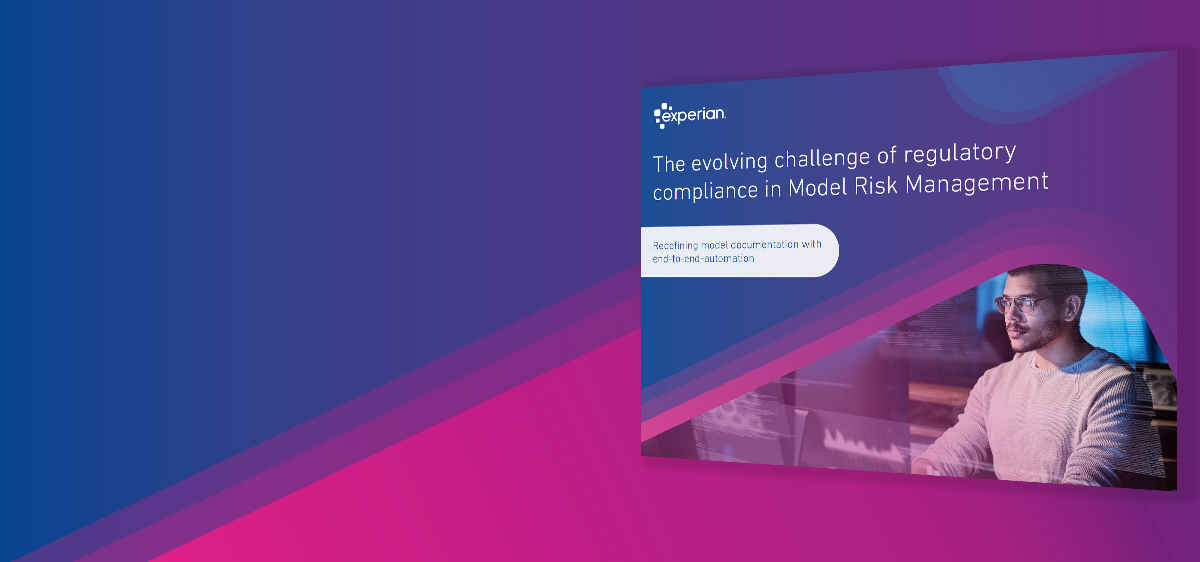
Experian recently conducted a global study of 511 financial institutions in the United States, the United Kingdom, and Brazil to explore how firms are navigating the compliance challenge. Find out more about automated model documentation.

Lenders have a unique opportunity: to transform credit operations from rigid and reactive, to agile, intelligent and scalable. Experian commissioned Forrester Consulting to conduct a Total Economic Impact™ study on the impact of Experian Ascend Platform with organisations that have made this move.

Understand the current challenges in feature building with Experian's eBook. By centralising and automating feature development, financial institutions can reduce risk, boost agility, and improve time to market.

By leveraging insights from leading industry analysts, Experian's expertise, extensive market studies, and market sentiment, we identified four key themes shaping the financial services sector this year.