




Business Information Blog
Credit Management

Reports & Scores

Data & Analytics

The latest from our experts
I had the pleasure of speaking with Kelly DeBoer recently. She is a Product Manager at Experian working in Business Information Services. Kelly leads product strategy for our business marketing products.
Experian API Developer Hub Creates Opportunity for Innovation and New Business Models
Data and AnalyticsCarl Stronach talks about the Experian API developer hub and how we are helping clients solve problems through accessible data.

Andrea Schmalzer is an analytical consultant in the Commercial Data Sciences team here at Experian, and she just completed a study of the mining industry titled “Managing volatility: the unique credit risks of the mining industry”, so we did a quick Q&A with Andrea about her research.

Here at Experian, we work with many clients whose customers and suppliers operate all over the world, and one of the biggest challenges for many is being able to detect financial duress by monitoring companies whose headquarters are outside of the United States.
Experian has just released the Q3 2017 Experian/Moody’s Analytics Main Street report and the overall outlook for small-business credit is stable. The report states outstanding balances on small-business credit declined slightly in the third quarter, continuing a two-year trend. Delinquency and default rates were steady to declining, and business balance sheets continue to improve. Continued improvement in the labor market and economic growth bodes well for credit performance in the short term. Despite the overall optimism, pockets of localized weakness are developing and will warrant observation over the next few quarters.
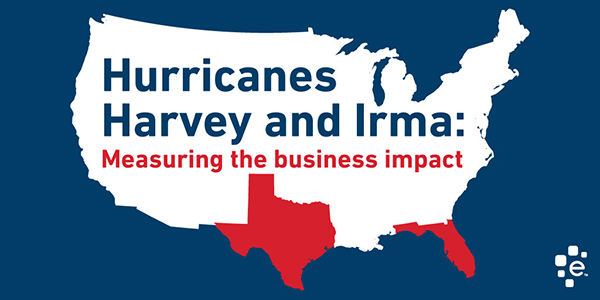
Within the span of two weeks, Texas and Florida, have been devastated by two category 5 hurricanes. This post summarizes business impact.
Experian looked to its wealth of business credit data to gauge the overall magnitude of hurricane harvey, and the impact to regional businesses.

According to the Kauffman Foundation Index of Startup Activity, only 0.31 percent of U.S. adults ever starts a business. That’s 310 people out of every 100,000. That’s a shocking statistic for a country of 325 million people. In fact, new business starts have been in a slow, steady decline since the late 70’s.
Experian and Moody’s Analytics accounce the release of teh Q2 2017 Main Street Report. Small business delinquencies push lower.
The Consumer Financial Protection Bureau (CFPB) is engaged in increasing its understanding of the opportunities and potential challenges associated with consumer permissioned account data. The agency launched a request for information on the topic in November 2016 and is currently analyzing information it received prior to the February 2017 comment deadline. In remarksat a field hearing in conjunction with the launch of the RFI, CFPB Director Cordray stated, that “access to digital financial records is critical. As with your student records or medical records, your financial records tell an important story about you. With health care, for example, if you can see your records, it is easier to participate.”
This week for Business Chat | Live we interviewed Peter Bolin about business owner wealth, and how lenders are finding new ways to evaluate entrepreneurs in the underwriting process. Gary: Today we’re going to have a discussion on business owner wealth and evaluating business owner wealth in risk models. Joining me today is Mr. Peter Bolin. He’s the Director of Analytics and Consulting for Experian. Good morning Peter. Peter: Good morning Gary. Good morning everyone. Gary: Let’s just kick off this discussion. Business owner wealth and small business owners and evaluating risk. What’s it all about? Peter: Yeah, thanks Gary, thanks everyone. As I travel around talking to a hundred clients a year, one theme that always comes back is, “Hey Pete, can you and Experian help us get to yes?” We know that there is a pool of small businesses, a pool of small business owners out there that are small, that are emerging, that are cutting edge, maybe not solid yet, but they don’t have a credit file, what we typically call maybe credit invisibles or maybe thin files, but we know that they have a good idea, we know that they’ve good product and services, but we can’t approve them. Is there anything you can do to help us get to yes? At Experian we got to thinking about that. We have a tremendous amount of data assets as everyone know. We looked around and we said, “Hey, there is this new product that we have called the Wealth Opportunity Score,” and that estimates, based on our proprietary database, the wealth of an individual. We got to thinking, does wealth of a business owner affect the opportunity to be approved? That’s what we’re here to talk about today, Gary. Can we use the Wealth Opportunity Score on a business owner based on a sample of our data, we have some great results, and we definitely feel that we can help lenders, wholesalers, target marketers, get to yes. Gary: Okay. So you mentioned getting to yes. What does that mean in terms of say, a new business or a business that has say, a very thin credit file? How does that work? Peter: The first thing that we do when we’re evaluating any new data source, and while wealth insights have been at Experian for a year or two, it’s new, we’re introducing it for the first time to the commercial space for the business owner, the first thing we do is say, “Okay, can we get a predictive lift by using this data?” The answer is yes. In particular, can we use this in the thin file, in the very, very small, emerging businesses that maybe we could refer to as the credit invisibles. It’s kind of an overused term. Invisible to who? So, we’re using this in this example as credit invisible are a very thin file or maybe have no file on the commercial credit report. We took a sample of business owners in that population and we added this Wealth Opportunity Score as an attribute within our demographic only segment, and we said, “Yes, indeed, this does help the predictive power of that segment.” Going from a KS of a 16 to a 23. A KS for those of you who might not know, that’s the Kolmogorov-Smirnov statistic, that’s the industry standard for measuring the predictiveness of the model, the higher the KS the better the separation between the goods and the bad. We’re seeing that yes, by just including this data, on the credit invisible/thin file, that segment was able to improve the predictive power by 43%. Gary: Wow, that’s incredible. So, we discussed the better prediction of risk using the owner wealth. What does rank ordering have to do with that, and why is that such a big deal? Peter: As quant jocks sometimes we get overly, overemphasize the KS, the rock, the Genie, area under curve and those are all important statistics, but we can’t forget about another critical part, which is the stability of the model. That’s where we look at how well it rank orders. We’d like to see a nice, smooth monotonic progression in the rank ordering of the bads throughout the decile. We would like to see a large number of bads pushed down to the riskiest scoring, and fewer number of bads pushed up to the least risky. As you can see, when we added the Wealth Opportunity Score to our demographic only file, we got a nice, more smooth monotonic progression, which says not only do we get lift like we talked about in the first slide, but we’re also improving the stability of the model, which is very, very important. As you can see, it’s still a little bit choppy. Some of you might say, the skeptics out there might say, “Gee, Pete, this is all pretty choppy.” However, keep in mind this is a demographic thin file, not much to go on other than some key demographic items, but by adding the Wealth Opportunity Score we’re able to increase the predictiveness and the stability of the model. Gary: Wow. Okay, so there’s been a lot of talk about women-owned businesses, minority-owned businesses lately. How does wealth play in the role in accessing credit for minorities, and in particular women-owned businesses? Peter: Absolutely. Gary, that’s a huge topic right now, access to credit. Do minority-owned businesses and especially women-owned businesses have access to credit? We’re also looking at data to help evaluate that. The next thing we did was, we were curious. Okay, is there a difference between a male-owned business and a female-owned business when it comes to wealth? Really, if you look at the bottom two lines on the curve, you see that there’s really not. They’re pretty similar. They are fairly similar. There is some blips on the lower side, so if you’re looking at the left side of the graph, you do see where that pink line is the female owner, they do tend to have slightly lower wealth, and that’s measured on the first Y axis. What we’re saying is that there’s really no difference. If you’re looking at wealth, there isn’t much difference between a woman-owned business and a male-owned business, so that should not be a prohibitor in access to credit. The other thing that we looked at on the other, secondary X axis, is the whole concept around annual spend. This is annual spend on the business owner personally, not the business, so I just want to make that clear. We looked at that, and we saw similar trends, that there really wasn’t much difference in spending except in the very, very high quadrant up there, there was a little bit of difference in the extremely wealthy. Actually, it says that male owners, male business owners, had much more annual spend. So, not only were we introducing the Wealth Opportunity Score, which is a new concept in commercial lending, we’re also looking at the total plastic spend on the business owner personally, which we found is a very powerful indicator, especially when you’re trying to target market. Gary: Excellent. Okay, changing gears a little now, to target marketing and how does wealth help with those that are maybe in the market for credit? Peter: Well, it’s very interesting Gary, because what we find is that there’s an inverse relationship between wealth and in the market, so very, very wealthy owners are not as in the market based on our in the market score. We have a business credit seeker model, which predicts the likelihood that someone’s going to open up a new trade, so, that they’re in the market. They’re really serious about it. We threw these attributes and this scores into that model, and what we found is that intuitively I think that it makes a lot of sense as well. What we see is that lower wealthy business owners are more in the market, right? They don’t have any personal wealth. They need capital. They need access to capital. They’re anxious to get capital. There’s a higher percentage of the lower wealth spectrum that are looking for credit. However, however, that’s not to say that the high end, so if you look at the very high end, three million or more in wealth, there’s also a percentage, 9.5% of the population that are also looking for credit. They could be a small business, they could have two employees or less, they could be around for two years or less, but they have high net worth. They might be invisible on the commercial side and this Wealth Opportunity Score will definitely help them, help lenders and wholesalers get to yes. Gary: Are there other particular industries that you recommend targeting with the new business credit seeker model? Peter: Sure, that was the other kind of thing that was surprising to me, I’ll be very frank. This surprised me, because when we looked at the industries and then we plotted the risk scores, and then we plotted the bad rates, and then we looked at the wealth of the individual, or sorry, not the wealth at this particular point. What we’re looking at here is the actual in the market. What we found is that the industries that have the highest in the market percentage, which is measured on the blue bar, and then we look at their average IPV2 score, that’s Experian’s commercial risk score predict a likelihood of a trade going 91-plus, we see a convergence that the agricultural, wholesale trade and mining industry, which surprised the heck out of me, were the three industries that have the highest percentage and likelihood to be in the market, and also had the highest IP score, which means they have the lowest risk. The mining industry in particular, Gary, is shocking, because over the last eight years, without me getting too politically sensitive, that industry has taken a battering in the last nine years. Big cuts, big cutbacks, in traditional coal mining, and what we’re seeing now, with some of the new administration’s outlook on mining, the regulations are coming off and we’re predicting that this could be a very big growth opportunity for our clients in terms of marketing, in terms of wholesale credit, traditional lines of credit, and traditional term-type credit. The mining industry in the market and a very high IPV2 score, and later on we’ll see also some interesting wealth information about that as well. Gary: Excellent. You talked about credit scores. What about bad debt rates and industry targeting? Can you talk a little bit about that? Peter: Yep, very similar results. We also wanted to look and see what the bad rates were for each of these industries to give the viewers an opportunity to see this trend. This is also the exact same thing as you saw with the score, relatively low risk. Agricultural, wholesale trade, mining again, when you look at their bad rates as measured on that secondary axis, but high in the market. Very, very surprising to me, once again, I did not expect to see especially the mining, given the fact that they’ve been hammered the last nine months, so again, if you’re looking about low-risk industries to target, those are the three that I would recommend. Gary: Does owner wealth matter in these industries in particular? Peter: It does, it does, especially again in the mining industry. You see some interesting wealth statistics. If you look at the distribution of the Wealth Opportunity Score, which once again, predicts the wealth of the business owner, or the individual but in this case we scored it with business owners, you see some blips. Those yellow bars, some blips, and as you can see, there’s also a tremendous opportunity really up there in that big, look at up there, there’s a significant percentage in all three of these industries, but particular mining industry that have extremely high net worth. We already know from previous slides that they have low risk, low bad rates, so again, the mining industry, high wealth, high scores, low bad rates, again, another indication that using this data can help you get to yes. Gary: What about micropreneurs, you know, these businesses that are just emerging, just getting started, they’re credit invisible, right? Does the business owner wealth factor come into lending and risk models? Peter: Certainly, and the whole concept of a micropreneur, that’s kind of a new term, I’m not even sure it is a word, but maybe we invented it, the micropreneur, a great concept, very, very small businesses. It’s not uncommon, Gary, that I get the following statement made to me when I’m talking to clients: “Pete, we don’t approve anyone that’s been in business for two years or less. We don’t approve anyone that has two employees or less. We don’t approve anyone who’s a sole proprietor. We want to avoid those type of businesses,” and I would urge all of the listeners and all of the viewers to think a second time about that, because even if you look at the far right-hand side bar, there are 28% of the population with three million or more in estimated wealth, 28% of that population have been in business or have one or two employees or less. That wealth could be used in your personal guarantee situation, that could be used as collateral. The other nice thing about the Wealth Opportunity Score before I forget is actually evaluating the net worth of an individual. It gives you the opportunity to verify that. It’s very common in these situations that if a small business, one or two employees or less, goes in for an application, applies and they have to have a personal guarantee, and they say, “I’m worth $3 million,” well, how do you know? Well, with this system you can come to Experian and at least get an estimate that that wealth is right, that you’ve verified that wealth and that you can set your credit limits, you can set your approval accordingly. So again, what does it mean for the micropreneur? It means that if they have wealth, it’s another data point that can help you. Gary: It’s helping them get their businesses started. It’s helping to drive the economy, which is, at the same time this is good for everybody. It’s a win-win situation of, it sounds like to me anyway. Peter: Absolutely. You know Gary, the whole concept of what we’re talking about today comes from my personal passion, and I know Experian Business Information Services as an entity’s passion, to be an advocate for the small business owners. What we talk about frequently. Through this passion, we’re looking at all of our data assets. Can we use our data assets for good? And the good is, as small businesses goes, so goes the United States, and I’m really passionate, and I know Experian Business Information Services is passionate about turning over every leaf, every piece to data, that will fuel small business growth and fuel our economy. Gary: That’s awesome. Okay, well this has been excellent Peter. I think if folks are interested in this, we just invite them to drop a comment on the video here if you find this on YouTube, or come to our website, experian.com/b2b. I’m sure we can connect you to Pete and his experts in business information if you want to talk about business owner wealth models. Pete I want to thank you so much for taking time out this morning to come on and talk to us about this topic. I really enjoyed our chat, and we’d love to have you back again in the future. Peter: Thank you Gary. I had a lot of fun. My first live TV spot. Gary: All right, thank you Pete. Have a good day, and- Peter: Thank you. Gary: And have a good day everybody. Thank you so much for coming to our live video. As I said, we’re just wading into this. We’d love to have more of these live shows. If you’ve got ideas for live shows, if there’s things about business information, things that would help you be more successful in business or evaluating risk, just send us a note on our YouTube channel. We’d be happy to consider that, and maybe put a show together. Maybe even invite you on as a guest. That’s it for today, so thank you everyone and have a good day.

This article discusses changes in consumer behavior and why debt collection agencies should tailor debt collection outreach efforts for today’s technology.