The Experian Small Business Index™ rebounded by 8.5 points month-over-month, remains up by 12.8 points Year-Over-Year
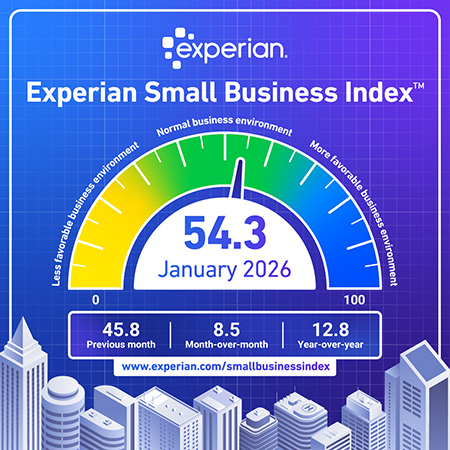
Jan 2026
- Index Value (Jan):54.3
- Previous Month:45.8
- MoM:8.5
- YoY:12.8 (Jan 2025 = 41.5)
The Experian Small Business Index™ increased 8.5 points to 54.3 in January. This is 12.8 points higher than it was a year ago. The improvement coincided with declines in certain risk indicators, including utilization and overdue balances, alongside increased demand for and access to new credit. At the same time, some risk factors warrant continued monitoring, as later delinquencies on commercial trades and early-stage delinquencies on consumer trades ticked upward.
Several macroeconomic indicators improved in January, including inflation and labor market measures. Inflation decreased from 2.7% in December to 2.4% in January, the lowest since May 2025. Core inflation was down from 2.6% to 2.5%, the lowest since March 2021. The U.S. economy added 130K jobs in January, and unemployment ticked down to 4.3% from 4.4%.
Some indicators, however, pointed to ongoing economic pressure. The PCE price index increased slightly in December to 2.9% from 2.8%, remaining above the Federal Reserve’s 2% target. Personal savings also fell for the eighth consecutive month as households continue to face higher prices. Consumer interest in new business formation remained elevated, with 532K new business applications filed in January.
Related Posts
Small businesses navigated headwinds in May as uncertainty began to rise May 2026 Index Value (Mar): 51.2 Previous Month: 52.2 MoM: -1.0 YoY: +6.0 (May 2025 = 57.2) The Experian Small Business Index™ decreased slightly, falling 1 point to 51.2 in May, but remained 6 points higher than a year ago. Several credit risk factors supported the index in May. Past-due balances on business owners’ consumer accounts declined, as did later-stage delinquencies on their commercial accounts. However, several factors weighed on the index. Commercial credit utilization increased, and there was a sharp rise in consumer public records filings. While public records are typically a lagging indicator, this trend warrants monitoring in the coming months. In the broader economy, the unemployment rate declined to 4.2% from 4.3%, and GDP grew by 2.1%, exceeding expectations. Several measures of inflation also increased in May. Headline inflation rose from 3.8% in April to 4.2%, while core inflation, which excludes food and energy, increased from 2.8% to 2.9%. Energy prices were 23.5% higher than a year earlier and likely contributed to broader inflationary pressures. Food prices declined 0.1%, while rent increased 0.1%. Business formation remained strong, with 524,000 new business applications filed in May, up from 505,000 in April. This occurred despite the NFIB Uncertainty Index increasing to 91. The NFIB Small Business Optimism Index edged down to 95.3 in May from 95.9 in April. Explore Experian Small Business Index Related Posts
The Experian Small Business Index gained 3 points in April, driven by strong business formation, increased business credit demand.
Small Business Stability Holds as Experian Small Business Index Edges Up in March
Small Business IndexIncremental increase underscores steady operating environment even as inflation and sentiment present headwinds Mar 2026 Index Value (Mar): 49.2 Previous Month: 48.8 MoM: 0.4 YoY: 2.0 (Mar 2025 = 47.2) The Experian Small Business Index™ remained largely unchanged in March, increasing by 0.4 points to 49.2. This reflects a year-over-year increase of 2 points and indicates relative stability in small business conditions. The broader macroeconomic environment continues to present mixed signals, contributing to recent variability in the index. Conditions appeared more stable in March. The unemployment rate held steady at 4.3 percent, and wages continued to rise modestly. Gross domestic product increased by 2 percent in the first quarter and has been positive in most quarters over the past two years. Private employers added approximately 62,000 jobs in March. U.S. employers also reported 32,826 planned hires, which is an increase from 12,755 reported in February. Inflation increased to 3.3 percent in March, up from 2.4 percent in February, driven in part by higher fuel prices. Gasoline prices rose by approximately $1.00 from the end of February through the end of March, reaching an average of about $4.00 per gallon. This represents a month over month increase of 36 percent. Diesel prices rose by 46 percent compared to the prior month and are up 52 percent year over year. Consumer sentiment declined to 53.3 in March from 56.6 in February. The Small Business Optimism Index also decreased slightly to 98.8. Retail sales remained stable to slightly higher, suggesting that increased fuel costs and lower sentiment have not yet led to a significant reduction in consumer spending. New business formation remained strong, with approximately 492,000 new businesses established in March. Explore Experian Small Business Index Related Posts