Innovation
At Experian, we are continually innovating and using technology to find solutions to global issues, modernize the financial services industry and increase financial access for all. Read about our latest innovation news below:

I recently attended a conference in Alwar, India, hosted by Experian and the International Finance Corporation. During one of the sessions, I met a single mother of two who had recently moved to a rural village in India. Her husband had left her and she was hoping to pick up work as a tailor once she purchased a sewing machine to support her family. As we talked, she confided in me that she was having trouble securing a loan from microfinance institutions because she didn’t have papers to prove her identity. And since she was new to the village, no one knew who she was. Without a proven identity, she couldn’t qualify for a loan and get the money she needed to support herself and feed her children. Indian banks predominantly serve urban customers whose credit reports are extensive. However, most customers from smaller districts and rural towns – like this woman – can fit their credit history on less than a page. Identification may be the only way they can verify their character to secure a loan. As I sat with this woman, I started telling her about our Prove ID tool that I had recently helped to develop. Using an individual’s biometrics, the tool would search her credit history, bank card and any information that can prove she is who she claimed to be. I explained that by using this tool, she could now prove what village she’s from, that she was a permanent resident in her new village and that she was likely to repay her loan. She was stunned and overwhelmed. In that moment, I realized that rural clients often need human connection to clearly understand what a bank or microfinance institution requires in order to obtain a loan. Many rural customers can’t read the brochures or pamphlets sitting in a bank, but by engaging them in conversation, you can effectively educate them about how to prove their identities and build their credit profiles to successfully access the finances they need. As a Product Developer for banks, I sometimes get so caught up on how to make products run that I lose sight of how the work I do impacts the community. Helping one woman discover Prove-ID to secure a loan and provide for her family inspired me. I want to continue being more involved in my community to help others who may not be literate learn how to prove their identities so they can better support their families.
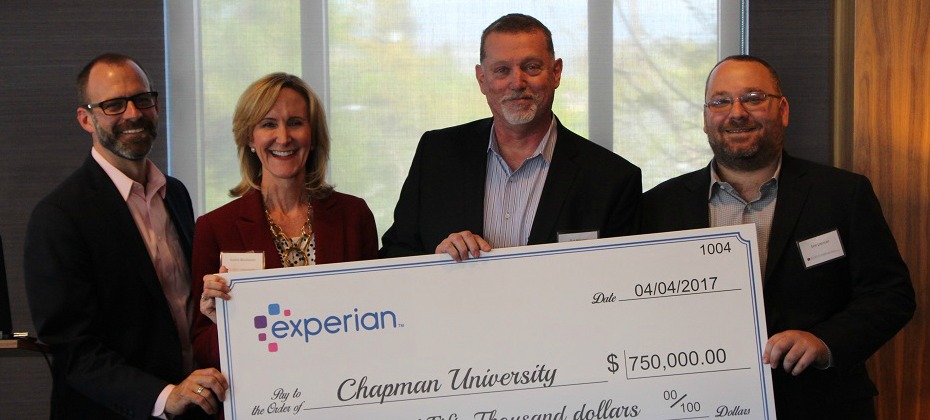
The field of data science is still in its infancy. Every day, new advancements are helping to yield more exciting results. We’re learning how data can allow cities to provide more effective services for residents, how it can help to solve vexing health riddles, and how companies can leverage data to better serve consumers. But for advancements to be achieved, collaboration between research institutions and the private sector is essential. Even more essential is ensuring that the next generation of data scientists are equipped with the latest knowledge and resources to continue to advance the field. That’s why we are excited to announce Experian’s $750,000 gift to create the Experian Assistant Professorship in Machine Learning at Chapman University, which will be used to expand machine learning opportunities at Chapman University’s Machine Learning and Assistive Technology Lab (MLAT), where Chapman researchers use big data and technology to address challenges of social significance like autism. We believe this investment is a necessary step in an ongoing commitment to ensure our Southern California community continues to fuel economic growth by ensuring that businesses like Experian have the talent to advance field of information services. The assistant professorship will be held by Erik Linstead, Ph.D., the director of the undergraduate computing programs in computer science, software engineering, and data analytics. Dr. Linstead, one of the nation’s leading authorities on big data, is also the principal investigator MLAT. Experian has learned the value of attracting data scientists with a wide degree of interests, backgrounds, and professional experiences to help assist our clients best serve consumers. Similarly, MLAT seeks to do the same. Projects that they take on range from bioinformatics and molecular biology to machine learning and artificial intelligence. Experian’s gift will help MLAT to expand their data science-focused efforts into new fields. This gift is the latest of a long series of collaborations between Chapman and Experian. Several years ago, Experian and Chapman began a partnership that involved placing graduate students training to become data scientists in internships within Experian to provide them real-world, hands on training. Since then, the partnership has blossomed to include embedding a Chapman faculty member within Experian to better ground the academic community on how data scientists work within the private sector to better shape their curriculum. We’ve also supported scholarships and programs at Chapman to ensure that the field of data science remains inclusive, diverse, and talented. Data science will inevitably continue to have a growing impact on our lives. This gift is a commitment to the future of data science and the promise of a better tomorrow that it holds. We wish a congratulations to Dr. Linstead, and look forward to a continued stream of talent emerging from Chapman to continue to advance the field and produce better outcomes for everyone. Photo of the check presentation courtesy of Christopher Simonson. Pictured (L-R): Dean of Schmid College of Science and Technology Andrew Lyon, EVP of University Advancement Sheryl Bourgeois, President of Experian Consumer Services Guy Abramo and Principal Investigator of the MLAT Lab Erik Linstead.

Spanish Translation I’m a Senior Product Manager in Experian’s Fraud and Identity Solutions department, which means I partner with data scientists to protect banks and their customers from fraud. When most people think of fraud, they envision someone trying to open a bank account in someone else’s name. However, it wasn’t until I did a series of customer visits with big banks to understand their struggles and discovered a pervasive form of fraud in the finance industry called “bust-out” fraud. In a "bust-out" fraud, an individual applies for a credit card in their own name, establishes a normal usage pattern and builds a solid repayment history. Then, when they’re ready to execute their scam, they max out all their available lines of credit from various lenders, disappear and leave the banks with the losses. Meanwhile, the money could be funneled into funding many types of organized crime, from human trafficking to drug trading and other illicit activities. What makes this type of crime all the harder to identify and catch before it occurs is that the person applying for a credit card is who they say they are. So it’s not about identity theft. To address this issue, my team and I created a solution called BustOut ScoreSM. We began by reviewing data from different banks to identify patterns where bust-outs occurred. From there, we built a score that predicts the likelihood that an individual will execute the scam — months before the scam occurs. Our clients now use this tool both when opening new accounts and as part of account management. The tool flags suspicious-looking accounts, which our team then manually reviews to evaluate if the account is truly at risk for a bust-out. If it is, we work with our clients to freeze or close out those suspicious accounts. Finding solutions to a fraud problem that hasn’t been solved is probably my favorite part of the job. I love seeing products that solve real issues affecting real people come to life — from inception to launch. Helping protect people from identity theft and fraud is what gives me purpose and meaning in my work. I am proud to use the power of data as a force for good.
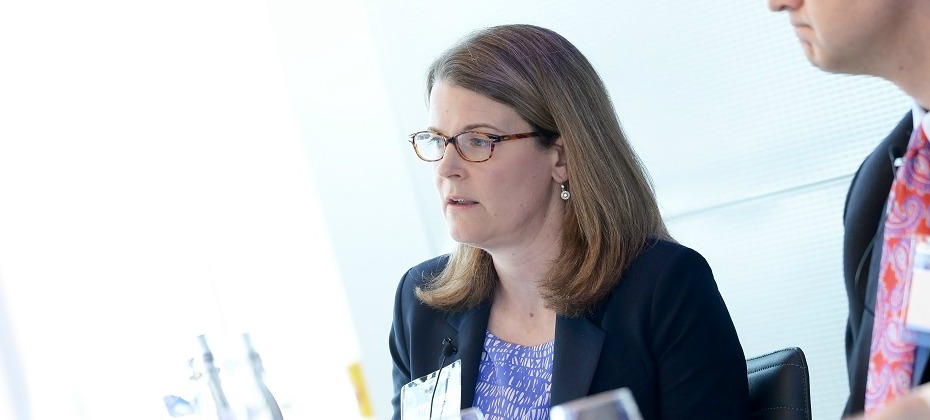
There’s no arguing the importance of data to the marketing industry, but it’s equally important for marketers to leverage data in a responsible manner. On March 22, the Data & Marketing Association (DMA) held the Dynamic State of Data conference in Washington, D.C. to highlight critical public policy initiatives the industry is currently engaged in Congress and state legislatures across the country. The conference included remarks from Senator Thom Tillis (R-N.C.) and Federal Trade Commission Chairwoman Maureen Ohlhausen on their views of why data driven marketing is vital to our nation’s economic engine. Additionally, Liz Oesterle, Experian’s Senior Director for Government Affairs and Public Policy, participated in a panel discussion on the DMA’s Data Standards 2.0 initiative. The Data Standards 2.0 will tackle new high profile and emergent data issues, and update DMA’s marketing compliance standards – DMA’s Guidelines for Ethical Business Practice – focusing them to be more relevant for today’s data practices. During the panel, Oesterle outlined why industry self-regulation and the Data Standards 2.0 initiative is critical for responsible information sharing. In addition to providing business and compliance teams with certainty, Oesterle said “self-regulation helps to get in front of potential legislative and regulatory action by demonstrating to policymakers the industry is able to address any potential issues.” Stu Ingis, a Partner at Venable and DMA’s Legal Counsel, also participated in the panel. Ingis provided background on the Data Standards 2.0 initiative and discussed some of the areas in which the updates are expected to address, including cross-device tracking; data security; compliance with health and children’s data privacy; onboarding; and the Internet of Things. "Experian believes that self-regulation, like the DMA Data Standards 2.0, strengthens consumer protections, allows for responsible innovation and creates regulatory certainty,” said Oesterle. Photo courtesy of: The Data & Marketing Association

Experian and Finicity are announcing a partnership that promises to transform the consumer and lender experience and bring it into the 21st century. By partnering with Finicity, we are leveraging our combined capabilities – their industry-leading 16,000 connections throughout the financial services field and Experian’s Decisioning as a Service platform, to be the first credit bureau that can digitize the loan asset and income verification steps of the underwriting process for consumers and lenders.

I’m a Senior Vice President of Sales, responsible for leading Experian Health’s teams as they assist hospitals, physicians, labs and pharmacies across the U.S. We provide technology for providers and patients to help keep the costs and payment processing component of healthcare easy and transparent. The part of my work I am most passionate about, however, is our efforts to decrease identity theft in healthcare. Medical identity theft is one of the fastest growing areas of identity fraud in the world. With everything moving online at a fast pace, health care providers may not always keep up with the protections needed with new technologies. Unfortunately, that means hackers can sometimes acquire a patient’s personal information – name, Social Security number, health insurance number – to illegally obtain medical services or devices, insurance reimbursements or prescription drugs. One of the biggest issues with this type of fraud is that it leaves its victims with little to no recourse for recovery. They often experience financial repercussions and discover that faulty information has been added to their personal medical files as a result. To address this issue, my team and I partnered with Experian’s Decision Analytics team to create a new tool that protects patients’ online portals in much the same way that banks have protected their online clients for years. Additionally, our team is the in process of launching a Universal Identity Matching solution – a unique PIN which acts like the Social Security Number for your health care information. As more health care companies begin to adopt it, this PIN will be the one thing you will need to carry with you, as it will be your unique identifier for all your health care experiences. A lot of processes in hospitals today are still manual, but I want to change that. I want to automate systems so hospital staff can focus on where they are most needed. I am proud to work at a company that’s at the forefront of solving the major problems in healthcare IT. Being able to provide technological solutions in an industry where you can directly see the benefit is both personally and professionally rewarding. Read more #ExperianStories from our colleagues around the world.

I’m a Senior Director of Experian’s Decision Analytics Global Consulting Practice. That means I help banks manage their credit and fraud risk to help drive profits forward. Many of my clients are banks that need help across multiple business units, including credit cards, auto loans and mortgages. What I love about my job is how it constantly challenges me to expand my imagination of what data is capable of achieving. I’m always finding new ways to use data to keep banks’ revenue flowing, save them money, improve underwriting criteria for people seeking auto loans and help banking customers get a better rate on their mortgage. For example, I was recently approached by a major bank that needed a way to collect on delinquent credit card accounts that had previously been written off. The bank needed a way to collect on these accounts that would work within their budget and strict pricing structures while providing the maximum amount of revenue. Using data, I was able to show the bank a solution that not only improved delinquency rates on their numerous credit card accounts, but also provided a significant reduction in operational expenses. Technology has enabled us to do so much more for banks like this. I began working for Experian in the 1970s, when credit reporting was a highly manual process where clients would call us and we would read their credit report back to them over the phone. I’ve held a number of positions within the company over the years and have seen it undergo tremendous growth and change. Some things, however, never change. After having worked at Experian for 46 years, I am proud to say data still powers everything we do here. Read more #ExperianStories from our colleagues around the world.

I’m a Senior Product Strategy Manager in Experian’s Consumer Services department. I help banks connect people to the loans and credit cards they need, but my role is always changing because the world around us is changing. My team and I noticed how a whole generation is now thinking differently from other generations about the way they work and live. Rather than joining a large corporation, they make a living through a variety of platforms, like Uber, Airbnb and others — stringing together multiple jobs to make their income on their own timetable. The challenge for these people comes when they go to a bank to take out a loan, apply for a credit card or try to finance a car. The banks have difficultly gauging their risk or creditworthiness because they don’t have a traditional income source or because their credit footprint is difficult to trace. Banks refer to those types of individuals as “credit invisibles.” That’s where my team and I come in. We brainstorm ideas and create concepts for Experian to implement that will enable us to aggregate data from alternative sources — like utility bills or phone bills — to give banks a more accurate, robust view of each individual. Additionally, we create useful tools that help people manage their multiple income streams to ensure they’re able to meet their financial obligations each month. As the wealth of data in the world continues to grow, I see myself as an innovator who turns data into utility that works for people. I am constantly dreaming up new ways to connect banks with people who need a loan to feed their family, send their kids to college or buy a car for work. I want to help people take the guesswork out of taking each of life’s biggest steps. I want to empower them — through their data — to realize their dreams. Read more #ExperianStories from our colleagues around the world.

I’m the Head of Utilities in Experian’s Energy and Water Sector. I handle a very specialized form of fraud called “energy theft,” where an individual or business steals electricity by tapping a line or bypassing the energy meter. Back in 2010, the process for handling this type of fraud was broken. Few companies bothered investigating instances of theft; they just accepted the pervasive issue as a cost of sale. This fraudulent activity was costing energy consumers approximately £30 per year, while putting countless homes and offices at risk, since faulty wiring for gas and electricity often leads to house fires or even explosions. Energy regulators decided the time had come for energy providers to crack down on the practice. My team and I at Experian were invited to a consultation to discuss how to use data and innovative techniques to end energy theft. The model we suggested was adopted as the preferred approach, and in the last year the project has been implemented across the entire industry in the UK. Our model combines data from the big energy companies with Experian’s own database to identify which residential or business properties may be stealing energy from the network. We can determine this by comparing energy consumption trends with information on how many people actually occupy the property. With both data sets, we can determine the amount of energy we believe the property should be consuming. If the energy consumption is lower than it should be on a particular piece of property, we look at fraud and credit data sets to see if the case qualifies as a genuine instance of low consumption (such as an older woman living alone), or if someone is perpetrating theft. We send that information back to the supplier so they can prioritize it for investigation. Through this program, I’ve helped protect countless homes and saved consumers from having to pay for energy they’re not using. I love that what I do not only gives me the opportunity to be creative in how I use data, but also helps protect businesses and everyday people. Read more #ExperianStories from our colleagues around the world.