
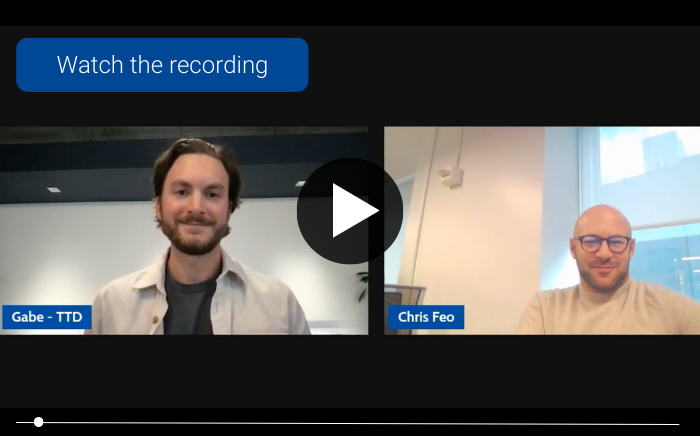
The digital advertising landscape is undergoing a significant transformation with the gradual deprecation of third-party cookies. This shift necessitates the adoption of new strategies for audience targeting and data management. In our next Ask the Expert segment, we explore this evolution, discussing new strategies for audience targeting and data management in a world without cookies.
We’re joined by industry leaders, Gabe Richman, Senior Director of Data Partnerships at The Trade Desk, and Chris Feo, Experian’s SVP of Sales & Partnership who spotlight The Trade Desk’s innovative approach to navigating a cookieless future. Tune in to our Q&A below to learn more about these topics and learn how the collaborative efforts of Experian and The Trade Desk offer a glimpse into the future of advertising.
Cookieless IDs are the new face of identity in advertising
Traditional tracking and targeting techniques are being replaced by more advanced and privacy-conscious methods. Unified I.D. 2.0 (UID2), led by The Trade Desk, exemplifies this shift, offering a new identifier based on encrypted email addresses or phone numbers. This approach not only caters to the evolving privacy regulations but also places greater control in the hands of consumers. UID2’s design fundamentally differs from cookies since it is rooted in transparency and consumer consent.
UID2: A catalyst for industry-wide adoption
UID2’s journey reflects a rising industry-wide recognition of its value across the industry. The adoption of UID2 by major publishers, demand-side platforms, and advertisers indicates a shift toward more sustainable and consumer-friendly approaches to identity in advertising. This is particularly evident in areas like connected TV (CTV), where UID2 is rapidly becoming a currency and standard.
“The purpose of UID2 is not only to create a better ID for advertisers and publishers to achieve their objectives, but also to benefit the consumers. Unlike cookies, UID2 provides transparency and control to the consumers for the first time.”
gabe richman, sr. director, data partnerships, the trade desk
How Experian and The Trade Desk work together
The partnership between The Trade Desk and Experian goes beyond adapting to the absence of cookies. Our joint efforts highlight a commitment to developing solutions that cater to advertiser’s needs while respecting consumer privacy, a balancing act becoming increasingly crucial in today’s digital ecosystem. The Trade Desk’s emphasis on UID2 as a foundational element in the open web, campaign design, and activation is a testament to the potential of new identifiers in enhancing advertising efficacy. Similarly, our ability to utilize these identifiers to deliver detailed audience insights offers advertisers a powerful tool to remain effective in a post-cookie world.
Experian’s role in the adoption of UID2
Experian’s integration strategies have played a critical role in diversifying the applications of UID2. By partnering with The Trade Desk, we help broaden the reach and effectiveness of UID2 across various advertising channels. In terms of reach – by incorporating a prominent cookieless ID, we further amplify the reach of UID2. The increased adoption of this new ID allows the digital ecosystem the ability to interact using an alternative identifier, thereby broadening the potential audience. In terms of effectiveness – we help advertisers serve relevant ads to the right audiences, ensuring the relevance of the ads and control over their frequency.
Targeting with Geo-Indexed audiences
The Trade Desk works with Experian to ingest and host our syndicated audiences. This partnership gives The Trade Desk’s clients access to over 2,400 syndicated audiences that span across eight verticals. This includes access to our new Geo-Indexed audiences that allow brands to reach consumers and households based on geographic regions that over-index for a common set of attributes, ultimately offering brands a targeting solution that prioritizes both consumer privacy and accuracy.
What a future beyond cookies looks like
Looking ahead, the focus in advertising is not solely on replacing cookies but on a broader evolution of the industry. This includes continuing to apply machine learning technologies, like artificial intelligence (AI), to enhance ad personalization and effectiveness. The interplay between creative content, audience insights, and privacy-compliant targeting will become increasingly important as the industry evolves. As cookies become a thing of the past, the initiatives spearheaded by The Trade Desk and Experian will likely set the tone for the next era of digital advertising, and emerging solutions like UID2 are leading the way.
Watch the full Q&A
Visit our Ask the Expert content hub to watch Gabe and Chris’ full conversation about cookieless advertising. In their conversation, Gabe and Chris share more about UID2, consumer transparency, and the importance of consumer data for targeted advertising.
Connect with us
About our experts

Gabe Richman, Sr. Director, Data Partnerships, The Trade Desk
Gabe Richman is the Senior Director of Data Partnerships at The Trade Desk where he focuses on global identity strategy and platform partnerships as well as driving UID2 and EUID adoption across the broader ecosystem. Prior to joining The Trade Desk in 2021, Gabe held various roles in AdTech at HealthVerity, Wunderkind and LiveRamp. For the last decade Gabe has taken pride in helping advertisers and platforms alike demystify the complex identity landscape and embrace the change needed to preserve the open internet. Gabe is a graduate of the University of Maryland and resides in Los Angeles.

Chris Feo, SVP, Sales & Partnerships, Experian
As SVP of Sales & Partnerships, Chris has over a decade of experience across identity, data, and programmatic. Chris joined Experian during the Tapad acquisition in November 2020. He joined Tapad with less than 10 employees and has been part of the executive team through both the Telenor and Experian acquisitions. He’s an active advisor, board member, and investor within the AdTech ecosystem. Outside of work, he’s a die-hard golfer, frequent traveler, and husband to his wife, two dogs, and two goats!
Latest posts
Experian kicks off the AdTech year at CES What better way to jump-start start 2023 than a trip to Las Vegas for the Consumer Electronics Show (CES). Our team was thrilled to participate in this annual kick-off with the AdTech community. The uniqueness of what CES has become for our industry can be defined as the intersection between technology brands, digital, television, and AdTech. CES creates the space necessary for marketing and advertising leaders to collaborate to drive rewarding outcomes for the year ahead. Our goal in attending CES was to connect with our partners, clients, and industry leaders to build relationships, form strategic plans, and listen. The opportunity to learn about our industry’s challenges and goals enables us to develop initiatives, drive success, and support our clients and partners. Keep reading for our 2023 CES AdTech recap. “I have been to CES too many times to mention the number; this year was as energetic, collaborative, engaged, and effective as I can ever recall. Our presence was first-class and meticulously organized, which made our interactions as robust as possible. It's a team effort, and we appreciate all the work that goes into this event. “ – Greg Koerner, Vice President of Digital Advertising Sales Our CES AdTech recap Supporting publishers and advertisers is top of mind for us. Many of our conversations focused on the technologies we deliver or collaborate with our partners to provide. Clean rooms and activation were two common themes throughout our discussions. Clean rooms Consumer privacy, regulatory requirements, and data deprecation are driving the AdTech industry to talk about and explore clean rooms. There’s a need to address data collection, storage, analysis, and sharing. Clean rooms are a potential solution that can standardize data and address interoperability issues. Activation In 2023, we predict that digital activation will increase. We continue to see increased demand for environments where alternative identifiers are being transacted (like demand side platforms and video). Social platforms will continue to experience volatility and advertisers will shift their focus to demand-side, video, and supply-side platforms. Download our 2023 Digital audience trends and predictions report to learn where you should activate your audiences in 2023. We can help plan your 2023 digital activation strategy. How we support clean rooms and activation Our Consumer Sync and Consumer View products support these areas and can help you understand people better–so you and your customers can connect with confidence. What is Consumer Sync? Consumer Sync, our consumer identity product, enables signal agnostic collaboration across marketers and technologies, bringing together digital devices, IDs, households, and attributes. Consumer Sync’s Resolution and Collaboration solutions can help you gain a better understanding of your consumers and make identities actionable in any environment. What is Consumer View? Consumer View, our data discovery product, offers marketers a robust, privacy-first understanding of their customers and prospects. Grounded in consumer identity, Consumer View provides the data foundation to engage consumers where, when, and how they want. Consumer View’s Audience and Attribution solutions provide expansive coverage so that you can fill in the gaps to better understand your prospects. Additionally, our collaborative efforts with strong partnerships across the clean room ecosystem and with our activation partners help our clients serve the best ads, at the best times, to the right audience. “CES is back and was a great way to kick off the new year! We were able to meet with a high volume of clients to eagerly talk about building new solutions for the TV space. We are excited to see where these conversations lead in the next few months.” – Ali Mack, Senior Director of TV Advertising Sales Let’s navigate what’s new in our industry, together We can help you connect with your consumers in innovative, impactful ways. Contact us to continue the conversation and learn more about our Consumer Sync and Consumer View products. We can help you take advantage of the opportunities on the horizon. Get in touch

2022 was a year of adjustment. Consumers adjusted to a post-pandemic world and returned to pre-pandemic shopping behaviors. Consumers adjusted their budgets as the price of goods skyrocketed, as a result of high inflation. To combat inflation, the U.S. Federal Reserve adjusted interest rates. This further restricted consumer buying power. The AdTech ecosystem also experienced adjustments. Google adjusted the date of cookie deprecation. Federal legislation forced technology companies to adjust their consumer privacy practices. Marketers and advertisers adjusted how they address interoperability issues by investing in clean room solutions. This year of adjustment makes it harder to predict where consumers will spend and how marketers should plan their digital audience strategies. What will 2023 bring to AdTech? Download our 2023 AdTech trends and predictions report to access our forecast to help you plan for 2023. Our report will answer: How has digital activation changed over the last four years? What are the top advertising platforms? Which digital audiences are advertisers buying? Do digital audience strategies vary by vertical? Our AdTech trends forecast In 2023, digital activation will increase. Digital audience activation continues to grow at a significant rate despite market shocks like the pandemic, inflation, and higher interest rates. Given the current economic uncertainty, we predict that marketers will look toward tried and true channels where they are confident they will have quality audiences, inventory, and be able to drive ROI. What will digital activation look like in 2023? Between 2018-2021, digital audience activation increased annually by 46%. Using projected 2022 results, between 2018-2022, it will increase annually by 34%. We anticipate continued growth in 2023. Top advertising platforms in 2023 2023 will see increased digital activation, but which platforms will advertisers use to serve their ads? Advertisers will shift their focus to demand-side, video, and supply-side platforms. Social media platforms will continue to experience volatility. Advertisers will place bigger bets on the combination of addressable and CTV. Our report will also reveal which platforms are creating a path toward a post-cookie future and where data-sharing relationships will become the strongest. The most popular advertiser audiences trending now in AdTech Which digital audiences are advertisers buying? Demographics Modeled Lifestyles Behavioral Custom Audiences Traditional targeting methods like Demographics and Modeled Lifestyles are the baseline of many marketing strategies. We predict that we will continue to see marketers activate against these data sets. Digital audience strategies by vertical Digital audience strategies vary by vertical. Download our report to uncover the digital audiences purchased by advertisers in the following industries: Financial Services Health Retail & CPG Technology & Communication Download our new 2025 Digital trends and predictions report Marketers, agencies, and platforms are facing new challenges as privacy regulations evolve, AI technology advances, and consumer behaviors shift. Our latest report highlights actionable strategies for navigating these changes and improving how you connect with audiences, measure impact, and deliver results. What you’ll learn Navigating signal loss: Explore the rise of alternative IDs and contextual targeting as privacy regulations and signal loss reshape data-driven advertising. Connected TV (CTV): Understand the growth of connected TV (CTV), the importance of frequency capping, and strategies for effective audience activation. Omnichannel campaigns: Learn how marketers are moving from channel-specific strategies to audience-led omnichannel campaigns that tell a more cohesive story. Retail media networks: Learn how retail media networks (RMNs) are capitalizing on enriched first-party data to learn more about their customers and reach them across on-site and off-site inventory. Curation: Examine how curation is transforming programmatic campaigns by combining audience, contextual, and supply chain signals to deliver premium inventory packages that maximize addressability, efficiency, and performance. Download now Get in touch

Viewers shift between streaming services, live TV, and on-demand content across multiple devices, making it harder to know exactly who sees your message. Instead of wondering if your ads are reaching the right viewers, it's important to have a clearer understanding of viewing behaviors so you can focus your efforts on the audiences that matter most to your campaign. Experian has collaborated with The Advertising Research Foundation (ARF) to create new opportunities for marketers. By combining data from the ARF’s DASH (Device and Account Sharing) study with Experian Marketing Data, we’ve developed a new way for you to understand and reach modern TV viewers. Instead of estimating who might see your message, you gain a clearer view of viewing behavior and can align activation with the audiences that matter to your campaign. What is the DASH study? The DASH study, developed by the ARF together with the National Opinion Research Center (NORC) and seven industry sponsors, including Experian, provides a detailed picture of how American households consume TV and digital media. This research offers an unbiased and accurate view of media habits, measuring everything from device usage to streaming account sharing. When this viewership data is combined with Experian Marketing Data, it allows for the creation of unique audience segments. These segments are built on real-world media and device usage, providing a more accurate representation of how people watch, share, and engage with TV content. This combination of identity and connectivity helps marketers understand exactly how people engage with media, technology, and their favorite brands. “Television viewing behavior has undergone a massive transformation, making it challenging for advertisers to reach their target audience and optimize frequency. These audiences give advertisers invaluable tools for managing their campaigns in an increasingly fragmented environment.”Doug McLennan, Director of Product Management How do DASH audiences help? By using the DASH study, Experian developed TV audience segments that reflect how people truly interact with content. These audiences provide the insights you need to align your campaigns with actual media consumption habits, helping you reach viewers with more relevant messages. This approach moves beyond basic demographics. It allows you to connect with people based on specific behaviors, such as co-viewing, screen preferences, or household streaming habits. The result is a more focused and efficient advertising strategy that delivers better outcomes. “DASH has established itself as a reliable and unbiased calibration set, a “true North”, for media measurement. Our collaboration with Experian puts the power and precision of DASH in the hands of marketers and advertisers as well.” Paul Donato, Chief Research Officer Which audience segments help you target viewers more effectively? These audience segments make it possible to find specific types of viewers and align your marketing campaigns with their media usage. Whether you’re connecting with people who are receptive to ads, households that enjoy shows together, or individuals who are frequent streamers, you can approach campaigns with greater accuracy and confidence. We’re pleased to introduce these segments and continue our partnership with the ARF, creating new opportunities to help you build effective connections with your target audiences. Explore some of our key audience segments: Ad Acceptors: Viewers who are more open to watching advertisements. Ad Avoiders: People who actively try to skip or block ads. Co-Watchers: Households where multiple people view content together. Solo Watchers: Individuals who typically watch TV by themselves. Paid TV High Spenders: Households that subscribe to multiple paid TV or streaming services. Large Screen Viewers: People who primarily watch content on large television screens. Small Screen Viewers: Individuals who prefer watching on smaller devices like tablets or phones. How can I use these audiences? Experian’s DASH audiences are available in your demand-side platform (DSP) of choice, ready for activation across all offline and online channels. This easy access means you can build more effective campaigns without changing your existing workflow. Using these segments, you can manage your advertising with greater confidence. You gain the tools needed to navigate the fragmented media environment and ensure your campaigns are seen by the right people. This targeted approach helps you maximize the impact of your marketing efforts and achieve your goals. Strengthen your TV planning and activation with DASH audiences. Are you ready to connect with your audience in a more meaningful way? FAQs What is the DASH study? The DASH study, developed by ARF, provides an unbiased view of how American households consume TV and digital media. It measures device usage, streaming habits, and account sharing to create a detailed picture of media consumption. How does Experian help advertisers understand media habits? Experian combines its Marketing Data with insights from studies like DASH to create audience segments based on real-world behaviors. This allows advertisers to align their campaigns with how people actually consume content. What types of audiences can I target with these segments? Audience segments include Ad Acceptors, Co-Watchers, Solo Watchers, Paid TV High Spenders, and Large or Small Screen Viewers, enabling precise targeting based on viewing habits. Why is understanding viewing behavior important for advertisers? By focusing on actual media consumption habits, advertisers can deliver more relevant messages, reduce wasted impressions, and improve the overall effectiveness of their campaigns. Latest posts