At A Glance
CES 2026 showed that AdTech in 2026 will depend on strong data foundations, intentional media buying, and measurable outcomes. Agentic AI systems that can act, optimize, and transact on behalf of marketers emerged as a defining force, but only where data is accurate and privacy-first. Curation is becoming a standard buying approach as AI-powered systems prioritize quality and control. And activation and measurement are finally aligning through identity, allowing AI-driven decisions to be evaluated against real business results.Year after year, CES signals where marketing is headed next. In 2026, the message was clear. Progress comes from connecting data, intelligence, and outcomes with discipline, not spectacle. Across AI, programmatic media, and measurement, the same priorities surfaced again and again.
Under the bright lights of Las Vegas, three themes cutthrough,and each one pointed to a future where data, intelligence, and outcomes move in lockstep.
Here are the three themes that defined CES 2026.
1. Agentic AI proved that it’s only as good as its data inputs
AI was once again the star of the show. At CES 2026, marketers focused less on demos and more on proof that AI improves decisions, reduces friction, and drives outcomes. Every credible use case traced back to accurate, privacy-first data.
What changed at CES was how that intelligence is being applied. Agentic AI systems designed to act autonomously are moving beyond insights and into execution. From media buying to optimization, these agents are increasingly expected to make decisions at speed and scale. That shift raises the stakes for data quality. When AI is operating campaigns, not just informing them, accuracy and privacy are non-negotiable.

“This year’s CES made agency priorities crystal clear. Efficiency, differentiation, and outcomes. As agentic AI takes on more responsibility across planning, activation, and measurement, Experian gives agencies a robust data and identity foundation they can trust to own the outcome for every client.”
ExperianGreg Williams, Chief Operating Officer
Without accurate, privacy-compliant data, AI agents struggle to reflect real behavior or support responsible personalization. A reliable, privacy-first data foundation is what turns AI from an interesting experiment into an operational advantage.

That advantage gets even stronger when it’s anchored in an identity graph that understands people and households across channels. When identity and intelligence move together, AI becomes more accurate, accountable, and effective at driving outcomes.
In an AI first world, the strongest signal isn’t scale. It’s data quality.
2. Curation goes mainstream
Curation is no longer experimental. At CES, it showed up as a mandated capability for buyers and sellers navigating fragmented signals and complex supply paths. Marketers want intentional media buys they can explain, defend, and repeat.
AI is accelerating this shift. As AI systems take on more responsibility for planning, packaging, and optimization, curation provides the guardrails. It defines what “good” looks like (premium supply, trusted data, and clear performance goals), and allows AI to operate within those constraints driving the optimal outcomes for marketers.

“Our sell-side clients walked into CES asking how to stand out in a crowded landscape. The answer kept coming back to data-driven curation. With Experian Audiences and Curated Deals, SSPs and publishers can improve targeting within PMPs, package inventory more intelligently, and prove value with confidence. As we head into 2026, data is no longer a supporting input. It needs to be at the center of every conversation.”
ExperianChris Meredith, Head of Sell-Side
Rather than maximizing inventory access, curation prioritizes control, transparency, and performance. Buyers want premium supply aligned to specific goals. Sellers want clearer paths to demand. They can play the odds or own the outcome. When data leads, they own it. When curation is powered by high-fidelity audiences and a connected identity framework, it becomes even stronger. That’s what allows curated deals to deliver clarity, confidence, and repeatable performance.
This shift reflects a broader move away from probability-based buying toward outcome ownership, where AI-driven systems are measured not on activity, but on results.
3. Activation and measurement finally shared the same stage
Activation and measurement are now coming together around shared data and identity. CES 2026 marked a turning point where closing the loop felt achievable, not aspirational. Both the buy-side and sell-side face pressure to show that media investment drives outcomes.
Agentic AI was a quiet driver of this optimism. As AI agents increasingly manage activation decisions in real time, marketers need measurement systems that can keep up. That requires a shared data and identity foundation. One that allows AI-driven actions to be evaluated against outcomes consistently, across channels and partners.

In healthcare, accuracy is everything. Our clients need to reach patients and healthcare professionals in ways that respect privacy while driving meaningful outcomes. CES underscored that privacy, identity, and measurement must work in harmony. That’s how health marketers reduce risk and increase the likelihood that every message leads to better care.
ExperianSheila Wirick, Sales Director, Health
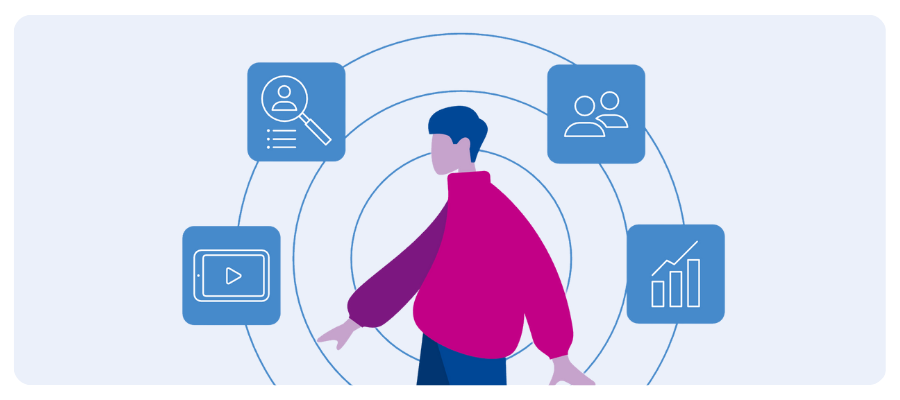
Achieving that requires a consistent identity spine that connects planning, activation, and outcomes across channels. And that spine is strongest when it’s built on accurate, privacy-first data and audiences that understand people and households. That connection allows marketers to move beyond proxy metrics and evaluate performance based on tangible results. When campaigns and measurement rely on the same data foundation, AI-driven platforms can optimize toward outcomes such as new customers, account growth, or in-store activity, not just delivery metrics.
That’s the connective layer that turns disconnected touch points into a measurable, outcomes-based system.

Three takeaways from CES 2026
- AI is maturing, but only for teams withaccurate, connected, privacy-first data that AI agents can act on responsibly.
- Curation is scaling, giving both humans and AI systems clearer paths to quality, control, and differentiation.
- Activation and measurement are aligning, allowing AI-driven decisions to be judged on outcomes, not assumptions.
We’re building for that world today. One where agentic AI operates on a trusted data and identity foundation, curation defines the rules, and outcomes determine success. With the right foundation and the deep data inputs, you can move faster, reduce risk, and let intelligence (human and artificial) work together to deliver results that last long after the neon lights fade.
Connect with us
FAQs
The biggest shift was the move from hype to accountability. Marketers focused on data quality, intentional media buying, and outcome-based measurement rather than experimental technology.
Privacy-first data supports accuracy, compliance, and trust. AI models built on unreliable or opaque data struggle to reflect real consumer behavior and create risk for brands. At Experian, privacy and compliance are built in. Every data signal, attribute, audience, and partner goes through our rigorous review process to meet federal, state, and local consumer privacy laws. With decades of experience in highly regulated industries, we’ve built processes that emphasize risk mitigation, transparency, and accountability.
Curation simplifies buying by pairing premium inventory with specific audience and performance goals. This approach reduces waste and creates clearer, more repeatable buying paths. With the acquisition of Audigent, Experian is now more than just a premier data provider. We’re also a full-service curation partner. Together, we deliver end-to-end programmatic curation across data, inventory, and optimization, helping brands and publishers unlock smarter, more scalable media strategies.
It means using the same identity and data foundation to plan campaigns and evaluate results. This alignment allows marketers to measure success based on business outcomes, not just delivery metrics. With Experian, marketers can plan, reach, and measure in a connected cycle. Every impression is measurable. Every audience is accurate. Every decision is powered by data ranked #1 in accuracy by Truthset.
Identity connects data across channels and stages of the customer journey. It enables accurate AI, effective curation, and consistent measurement within one system. Experian delivers identity resolution at the scale, accuracy, and compliance required by the world’s largest enterprises. Our solutions are:
– Built on trust: Backed by 40+ years as a regulated data steward and rated #1 in data accuracy by Truthset, so you can act with confidence.
– Powered by our proprietary AI-enhanced identity graph: Combining breadth, accuracy, and recency across four billion identifiers, continuously refined by machine learning for maximum accuracy.
– Seamlessly connected: Pre-built data integration with leading CDPs, DSPs, and MarTech platforms for faster time to value.
– Always up to date: Frequent enrichment and near-real-time identity resolution through Activity Feed for timely personalization and more responsive customer engagement.
– Privacy-first by design: Compliance with GLBA, FCRA, and emerging state regulations baked in at every step, supported by rigorous partner vetting.
Latest posts

Ongoing signal loss is driving marketers, agencies, and platforms to turn to supply-side advertising. By using first-party data from publishers and platforms, supply-side advertising has the potential to deliver high-quality audience and context for more effective ad targeting. The supply-side refers to the publishers and platforms that sell advertising inventory. These companies have access to first-party data about their users, which can be used to target ads more effectively. By tapping into supply-side advertising, you can overcome the challenges of signal loss and target ads more effectively. To shed light on this topic, we hosted a panel discussion at Cannes, featuring industry leaders from Audigent, Captify, Newsweek, Pubmatic, Truthset, and Experian. In this blog post, we'll explore how partnerships between supply-side channels and publishers are working to enhance advertising opportunities while balancing the need for transparency and control in programmatic ad buying. Shift toward supply-side advertising Traditionally, the demand-side dominated the programmatic media buying chain due to an abundance of supply. However, with the emergence of finite data and its interpretation, collaboration between supply-side technology companies and publishers is required to redefine these economics. It's no longer sufficient for the demand-side to blindly negotiate prices based on limited knowledge. Marketers can still define their target audience, but effective communication is key. This presents an opportunity for premium journalistic outlets to guide the industry's understanding of how data from the supply-side impacts media buying economics in the future. "Supply-side technology partnerships with publishers are now in a position to shape the economics of programmatic media buying as there is a finite amount of data. It’s crucial for supply-side technology companies to collaborate with publishers to shape these new economics. This presents an opportunity for premium journalistic outlets to provide guidance on how data from the supply-side can affect the future of media buying." matthew papa, svp, business & corporate development, captify Democratizing data from the supply-side Cookies haven't brought significant benefits to premium publishers. They mainly serve to retarget users from sites like The Wall Street Journal to advertising sites. This approach primarily serves the purpose of generating revenue. The elimination of third-party cookies presents an opportunity for premium publishers to shift this dynamic. By using their knowledge of first-party audiences, and using identifiers like Experian's LUID, publishers can own and understand their audience data, which can then be modeled. Here’s how publishers can win Establishing a connection with consumers and emphasizing the value exchange is essential to building trust. Determining what incentives and benefits consumers find meaningful will be crucial in gaining their opt-in. With consumers The Apple tracking transparency initiative, specifically the deprecation of IDFA signals, had significant implications for mobile app developers. Overnight, opt-in rates plummeted, causing a drastic decline in iOS ad monetization. To combat this, developers focused on demonstrating the value exchange to consumers—better ad experiences and personalized content. By articulating the benefits over a couple of years, opt-in rates increased from 10-15% to 30-40%. The key takeaway is the need to effectively communicate the value exchange to consumers. With partners Trust plays a crucial role in planning your first-party data strategy. Publishers, advertisers, and data partners highly value their proprietary data. However, there are concerns about how it's used, mishandled, or leaked in the ecosystem. Building trust between partners is essential. It's important to work with trustworthy partners who are agnostic, committed to innovative solutions, and globally oriented. These partners can help navigate the complexities of laws and regulations. Choosing the right partners is crucial in a world where first-party data is a key asset. "Power is shifting toward brands that have strong relationships with customers and possess first-party data. As the ownership of customer data becomes more important, it is crucial to establish a first-party data strategy to better serve customers and adapt to changing market dynamics."chip russo, president, truthset Balance probabilistic and deterministic data Focus on building trust with consumers and collaborating with reliable companies to share data. However, it's important to remember that achieving a 100% opt-in rate is unlikely. The cookie, which has become omnipresent, requires us to shift our strategic thinking. We need to consider both deterministic and probabilistic approaches instead of viewing them as mutually exclusive. The landscape will be fragmented, with some consumers opting in and others not. "Probabilistic and predictive audience data holds immense potential. With the power of AI, we can expect enhanced performance and efficacy in media campaigns. At Audigent, we firmly believe that this data will outperform deterministic data, making it an integral part of our strategy." drew stein, ceo, audigent Premium content Trust plays a crucial role in leading to premium content. By placing trust in the best media brands, data, and technology partners, we can expect to see improvements in media, journalism, and advertising. This shift may have a direct impact on the long tail of free natural resources, making it more challenging for them to thrive. However, this change is ultimately beneficial since it promotes higher-quality media experiences overall. "The homepage surface is making a comeback in the publishing industry, proving its value in establishing a direct connection with readers. While we acknowledge the importance of technology partnerships for addressability and identity, our core competency as a publisher remains outstanding journalism that captures and engages great audiences." kevin gentzel, cco, newsweek Watch our Cannes panel for more on supply-side advertising We hosted a panel in Cannes that covered supply-side advertising. Check out the full recording below to hear what leaders from Audigent, Captify, Newsweek, Pubmatic, Truthset, and Experian had to say. Watch now Check out more Cannes content: Our key takeaways from Cannes Lions 2023 Insights from a first-time attendee Four new marketing strategies for 2023 Exploring the opportunities in streaming TV advertising The future of identity in cookieless advertising Follow us on LinkedIn or sign up for our email newsletter for more informative content on the latest industry insights and data-driven marketing. Contact us today Latest posts

The digital advertising landscape has undergone a seismic shift in recent years. Privacy-conscious consumers, transformative regulations, and emerging technologies are converging to redefine how addressability — the ability to accurately reach a specific audience — functions in this new era. Addressability is a cornerstone of digital advertising, and its evolution presents both challenges and opportunities for publishers and advertisers alike. The need for enhancing addressability is driven by a complex set of factors. More consumers are opting out of data sharing or disabling cookie-tracking, leading to a drastic reduction in the reach of traditional programmatic advertising. Nearly 70 percent of consumers are now unreachable through these conventional methods, creating an 'addressability gap' that publishers and advertisers are eager to bridge. The landscape is further complicated by privacy regulations such as General Data Protection Regulation (GDPR) and California Consumer Privacy Act (CCPA), which mandate solutions that balance user privacy with advertisers' needs. Contributing to this intricate mix is the growing shift toward video and connected TV (CTV). These platforms have long operated in a cookie-less environment and are witnessing rising demand due to their engaging nature and broad reach. However, the attractiveness of these mediums to advertisers hinges on effective addressability, highlighting the urgent need for innovative audience identification and targeting methods. The emergence of data enablers and collaborative initiatives Data enablers like Experian are stepping up to meet this need. These companies are providing robust, privacy-compliant data resources to improve addressability. Experian's unique approach to identification, the Living Unit ID (LUID), is a key tool in bridging the current gap in reach. How Experian and Microsoft Advertising are redefining addressability We recently expanded our collaboration with Microsoft, to make our extensive data resources available through Microsoft Advertising’s data marketplace. This collaborative initiative represents a significant move, offering a compelling model of how data enablers and buy-side and sell-side platforms can work together to redefine addressability. The benefits of this arrangement extend to all stakeholders in the ecosystem. Advertisers using Microsoft Invest can now access Experian's audience data. This not only enhances the granularity of their audience targeting but also broadens the reach of their campaigns. Experian's identity spine also serves as a robust framework to extend the value and reach of advertisers' first-party data. For publishers, the accessibility of Experian data on Microsoft Advertising’s data marketplace opens the door to greater addressability in their inventory, enabling them to offer advertisers more addressable impressions. This then amplifies the value of their inventory, potentially increasing their overall yield. For advertisers, this integration facilitates access to highly relevant audiences while simplifying campaign setup and respecting user privacy. We can help you carve a new path toward addressability In the ever-evolving landscape of digital advertising, such collaborative efforts are becoming critical to ensure that advertising remains effective for brands, profitable for publishers, and respectful of consumer privacy. This model of cooperation and innovation is essential to navigate the challenges of a privacy-centric, cookie-less world and unlock the true potential of every media channel. With collaborative initiatives and innovative solutions, the industry is set to transform these challenges into opportunities, carving a new path toward addressability that respects privacy and delivers value for all stakeholders. Connect with us to learn more about how you can access our data in Microsoft Advertising’s data marketplace. To learn more about our partner Microsoft Advertising, visit their website. Contact us Latest posts

The cookieless future is here, and it's time to start thinking about how you will adapt your strategies to this new reality. In a cookieless world, you will need to find new ways to identify and track users across devices. This will require reliance on first-party data, contextual advertising, and alternative identifiers that respect user privacy. To shed light on this topic, we hosted a panel discussion at Cannes, featuring industry leaders from Cint, Direct Digital Holdings, the IAB, MiQ, Tatari, and Experian. In this blog post, we'll explore the future of identity in cookieless advertising. We'll discuss the challenges and opportunities that this new era presents, and we'll offer our tips for how to stay ahead of the curve. How cookieless advertising is evolving Programmatic advertising is experiencing multiple changes. Let's dive into three key things you should know. Cookie deprecation One significant change is cookie deprecation, which has implications for tracking and targeting. Additionally, understanding the concept of Return on Advertising Spend (ROAS) is becoming increasingly crucial. The demand and supply-side are coming closer together Demand-side platforms (DSPs) and supply-side platforms (SSPs) have traditionally been seen as two separate entities. DSPs are used by advertisers to buy ad space, while SSPs are used by publishers to sell ad space. However, in recent years, there has been a trend toward the two sides coming closer together. This is due to three key factors: The rise of header bidding Header bidding is a process where publishers sell their ad space to multiple buyers in a single auction. This allows publishers to get the best possible price for their ad space, and it also allows advertisers to target their ads more effectively. Cookie deprecation As third-party cookies are phased out, advertisers need to find new ways to track users, and they are turning to SSPs for help. SSPs can provide advertisers with data about users, such as their demographics and interests. This data can be used to target ads more effectively. The increasing importance of data Advertisers are increasingly looking for ways to target their ads more effectively, and they need data to do this. SSPs have access to a wealth of user data, and they're willing to share this data with advertisers. This is helping to bridge the gap between the two sides. The trend toward the demand-side and supply-side coming closer together is good news for advertisers and publishers. It means that they can work together to deliver more relevant ads to their users. Measuring and tracking diverse types of media The media measurement landscape is rapidly evolving to accommodate new types of media, such as digital out-of-home (DOOH). With ad inventory expanding comes the challenge of establishing identities and connecting them with what advertisers and agencies want to track. Measurement providers are now being asked to accurately capture instances when individuals are exposed to advertisements at a bus stop in New York City, for example, and tracking their journey and purchase decisions, such as buying a Pepsi. To navigate cookieless advertising and measurement, we must prioritize building a strong foundational identity framework. What you should focus on in a cookieless advertising era In a cookieless advertising era, you will need to focus on two key things: frequency capping and authentic identity. Frequency capping Frequency capping is a practice of limiting the number of times an ad is shown to a user. This is important in cookieless advertising because it helps to prevent users from being bombarded with ads. It also helps to ensure that ads are more effective, as users are less likely to ignore or click on ads that they have seen too many times. Frequency capping is often overhyped and yet overlooked. Instead of solely focusing on frequency, consider approaching it from an identity perspective. One solution could be to achieve a perfect balance between reaching a wider audience and avoiding excessive repetition. By increasing reach in every programmatic buy, you naturally mitigate frequency control concerns. Authentic identity The need for authentic identities in a digital and programmatic ecosystem is undeniable. While we explore ways to connect cookies, mobile ads, and other elements, it's crucial to remember who we are as real individuals. By using anonymized personal identifying information (PII) as a foundation, we can derive insights about households and individuals and set effective frequency caps across different channels. Don't solely focus on devices and behaviors in your cookieless advertising strategy and remember the true value of people and their identities. What’s next for cookieless advertising? The deprecation of third-party cookies is a major challenge for the digital advertising industry. Advertisers will need to find new ways to track users and target their ads. Here are three specific trends that we can expect to see in cookieless advertising. First-party data is moving in-house Many major media companies, equipped with valuable identifier and first-party data, are choosing to bring it in-house. They are focused on using their data internally rather than sharing it externally. "Many larger media companies are opting to bring their identifier and first-party data in-house, creating more walled gardens. It seems that companies are prioritizing data control within their own walls instead of sharing it externally."laura manning, svp, measurement, cint Fragmentation will continue The number of identifiers used to track people online is growing rapidly. In an average household, over a 60-day period, there are 22 different identifiers present. This number is only going to increase as we move away from cookies and toward other identifiers. This fragmentation makes it difficult to track people accurately and deliver targeted advertising. This means that we need new identity solutions that can help make sense of these new identifiers and provide a more accurate view of people. A portfolio of solutions will address signal loss Advertisers are taking a variety of approaches to cookieless advertising. A few of the solutions include: Working with alternative IDs. This refers to using alternative identifiers to cookies, such as mobile device IDs or email addresses. These identifiers can be used to track people across different websites and devices, even without cookies. Working with data index at a geo level. This refers to using data from a third-party provider to get a better understanding of people's location. This information can be used to target ads more effectively. Working with publisher first-party data that's been aggregated to a cohort level. This refers to using data that is collected directly from publishers, such as website traffic data or purchase history. This data can be used to create more personalized ads. Working with contextual solutions. This refers to using contextual data, such as the content of a website or the weather, to target ads. This can help to ensure that ads are relevant to the user's interests. "Cookie deprecation is often exaggerated, and alternate solutions are already emerging. As data moves closer to publishers and first-party data gains prominence, the industry will adapt to the changes."mark walker, ceo, direct digital holdings There is no one-size-fits-all solution for cookies, and you will need to be flexible and adopt a variety of different approaches. How will these solutions work together? You can take a waterfall approach to cookieless advertising. A waterfall approach is a process where advertisers bid on ad impressions in sequential order. The first advertiser to meet the minimum bid price wins the impression. In the context of cookieless advertising, a waterfall approach can be used to prioritize different targeting signals. For example, you might start by bidding on impressions that have a Ramp ID, then move on to impressions that have a geo-contextual signal, and finally bid on impressions that have no signal at all. This is a flexible approach that can be adapted to different needs and budgets. Watch our Cannes panel for more on cookieless advertising We hosted a panel in Cannes that covered the future of identity in cookieless advertising. Check out the full recording below to hear what leaders from Cint, Direct Digital Holdings, the IAB, MiQ, Tatari, and Experian had to say. Watch now Check out more Cannes content: Our key takeaways from Cannes Lions 2023 Insights from a first-time attendee Four new marketing strategies for 2023 Exploring the opportunities in streaming TV advertising Maximize ad targeting with supply-side advertising Follow us on LinkedIn or sign up for our email newsletter for more informative content on the latest industry insights and data-driven marketing. Get in touch Latest posts