Delivering personalized customer experiences is essential, with 81% of customers preferring a personalized approach to their relationships with brands. However, 80% of consumers are concerned about how their data is used, presenting businesses with the challenge of balancing data collection and privacy with personalization.
Despite consumer appetite for personalization, many organizations lack the data to make data-driven decisions: 68% of businesses don’t understand how their customers think, and 82% don’t confidently know their customers’ pain points.
Without this critical data, businesses cannot effectively create personalized consumer connections. Experian offers businesses robust and unique data through our Marketing Attributes to empower businesses with the insights required to derive accurate insights into consumers and drive personalized experiences.
How Experian can help businesses with their data acquisition needs through Marketing Attributes
Experian’s Marketing Attributes allow businesses to license Experian’s data attributes in part or full to provide reliable and accurate data solutions. These solutions assist companies in finding, reaching, and influencing their customers. They are supported by rigorous quality and privacy controls which has earned Experian a #1 data accuracy ranking by Truthset helping our clients reach people based on who they are, where they live, and what they do.
Experian has built a strong foundation of consumer behavioral and demographic data with over 5,000 attributes available across over 15 categories and verticals, helping our clients gain deep insights into their consumers. Below we go through five common use cases we have seen using Experian’s data to power various business initiatives.
Exploring everyday use cases for Experian’s Marketing Attributes
1. Understand areas of the country where your products or services are underserved
For instance, a brand offers a diverse range of products that cater to various market segments and audience personas. They seek to gain a deeper understanding of geographic distribution to refine their marketing strategies. Specifically, they aim to identify which market areas are currently underserved, presenting a valuable opportunity for targeted marketing campaigns to boost product adoption in regions that have not fully embraced their offerings.
Utilizing Marketing Attributes from Experian, the brand can access detailed data aggregated at the geographic level. This data provides crucial insights into markets where their products have seen limited adoption yet show a strong potential for success based on the preferences of their target audiences. This approach will help the brand strategically direct its marketing efforts to areas with high growth potential.
2. Better understand consumers who purchase within a category
Brands frequently operate based on assumptions regarding their customers’ preferences and interests, yet they may lack the comprehensive data necessary to substantiate these beliefs.
Experian’s Marketing Attributes provides brands with access to extensive data across 15 diverse verticals and categories. This wealth of information allows businesses to develop a holistic understanding of their customer base, enabling them to validate their assumptions and uncover valuable insights into customer behaviors. By utilizing this data, brands can significantly enhance their marketing strategies, refine their product offerings, and implement personalized tactics that resonate with their audiences on a deeper level.
3. Reach a new segment of the market for a new product offering
Introducing a new product to a new segment of the market presents unique brand challenges. Without any historical customer data to draw upon, companies lack vital insights that could help them identify and reach their target audience. This absence of foundational knowledge makes it challenging to understand consumer preferences, craft suitable messaging, or determine the most effective channels for connecting with potential customers.
To navigate these hurdles, brands frequently turn to Marketing Attributes for consumer research within the new segment. Analyzing demographics, common behaviors within a geographic region, or previous purchase behaviors can uncover patterns and preferences among potential customers. This deeper understanding enables them to create tailored audience models, allowing brands to develop and activate customized messaging based on common interests, identify channels consumers are most likely to engage by using TrueTouch data from Experian.
4. Create custom lookalike models based on your current customers
We have found brands trying to launch an acquisition campaign to look at consumers whose behaviors and interests closely mirror those of their highest-converting customers. However, they often lack the necessary data to find new customers that look like their most loyal base.
To address this gap, they turn to Marketing Attributes in combination with Experian’s Offline Graph or Digital Graph, which allow them to pinpoint and analyze the key characteristics and behaviors that define their top customers and reach these consumers on digital or offline channels. Marketing Attributes power the insights into their client’s behaviors and Experian’s Offline or Digital Graph create the linkage to their customer base. Using these insights, the brand can develop a distinct audience model tailored to reflect their most successful customers’ unique traits and preferences. This customized approach will help them reach potential new customers who will likely engage and convert.
5. Develop unique audience products
We have seen clients use their own first-party data alongside Experian Marketing Attributes and other data sets they own or lease. With Experian’s Offline Graph or Digital Graph, they can connect the different data sources together to create a tailored audience solution that meets the specific needs of the brand’s clients and the requirements of their market segment.
Exploring joint solutions
Combining Experian’s Offline Graph with Marketing Attributes
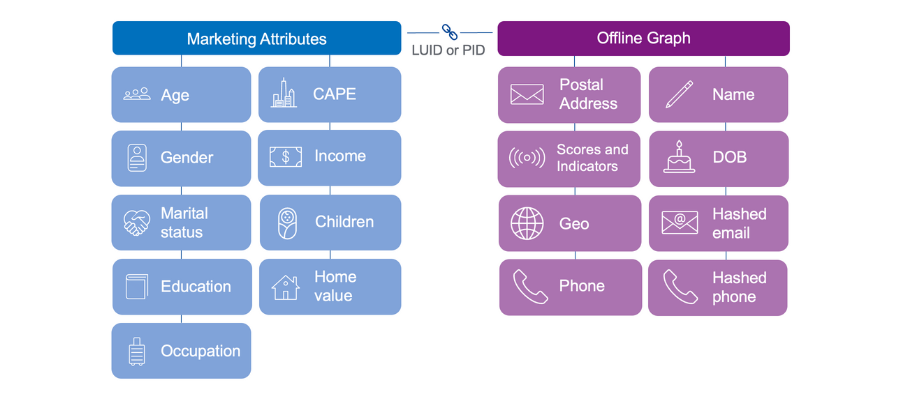
Many customers use Experian’s Offline Graph with Marketing Attributes to connect Experian’s data to the brand’s offline marketing strategy. Experian’s Offline Graph offers companies a license of stable offline data points, like name, address, phone number, email, geographic, date of birth, and more that provide a complete view of household and individual identities.
Powering use cases like:
- Regional consumer insights for marketing strategy, media activation, product and location planning
- Offline media activation, including direct mail, telemarketing, out-of-home, and more
- Client-driven enrichment
The combination of Offline Graph and Marketing Attributes provides unmatched consumer connectivity, enabling clients to generate custom insights, inform product strategy, and activate marketing campaigns. Offline Graph acts as the link between consumers insights and activation.
Combining Experian’s Digital Graph with Marketing Attributes
The uncertainty around third-party cookies in Chrome and the overall decline in signal complicates the industry’s ability to reach the right consumer. Omnichannel media consumption results in scattered data, making it harder for marketers and platforms to understand consumer behavior and reach them across channels. These challenges call for a comprehensive solution.
Our Digital Graph and Marketing Attributes solution addresses these challenges by providing identifiers for seamless cross-channel engagement. By adding Marketing Attributes, like demographic and behavioral data, marketers and platforms also gain a better understanding of their customers. This solution uses Experian’s Living Unit ID (LUID) to combine offline and digital data, giving customers deeper insights into consumer behavior, greater audience reach, and improved cross-channel visibility.
Transform insights into loyalty with Experian’s Marketing Attributes
Experian’s Marketing Attributes enable businesses to gain valuable insight into their prospects and customers. Through this deeper understanding, they can deliver personalized experiences while successfully navigating the complexities of data acquisition and privacy. This helpful information allows brands to make strategic, informed decisions that enhance their marketing efforts. Ultimately, these insights foster more substantial, meaningful connections between businesses and their customers, leading to enhanced customer satisfaction.
Get started today
Latest posts

The rise of streaming TV advertising is revolutionizing the marketing landscape, bringing together the best of traditional television's broad audience reach and digital's precise targeting capabilities. Marketers now have a new platform to explore, but it comes with its own set of challenges and opportunities. To shed light on this topic, we hosted a panel discussion at Cannes, featuring industry leaders from AMC Networks, Disney, OMG, Paramount, Roku, and Experian. In this blog post, we'll explore the effectiveness of TV as a performance channel and audience targeting. TV as a performance channel Television has come a long way over the years. The evolution of linear TV to connected TV (CTV) is opening new possibilities for targeting and performance measurement, like what we're accustomed to in search and display. However, there's still a way to go. What's preventing us from fully realizing the potential of CTV? Let's explore what's holding us back. Three challenges Advertisers are captivated by CTV, a media platform that combines the best features of TV and digital advertising. With its unparalleled data and identity capabilities, alongside the immersive TV experience, it has the potential to be a powerful performance channel. However, we still face three challenges as performance dollars take center stage. "CTV is a valuable household device that provides direct audience insights. However, to gain a comprehensive understanding of the household and the individuals in the household, we need different techniques. The implementation of such methodologies from user level profiles to algorithmic inferences are still evolving across different companies." Louqman parampath, vp, product, roku Client education Performance marketers and agencies are still primarily focused on social and search. It's important to reassure them that CTV aligns with their established standards. Optimize KPIs We need to address the challenges around attribution and incrementality. We should optimize for the KPIs that performance marketers desire, which are different from the metrics commonly used in social media and search marketing. Results-driven interactions You should invest in interactive ad formats and novel experiences to give users clickable options that deliver the instant impact of performance marketing. While conversions and purchases can happen after seeing an ad thanks to view-through attribution, your goal should be to make video ad experiences feel like performance-based engagements. This transition is crucial to building trust and familiarity among performance marketers and agencies. Strategies to effectively reach audiences across different mediums There are various mediums to connect with consumers — TV, digital, and mobile offer multiple avenues. Which strategies should you prioritize? Data interoperability When it comes to buying unified audiences, programmatically is the easiest route. By prioritizing data interoperability, you can ensure a seamless buying experience across all screens. "At Disney, we focus on data interoperability with industry solutions such as The Trade Desk/UID2, Google PAIR, and Experian and the LUID, making it effortless to buy unified audiences programmatically across all screens. With an identity graph as the foundation of our tech stack, we help our clients reach their target audience across linear, digital, and streaming properties."jamie power, SVP, addressable sales, disney Advanced targeting capabilities in linear TV Don't limit your perspective on television consumption to traditional streaming platforms alone. While streaming is popular, it's equally exciting to see advanced targeting capabilities integrated into linear television. Viewer habits are shifting, with appointment TV becoming a thing of the past. Today, viewers have more options to watch a variety of programming, regardless of its age. "Streaming has become another platform for viewers to consume programming, and it's exciting to see digital targeting capabilities being applied to linear TV. Viewer behavior has changed, with more opportunities to consume programs at different times, so it's important to use targeting capabilities like linear addressable to effectively reach the audience across multiple channels."evan adlman, Evp, commercial sales & revenue operations, amc networks While live premieres still attract a substantial audience, utilize linear addressable targeting to reach viewers across channels. By doing so, you can ensure your message reaches the right viewers at the right time. The viewership landscape has diversified – it's time to adjust our strategies. Make TV viewing patterns predictable To bring predictability to the unpredictable and fragmented landscape of TV, advertisers can create products that simplify and unify the viewing experience. This allows users to effortlessly transition between episodes, resulting in a cohesive and engaging viewing journey. Watch our Cannes panel for more on the future of streaming TV advertising We hosted a panel in Cannes that covered the future of streaming TV advertising. Check out the full recording below to hear what leaders from AMC Networks, Disney, OMG, Paramount, Roku, and Experian had to say. Watch now Check out more Cannes content: Our key takeaways from Cannes Lions 2023 Insights from a first-time attendee Four new marketing strategies for 2023 The future of identity in cookieless advertising Maximize ad targeting with supply-side advertising Follow us on LinkedIn or sign up for our email newsletter for more informative content on the latest industry insights and data-driven marketing. Get in touch Latest posts

As a marketer, you know that the digital landscape is always changing. That's why it's important to make sure you're equipped with the right tools every step of the way – no matter how rapidly things change. You want to ensure your strategies and tactics stay ahead of any changes in technology or consumer behavior, so what new marketing strategies should be in your toolbox in 2023? Discover what industry leaders from Experian, Adweek, FreeWheel, Tubi, and Instacart had to say about what should be in every marketer's toolbox in 2023 at Cannes. Keep reading to learn the top four new marketing strategies you need in your marketing toolbox for 2023 and beyond. 1. A plan for signal loss The first item you should have in your marketing toolbox is a plan for signal loss. The phasing out of third-party cookies presents both a challenge and an opportunity. This shift not only poses challenges but also opens up opportunities for alternative strategies. On the one hand, it makes it more difficult to track users across channels and measure the effectiveness of marketing campaigns. On the other hand, it forces marketers to focus on building relationships with their customers and collecting first-party data. Consumer behavior is changing When we consider signal loss in a traditional sense, we think of the implementation of iOS 14, where we couldn't track click-based data from campaigns. It's important to reflect on the fact that the paid media ecosystem needed to adapt to new consumer realities. Younger demographics are less likely to click on ads and instead engage in video environments. They discover brands through platforms like TikTok or Instagram. It's crucial to understand how people behave, where they discover products, and where influence takes place. This understanding becomes even more vital when targeting a young audience demographic. Four things to consider when planning for signal loss There are four things you should consider when building out a plan to address signal loss and fragmentation. Channel diversification You need to reach your customers on the channels where they are already spending time, such as social media, email, and your own website. You should work with platforms that have first-party data to understand how your customers interact with your brand. Data privacy You need to be transparent about how you are collecting and using customer data. You should also anonymize data whenever possible. First-party data First-party data is now more crucial than ever, awakening its importance in shaping our actions. The combination of channel diversification and first-party data will be essential in the years to come. By focusing on these two areas, you can build stronger customer relationships and create more effective marketing campaigns. Contextual targeting Contextual targeting is emerging as a viable method to deliver more relevant content to your intended audience. By embracing signal loss, the alternative new marketing strategies that are emerging as a result, and adopting a privacy-centric mindset, you can navigate cookie deprecation. 2. Collaboration The second item you should have in your marketing toolbox is collaboration within the AdTech ecosystem. To address signal loss and changes in privacy, moving toward a more collaborative, holistic marketing ecosystem is key. Two ways we can achieve better collaboration Here are two ways we can create better collaboration in the AdTech ecosystem. Enable interoperability We should aim to create an ecosystem that fosters collaboration between marketers, publishers, advertisers, ad tech companies, and more. When we enable seamless interoperability, everyone can use the best data available. Use clean rooms We are witnessing a growing trend of collaboration between parties, where buyers and sellers share data in these secure environments. Clean rooms can help us develop data strategies in a controlled manner. 3. Generative artificial intelligence (AI) The third tool you should have in your marketing toolbox is generative AI. Benefits of implementing AI There are three main benefits to implementing AI within your marketing strategy. Enables creativity Although AI and machine learning have long been part of our toolbox, this moment marks an extraordinary acceleration that expands our capabilities. Copywriters can now create visuals, and art directors can write compelling copy. It's an extension of what we're capable of, potentially alleviating the burden of repetitive tasks and enabling more time for collaboration, creativity, and strategic thinking. By embracing generative AI, we can preserve valuable talent, prevent burnout, and invigorate the advertising industry. Enables more personalization The rise of personalization with AI has significantly increased the demand for tailored experiences. People now willingly allow AI agents to read their emails, hoping for quicker and easier responses. This shift signifies a change in the previous emphasis on privacy and consumer preferences. Consumers now see the value in exchanging personal information for more targeted services. E-commerce has already witnessed this transformation with customized ads based on individual preferences and behaviors. For instance, if a CPG brand notices you're not purchasing meat, they won't serve you ads for meat products. However, it's crucial to strike the right balance between being useful and intrusive. Users want relevant information that aligns with their needs without feeling intruded upon. As we navigate this path, we must ensure that personalization remains beneficial and respectful of user preferences. Helps drive impactful results and customer satisfaction The tool is a perfect analogy for improving your job performance and business operations. Having the right data input to feed the machine is crucial, just like using the right ingredients to cook a perfect meal. Keeping the consumer in mind throughout the process is key. You can ensure customer satisfaction by putting the right ingredients in and allowing the machine to work its magic. Scaling up, repeating, and refining the process will drive impactful results. 4. First-party data The fourth item you should have in your marketing toolbox is first-party data. Benefits of implementing a first-party data strategy Moving from a third-party cookie world to a first-party cookie world brings about significant transformation. Here are two benefits of implementing a first-party data strategy. Greater accuracy The shift to first-party cookies ensures greater accuracy, enabling us to establish critical mass through secure partnerships. This empowers us to strengthen and refine our personalization capabilities, much like Amazon's ability to anticipate customer needs before they arise. When you can predict and understand customer behaviors with remarkable precision, you can reach your customers with tailored and creative ads. "Building a robust first-party data strategy should be a central discussion for marketers, involving key stakeholders such as CEOs and CMOs. Quality and precise data are paramount, and while first-party relationships with consumers form the foundation, even established brands benefit from strategic partnerships. Together, we can unlock the potential of accurate and meaningful data-driven marketing."jeremy hlavacek, cco, experian Identify high-growth audiences First-party data can help you identify audiences with the greatest growth potential, ultimately optimizing marketing dollars for greater efficiency. Watch our Cannes panel for more new marketing strategies for 2023 We hosted a panel with Adweek in Cannes that covered what should be in every marketer's toolbox this year. Check out the full recording below to hear from leaders at Tubi, Freewheel, Instacart, Adweek, and Experian. Watch now Check out more Cannes content: Our key takeaways from Cannes Lions 2023 Insights from a first-time attendee Exploring the opportunities in streaming TV advertising The future of identity in cookieless advertising Maximize ad targeting with supply-side advertising Follow us on LinkedIn or sign up for our email newsletter for more informative content on the latest industry insights and data-driven marketing. Get in touch Latest posts

It's back-to-school season. Knowing your target audience is an essential piece of planning a successful back-to-school marketing campaign. To get the most out of your marketing investment this back-to-school season, it’s important to understand how to identify and segment back-to-school shoppers so you can make sure that the right message reaches the right group at the right time. In this blog post, we'll cover how you can segment your target audience to create and deliver custom messaging tailored to individual groups. We'll discuss segmentation methods that uncover: Who they are Where they live What type of person they are How they behave and spend Here are our tips to accurately define and target your back-to-school marketing audience. Maximize back-to-school marketing with customer segmentation Customer segmentation is the process of dividing your audience into smaller groups based on common characteristics such as demographics, behaviors, psychographics, geographics, and more. The purpose of customer segmentation is to create a more personalized and effective approach to marketing. By understanding the unique needs and preferences of each segment, you can tailor your messaging, campaigns, and content to resonate with your customers on a deeper level. Benefits of customer segmentation Three benefits of customer segmentation include: Improved audience targeting Higher engagement rates Increased ROI Instead of addressing your entire customer base with generic messaging, segmentation enables you to deliver custom campaign messaging that speaks directly to each group. This personalized approach helps build trust and loyalty with your customers over time. Customer segmentation also allows you to better understand your customers, their motivations, and pain points, ultimately leading to more effective marketing campaigns. Types of customer segmentation When it comes to segmenting your customers, there are several methods to consider. By experimenting with different approaches, you can find the best fit for your business. Keep in mind that the most effective customer segments will differ depending on the industry. Let's review four types of customer segmentation that you can implement as part of your back-to-school marketing strategy. 1. Demographic segmentation Demographic segmentation categorizes consumers into groups based on shared demographic characteristics such as age, gender, income, occupation, marital status, and family size. For example, targeting college students during the back-to-school season with promotions on laptops is likely to be more effective than targeting retirees who may have less interest in such products. 2. Behavioral segmentation Behavioral segmentation divides customers into groups based on their demonstrated behaviors. This method sorts customers by their knowledge of products or services, attitudes toward brands, likes/dislikes about offers, responses to promotions, purchasing tendencies, and usage of products/services. Behavioral segmentation can help you identify the highest-spending customer segments, so you can budget and target more effectively. Through this type of segmentation, you can analyze each group's patterns, discover trends, and plan informed marketing moves for the future. In a back-to-school campaign, you could use behavioral segmentation to identify students who prefer to shop locally. You could then target students who value supporting local businesses and emphasize the importance of buying from local retailers during the back-to-school season. 3. Geographic segmentation Geographic segmentation involves dividing your target market into groups based on their physical locations. Geographic segmentation reveals aspects of a local market, including physical location, climate, culture, population density, and language. In a back-to-school campaign, you could use geographic segmentation to identify target audiences in colder climates who may be more interested in winter clothing and gear. You could also use geographic segmentation to target students living in college towns with messaging that speaks directly to campus life. 4. Psychographic segmentation Psychographic segmentation groups customers based on psychological factors such as lifestyle, interests, personality, and values. In a back-to-school campaign, you could use psychographic segmentation to target students who value sustainable practices, promote eco-friendly products, or offer incentives for recycling and reusing items. Watch our 2024 video for tips from industry leaders for back-to-school In our new Q&A video with Experian experts, we explore changing consumer behaviors surrounding back-to-school shopping in 2024. In the video, we discuss: Anticipated shifts in consumer behaviors and shopping habits Tactics we predict marketers will employ to navigate signal loss Which channels will be the most successful And more! Watch now Get in touch Latest posts