The AdTech industry is undergoing rapid changes as it adjusts to the impacts of data deprecation and ever-changing privacy regulations. At the same time, there are fears of a potential economic downturn. How should you handle marketing in a recession? What should your marketing mix look like? In this blog post, we’ll cover how to navigate this uncertainty and three essential ingredients for your marketing mix.
First, we’ll look at the complexity and uncertainty facing marketers.
Turbulence with Twitter
After Elon Musk’s Twitter takeover in October 2022, half of Twitter’s top 100 advertisers left the platform and started to seek out alternatives.
The retail media boom
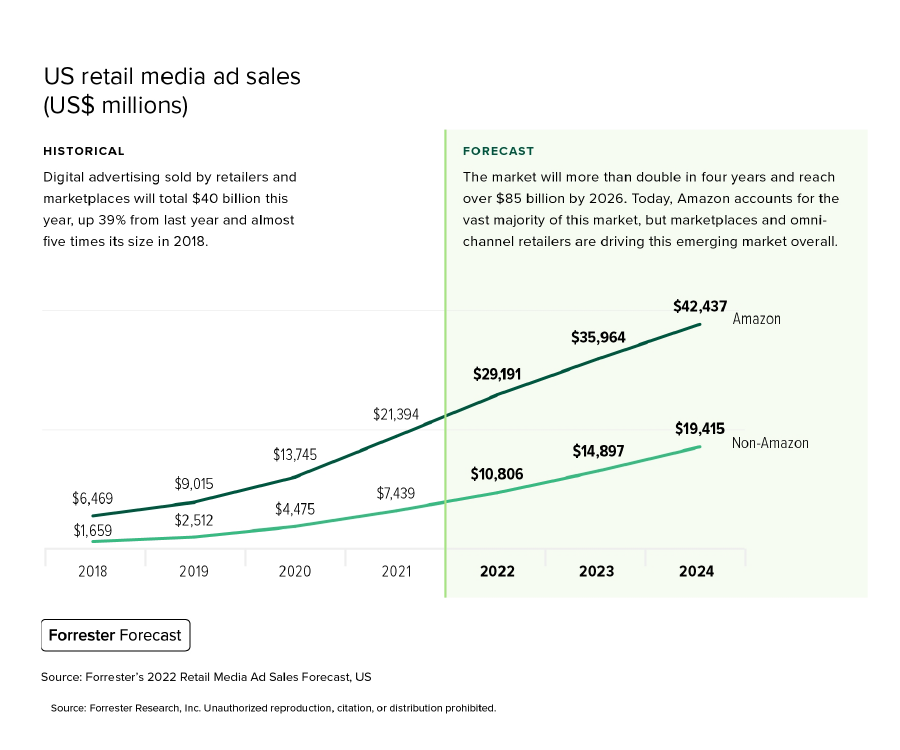
In the next four years, Forrester Research projects that U.S. retail media ad sales will double to reach 85 billion by 2026.1
Most of this growth is catalyzed by CPG and consumer electronic brands that have a scarcity of zero- and first-party data; they need more media closer to the point of purchase, especially as CFOs are scrutinizing budgets.
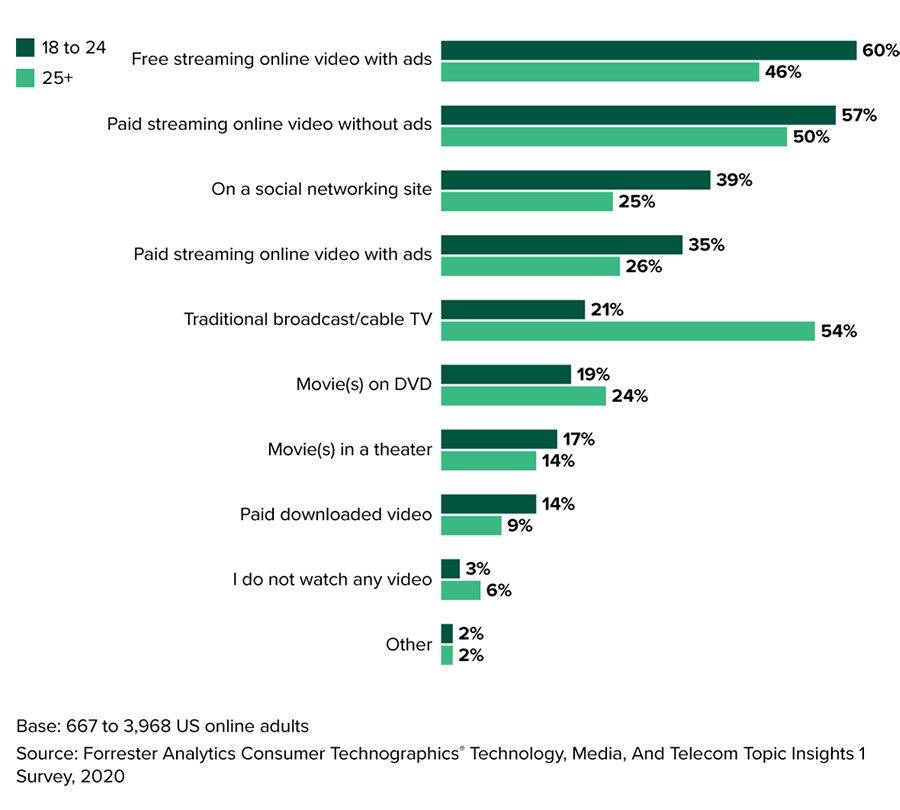
Consumption continues to fragment
It’s becoming harder than ever to reach the right person, at the right time, predict their intent, and get a 360-degree view of your customer.2
Data deprecation is top of mind
According to Forrester Research, updating their data strategy to address data deprecation is the number one priority for marketers. Addressing data deprecation is also a priority for consumers, who increasingly feel that audience targeting is more intrusive than beneficial.3
Data deprecation affects identity solutions
Third-party data and mobile ad IDs (MAIDs) are the connective tissue for identity solutions. As we see those signals go away, there are fewer linkages to resolve identity and it’s leading to a rise in fragmented, duplicated, and shallow identity.
Recession fears
In addition to everything happening in AdTech, there are also fears of a possible recession. According to Forrester, 40% of Gen Z and 41% of Millennials believe fears of an upcoming recession are greatly exaggerated. On the other hand, only 24% of Gen X and 12% of Baby Boomers agree.4
Navigate uncertainty and marketing in a recession
With the current macroeconomic conditions, data deprecation, and fragmented consumption in mind, what should your strategy look like for marketing in a recession? Forrester recommends three strategies:
- People-led planning
- Test creative
- Optimize for marginal costs
People-led planning
Planning doesn’t have to be fragmented. Map offline and online media exposures to consumer decision journeys. Strategies like lifetime value (LTV) driven audience segmentation to correlate awareness at top of the funnel layered with demand generation exposures harvested later in the funnel. To do this, it’s crucial to work with providers that give you visibility into the audience buyer’s journey to awareness, intent, consideration, and purchase, all the way through to loyalty.5
Test creative
Make your creative work harder for you. Apply the same rigor with your creative that you applied to segmentation. Utilize multivariate testing to identify creative that is winning or losing. When you understand how each variable performs, you can scale the variables with creative optimization to have a material impact on performance.
Optimize for marginal costs
Optimize for marginal costs of acquisition, not just the average. Adjust for incrementality – what is the cost to acquire one more customer, rather than the average cost of acquisition.
Find the right marketing mix in a recession
With these changes in mind, how can you find the right marketing mix in a recession? We can show you the way.
You can create the right marketing mix with three key ingredients:
- Audiences
- Identity
- Activation
Let’s explore each ingredient to start you down the path toward marketing campaign success.
Audiences: Know your customer
The first ingredient to add to your marketing mix in a recession is your audience. Knowing your customer is key to targeting the right audiences successfully. Data-driven targeting can help you find your best audiences based on demographics, modeled lifestyles, and behaviors to improve marketing campaign performance.
Not sure where to start when it comes to developing your target audience strategy? We can help. We track digital usage of our data used by advertisers and identified the top four digital audiences that advertisers purchased over the last four years.
Four digital audiences to consider
Marketing strategies are only as strong as the data foundation they’re built on. The top four digital audiences that advertisers are purchasing from Experian include:
- Demographics
- Behavioral
- Modeled Lifestyles
- Custom Audiences
Demographics
Examples include age, gender, relationship status, living situation, life experience, and employment.
Behavioral
This audience allows marketers to identify households that are more likely to engage in certain activities or belong to certain groups.
Modeled Lifestyles
Experian’s Mosaic® USA segmentation. This is a household-based consumer lifestyle segmentation system that classifies all U.S. households and neighborhoods into 71 unique types and 19 overarching groups, providing a 360-degree view of consumers’ choices, preferences, and habits.
Custom Audiences
This is an audience blended from multiple sources or derived from first-party look-alike modeling.
Changes in digital audience strategies
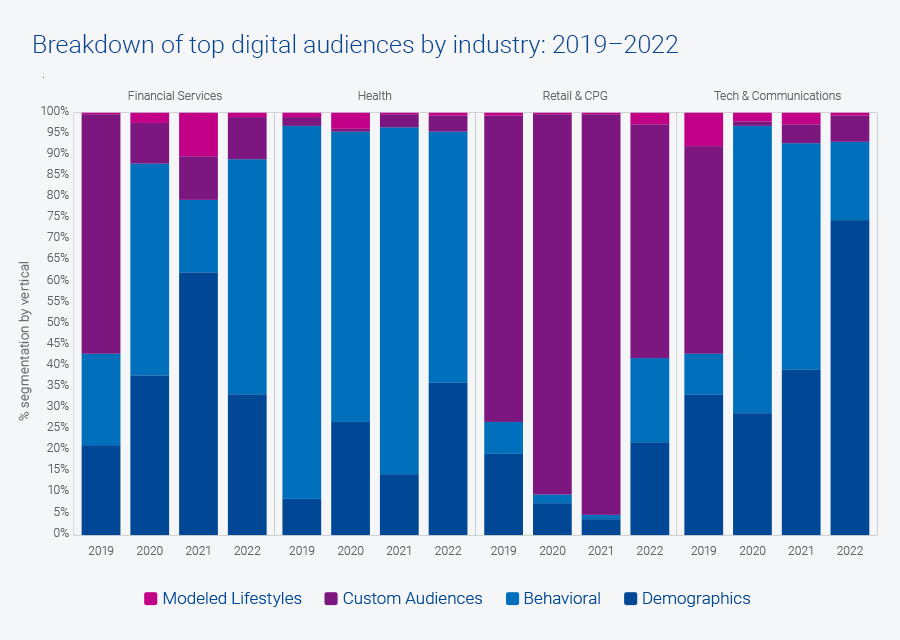
Over the last four years, Modeled Lifestyles and Custom Audience purchases represented the smallest share of digital activation, while Behavioral and Demographic segments were more popular with advertisers.
When the U.S. rolled out the COVID-19 vaccine, consumers became more active. People were shopping in stores, returning to the gym, and taking trips that they had postponed during the height of the pandemic. Marketers turned to higher compositions of Demographic and Modeled Lifestyles to reach these audiences between April and December of 2021.
Sustained growth in Demographic audience activation could suggest a move back to tried and true audience strategies as signals continue to decline and amid evolving regulation. With economic uncertainty, marketers return to what they know. Traditional targeting methods like Demographics and Modeled Lifestyles are the baseline of many marketing strategies and we predict that we will continue to see marketers activating against these data sets.
Download our 2023 digital audience trends and predictions report to discover our full insights on how digital activation has changed and where we’re headed.
Identity: Understand the customer journey
Identity resolution is the next ingredient that you should add to your marketing mix in a recession. It should be a foundational element of every marketer’s strategy.
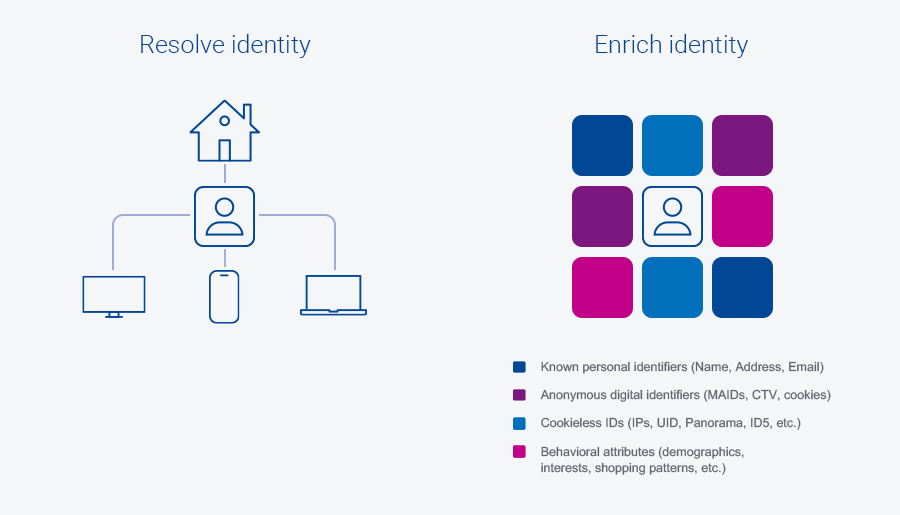
What is identity resolution? In the simplest terms, identity resolution is the process of matching different devices, IDs, and touchpoints back to a single person. Identity resolution expands marketers’ addressability and reach of their target audience and helps inform and measure accurate customer journeys.
Identity resolution challenges
Identity resolution faces two main challenges:
- Making the data actionable. Humans are complex. We have behaviors that change based on our current social groups and life events, we use dozens of internet-connected devices in a single day, and we exhibit distinct behaviors that happen online and in the physical world. This means marketers have mounds of data being collected from different channels based on that dynamic behavior of people, making it feel impossible to organize the data in a way that makes it feel actionable, know how it ties back to real humans, and ensure they’re doing it in a responsible and compliant way.
- Signal loss. Marketers continue to lose important signals that they’ve previously been able to rely on to inform their next move. Signals are being lost as our industry places more privacy regulations and restrictions on what can be tracked and as consumers themselves change behaviors to protect their privacy.
As consumer behaviors continue to change and signals disappear, identity resolution gets exponentially harder.
Expand addressability and reach with identity resolution
Data deprecation adversely affects identity solutions, but identity resolution should be a key ingredient in your marketing mix. Identity resolution ensures that consumers experience more relevant products, offers, and messaging – allowing you to reap the ROI benefits of hitting consumers at the perfect point in their journey.
Finding an identity resolution partner
When selecting an identity resolution partner, you should understand the data and processes that are implemented behind the scenes. It’s important to know:
- What makes up their consumer database?
- How fresh is their data?
- What identifiers can they match?
- How do they protect consumer privacy?
At Experian, we’re rooted in deterministic offline data which creates a stable foundation. We then layer in digital and behavioral touchpoints. We have decades of experience managing consumer data safely. We have insights on 250 million individuals, three billion devices, and one trillion device signals. Our databases evolve as quickly as the human behavior powering them does.
Our approach to identity resolution is open and agnostic. This means we can collect and ingest nearly all available offline and online identifiers. We can do this in all types of environments, including connected TV (CTV), mobile, and cookieless. We have two types of identity resolution:
- Offline
- Digital
This ensures we control how known and anonymous data points are connected for consumer privacy purposes.
Identity resolution in action
Our depth of data gives our clients access to see the whole human and gain the context around singular data points.
Let’s walk through an example of our identity resolution capabilities.
Challenge
Our TV media platform client needed to measure the effectiveness of an ad campaign they were running on behalf of a leading consumer electronics brand. The TV platform wanted to be able to accurately report on which consumers made a purchase after seeing the brand’s TV commercial on their platforms.
Solution
Using our digital identity resolution services, our client could capture online purchases made on the brand’s website and link them back to a consumer profile. In addition to online transactions, our client used our offline resolution services to resolve email addresses of consumers that purchased offline, using warranty registration details.
With online and offline purchase data now resolved back to an individual ID, we also performed identity resolution on viewers in their TV subscriber files that had also been exposed to the TV commercial. This allowed us to identify subscribers that had both seen the ad and purchased a product.
We provided our client with a packaged report that they could white-label and pass along to the brand.
Results
By providing this attribution reporting to the brand, the TV platform could validate the ROI spent on their platform. The brand was extremely satisfied with the results, and they transitioned the one-off TV commercial into an ongoing campaign and purchased quarterly measurement. This led to solid recurring revenue for the TV platform.
Activation: Experiment and measure the impact
The third and final ingredient to finding the right marketing mix in a recession is activation. Experimentation is the best way to determine which channels work best for your business and provide the most ROI.
Demand-side platforms (DSP), video platforms, and sell-side targeting are three important activation channels that you should consider experimenting with.
Demand-side platforms
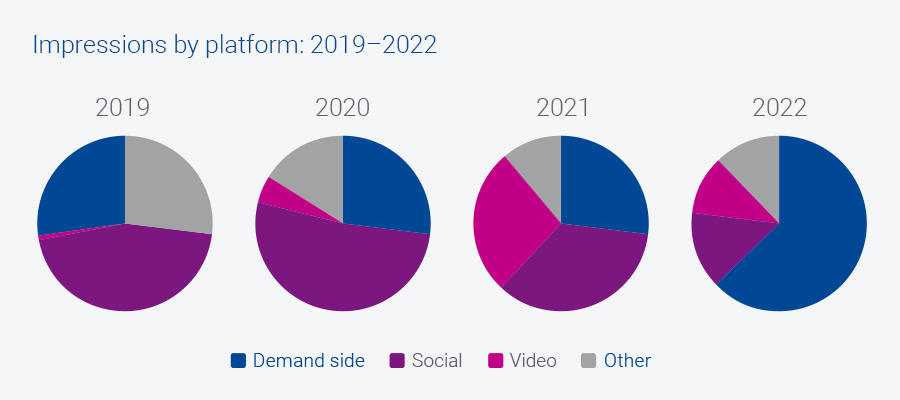
We continue to see increased demand for environments where alternative identifiers are being transacted (like DSPs and video). Social channels are decreasing; this can be attributed to changes in privacy, security, and concerns around brand safety.
Amazon’s DSP is catching up with Google and Meta to become a top ad platform.
Video platforms
Digital video and other video channels like over-the-top (OTT) and CTV will continue to grow. Digital video will capture the most ad spend in 2023 (22.4% in 2023 vs 19.3% in 2022). Because of this, advertisers are placing bigger bets on the combination of addressable and CTV.
Sell-side targeting
Data sharing relationships will become strongest on the sell-side as we move toward consented first-party data. Ad dollars are shifting to channels that use the sell-side approach, like retail media and CTV.
Sell-side targeting enables brands to access large amounts of inventory across publishers and retailers. By getting closer to the ad inventory, advertisers can future-proof their strategies by having more access to better data signals. Direct relationships like these will be necessary as privacy regulations increase and signal loss continues.
We can help you find the right marketing mix in a recession
Now is the time to be opportunistic. Gaining share of voice during a downturn is cost-effective. Proactive marketing builds pent-up demand.
Delivering the right message in the right place at the right time means truly knowing your prospects and customers as individuals. At Experian, we bring you the highest-resolution picture of people, so you and your customers can connect with confidence.
You can turn prospects into customers with the right audience. By understanding your customers better, you can find more like them. Together we can power better results.
Find the right marketing mix
Check out our webinar, “Find the right marketing mix with rising consumer expectations.” Guest speaker, Nikhil Lai, Senior Analyst from Forrester Research, joined Experian experts Erin Haselkorn and Eden Wilbur. Watch the recording to learn:
- New data on the complexity and uncertainty facing marketers
- Consumer trends for 2023
- Recommendations on finding the right channel mix and the right consumers
Get in touch
Sources
- 2022 Retail Media Ad Sales Forecast, US. Forrester Research, Inc. 2022.
- Forrester Analytics Consumer Technographics® Technology, Media, and Telecom Topic Insights 1 Survey. Forrester Research, Inc. 2020.
- CMO Pulse Survey. Forrester Research, Inc. July 2021.
- Forrester’s Consumer Energy And Retail Online Survey. Forrester Research, Inc.
- People-Led Planning Solves Customer Problems to Drive Growth. Forrester Research, Inc. August 2, 2021.
Latest posts

Retail media networks (RMNs) rank among the fastest-growing media channels. According to eMarketer, retail media spend is forecasted to account for more than a fifth of overall digital spending in 2025, and retail media spend will grow by 21.8%. For RMNs, the path to realizing this opportunity is marked by navigating through a series of critical stages, each with its own set of challenges and solutions. Retail media strategies Simply put, RMNs need to know who their customers are, where they are, and how to reach them to succeed. But we know nothing is that simple. This blog post reviews the three pivotal stages of RMN success, offering a roadmap for networks aiming to optimize their operations and claim their share of the rapidly growing category. Stage 1: Develop a data foundation In a world where traditional tracking methods are fading, first-party data has become essential for targeted advertising. Retailers have a wealth of this valuable data due to their direct consumer relationships. The initial step in establishing an RMN is to organize and utilize this data effectively. Steps to develop a data foundation: Organize data: Bring together fragmented shopper data, loyalty program information, and other customer data into a unified location. Clean and deduplicate this data to create consistent customer profiles. Enhance profiles: Gain insights into your customers and your brand’s customers so you can learn who your best, lapsed, and non-customers are. Append additional attributes to your shopper data, including media consumption habits, lifestyle preferences, demographic information, and more. Use identity graphs: Identity providers, like Experian, enable you to learn about the anonymous – and known – visitors on your platform and organize disparate customer data points into households. This will allow RMNs to connect addressable identifiers to the household, making it easier to reach customers across channels. Create audience segments: With a solid data foundation, RMNs can build audience segments beyond basic shopper data. These segments will make your data more attractive and actionable for media buyers. For example, consider a retailer that knows its shoppers are primarily young professionals, but a CPG brand wants to target not only these shoppers but also young professionals who are parents. By partnering with an identity solution provider like Experian, the retailer can append additional data to identify and target the young parents within their existing customer base, enabling the CPG brand to reach both audience segments effectively. “Retail media networks thrive on clean, accurate, and actionable data. Simply put, it's crucial to know who your customers are, when they're most engaged, and where to reach them to drive effective marketing strategies and maximize ROI.”anne passon, sr. director, sales, retail Stage 2: Become a publisher for optimal retail media growth The next step for RMNs is to transition from building a data foundation to helping marketers reach their target audience, essentially becoming a publisher. This involves two main processes: organizing advertising inventory and connecting it to demand. Steps to become a publisher: Audit and organize inventory: Conduct a thorough review of all existing ad spaces, including websites, apps, and in-store placements. Identify gaps and consider creating new advertising opportunities, such as website and app features, interactive digital experiences, or expanded in-store touchpoints. Connect inventory to demand: Integrate the organized inventory with platforms, allowing advertisers to access it easily. This often involves using supply-side platforms (SSPs) and demand-side platforms (DSPs). Continuing with our example, the CPG brand can work with its DSP or SSP partners and easily access your ad inventory, and effectively target the young professional and young parent audience segments. Stage 3: Scale inventory for retail media growth As RMNs progress to the final stage of their success journey, they may face the challenge of limited inventory within their owned and operated (O&O) channels. To meet marketers' expansive reach requirements and to continue to drive growth and profitability for their organizations, RMNs must expand their inventory beyond O&O. Steps to scale inventory: Utilize data collaboration tools: Clean rooms allow secure merging and enrichment of data from various sources, creating richer audience profiles while maintaining privacy. Resolve identity and enhance addressability: Identity graphs help resolve known customer identifiers (e.g. emails) into addressable IDs (e.g. mobile IDs and connected TV IDs), which can be used to reach customers across all the platforms they consume media. Expand audience reach: Onboarders, like Experian, help extend data and audiences to programmatic destinations beyond a retailer's O&O inventory. By mapping audiences to digital identifiers maintained by identity partners, RMNs can significantly widen their reach, meeting advertisers' needs for engaging with broader and more diverse audience segments. The CPG brand can now reach young professionals and young parents on the retailer’s platform and in all the other places where they consume media, like watching their favorite shows on connected TV (CTV) or browsing the web on their phones. Measurement across stages for retail media growth Measurement is crucial and must be conducted during and after a campaign to understand and validate performance. Here are two types of measurement to consider: Cross-device campaign measurement: Measure performance by connecting an ad exposure in one environment (e.g. CTV) to an action in another (e.g. mobile purchase). This holistic, cross-device approach requires a partner for identity resolution as it will ensure that the impact of a campaign is fully understood. Aggregate performance analysis: Understand performance in aggregate across several campaign studies. Receive independent third-party measurement validation that you can promote to advertisers to drive increased spend. For our CPG brand, these measurement reports ensure that they can track the performance of their campaigns from the initial exposure on a CTV to the final purchase made on a mobile device, providing comprehensive insights and validation of their advertising strategy. The retailer can aggregate these studies and promote their network’s effectiveness to prospective advertisers. Accelerate retail media growth with strategic partnerships The journey through the stages of RMN success is riddled with deep technical challenges that are often beyond the institutional capabilities of non-media businesses. The intricacies of data management, audience insights, identity resolution, precise cross-device targeting, and measurement require specialized expertise and technologies that may not be readily available in-house. RMNs stand to benefit from forging strategic partnerships with companies that possess not only the necessary technological tools but also a profound understanding of the media landscape. The steps outlined here will accelerate your growth and ensure you capitalize on the opportunity in front of you. Connect with a member of our team to learn how we can support your journey toward RMN success. Contact us to enhance your retail media strategies Latest posts

Get ready for Cannes Lions 2024—the advertising industry is buzzing with excitement. This year's event promises to be a center of innovation, ideas, and networking. Here are five themes we expect will take center stage in conversations and how Experian can help marketers be prepared for what’s ahead. Cookie deprecation and signal loss At Cannes Lions 2024, the theme of transitioning to a cookieless advertising ecosystem is likely to dominate discussions. The saga of cookie deprecation continues to unfold, with Google recently pushing back the demise of third-party cookies once again. Experian remains fully committed to prioritizing continued testing of different industry solutions, including the Google Privacy Sandbox, to help customers prepare for a future without cookies. We've identified six viable alternatives to third-party cookies, how these alternatives fall short, and how Experian can help you navigate these alternatives. With Experian, the loss of cookies does not equate to a loss of coverage. With our strong roots in offline data and significant investments in our Graph, Experian ensures uninterrupted and effective marketing with robust signal coverage, with or without cookies. Based on early tests, we expect our Graph to maintain 97% of its household coverage. Read how MiQ, a leader in the cookieless era, strengthened its Identity Spine with the integration of Experian’s cross-device Graph here. Commerce The theme of commerce is poised to be a central topic of discussion at Cannes Lions 2024, reflecting the emergence and growth of retail media networks (RMNs). Evolving customer expectations are a key driver, with consumers demanding seamless and personalized experiences across all touchpoints of their shopping journey. The importance of bridging physical and digital experiences to create a cohesive customer journey will undoubtedly feature prominently in discussions at Cannes. Experian's Consumer Sync offerings facilitate seamless integration between online and in-person interactions, fostering a cohesive approach to engaging audiences across various platforms while measuring campaign effectiveness. As we heard at Shoptalk 2024, the evolution of retail media is propelling us into a new era of advertising and first-party data monetization. The integration of e-commerce with advertising presents an exciting opportunity for brands to drive direct sales through ads displayed within retail platforms, blurring the lines between marketing and commerce. Our Consumer View solutions provide access to over 5,000 demographic and behavioral data points, enriching your customer profiles for deeper insights. By combining first-party data with Experian's industry-leading data sets, you can create bespoke audience segments that drive increased return on investment (ROI), going beyond conventional category-based targeting strategies. Looking ahead, the future outlook for RMNs remains promising, with anticipated growth and expansion as brands increasingly recognize the value of reaching consumers precisely at the point of purchase. Connected TV At Cannes Lions 2024, we anticipate discussions to focus on how connected TV (CTV) can continue to live up to its promise. CTV is the most rapidly expanding advertising channel in the U.S and 95% of advertisers plan to increase their share of spend on programmatic CTV in 2024, according to The Trade Desk's latest CTV report. The growing adoption of CTV among viewers, driven by factors like quality content, reduced ad interruptions, and cost-saving alternatives to traditional cable, signals a shift in consumer behavior that marketers cannot afford to overlook. Experian supports the growth of advertising interest in CTV through our signal-agnostic Graph that connects CTV IDs, universal IDs like Unified I.D. 2.0 (UID2), IPs, and mobile ad IDs (MAIDs) for effective activation. Our digital identity resolution with Activity Feed provides insights into CTV viewership behavior, linking CTV exposure to e-commerce conversions. CTV also enables greater collaboration, and we've recently announced new partnerships with CTV industry leaders Microsoft, Samsung, Attain, Sonobi, and EDO. Consumer privacy Consumers are increasingly aware of privacy concerns surrounding their data and numerous laws are going into effect across the U.S. at the state level. Most recently, there has been momentum on a federal data privacy law. We expect consumer privacy to be a significant topic of discussion at Cannes Lions 2024, reflecting the growing importance of ethical data practices in advertising. In a recent Q&A with Datavant, Jeremy Meade, VP of Marketing Data & Product Operations at Experian, highlights the importance of balancing data privacy and utility, focusing on "data for good" practices while using de-identification techniques to support research without compromising consumer privacy. Our Geo-Indexed audiences are an example of how Experian can help you reach your audience while balancing data privacy and accuracy. Our Geo-Indexed audiences combine location data with audience insights to deliver targeted marketing solutions. These audiences are created without the use of sensitive personal information, so you can confidently reach your target audience without sacrificing data privacy. With deep roots in data protection and security, you can confidently partner with Experian as we proactively stay ahead of regulations and strictly follow all consumer privacy laws. Campaigns and competition The theme of campaigns and competition is poised to be an important discussion point, driven by the convergence of major global events like the U.S. presidential election and this summer’s games—both occurring once every four years. These landmark occasions present opportunities for marketers to craft targeted campaigns that resonate with specific audience segments. As we approach the 2024 election season, the advertising landscape is primed for growth, with political ad spending projected to exceed $10 billion. Effective audience targeting during this crucial period can sway voters, shape public opinion, and influence election outcomes. Experian's 240+ politically relevant syndicated audiences, including our 10 political personas, enable a nuanced understanding of voter viewpoints and empower tailored engagement strategies to connect more effectively with constituents. At the same time, this summer’s games in Paris offer a unique opportunity for sports marketing. With one billion viewers expected to tune in, the global spectacle presents a platform to engage with passionate sports audiences worldwide. Using Experian's syndicated audiences, marketers can precisely target sporting goods shoppers, avid fans, athletes, and spectators alike. The combination of these major events emphasizes the need for careful planning and data-driven strategies and marketers should take advantage of the excitement surrounding both events. Follow us on LinkedIn or sign up for our email newsletter for more informative content on the latest industry insights and data-driven marketing. Contact us Latest posts

With the back-to-school season approaching, marketers are preparing to engage both eager students and parents. Our Q&A video with Experian experts shares our predictions and tips for the 2024 back-to-school season so you can craft effective back-to-school marketing campaigns. From early campaign launches to the rise of online shopping and budget-conscious consumer behaviors, let’s explore what lies ahead and how brands and agencies can prepare. What separates Experian's syndicated audiences Experian’s 2,400+ syndicated audiences are available directly on over 30 leading television, social, programmatic advertising platforms, and directly within Audigent for activation within private marketplaces (PMPs). Reach consumers based on who they are, where they live, and their household makeup. Experian ranked #1 in accuracy by Truthset for key demographic attributes such as Presence of Children. Access to unique audiences through Experian’s Partner Audiences available on Experian’s data marketplace, within Audigent for activation in PMPs and directly on platforms like DirectTV, Dish, Magnite, OpenAP, and The Trade Desk. Watch the highlights from our video below. Three trends for the 2024 back-to-school marketing season Campaigns will start earlier We expect back-to-school marketing efforts to kick off earlier than usual. Brands will launch campaigns with special promotions to secure mind and market share ahead of competitors. Additionally, the traditional back-to-school season is extending, urging marketers to prolong their campaigns to capture the attention of consumers who are taking more time to make purchasing decisions. Online shopping will continue to rise The surge in online shopping during the pandemic has become a lasting trend – and is especially appreciated by busy parents seeking convenience. Brands should focus on enhancing online and mobile shopping experiences, including options for in-store pickup and delivery. Marketers should prioritize their online presence and optimize e-commerce platforms, including experimenting with shoppable ads on connected TV (CTV), to meet the needs of families shopping for back-to-school supplies. Budget consciousness is top of mind With inflation on the rise and tighter budgets at home, households are becoming more selective in their back-to-school spending. Marketers should align their efforts with value-driven products and prioritize advertising that resonates with these financial priorities. Strategies for brands and agencies Next, let's explore strategies brands and agencies can use to prepare for the upcoming back-to-school season. Brands First, we'll highlight three recommended strategies for brands. Maintain an evergreen presence Launch your back-to-school campaigns early and maintain a steady presence throughout the season. Experian's TrueTouchTM audience insights can guide your channel selection for maximum impact, helping you decide on key channels such as email, digital video, or specific social media platforms. Build loyalty programs that deepen customer relationships Use your customer data to create loyalty programs that foster stronger connections with your audience. By using insights from Experian, you can gain a holistic understanding of customer profiles and identify potential back-to-school prospects within your existing customer base. On average, Experian has 250 behavioral and demographic marketing attributes per individual, which means we can decorate households and people with marketing data to get a full customer profile and fill in any gaps you have on your audience. Prioritize value and convenience Offer flexible shopping options like in-store, online, and buy online, pick up in-store (BOPIS) to cater to busy families. Partner with services like Shipt or Instacart to streamline shopping experiences. Agencies Now, we'll share two ways agencies can effectively prepare for the back-to-school season. Engage early and extend your campaigns Initiate conversations with brands earlier to ensure timely planning and execution. Extend campaign durations to capture late-decision makers. Adapt your channel strategies Shift focus to digital channels like CTV and social media, aligning with evolving consumer habits and preferences. Experian works with major platforms, marketers, and agencies, which means we have existing partnerships across the ecosystem for you to connect with and bring your consumer data to life to meet your needs. Watch the full Q&A The 2024 back-to-school season promises new challenges and opportunities for marketers. By starting campaigns earlier, optimizing online experiences, and aligning with budget-conscious consumers, brands and agencies can position themselves for success. Watch our full Q&A video where our experts cover: Tactics we predict marketers will employ to navigate signal loss Which channels will be the most successful Recommended audiences for targeting And more! Watch now Need a custom audience? Reach out to our audience team and we can help you build and activate an Experian audience on the platform of your choice. Additionally, work with Experian’s network of data providers to build audiences and send to an Audigent PMP for activation. Contact us Latest posts