At A Glance
Experian introduces a solution for commerce media networks (CMNs) that connects first-party shopper data with trusted identity, audience, activation, and measurement capabilities. Brands gain deeper shopper insight, broader off-site reach, and closed-loop measurement across channels, with a clear path to incremental media revenue.Experian is introducing a solution designed specifically for commerce media networks (CMNs) to capture more advertising revenue. This solution connects brands’ first-party shopper data, combining it with Experian’s #1 ranked identity and audience services. Together, these capabilities help CMNs gain deeper customer insight, build richer audiences for activation, extend reach outside of their owned and operated inventory, and run real-time measurement and attribution.
Why are commerce media networks investing in audience and identity solutions?
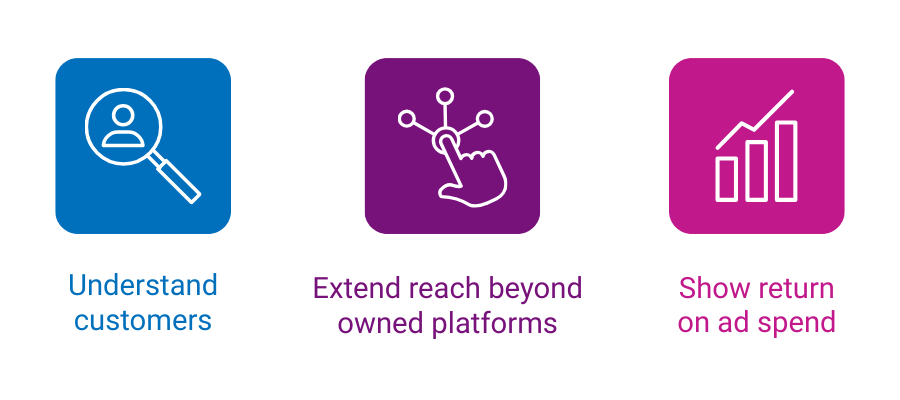
CMNs now play a central role in how brands reach high-intent shoppers. CMNs are expected to offer more than on-site placements. Advertisers want broader reach, consistent targeting, and proof of performance. Experian’s solution is built to address those expectations by helping CMNs turn common challenges, including limited audience visibility and reach, and growing demand for programmatic access, into revenue opportunities. By working with Experian, CMNs can better understand their customers, extend reach beyond owned platforms, and show return on ad spend as shoppers move from ad exposure to purchase.
How does Experian help commerce media networks grow media revenue?
As commerce media continues to expand, success depends on understanding shoppers and monetizing that knowledge responsibly. Experian’s solution supports CMNs across identity, audience development, activation, and measurement, with benefits designed to support growth.
Identity resolution
Every CMN captures authenticated first-party data, whether collected online or offline. On its own, that data represents only a portion of a customer or household’s addressable footprint. By connecting to Experian’s identity graphs, CMNs gain a broader view of their customers across offline and digital environments, supported by coverage across 126 million households, 250 million individuals, and 4.2 billion digital IDs.
Expanded insights
Understanding shoppers at scale is critical for commerce media networks looking to differentiate their offerings and grow media revenue. Beyond data hygiene, Experian enables CMNs to build customer profiles that go deeper than purchase behavior alone, incorporating demographics, lifestyle attributes, TrueTouchSM, Mosaic® USA, and more.
These insights help CMNs better understand who their audiences are, identify high-value segments, and create unique, differentiated audiences at scale. By offering brands a clearer view into shopper behavior and intent, CMNs can attract the right brand partners, support more effective activation strategies, and position their network as a premium destination for commerce media investment.
Create audiences
CMNs can enrich first-party data with Experian Marketing Data to build custom segments for advertisers. With more than 5,000 Marketing Attributes available, CMNs can help advertisers reach first-party audiences enhanced with data based on demographics, media preferences, and behavioral signals.
Maximize reach and distribution
Experian’s Third-Party Onboarding capabilities allow CMNs to move audiences from owned platforms into programmatic, television, and social channels. Through Experian’s network of more than 20 platforms, including The Trade Desk and Magnite, CMNs can extend audience reach and create new monetization opportunities. Self-service tools, native integrations, and transparent pricing support efficient activation.
Through Experian’s Curated Deals, CMNs can make their data usable in private marketplaces (PMPs), offering unique data for advertisers to build their PMPs. This helps advertisers obtain more reach, achieve their intended outcomes,and offers CMNs another way to monetize their data.
Demonstrate success
CMNs need clear, trusted measurement to support advertiser investment. Experian’s Activity Feed empowers CMNs to run attribution, so they can show their clients the impact their data delivered. It does this by connecting ad exposures and consumer touchpoints across environments, including web and connected TV (CTV), to households and individuals, making the link between ad exposure and consumer action clear.
Case study: How Experian enhanced addressability for a leading retail media network
A leading RMN has worked with Experian since 2021 to better understand its customers, organize first-party shopper data, and activate audiences across the digital ecosystem. Experian supported this RMN in reducing reliance on third-party cookies by anchoring shopper data to more stable digital identifiers, including mobile ad IDs (MAIDs), hashed emails (HEMs), CTV IDs, and Unified ID 2.0 (UID2).
As a result, addressability across owned platforms and programmatic channels increased by nearly 300%. This improvement supported more consistent reach and measurement throughout the shopper journey.

“Accurate data is the backbone of effective commerce media strategies, and Experian’s top-tier data solutions are critical for precise targeting and audience delivery. Experian’s advanced capabilities in data onboarding, customer audiences, and robust identity graphs allow advertisers to seamlessly reach the right audiences.”
NexChatper IncArt Sebastian, CEO
What value does Experian bring to commerce media networks?
Experian supports CMNs with a combination of identity, data quality, and ecosystem connectivity.
How can commerce media networks partner with Experian?
Experian’s data and identity solutions help commerce media networks make the most of their opportunity. By connecting shopper insight to activation and measurement, CMNs can strengthen advertiser relationships and grow revenue.
Connect with a member of our team to learn how Experian can support your commerce media strategy.
Connect with us
FAQs
Experian’s solution for CMNs connects first-party shopper data with identity, audience, activation, and measurement capabilities. Commerce media networks use it to expand reach, support advertisers, and measure outcomes across channels.
Identity supports commerce media performance by connecting shopper data across devices, channels, and environments. This connection supports consistent targeting, broader reach, and measurement tied to real purchases.
Yes. Experian enables activation across programmatic, television, and social platforms through Third-Party Onboarding, direct platform integrations, and Curated Deals through PMPs.
Experian supports closed-loop measurement for commerce media networks through Activity Feed. Activity Feed links exposures and online actions to households and individuals, enabling CMNs to easily run attribution. With Activity Feed, commerce media networks can show how media contributes to shopper behavior and sales.
Latest posts

Learn how Experian and Audigent are using privacy-first strategies, first-party data, and contextual targeting for scalable solutions.

From the rise of curation to commerce media consolidation, explore the four themes we expect everyone to be talking about at CES 2025.

Our top 10 list is designed to assist agencies and media buyers with q1 audience targeting based on the top audiences activated in Q1 2024.