A successful back-to-school campaign strategy starts with identifying the key audience segments to target. Over half of all searches related to back-to-school happen within a select group of consumers – knowing which ones can go a long way in forming an effective marketing strategy. Focus on this smaller, targeted set to maximize your efforts.
With over $72 billion projected in total U.S. back-to-school retail sales this year, you can capture more spend than ever before during this big shopping season by tailoring your strategy to a smaller set of targeted shoppers. Experian data can help you make the most of your back-to-school campaigns by uncovering the top five back-to-school audiences.
What separates Experian’s syndicated audiences
- Experian’s 2,400+ syndicated audiences are available directly on over 30 leading television, social, programmatic advertising platforms, and directly within Audigent for activation within private marketplaces (PMPs).
- Reach consumers based on who they are, where they live, and their household makeup. Experian ranked #1 in accuracy by Truthset for key demographic attributes such as Presence of Children.
- Access to unique audiences through Experian’s Partner Audiences available on Experian’s data marketplace, within Audigent for activation in PMPs and directly on platforms like DirectTV, Dish, Magnite, OpenAP, and The Trade Desk.
Five audience segments for 2023
Our data provides key insights into who these shoppers are and how to reach them, allowing you to create personalized content tailored to their needs. What are the top five audiences you should add to your 2023 back-to-school campaign?
- High-Net-Worth Households
- Bilingual Multi-Generational Households
- Suburban Savvy Shoppers
- Young Suburban Families
- Tech-Savvy Families
What do these audiences look like? Who are they? Where do they shop? Let’s review each audience in a little more detail.
High-Net-Worth Households
This group consists of households with above-average income and education levels. They often lease luxury cars, purchase products in every channel, travel extensively, and are philanthropic supporters of the arts.

Key features
- Wealthy
- Highly educated
- Lease luxury cars
- Purchase products in every channel
- Travelers
- Philanthropic supporters of the arts
Bilingual Multi-Generational Households
Large households in multilingual neighborhoods, filled with married parents and their kids. They are financially cautious, bilingual, and participate in team sports.

Key features
- Bilingual
- Large households
- Married with kids
- Financially cautious
- Team sports
Suburban Savvy Shoppers
Middle-aged couples and families who earn above-average incomes, maintain active lifestyles, and spend their money on quality home products and furnishings.

Key features
- Affluent
- Athletic activities
- Home products & furnishings
- Sporting goods
- High-priced children’s clothing
Young Suburban Families
This segment includes households in the middle child-rearing stages of life, typically with a dual income household and multiple children of school age. They typically have spacious single-family residences in suburban neighborhoods that are slightly above average in housing values. On weekends, these suburban young families often engage in activities like skateboarding, biking, and video games with their children.
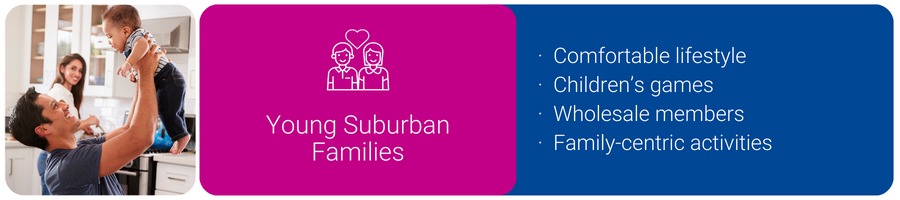
Key features
- Comfortable lifestyle
- Children’s games
- Wholesale members
- Family-centric activities
Tech-Savvy Families
Highly educated, affluent couples in their peak earning years, with a preference for both traditional and digital media, who live in upscale housing and are savvy investors and environmental philanthropists.

Key features
- Highly educated
- Affluent
- Upscale housing
- Savvy investors
- Environmental philanthropists
- Tech apprentices
Watch our 2024 video for tips from industry leaders for back-to-school
In our new Q&A video with Experian experts, we explore changing consumer behaviors surrounding back-to-school shopping in 2024. In the video, we discuss:
- Anticipated shifts in consumer behaviors and shopping habits
- Tactics we predict marketers will employ to navigate signal loss
- Which channels will be the most successful
- And more!
Need a custom audience? Reach out to our audience team and we can help you build and activate an Experian audience on the platform of your choice. Additionally, work with Experian’s network of data providers to build audiences and send to an Audigent PMP for activation.

Contact us
Latest posts

Email hashing was originally intended to be used as an email security feature that has ended up being a very powerful marketing tool. A hashed email is a cryptographic function that changes an email address to a random code which can be used as an anonymous customer identifier. This code is privacy-safe and cannot be traced back to the customer’s email address. However, this hashed email can function like a digital passport that traces every behavior and action a customer takes when logged into an account that is authenticated with an email, making hashed emails a goldmine for customer data. Today emails are used across traditional publishers and within the CTV ecosystem; tying them to more consumer touch points than ever before. Why the emphasis now? Cookies are on their way out the door and have been the primary way that many marketers have tracked their existing and potential customers. In order to replace this granular level of data, marketers are likely going to need multiple solutions. With so many cookieless solutions and IDs appearing in the marketplace, the mapping of the customer journey is bound to be fragmented. Relying on first-party data, such as hashed email, is just one way to reduce that fragmentation; as it can serve as an authenticated starting point for cross-device identity resolution that can be leveraged for targeting, personalization and measurement. How can Tapad + Experian help? Tapad + Experian's Hashed Email Onboarding is a privacy-safe way to connect consumer email addresses to their related digital devices and other digital identifiers through high precision probabilistic identity. By onboarding hashed emails and incorporating them within your Tapad Graph file you can: Build a more holistic view of individuals and households and their relationship to email addresses in your first-party data set Leverage these relationships for increased cross-device scale for targeting Employ personalization tactics at the household or individual level across devices Create new audience segments and look-alike models for cross-channel activation Design more inclusive measurement and attribution for customer journey mapping Tapad, a part of Experian has built a hashed email onboarding product feature that works with the existing flexibility of The Tapad Graph to deliver the most holistic consumer view, combined with the attributes you need, in the structure that works best for your business objectives. Get in touch
The result of epic shifts from traditional cable to streaming television, the CTV ecosystem is experiencing compounded fragmentation, making it challenging for marketers to leverage in the most effective way for both activation and measurement. Heralded as the hot new household level device for highly engaged viewers, CTV brings massive opportunities for brands to move users down the funnel and incorporate CTV into their attribution modeling post-campaign. Leveraging CTV IDs within a cross-device identity resolution strategy can yield big benefits if you know how to do it right. Check out our breakdown of today’s CTV landscape to help you better understand how and what you can leverage for activation and measurement in the streaming-verse today. CTV Ecosystems as identifiers (for illustrative purposes only) This is just a small peak at the players and complexities of CTV IDs available for marketers today, but it illustrates the need to understand what IDs can benefit your strategies and where you can use them. Addressability and attribution Not all CTV devices and IDs are addressable; or have ad slots for biddable inventory for advertisers. For example, Apple TV devices and Apple TV + are not ad supported, but could still appear within an identity graph for measurement purposes; helping understand customer behavior and habits, which can inform marketing strategies. Having a household to individual view that's as inclusive as possible can provide valuable insights. CTV identity strategy Whether or not CTV devices or apps are addressable for advertisers, they can bring immense value when leveraged as part of a holistic identity resolution strategy. As a household level device with user authentication it can provide marketers a top-down view; unlocking household:individual targeting opportunities and unification of IDs at both levels for frequency management and customer journey mapping Get started with us Tapad, part of Experian, offers CTV ID onboarding and extension to our CTV ID Universe as a part of The Tapad Graph suite of products.

CPG companies often base marketing decisions on custom market positioning studies, surveys and generic consumer personas. There’s a better way…