At A Glance
Agentic AI is changing programmatic advertising from something you tweak after the fact into something that learns and improves while campaigns are running. Instead of guessing what might work, marketers can use data, identity, and context to reach the right people in the right places and adjust in real time. Experian connects everything behind the scenes, from data and audiences to activation and measurement, so campaigns feel more coordinated, relevant, and easy to manage while staying compliant and grounded in strong data practices.In this article…
Programmatic advertising has become much more sophisticated over the years. As capabilities have expanded, so has complexity. Marketers are now working across more platforms, with more signals and opportunities to optimize. Despite performance improvements, it can take time to fully understand what’s driving results and how to scale them.
Agentic artificial intelligence (AI) is closing that gap. Instead of just automating tasks, it introduces systems that can interpret signals, suggest next steps, and enable action within defined parameters — helping live campaigns adapt, and your marketing feel more human-centered.
In this article, we’ll break down what agentic AI looks like in programmatic advertising, how it’s changing campaign planning and activation, and where it’s delivering the most impact.
What is programmatic advertising in the agentic AI era?
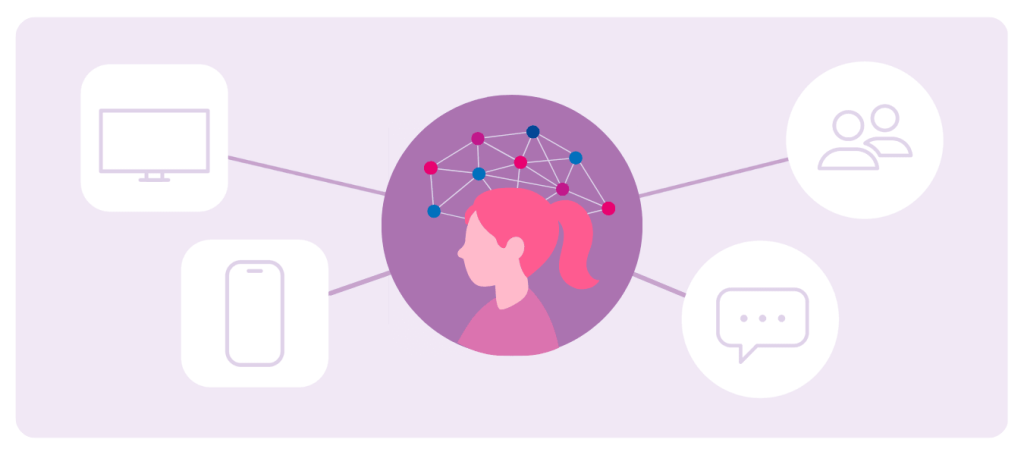
Programmatic advertising is the automated, cross-channel buying and selling of digital media across channels like display, video, and connected TV (CTV). In the age of agentic AI, marketers can identify and act on opportunities while campaigns are live, as agentic AI functions less as a passive tool and more like a dynamic teammate.
With AI-powered programmatic marketing, your team can now proactively anticipate what’s likely to work next, simplify fragmented channels into a more unified strategy, and focus campaigns on outcomes that move your business forward with support from predictive insight and real-time intelligence.
Machine learning now processes and analyzes massive volumes of data in milliseconds, allowing systems to decide which impression to buy, what it’s worth, and where it’ll deliver the most impact in real time.
How is agentic AI reshaping programmatic marketing?
Programmatic advertising has always been about automation, but agentic AI is pushing it into something more adaptive. AI-driven processes now analyze the marketplace and enable autonomous media activation with human oversight, grounded in responsible automation.
As you integrate agentic AI into your advertising, it helps automate time-intensive, day-to-day tasks so your team can focus more on strategy, planning, and performance. Marketers still define the goals, set the guardrails, and oversee how AI is applied, which keeps decisions aligned with business objectives, compliance requirements, and overall campaign strategy.

Here’s how marketers can benefit from agentic AI:
- AI accelerates and improves how fragmented signals across identity, behavior, and context are connected into a usable customer view.
- Optimization happens continuously, not in reporting cycles, as bids, audiences, and spend adjust in real time.
- Decisioning moves beyond static rules toward adaptive, data-driven prioritization.
- Predictive models help reduce waste by identifying low-value impressions before allocating spend.
- Personalization becomes more accurate while still grounded in privacy-safe, identity-first data.
How is AI transforming media curation and supply optimization?
Programmatic advertising has traditionally relied on open exchange buying, optimizing across large volumes of inventory. As AI becomes more embedded in programmatic marketing, the focus is shifting toward more intentional activation, prioritizing environments that are more likely to perform from the start.
Dynamic curation and supply optimization
With dynamic curation, AI aligns predictive audiences with contexts where engagement is strongest, using real-time signals to determine who to reach and where they’re most likely to engage. Campaigns are guided toward higher-probability environments upfront, rather than relying on post-impression optimization.
This moves programmatic marketing away from broad open exchange buying and toward more curated, intentional activation, with continuous adjustments as signals evolve.
Emerging agentic workflows
Emerging agentic workflows introduce systems that analyze performance, recommend changes, and activate them within defined guardrails. Instead of waiting for reporting cycles, campaigns continuously evaluate signals and adjust in real time.
AI handles day-to-day decisions like shifting spend or refining audiences, while marketers retain strategic control and accountability.
Generative and analytical AI applications
Not all AI in programmatic advertising is about activation. Many gains are happening behind the scenes, especially in analytics.
Generative and analytical AI support tasks like attribute development, description creation, and insight acceleration. This reduces time spent on reporting and helps teams focus on understanding performance, surfacing patterns, and identifying what to scale.
Experian’s curation capabilities
At Experian, we combine identity-based predictive data with contextual AI models to better align audiences with available supply. With Audigent now part of Experian, audiences are indexed to the live bidstream and contextual signals, helping campaigns activate in environments where they’re more likely to perform.
Experian Curated Deals package high-quality inventory, such as streaming and premium lifestyle content, with predictive audience data. When layered with our #1-ranked data accuracy by Truthset, these deals become predictive and help you activate greater confidence in campaign placement and performance.
Practical use cases of AI in complex and regulated markets
The value of AI in programmatic advertising becomes clearer in environments where complexity is highest, such as industries with strict regulations, fragmented data, and significant financial stakes tied to every impression. Financial services, healthcare, and retail all require approaches that balance accuracy, compliance, and measurable outcomes, built on privacy-first data and human-centered activation.

The following shows how programmatic advertising can come to life in practice.
Financial services
In financial services, performance only matters when it’s compliant. AI helps marketers reach qualified consumers without crossing regulatory lines.
Your team can:
- Activate identity-based audiences for lending, credit, and financial products within defined compliance guardrails.
- Use predictive financial attributes (where permitted) to prioritize prequalified and high-intent consumers.
- Support responsible offer prioritization and budget allocation based on eligibility and likelihood to respond.
- Operate within transparent, auditable environments designed for regulated activation.
Healthcare
Healthcare marketing requires accuracy without ever exposing sensitive data. AI enables more relevant engagement while maintaining strict privacy standards.
With AI-powered programmatic marketing, you can:
- Activate privacy-safe, compliant health-interest segments without relying on protected personal data.
- Deliver campaigns without exposing sensitive identifiers or violating regulatory requirements.
- Optimize delivery based on region, timing, and contextual alignment with patient research behavior.
- Maintain controlled, privacy-forward environments that prioritize trust and compliance.
Commerce media
In commerce media, programmatic performance is measured by its impact on transactions and revenue. AI helps unify signals into a more connected, outcome-driven strategy.
It empowers marketers to:
- Connect household-level insights to activation across CTV, display, and commerce media networks.
- Use AI-powered identity resolution to maintain continuity as consumers move across devices, channels, and purchase journeys.
- Enable dynamic curation by aligning predictive audiences with more effective inventory in real time.
- Adjust spend toward environments and segments that actively drive purchase behavior.
As these use cases expand across industries, so does the need to ensure AI is applied responsibly.
Trust, transparency, and ethical challenges in AI-powered AdTech
As AI takes on a larger role in programmatic advertising, the focus is shifting from what it can do to how it does it. Marketers need to validate results and the data behind them to ensure every decision stands up to regulatory and consumer scrutiny.
AI systems now influence audience selection, media investment, and measurement at scale. But those decisions are only as reliable as the data behind them. Without clear governance, it becomes difficult to answer basic but critical questions, such as, “What data informed this decision? Was it compliant?” Or, “Could bias be influencing the outcome?”
This is why trust in AI starts with the data rather than the model.
AI governance and data stewardship
Rather than governing our clients’ AI systems, Experian helps govern the data those systems depend on. Our guiding principle is simple: responsible automation begins with governed data. We ground our AI approach in strict data governance frameworks, ensuring the data entering any model is compliant, consented to, and accurate before it’s used.
We treat AI and machine learning as advanced modeling technologies operating within contractual and privacy-first guidelines, with controls for data quality, consent validation, and compliance applied upfront. In the end, you’ll have confidence that your AI outputs are not only performant but also explainable, auditable, and aligned with regulatory expectations from the beginning.
Clear usage restrictions
Strong governance only works when it’s paired with clear boundaries. To protect data integrity, privacy, and compliance, Experian enforces strict controls on how data is used across AI and programmatic workflows.
- Data is used only within defined contractual, legal, and regulatory guidelines.
- Sensitive information is protected and restricted from use in unauthorized environments.
- Data access is limited to approved, compliant systems and workflows.
- Data is not shared, exposed, or repurposed beyond its intended use.
- AI processing occurs within controlled environments that meet privacy and security standards.
- AI use cases are subject to appropriate review, governance, and oversight.
These guardrails give you the assurance that innovation moves forward without compromising trust.
Bias mitigation and responsible modeling
As AI plays a larger role in audience creation and activation, models must be continuously monitored for fairness. At Experian, models are continuously reviewed and refined to reduce bias and ensure outputs align with responsible marketing practices and changing regulations.
Consent and consumer control
Consumer consent and control are central to responsible AI usage in programmatic advertising. Data must be sourced through compliant, transparent mechanisms, with controls that allow consumers to access, manage, and opt out of how their data is used.
This aligns with regulatory frameworks such as the California Consumer Privacy Act (CCPA), the General Data Protection Regulation (GDPR), and the Health Insurance Portability and Accountability Act (HIPAA) (where applicable).
How Experian enhances every stage of the agentic AI programmatic workflow
AI in programmatic advertising only works if the system behind it is connected. When data, activation, and measurement are fragmented, optimization lags.
Experian brings those pieces together. By connecting identity, data, activation, and measurement into one workflow, AI can continuously turn first-party data into predictive audiences, help you activate them across channels, and measure outcomes in a single, connected system.
AI-ready data foundation
Everything in AI programmatic advertising starts with the data. Experian transforms first-party data into a predictive asset by onboarding and enriching it with Experian Marketing Data, ranked #1 in accuracy by Truthset, and unifying it through our Digital and Offline Graph.
This creates a high-integrity data layer that improves audience quality, extends reach, and supports activation across channels while maintaining privacy-forward standards.
Predictive intelligence
Predictive intelligence helps you understand what’s likely to work before activation begins. Experian applies behavioral modeling and signal analysis to identify high-potential audiences and generate identity-based lookalikes based on shared characteristics and patterns.
As campaigns run, AI surfaces next-best opportunities so teams can adjust activation strategy in real time.
Audience discovery and creation
Experian simplifies audience creation by bringing everything into one place. First-party data is combined with Experian Audiences and expanded through access to Partner Audiences in our data marketplace. Instead of stitching together multiple inputs, you’re working from a more complete, connected view upfront.
Our platforms and audience teams then help identify, build, and refine segments based on relevant attributes, reducing manual setup, accelerating activation, and enabling scalable, persona-based audience creation.
Identity-rooted activation
After you’ve defined your audiences, identity becomes critical in consistently reaching them across channels.
Partner with Experian for agentic AI-driven programmatic campaigns
Experian helps you turn first-party data into marketing that feels more connected, relevant, and accountable, bringing together identity, AI, and privacy-first data to support better decisions from planning to outcomes. Speak to an Experian expert about enabling agentic AI in your programmatic advertising strategy today.
FAQs
AI in programmatic advertising uses machine learning to improve how media is bought, targeted, and optimized. It enhances audience discovery, activation, and measurement by analyzing large volumes of data in real time, allowing campaigns to adapt continuously instead of relying on static rules.
Experian supports programmatic advertising across the full workflow, from identity resolution and audience development to contextual indexing and outcome-based measurement. Through a combination of Experian’s platforms, data, and audience teams, marketers can turn fragmented signals into more connected, performance-driven campaigns.
Agentic AI in advertising refers to systems that can analyze performance, recommend changes, and activate optimizations within defined guardrails. Unlike traditional automation, these systems adapt in real time while marketers maintain strategic oversight and control.
Experian supports privacy-first AI through strict data governance frameworks, compliant data sourcing, and transparent modeling practices. Identity resolution and activation are designed to meet regulatory requirements while maintaining consumer trust and control.
AI improves audience discovery through predictive modeling, inferred attributes, and lookalike techniques to identify high-potential audiences. It also surfaces next-best segments, reducing manual effort and accelerating time to activation.
AI supports media curation by aligning predictive audiences with high-performing environments in real time. Through dynamic curation and Experian Curated Deals, campaigns activate in more relevant contexts rather than relying on broad open exchange buying.
Latest posts

Discover Experian’s 19 new holiday shopping audiences designed for you to reach the most relevant shoppers this holiday season.

In our Ask the Expert Series, we interview leaders from our partner organizations who are helping to lead their brands to new heights in ad tech. Today’s interview is with Jordan Feivelson, VP, Digital Audiences at Webbula. Jordan is a 22-year advertising industry veteran who has worked for media properties such as WebMD and Disney. Over the past ten years, he has transitioned to the data and programmatic space, including growing the data business for Kantar Shopcom and Adstra. What types of advertisers might benefit from utilizing Webbula audiences across various verticals? Can you provide examples of how different industries successfully leverage your data to achieve specific campaign goals? Most advertisers can leverage Webbula’s award-winning attributes for their activation initiatives. Webbula offers approximately 3,000 syndicated segments covering categories such as Demographics, Automotive, Political, Mortgage, B2B, Hobby/Interest/Lifestyle, and Interests & Brand Preferences (brand name targeting). Audience insights and marketing strategies What specific types of audience segments does Webbula provide? How can advertisers leverage these segments to craft more effective, personalized marketing strategies? Webbula has incredible depth and breadth within its verticals, giving marketers the tools to deliver targeted messaging effectively. Our Demographic, B2B, Mortgage, Automotive, and Interest and Brand Preferences segments each contain 500-1,000 segments, all built on deterministic, self-reported, and individually linked data. We ensure the best accuracy with multiple deterministic data points tied to the real world (ex., first name, last name, postal address, and email address). Some examples of our unique syndicated audience types: B2B: A view of the latest industry trends with detailed cuts of the professional world, such as companies with and not within the Fortune 500 companies and job positions that are directors and below. This also includes custom capabilities, including ABM (list of target companies in an activation campaign or by industry code (ex. NAICS, SIC). Interest and Brand Preferences: Consumers who have shown interest and affinity to hundreds of brands (ex., Nike), genres (ex., comedy, hip hop), sports teams, and more. Mortgage: A detailed view of homebuyers’ purchase range, loan type (ex. jumbo loan, standard loan), mortgage amount, interest rate, and more. With Webbula’s audience data, brands can create a comprehensive picture of their audiences down to the individual level and reach them accurately. Data quality, sourcing, and differentiation How is consumer data sourced and curated at Webbula? Are there data quality standards that Webbula establishes for consumer data, and how do you ensure your sources and methods meet these standards consistently? Webbula’s data is aggregated from over 110 trusted and authenticated sources, including publishers, data partners, social media, and more. The data collected comes directly from consumers who self-report information through surveys and other methods. We apply our hygiene filters to mitigate fraud and accurately score the data. Data Collection: The data collected comes directly from consumers who self-report information through surveys, questionnaires, transactions, and sign-ups. This ensures that brands display ads to audiences based on self-identified, cross-channel behaviors, not modeled assumptions. Hygiene Solutions: Webbula applies multi-method hygiene solutions to mitigate fraud and accurately score the data before onboarding, ensuring that all data meets the highest quality standards. Examples of Data Sources: Questionnaires: Self-reported data through surveys, offer submissions, and telemarketing. Transactions: Deterministic data from aftermarket parts, online purchases or services, and more. Sign-ups: Individually linked data from information entered through sweepstakes, infomercials, newsletters, and forms. What differentiates Webbula’s data from other data providers in the market? Can you explain the unique value proposition that Webbula offers in terms of data depth and breadth? Due to our extensive experience in data cleansing, we provide the most accurate data within the programmatic ecosystem. TruthSet, the leading programmatic accuracy measurement company, has ranked Webbula as having the highest number of top attributes compared to other data providers with 150M+ HEMs. Additionally, Publicis Groupe and Neutronian further validate Webbula’s data quality, underscoring its position as a leader in the industry. Webbula’s data stands out in the market due to its unmatched accuracy and quality, achieved through years of expertise in data cleansing. Unlike other providers, Webbula’s foundation lies in its robust email hygiene process, ensuring that all data entering the programmatic ecosystem is thoroughly cleansed. Privacy, compliance, and future-proofing What measures does Webbula take to maintain data privacy and compliance? How do these efforts benefit advertisers in an evolving regulatory landscape and ensure ethical standards? Webbula was created over a decade ago with a future-proof, privacy-compliant foundation. We understand the industry’s rapid changes, including government and state legislation and cookie depreciation. Our goal has always been to build long-term partnerships and ensure we are prepared for industry changes. We rely on validated offline data sources, making us resilient to external influences. Success stories Can you share success stories where advertisers saw significant campaign improvements using Webbula’s data? What were the key factors that contributed to these successes? Our success is measured by client feedback and increased client spend. Webbula has helped several key advertisers achieve six-figure monthly thresholds by providing the most accurate data to meet campaign KPIs. Clients consistently return to use our data, validating our belief that “the proof is in the pudding.” Thanks for the interview. Any recommendations for our readers if they want to learn more? For those interested in learning more about Webbula, reach out for a personalized consultation. Contact us Latest posts

Experian’s 2024 Holiday spending trends and insights report covers consumer spending trends for the holiday season.