A deep dive with an Experian partner, ARF

by Experian Marketing Services 7 min read April 30, 2026

At A Glance

The Advertising Research Foundation’s DASH TV Universe Study provides a projectable view of how Americans connect to and consume TV across households, devices, and services. In this Q&A, Jim Meyer, General Manager, DASH, and Samantha Zhang, Senior Data Scientist, at the ARF explain what DASH measures, who uses it, why MRC accreditation matters, and how Experian combines DASH with its data to build audience segments for advertisers and agencies.

In our Ask the Expert series, we interview leaders from our partner organizations who are helping lead their brands to new heights in AdTech. Today’s interview is with Samantha Zhang, Senior Data Scientist, and Jim Meyer, General Manager of the DASH TV Universe Study at the Advertising Research Foundation (ARF). DASH is an annual tracking study conducted by the ARF to define and better understand TV audience behavior and household dynamics.

What does DASH measure, and how does it help the industry understand TV consumption today?

By capturing hundreds of individual- and household-level data points from each respondent in a rigorous and nationally projectable sample, DASH creates a comprehensive picture of U.S. consumer TV “infrastructure” – how America watches.

Core elements in DASHElements that create context in DASH
TV sets
Location | brand | smartness | service modes | sources
Demographics
Connected devices
Game consoles |video players | streaming devices
Yesterday viewing
Daypart | TV/device genre | Out-of-home viewing
Mobile devices
Owners | sharing users
Shopping
Online and in-store | Exposure to major RMNs
Internet service
Modes | ISPs | connectivity by device
Streaming audio
Streaming TV
SVOD/AVOD tiers and sharing | FAST
Email accounts and apps
Live TV
Modes of access | including casting from devices
Social media

For example, DASH gathers:

  • Data on every TV set, including brand, room location, age, “smartness,” and connection devices and modes
  • Household connectivity and video service data, even in homes with no TV set
  • Internet Service Providers (ISP) and TV service usage, including Multichannel Video Programming Distributors (MVPDs), virtual vMVPDs, streamers (ad-supported and premium), and Free Ad-Supported Television (FAST) channels
  • Person-level ownership and usage of video-capable mobile devices, including smartphones, tablets, and laptops
  • Measures of viewing and co-viewing across dayparts, devices, and services
  • Additional modules covering shopping and retail media networks, streaming audio, social media, email, and apps

Broad coverage and granularity make DASH a uniquely robust source of truth for practitioners across the industry, including measurement experts and ad programming strategists. DASH also reports regularly (and publicly) on key industry dynamics. DASH identified a growing segment of device-only viewers – now nearly 9 million households that watch TV, but do not own a TV set – and highlighted the implications of that trend for traditional ratings systems based only on households with TV sets.

Households (HHs – million)2025 HHs (M) U.S. penetrationChange vs. 2024 (M)
Total US134.8100%+2.7
Connected TV (CTV)114.685%+2.1
TV (Set)124.292.2%+1.1
Device-only8.86.6%+1.6
TV-Accessible133.198.7%+2.7

DASH called out the rise in app-based pay TV and proposed a new connection framework that better represents the modern TV world, in which linear and streaming overlap.
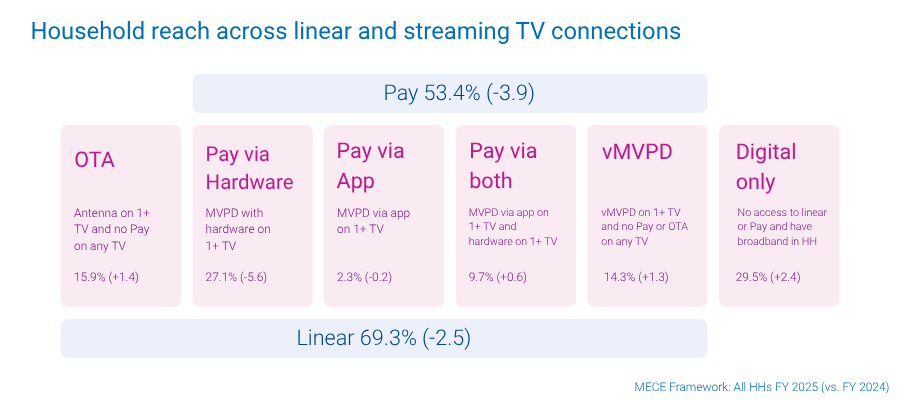
Household reach across linear and streaming TV

DASH also defines the universes of households reachable with advertising. This graphic, for example, shows how all ad-supported linear and streaming properties in aggregate define the true scale of TV advertising. While 35 million households (and growing) are reachable only with streaming ads and 13 million (and falling) only with linear ads, most households are reachable with both, underscoring the importance of understanding the “overlap.”
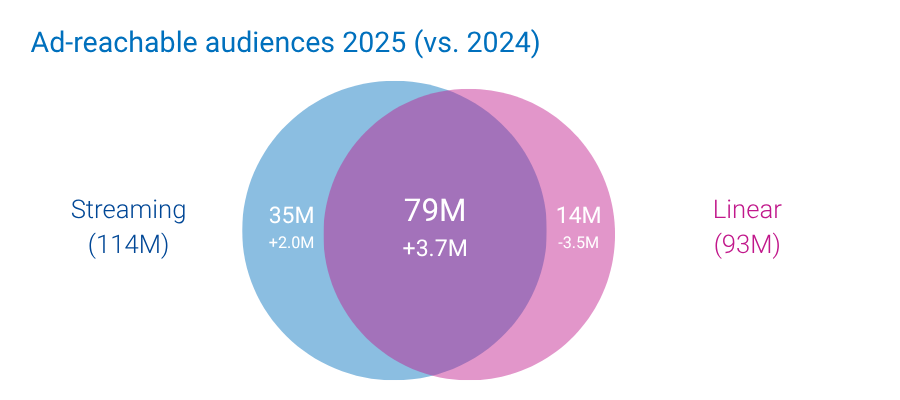
Ad-reachable audiences 2025 (vs. 2024)

Who uses DASH data, and what decisions does it help inform?

There are three primary users of DASH, each with its own use cases:

Measurement providers, including Nielsen, use DASH to calibrate viewership data, turn household data into persons data (and vice versa) and estimate potential reached audiences–what the providers call media-related universe estimate (MRUEs)–for the calculation of ratings. Not surprisingly, measurement companies were the first to see the value that an independent TV universe study could provide.

Media companies, including major broadcasters and streamers, use DASH to add context and color to their ad sales presentations – and to track the measurement providers, whose ratings play a major role in valuing ad inventory.

AdTech companies, including Experian, use DASH to create high-value audience segments for activation.

The recent accreditation of DASH by the Media Rating Council (MRC) and adoption by Nielsen as an input to its TV ratings have generated interest from a broad range of companies. We are actively pursuing new licensees and partners to make DASH more useful within, and even outside, the TV ecosystem.

What does MRC accreditation signify, and why is it meaningful for DASH?

MRC accreditation means DASH passed a rigorous audit conducted by Ernst & Young over many months, which validated our methodology, controls, and data quality. MRC accreditation establishes that DASH is an industry-standard dataset.

While the service provider normally announces its own accreditation, the MRC took the unusual step of issuing its own release on DASH, announcing the accreditation of DASH for TV universe estimation and endorsing the study for broader, cross-media use.

How does Experian use DASH data to build audiences?

The segments combine specific TV usage habits and behaviors from DASH with Experian data on demographics, spending, and other contextual inputs to create a fuller view of consumer viewing behavior. They are designed to be valuable to advertisers in many categories and planning contexts – and to be customizable to fit advertisers’ media targets. The segments can be used to:

  • Apply or suppress audiences to improve target coverage across a campaign
  • Better align media and creative
  • Reach elusive but high-value viewers, such as Ad Avoiders
  • Drive valuable consumer behavior
  • Achieve specific advertising objectives

What are some practical use cases for DASH-based audiences?

Here are some practical use cases for four different kinds of DASH segments in five different advertiser categories.

Travel

Co-Watchers

A couples-only resort uses TV Co-Watching Households without Children to strengthen target reach and ad memory recall

A big theme park destination uses TV Co-Watching Households with Children to reach families in moments of togetherness

Home Entertainment

TV Owners and Brand Loyalists

A premium TV manufacturer uses the overlap of Multi Brand TV Owners and Single Brand TV Loyalist Households to market its newest TV model to its most loyal consumers.

Fast Food

Screen Size Viewers

A fast food chain with a high-impact new brand campaign uses Large Screen TV Viewers to better align the media and creative

That same fast food chain uses Small-Screen TV Viewers to drive store traffic by increasing exposure of its retail campaign among on-the-go viewers

Financial Services

Cord Cutters

A personal cost management app and a cash-back credit card target Streaming-First Cord Cutter Households to reach young, tech-savvy, cost-conscious consumers

Thanks for the interview. Where can readers learn more about DASH?

We started work on DASH seven years ago, and it’s been fun to watch it “grow up.” Our partnership with Experian is a big step toward putting DASH to work for advertisers and agencies. To learn more, visit our site at https://theARF.org/DASH or contact us at DASH@theARF.org.

Contact us

This site is protected by reCAPTCHA and the Google Privacy Policy and Terms of Service apply.


About our experts

Samantha Zhang, Senior Data Scientist at ARF

Samantha Zhang, Senior Data Scientist at ARF

Samantha Zhang is a Senior Data Scientist at the Advertising Research Foundation working on the DASH TV Universe Study, with additional research spanning areas including attention measurement, digital privacy, and artificial intelligence.

Jim Meyer, General Manager at ARF

Jim Meyer, General Manager, DASH, at ARF

JimMeyer is general manager and co-founder of the ARF DASH TV Universe Study and managing partner of Golden Square, LLC, which advises media and research technology companies on growth strategy and development.


Latest posts
Forrester Study—how identity resolution can help marketers prepare for data deprecation and improve data quality

Marketers are under more pressure than ever before to prove ROI and efficiency of marketing activities in relation to business performance. On top of that, there are new privacy regulations and uncertainty around what new technologies will have to be implemented in order to replace the granular level targeting and measurement the industry historically has used third-party cookies for. It’s clear marketers are going to need the right tech stack and partners to continue to prove their team’s efficacy. We recently partnered with Forrester Consulting to evaluate the current state of customer data-driven marketing and surveyed over 300 global marketing decision makers at the brand and agency levels. We found that marketing is facing increased demands today, insights from the study include:Consumers expect brands to deliver engaging experiences across highly fragmented journeys. Seventy-two percent of decision-makers reported that customers demand more relevant, personalized experiences at the time and place of their choosing. Marketing runs on data, but the rules governing customer data usage are changing quickly. More than 70% of study participants stated that consumer data is the lifeblood of their marketing strategies, fueling the personalized, omnichannel experiences customers demand. These demands paint a challenging picture. Just as marketers are poised (and tasked) with delivering greater value to their organizations and customers, the ground rules are changing and threatening their ability to deliver. Indeed, 62% of respondents said that the forces of data deprecation will have either a “Significant” (40%) or “Critical” (21%) impact on their marketing strategies over the next two years. Effective identity resolution can help brands prepare for data deprecation challenges Marketers face a daunting landscape, but they can leverage the data, technology, and processes that comprise identity resolution to address business objectives, combat ecosystem complexity, and future-proof customer engagement efforts. By utilizing identity resolution, marketers will be able to match and connect multiple identifiers across devices and touchpoints. This allows for a cohesive, omnichannel view that enables brands to continue to deliver personalized and contextually relevant messages throughout the customer journey and without the use of cookies. The identity graph is the underlying infrastructure that defines connections between the numerous, fluid, and disparate identifiers created during moments of consumer engagement, turning disparate signals into addressable and actionable steps. These connections enable brands to bolster their ability to gain deeper customer insights and power audience building, attribution, and connected measurement. Identity resolution encompasses a wide range of capabilities that support an equally diverse set of marketing use cases. These include the targeting, personalization, and measurement of both known and pseudonymous audiences in the offline and digital worlds, which enables marketers to improve customer data management, drive more effective personalization, and gain insights and efficiencies through measurement across touchpoints. By taking the time to vet the privacy procedures and data collection processes of identity solutions you can reduce your regulatory risk and maintain customer trust. In an open-ended survey response, a marketer shared, “We’ve found that users are willing to volunteer data when they understand what it’s being used for and are asked for clear consent.” Finding the right partners to help navigate the changes The scramble to find an alternative to third-party cookies has slowed down since Google announced they will be delaying their cookie removal until late 2023. However, this gives marketers a unique opportunity to take advantage of the additional time and feel more prepared and confident in their solutions. With the delay, marketers can now test ID solutions and compare apples to apples with data from the third-party cookie while it’s still active and addressable. Test and find a solution that works now, so there are no surprises once cookies have finally made their way out the door in 2023. At Tapad, a part of Experian, we’ve developed a solution that provides agnostic interoperability for the myriad of cookieless identifiers emerging in the market. As a new module in the Tapad Graph, Switchboard will connect traditional digital identifiers to cookieless IDs to support the entire ad ecosystem with privacy-safe future-proof identity resolution. Get in touch 

Published: September 23, 2021 by Experian Marketing Services
Uncovering hashed email: you may be sitting on a goldmine of customer data and don’t even know it

Email hashing was originally intended to be used as an email security feature that has ended up being a very powerful marketing tool. A hashed email is a cryptographic function that changes an email address to a random code which can be used as an anonymous customer identifier. This code is privacy-safe and cannot be traced back to the customer’s email address. However, this hashed email can function like a digital passport that traces every behavior and action a customer takes when logged into an account that is authenticated with an email, making hashed emails a goldmine for customer data. Today emails are used across traditional publishers and within the CTV ecosystem; tying them to more consumer touch points than ever before. Why the emphasis now? Cookies are on their way out the door and have been the primary way that many marketers have tracked their existing and potential customers. In order to replace this granular level of data, marketers are likely going to need multiple solutions. With so many cookieless solutions and IDs appearing in the marketplace, the mapping of the customer journey is bound to be fragmented. Relying on first-party data, such as hashed email, is just one way to reduce that fragmentation; as it can serve as an authenticated starting point for cross-device identity resolution that can be leveraged for targeting, personalization and measurement. How can Tapad + Experian help? Tapad + Experian’s Hashed Email Onboarding is a privacy-safe way to connect consumer email addresses to their related digital devices and other digital identifiers through high precision probabilistic identity. By onboarding hashed emails and incorporating them within your Tapad Graph file you can: Build a more holistic view of individuals and households and their relationship to email addresses in your first-party data set Leverage these relationships for increased cross-device scale for targeting Employ personalization tactics at the household or individual level across devices Create new audience segments and look-alike models for cross-channel activation Design more inclusive measurement and attribution for customer journey mapping Tapad, a part of Experian has built a hashed email onboarding product feature that works with the existing flexibility of The Tapad Graph to deliver the most holistic consumer view, combined with the attributes you need, in the structure that works best for your business objectives. Get in touch

Published: August 25, 2021 by Experian Marketing Services
Connect the disconnect in your CTV universe

The result of epic shifts from traditional cable to streaming television, the CTV ecosystem is experiencing compounded fragmentation, making it challenging for marketers to leverage in the most effective way for both activation and measurement. Heralded as the hot new household level device for highly engaged viewers, CTV brings massive opportunities for brands to move users down the funnel and incorporate CTV into their attribution modeling post-campaign. Leveraging CTV IDs within a cross-device identity resolution strategy can yield big benefits if you know how to do it right. Check out our breakdown of today’s CTV landscape to help you better understand how and what you can leverage for activation and measurement in the streaming-verse today. CTV Ecosystems as identifiers (for illustrative purposes only) This is just a small peak at the players and complexities of CTV IDs available for marketers today, but it illustrates the need to understand what IDs can benefit your strategies and where you can use them. Addressability and attribution Not all CTV devices and IDs are addressable; or have ad slots for biddable inventory for advertisers. For example, Apple TV devices and Apple TV + are not ad supported, but could still appear within an identity graph for measurement purposes; helping understand customer behavior and habits, which can inform marketing strategies. Having a household to individual view that’s as inclusive as possible can provide valuable insights. CTV identity strategy Whether or not CTV devices or apps are addressable for advertisers, they can bring immense value when leveraged as part of a holistic identity resolution strategy. As a household level device with user authentication it can provide marketers a top-down view; unlocking household:individual targeting opportunities and unification of IDs at both levels for frequency management and customer journey mapping Get started with us Tapad, part of Experian, offers CTV ID onboarding and extension to our CTV ID Universe as a part of The Tapad Graph suite of products. 

Published: August 25, 2021 by Experian Marketing Services

Subscribe to our newsletter

Enter your name and email for the latest updates

This site is protected by reCAPTCHA and the Google Privacy Policy and Terms of Service apply.

About Experian Marketing Services

At Experian Marketing Services, we use data and insights to help brands have more meaningful interactions with people. As leaders in the evolution of the advertising landscape, Experian Marketing Services can help you identify your customers and the right potential customers, uncover the most appropriate communication channels, develop messages that resonate, and measure the effectiveness of marketing activities and campaigns.

Visit our website

Subscribe to our newsletter

Stay up to date on the latest industry news and receive expert tips from our marketing experts.
Subscribe now!