
Agencies, platforms, and marketers stand at the crossroads of transformation, as privacy regulations tighten, technology accelerates, and consumer behaviors evolve. Yet these challenges also present extraordinary opportunities.
Our 2025 Digital trends and predictions report highlights five trends that will shape 2025 and digs into:
- What’s changing in the market
- How to keep learning about your customers
- How to reach your customers in different places
- How to measure what’s really working along the way
In this blog post, we’ll give you a sneak peek of three of these trends — from cracking the code of signal loss to tapping into the buzz around connected TV (CTV) and stepping up your omnichannel game. Think of it as a taste test before the main course. Ready for the full menu? Download our report to get the lowdown on all five trends.
1. Signal loss: A rich appetizer of alternate ingredients
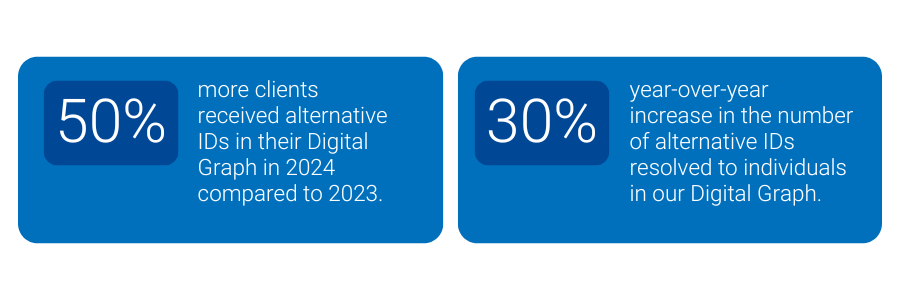
As traditional cookies crumble, marketers need fresh ingredients to keep the flavor coming. Already, about 40% of browser traffic doesn’t support third-party cookies, and marketers are spicing things up with first-party data, alternative identifiers like Unified I.D. 2.0 (UID2) and ID5, and contextual targeting strategies. In fact, 50% more of our clients received alternative IDs (UID2, ID5, Hadron ID) in their Digital Graph in 2024 compared to 2023. The number of alternative IDs resolved to individuals in our Digital Graph increased by 30% year-over-year – as everyone looks beyond the cookie jar.
There is no secret sauce to replace cookies. Instead, expect a multi-ID recipe that brings together different identifiers, unified by an identity graph. This approach turns a fragmented pantry of data into a cohesive meal, giving you a complete view of your customer on every plate.
2. The rising power of CTV: A hearty entrée of opportunities
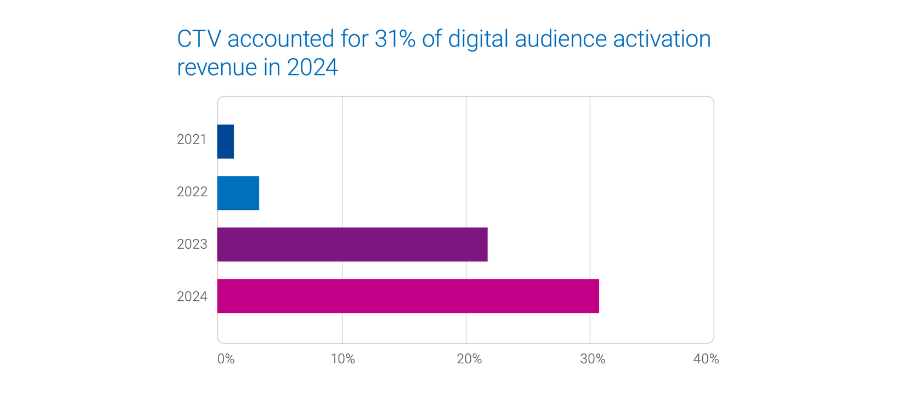
CTV is quickly becoming the main dish on the streaming menu, as viewers load up on their favorite shows. While CTV is slated to make up 20% of daily U.S. media consumption by 2026, advertisers are still holding back on pouring in the ad spend. To unlock its full flavor, marketers need to whip up solutions like frequency capping and unified audience activation.
Although CTV will account for 20% of daily U.S. media consumption by 2026, it’s projected to command only 8.1% of ad spend. Frequency capping and unified audience activation solutions will be key to unlocking CTV’s full potential.
By 2025, nearly half of CTV “diners” will choose free ad-supported streaming TV (FAST). Marketers need strategies to prevent ad overexposure. With 50% of U.S. consumers avoiding products due to ad overload, and 30% of marketers willing to increase their CTV spend if frequency capping improves, unified identity solutions help ensure every impression is served just right.
3. Omnichannel: A flavorful fusion plate
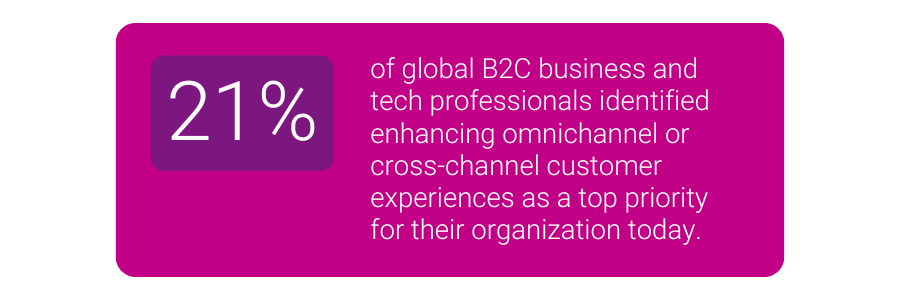
No one likes a one-flavor meal. Marketers are moving beyond single-channel “side dishes” to omnichannel “fusion feasts” that blend direct mail, digital, CTV, and retail media networks (RMNs) into a truly cohesive culinary experience. Even though only 21% of global B2C professionals currently put omnichannel at the top of their shopping list, the growing demand for seamless, audience-first campaigns is heating up.
In 2025, having an audience-first approach will be like having a perfect pairing for every course. Unified identity solutions act as your master sommelier, ensuring that each channel complements the next, and every customer enjoys a well-rounded, memorable journey.
Vertical trends: A dessert sampler from four unique kitchens
Different markets have their own signature flavors.
- In Auto, crossover utility vehicles (CUVs) claim 51% of new vehicle registrations, and consumers in the 35-54 age group and families are the primary buyers. Automotive marketers should prioritize CUV advertising with a strong focus on family-oriented and income-appropriate messaging
- In Financial Services, marketers need to anticipate shifts in consumer behavior tied to economic conditions, such as increasing demand for deposit products when interest rates are high. For insurance, aligning campaigns with life events, like new home purchases or marriage, can maximize engagement.
- In Healthcare, advertisers are prioritizing personalized, regulation-compliant campaigns that address social determinants of health (SDOH).
- In Retail, advertisers are increasingly activating on both CTV and social platforms, with many managing their own in-house campaigns. While larger brands often rely on media agencies, a shift toward in-house media buying is emerging among some bigger players, offering more control over audience targeting and performance metrics.
Our report covers each vertical’s unique menu, helping you select the right “ingredients” for your customers. With the top Experian Audiences on hand, you can create feasts that delight, nourish, and convert.
Download our new 2026 Digital trends and predictions report
Marketing in 2026 will be defined by connection: between activation and measurement, data and AI, platforms and outcomes. These connections are what turn innovation into impact, and they’re where Experian helps marketers lead with confidence.
What you’ll learn
- AI is only as good as its data : Find out why the marketers who shape how AI works, with high-integrity, human-centered data, will be the ones who lead.
- Activation and measurement are coming together: Explore how marketers are shifting from reporting after the fact to guiding performance in the moment.
- First-party data activation is becoming a foundational capability: See how it’s now possible to onboard and activate privacy-compliant audiences across channels, all from a single system.
- Commerce media is no longer just a retail play: Understand why auto, CPG, financial services, and travel brands are now adopting retail-style models to connect data, media, and sales outcomes.
- Curation is the new programmatic standard: Learn how curation brings identity, quality, and control together, allowing marketers to target confidently across connected TV (CTV), audio, and the open web.
Experian’s U.K. 2025 advertising trends
This article highlights the major advertising trends set to shape the U.S. market in 2025, but significant industry changes are happening on a global scale. For a more comprehensive look at worldwide trends, check out Experian’s U.K. 2025 advertising trends.
Contact us
Latest posts

Bridging disparate data in a fragmented world In today's world, consumers engage with brands across multiple platforms, including social media, online marketplaces, in-store experiences, and customer service touchpoints. However, the main challenge for marketers and advertisers is the fragmentation of customer data across these different channels. Each platform generates its own set of data, which is stored in different databases and formats. Integrating these various data sources to create a unified view of the customer is a complex task involving technology and understanding customer behavior across different digital and physical channels. Businesses must link these data fragments to avoid creating a disconnected customer experience. For example, a person may browse products on a mobile app, ask questions through a customer service chat, and eventually purchase in an online marketplace. Traditional data analysis methods often need to recognize these activities as those of a single customer, which can result in missed opportunities to deliver personalized customer experiences across the customer journey. Identity resolution: The key to a unified customer experience Connecting online interactions across various platforms is a challenge for brands. Identity resolution enables enterprises to overcome this challenge by stitching together disparate signals and records to orchestrate experiences and analyze outcomes more effectively. By pairing Experian's identity capabilities with AWS Clean Rooms, enterprises can securely collaborate with their partners to derive deeper insights without exposing sensitive underlying data sets. This partnership between AWS and Experian enables effective matching between disparate data sets, bolstering privacy-enhanced media planning, insights, data enrichment, media activation, and measurement use cases. Depending on their distinct needs and existing identifiers, customers can use two specific offerings of Experian's identity resolution solutions paired with AWS Clean Rooms. Experian's identity resolution products ensure a frictionless brand experience across various channels, enhancing the customer journey from start to finish. Brands can employ our adaptable identity resolution solutions to forge connections between contextual, behavioral, lifestyle, and purchase-based data sources, assembling comprehensive customer profiles. Use dependable digital data to make informed decisions and elevate consumer engagement. Advanced deterministic and probabilistic features, combined with data science and cutting-edge technology, work hand in hand to mitigate risk and uphold data privacy. Such recognition enables a more comprehensive understanding of your clientele, fostering trust and amplifying campaign effectiveness by utilizing securely managed, standardized customer data. With this strategic approach, businesses can achieve their objectives regulatory-compliant. The consumer perspective: Why consistency matters Data fragmentation can lead to inconsistent experiences for consumers, which can be frustrating and erode brand trust. For instance, imagine receiving a promotional email for a product you already purchased through an app or being targeted for a product you decided against. Consumers are increasingly tech-savvy and demand a seamless, integrated experience regardless of how they interact with a brand. They want to feel valued and recognized at every touchpoint and don't care about the complexities of data analytics. As a result, brands face significant pressure to get identity resolution right. Data security and privacy: A Fort Knox for your data AWS Clean Rooms empowers their customers to establish a secure data clean room within minutes, facilitating collaboration with any other entity within AWS. This fosters the generation of unique insights regarding advertising campaigns, investment decisions, clinical research, and more. With AWS Clean Rooms, the need to store or maintain a separate copy of data outside the AWS environment for subsequent dispatch to another party for consumer insight analysis, marketing measurement, forecasting, or risk assessment becomes obsolete. AWS Clean Rooms provides an expansive set of privacy-enhancing controls for clean rooms. This includes query controls, query output restrictions, and query logging that allows customers to tailor restrictions on the queries executed by each clean room participant. Moreover, AWS Clean Rooms include advanced cryptographic computing tools that maintain data encryption—even during query processing—to adhere to stringent data-handling policies. This process employs a client-side encryption tool—an SDK or command line interface (CLI)—that utilizes a shared secret key with other participants in an AWS Clean Rooms collaboration. With a wealth of expertise in data privacy management, Experian enhances campaign effectiveness and fosters trust by managing standardized customer data securely. By using the identity graph, you can preserve a unique identity for each customer. This strategy enables you to comprehensively understand your clientele and reach your business objectives in a regulatory-compliant manner. The future of data-driven marketing starts here AWS customers can use AWS Clean Rooms to establish their own clean rooms in mere minutes, initiating the analysis of their collective data sets without sharing their underlying data with each other. Customers can use the AWS Management Console to choose their collaboration partners, select data sets, and configure participant restrictions. With AWS Clean Rooms, customers can effortlessly collaborate with hundreds of thousands of companies already using AWS without needing to move data out of AWS or upload it to a different platform. When running queries, AWS Clean Rooms accesses data in its original location and applies built-in, adaptable analysis rules to assist customers in maintaining control over their data. Coupled with Experian's trusted data privacy management and unique Experian ID, businesses can effectively manage customer data, secure partners' communication, and achieve regulatory-compliance objectives. This combination allows companies to use data-backed insights to supercharge their marketing initiatives, resulting in more meaningful customer interactions, improved match rates, and business success. Start collaborating About the authors Kalyani Koppisetti, Principal Partner Solution Architect, AWS Kalyani Koppisetti is a technology leader with over 25 years of experience in the Financial Services Industry. In her current role at AWS, Kalyani advises financial services partners on best-practice cloud architecture. Kalyani works closely with internal and external stakeholders to identify industry technical trends, develop strategies, and execute them to help Financial Services Industry partners build innovative solutions and services on AWS. Technical and Solution interests include Cloud Computing, Software-as-a-Service, Artificial Intelligence, Big Data, Storage Virtualization and Data Protection. Matt Miller, Business Development Principal, AWS In his role as Business Development Principal at AWS, Matt drives customer and partner adoption for the AWS Clean Rooms service specializing in advertising and marketing industry use cases. Matt believes in the primacy of privacy-enhanced data collaboration and interoperability underpinning data-driven marketing imperatives from customer experience to addressable advertising. Prior to AWS, Matt led strategy and go-to-market efforts for ad technologies, large agencies, and consumer data products purpose-built to inform smarter marketing and deliver better customer experiences. Tyler Middleton, Sr. Partner Marketing Manager, Experian Marketing Services Tyler Middleton is the Partner Marketing Lead at Experian. With almost 20 years of strategic marketing experience, Tyler’s focus is on creating marketing strategies that effectively promote the unique value propositions of each of our partners’ brands. Tyler helps our strategic partners communicate their mutual value proposition and find opportunities to stand out in the AdTech industry. Tyler is an alumnus of the Seattle University MBA program and enjoys finding new marketing pathways for our growing partner portfolio. Latest posts

The holiday season is just around the corner, and retailers and marketers are gearing up for the busiest shopping period of the year. It's crucial to understand how consumer behavior is evolving and what emerging trends to expect. Experian's 2023 Holiday spending trends and insights report analyzes recent trends, consumer spending habits, and anticipates what's to come in 2023 to help you deliver a top-notch shopping experience this holiday season. In this blog post, we'll cover three key insights from our report. 1. Consumers are shopping earlier It's no secret that December has always been the go-to month for consumers when it comes to holiday spending. However, holiday shopping now starts earlier, particularly with online sales. This can be attributed to a surge in promotions and deals, enticing shoppers to open their wallets ahead of time, giving a significant boost to holiday sales. Notably, Cyber Week sales have proven to be an influential factor, accounting for 8% of total consumer holiday spending. Experian tip Reach the right shoppers with your promotions with sell-side targeting. This powerful approach gives you control over where your ads are placed while ensuring maximum visibility through direct connections with publishers. Whether on mobile, web, or CTV, this seamless ad experience will engage your audience effectively. 2. Online sales are on the rise The popularity of online holiday sales is continuously growing, surpassing in-store shopping. There has been a consistent 1% year-over-year increase in online sales, while in-store sales have seen a 1% decrease. "It’s easier for consumers to comparison shop for large ticket items online that they might find at a mass retailer or office supply store. Consumers prefer to have larger, bulkier items shipped directly to their home for minimal cost. By shopping online, consumers can save time since they don’t need to wait in checkout lines." Anna Liparoto, Sr. Account Executive, Retail & CPG Although online sales currently make up only one-third of all holiday shopping, there is immense potential for further expansion. Mass retailers and office, electronics, and games industries particularly excel in online holiday sales. While in-store purchases remain the primary choice for holiday shoppers, consumer online and offline activities intersect before the final purchase. Experian tip Take advantage of the surge in online shopping by diversifying your marketing channels. An agnostic identity graph can bring together device and media data, capturing valuable user insights. By gaining a holistic view of your target audience, you'll be able to optimize your ad spend and allocate resources effectively, ultimately boosting your return on investment. "Omnichannel targeting during the upcoming holiday season will continue to prove to be the best way to reach scale and maximize ROI across all marketing channels."Joe Ligé, Head of Enterprise Demand Partnerships 3. 2023 holiday spending will be on par with 2022 During the holiday season in 2022, consumer spending showed an anticipated increase, although the growth rate was slightly lower compared to previous years. October saw a surge in average consumer spending, indicating a swift response to early discounts and promotions offered by retailers. As the holiday season progressed, holiday spending gradually slowed down and reached a level similar to that of the previous year. Overall, there was a modest 2% growth. Looking into the future, if economic conditions remain stable in the second half of 2023, we can expect holiday spending to align with the figures from last year. Experian tip To truly maximize impact, consider data enrichment. By diving deeper into your target audience's preferences and behaviors, you can better tailor your strategies and seamlessly integrate the enriched data across various channels. This allows you to unlock the true potential of your ad inventory, creating more meaningful connections with your audience. Download our new 2025 report Get ready for the holiday shopping season with Experian's 2025 Holiday spending trends and insights report, in collaboration with GroundTruth. Inside you'll find: When shoppers plan to buy Why stores still drive results Where marketers are placing their bets How AI is shaping discovery To access to all of our predictions for this year's holiday shopping season, download our 2025 Holiday spending trends and insights report today. Download now Contact us today Latest posts

As technology reshapes our media experience, TV remains a powerful channel for content consumption. In our next Ask the Expert series, we dive into a pivotal subject – the convergence of TV, linear (conventional broadcast and cable TV), and digital marketplaces. In this Q&A segment, we’re joined by two industry experts, Dan Hickox, VP of Development & Partnerships at 605, an iSpot.tv Company, and Chris Feo, Experian’s SVP of Sales & Partnerships, who guide us through an engaging discussion on convergent TV, attribution, measurement, and safeguarding personal data in the evolving landscape of TV advertising. How convergent TV is changing the future of advertising The convergence of traditional TV and digital streaming platforms presents an innovative opportunity for advertisers to engage their target audience. With convergent TV, you can create campaigns that bridge the gap between linear and streaming, ensuring your message reaches your target audience while avoiding ad fatigue. Along with high-quality content, extensive inventory, and targeting capabilities, convergent TV offers advanced measurement and attribution tools that will empower you to optimize advertising campaigns for maximum impact. You can make better decisions regarding when and where to strategically allocate your advertising budgets with effective TV measurement and attribution. Attribution in converged TV TV attribution involves tracing consumer actions and uncovering valuable insights into their behavior. With these insights, you can gain a clear understanding of the audience exposed to your ads and their actions in response. Lean into data attribution tools to track your target audience throughout the customer buying journey. Measurement in converged TV In contrast, TV measurement enables the tracking of performance TV advertising campaigns to assess campaign effectiveness. Through converged TV measurement solutions, you can rely on a singular data source, unifying different channels, devices, and metrics for actionable insights. This analysis will give you insights into the audience reached, their location, and the resulting actions taken. TV attribution’s impact on cross-channel media Embracing an omnichannel advertising approach is vital. Evaluating advertising campaigns across various platforms and devices – including linear, TV, and digital channels – is essential for identifying the channels that drive revenue for your businesses. Converged TV and digital streaming enable you to control ad frequency across all channels, enhancing the cross-screen experience. This convergence paves the way for a more comprehensive and holistic future in advertising. Here are three ways TV attribution impacts cross-channel media. Identify the most effective channels TV attribution offers a significant advantage in determining the channels that generate the most conversions. By using this data, you can make informed choices about budget allocation to achieve maximum impact. Deliver a seamless customer experience Consumers demand consistency in their brand interactions. TV attribution can help you by guiding the optimal timing and placement of ads, resulting in a more seamless viewing experience. This synchronization can significantly enhance customer loyalty and retention. Enhance marketing effectiveness By identifying the most effective channels and refining campaign strategies, TV attribution can significantly improve the success of marketing campaigns. The outcome is a measurable increase in sales and revenue, demonstrating the impact of informed and data-driven advertising. Audience-based targeting across linear and digital ecosystems It's crucial to comprehend and connect with the appropriate audience. The emergence of linear and digital platforms has required the development of audience targeting. Across these two ecosystems, audience-based targeting aims to enhance this process by concentrating on specific audience segments rather than general demographics or programming. Benefits of audience-based targeting There are four key benefits of audience-based targeting across the TV ecosystem. Personalization at scale Digital platforms have conditioned users to expect tailored experiences. Audience-based targeting ensures ads resonate with individual preferences and behaviors, even within the vastness of linear TV. Combining data from both linear and digital sources makes it possible to segment audiences more precisely. This results in advertising content tailored to each individual, making it more relevant and personalized. Optimized ad spend Improve your return on investment by targeting specific audience segments more likely to convert, ensuring your messages reach suitable viewers. In contrast to traditional TV purchasing, where advertisement slots are bought based on a show's overall demographic, audience-based targeting focuses on the viewers' behavior and interests, regardless of the program they are watching. Unified measurement and analytics When combining traditional and digital methods of reaching target audiences, it is essential to have a consistent approach to measuring success. By doing this, you can gain insight into how well your ad campaigns perform across different platforms and the frequency with which they are being seen. By comprehensively understanding audiences within different ecosystems, you can adjust your strategies in real time, guaranteeing that your campaigns remain flexible and successful. Enhancing the viewer experience Audience-based targeting benefits viewers by reducing the number of irrelevant ads they see. As a result, viewers can have a more pleasant experience while watching content, which may discourage them from skipping ads and increase their engagement with the content. Future-proofing and safeguarding data Businesses are focusing on future-proofing for data privacy, and safeguarding individual data is becoming more significant than ever before. Now’s the time to embrace new methods that protect your data privacy while ensuring that measurement remains accurate. Experian offers privacy-safe solutions to help businesses preserve precise measurement, even with fewer cookies. "What we're working toward is future-proofing ourselves. To do that, we work with partners like Experian who are already thinking forward, and with your pixel technology, we can capture and resolve the identifiers that we know will be around for a while."Dan Hickox, VP, Solutions Consulting, Development & Partnerships, 605 How Experian and 605 work together 605 is an independent TV measurement and analytics company providing solutions for advertising, content measurement, attribution, planning, optimization, and media transactions. “We partner with great identity partners, such as Experian, that really help us act as the connecting glue across different data touch points. So what it really is, is the ability to have holistic measurement across the different channels, across the different audiences and it starts out with the ability to be able to take disparate data sources and match them together.”Dan Hickox, VP, Solutions Consulting, Development & Partnerships, 605 605 and Experian have a strong partnership that enables 605 to enhance its data through Experian’s Consumer Sync and Pixel solutions. Consumer Sync – 605 utilizes Experian’s Consumer Sync to ensure their data is privacy-compliant and deterministic across all sources. Experian identity organizes people into households, links their digital devices and IDs to them, enriches their identity with behavioral attributes, and then makes this data actionable in any environment, all while maintaining consumer privacy and data regulations. Web Pixel Attribution – 605 utilizes Experian’s pixel solutions to generate web pixel attribution reports on a client-by-client basis – for linear, TV, and cross-platform reporting. 605’s reporting capabilities allow customers to understand their marketing campaigns' true impact and precisely identify high-performing strategies. With the Experian pixel, partners like 605 can learn more about anonymous website visitors by linking associated demographics and behavior attributes, build audience segments based on the highest cart value customers, and more. The 605 and Experian partnership work hand in hand to make linear TV as actionable as digital media for you. Customers can prove the effectiveness of their marketing tactics and gain actionable insights to deliver highly impactful campaigns. Watch the full Q&A Visit our Ask the Expert content hub to watch Dan and Chris's full conversation about TV measurement, data analytics, privacy regulations, and the evolving landscape of TV advertising in the digital age. Contact us About our experts Dan Hickox, VP, Solutions Consulting, Development & Partnerships, 605 As the Vice President of the Solutions Consulting team, Dan collaborates with sellers to turn prospective opportunities into long-term client relationships. He leads new initiatives and drives partnerships that expand 605 capabilities and improve marketplace positioning. Dan brings over a decade of cross-channel media experience in advanced analytics, media optimization, data integration and statistical analysis to 605. Chris Feo, SVP, Sales & Partnerships, Experian As SVP of Sales & Partnerships, Chris has over a decade of experience across identity, data, and programmatic. Chris joined Experian during the Tapad acquisition in November 2020. He joined Tapad with less than 10 employees and has been part of the executive team through both the Telenor and Experian acquisitions. He’s an active advisor, board member, and investor within the AdTech ecosystem. Outside of work, he’s a die-hard golfer, frequent traveler, and husband to his wife, two dogs, and two goats! Latest posts