At A Glance
Holiday spending is starting earlier, shifting further online, and holding steady year-over-year. Experian’s 2023 Holiday spending trends and insights report shows promotions pulling demand into October and November, steady consumer intent across the season, and growing overlap between online and in-store journeys. For marketers, that means planning sooner, connecting channels more deliberately, and measuring performance across the full holiday window.Holiday shopping no longer starts in December. Consumers are responding to earlier promotions, moving fluidly between online and physical stores, and maintaining consistent spending despite economic uncertainty. Experian’s 2023 Holiday spending trends and insights report breaks down what’s changing and how marketers can respond.
Here are three holiday spending insights shaping the 2023 holiday season.
1. Holiday spending is starting earlier
Holiday momentum now builds well before December. Promotions tied to Cyber Week and early online deals are shifting spending into October and November, extending the window for planning and activation.
Holiday sales by month vs. holiday sales (October-December)
| October | November | December | |
| 2022 | 31% | 33% | 36% |
| 2021 | 30% | 32% | 38% |
| 2020 | 31% | 32% | 37% |
| 2019 | 30% | 33% | 38% |
Cyber Week alone accounts for 8% of total holiday spending. Early activity rewards brands that show up sooner with relevant offers and consistent messaging. Marketers that plan for earlier holiday spending stay visible throughout the entire purchase cycle.
How can you apply these holiday spending insights to your campaigns?
Reach the right shoppers with your promotions with sell-side targeting. This approach gives you control over where ads appear while supporting visibility through direct publisher connections across mobile, web, and connected TV (CTV). Earlier reach helps keep your brand present as shoppers move from browsing to buying.
2. Online holiday spending continues to grow
Shoppers are increasingly researching, comparing prices, and planning purchases online. Online holiday spending increased 1% year-over-year, while in-store activity saw a 1% year-over-year decrease.
Online vs. in-store sales in 2022 by month (October-December)
| October | November | December | |
| Online | 29% | 34% | 38% |
| In-store | 32% | 32% | 36% |
Online sales still represent about one-third of total holiday shopping, but growth opportunities remain strong, especially in categories like electronics, office supplies, and gaming. Even when purchases happen in-store, online activity often plays a role earlier in the journey.
How can you apply these holiday spending insights to your campaigns?
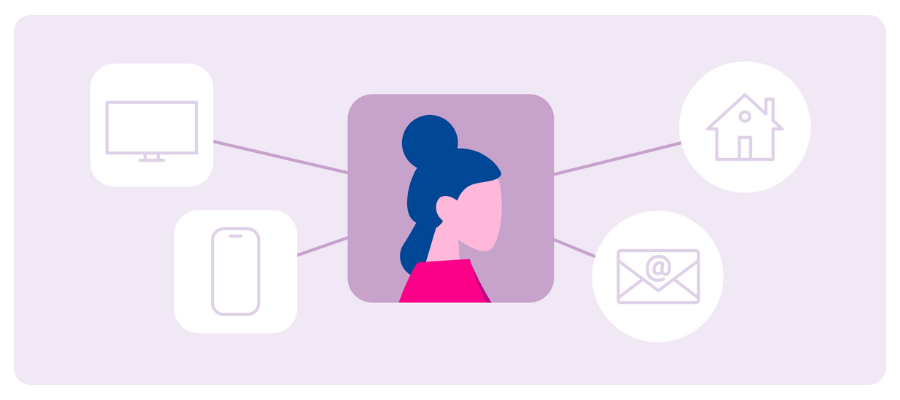
Support omnichannel shopping behavior with an agnostic identity graph. By connecting device and media signals, you can bring together online and offline activity, gain a clearer view of your audience, and make informed decisions about channel mix and budget allocation.
3. Holiday spending remains steady year-over-year
Holiday spending in 2023 is tracking closely with 2022, signaling consistent consumer intent throughout the season. Last year’s early promotional response in October was followed by steady spending through year end.
Year-over-year change on average consumer spending
| October | November | December | |
| 2020 vs. 2019 | 14% | 12% | 10% |
| 2021 vs. 2020 | 6% | 8% | 5% |
| 2022 vs. 2021 | 7% | 3% | 2% |
Overall holiday spending increased by 2% in 2022. That stability gives marketers room to focus on optimization and measurement, rather than reacting to short-term swings. When conditions remain consistent, it becomes easier to tie media decisions to meaningful business outcomes.
How can you apply these holiday spending insights to your campaigns?
Strengthen your strategy with data enrichment. Adding deeper insight into shopper preferences and behaviors helps tailor messaging and maintain consistency across channels, supporting stronger connections throughout the season.
Key takeaways
Get ready for the 2025 holiday season
2025 Holiday spending trends and insights report
Download Experian’s 2025 Holiday spending trends and insights report, in collaboration with GroundTruth. Inside you’ll find:
- When shoppers plan to buy
- Why stores still drive results
- Where marketers are placing their bets
- How AI is shaping discovery
Access our full set of predictions and plan your next holiday season now.
Connect with us
FAQs
Experian’s 2023 holiday spending analysis shows shoppers starting earlier, engaging more through digital channels, and maintaining steady year-over-year spend. These behaviors extend the season and reward brands that activate sooner. For marketers, this creates a longer runway to influence demand and measure impact.
Experian uses identity as the foundation to connect digital exposure with in-store and online purchase behavior. This approach allows marketers to see how holiday spending unfolds across channels rather than treating each interaction separately. The result is a clearer view of how media drives outcomes throughout the season.
Latest posts

With the recent announcement of delaying third-party cookie deprecation to 2024, the industry has more time to rethink how to identify and communicate with consumers.

As today’s digital landscape gets more and more complicated there are more ways for brands to connect with users and drive purchases and more ways for ad tech to target and measure those touch points. As in-person shopping picks up steam due to the re-normalization of society post-COVID 19; the connection between digital ads and in-person purchases needs to be made once again. With the rise of Connected TV throughout the pandemic there are even more digital opportunities to target a user. But how do you make sure that those brand engagements are captured and correctly attributed to offline purchases and conversions? The answer lies in a holistic identity resolution strategy. Cross-device identity resolution with The Tapad Graph connects the identifiers and devices of individuals within a household to each other; enabling targeting, frequency capping, extension, segmentation and measurement or attribution between devices; including Connected TV and hashed (privacy-protected) email addresses along with Cookies, Mobile Ad Ids and IP Address. Brands can join their first-party data to The Tapad Graph to execute strategies that connect online and offline data for pre, mid and post-campaign efficiencies. Let’s imagine a scenario in which an outdoor retail brand is targeting users watching specific content on a Connected TV device. Powered by identity resolution, they start with a general ad on CTV and continue targeting down individual paths with each user. When one of them converts in store and makes a purchase; the outdoor retailer can connect that action through location and in-store traffic data with the cross-device identity resolution used to execute the digital campaign. Now the actions of the user online and offline are resolved for more accurate measurement and attribution after the campaign ends. But it doesn’t stop there– the brand's CRM data can be reactivated for the next digital campaign and leveraged to capitalize on the most effective media mix for the user who made the purchase previously. These combined insights can be invaluable in shaping up future campaign strategies with geo-contextual ads, recommended additional products and personalization to help drive more conversions and purchases in-store or online. As in-person shopping picks back up and marketers are tasked once again with balancing online and in-store KPIs, the right identity resolution strategy can unlock necessary efficiencies for retailers, ad tech vendors and agencies tasked with supporting these initiatives. Get in touch

Experian Marketing Services and Data Quality President Genevieve Juillard recently sat down with Zach Rodgers, host of the AdExchanger Talks podcast to discuss the future of identity, the importance of data transparency and privacy, and our recent acquisition of Tapad. Genevieve focused on the opportunity for our industry to reimagine an advertising ecosystem that is resilient and adaptable; one that takes advantage of emerging data and prioritizes data transparency and consumer privacy. She also discussed the importance of advertising strategies that put consumers at the heart of every decision and give them more control over their data. Genevieve shared with AdExchanger that Experian’s acquisition of Tapad, a global leader in digital identity resolution, was a natural fit for our company. Tapad’s approach and role in the ecosystem is very much aligned with Experian’s, which is to develop solutions that are resilient to industry and consumer changes. The combination of our capabilities supports interoperability across all types of identifiers, both online and offline, and will position us to help our clients navigate the post-third-party cookie world. To learn more about Experian’s plans to support an effective advertising ecosystem that will evolve with our dynamic industry, listen to the full podcast Embracing ‘Healthy Fragmentation’ In Ad Tech, With Genevieve Juillard. Get in touch