Loading...

Three insights from our 2023 Holiday spending report

Updated: February 20, 2026 by Hayley Schneider, Sr. Manager, Content Marketing 4 min read September 14, 2023

At A Glance

Holiday spending is starting earlier, shifting further online, and holding steady year-over-year. Experian’s 2023 Holiday spending trends and insights report shows promotions pulling demand into October and November, steady consumer intent across the season, and growing overlap between online and in-store journeys. For marketers, that means planning sooner, connecting channels more deliberately, and measuring performance across the full holiday window.

Holiday shopping no longer starts in December. Consumers are responding to earlier promotions, moving fluidly between online and physical stores, and maintaining consistent spending despite economic uncertainty. Experian’s 2023 Holiday spending trends and insights report breaks down what’s changing and how marketers can respond.
 
Here are three holiday spending insights shaping the 2023 holiday season.

1. Holiday spending is starting earlier

Holiday momentum now builds well before December. Promotions tied to Cyber Week and early online deals are shifting spending into October and November, extending the window for planning and activation.

Holiday sales by month vs. holiday sales (October-December)

OctoberNovemberDecember
202231%33%36%
202130%32%38%
202031%32%37%
201930%33%38%

Cyber Week alone accounts for 8% of total holiday spending. Early activity rewards brands that show up sooner with relevant offers and consistent messaging. Marketers that plan for earlier holiday spending stay visible throughout the entire purchase cycle.

How can you apply these holiday spending insights to your campaigns?

Reach the right shoppers with your promotions with sell-side targeting. This approach gives you control over where ads appear while supporting visibility through direct publisher connections across mobile, web, and connected TV (CTV). Earlier reach helps keep your brand present as shoppers move from browsing to buying.

2. Online holiday spending continues to grow

Shoppers are increasingly researching, comparing prices, and planning purchases online. Online holiday spending increased 1% year-over-year, while in-store activity saw a 1% year-over-year decrease.

Online vs. in-store sales in 2022 by month (October-December)

OctoberNovemberDecember
Online29%34%38%
In-store32%32%36%

Online sales still represent about one-third of total holiday shopping, but growth opportunities remain strong, especially in categories like electronics, office supplies, and gaming. Even when purchases happen in-store, online activity often plays a role earlier in the journey.

How can you apply these holiday spending insights to your campaigns?

Support omnichannel shopping behavior with an agnostic identity graph. By connecting device and media signals, you can bring together online and offline activity, gain a clearer view of your audience, and make informed decisions about channel mix and budget allocation.
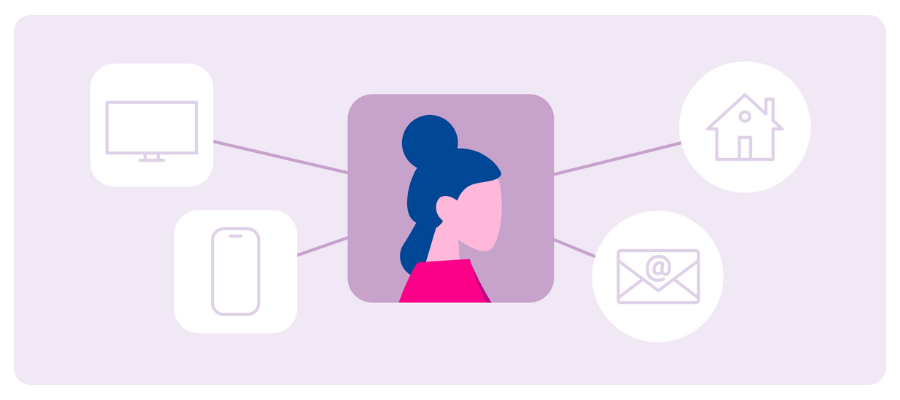
A picture of a woman with four icons surrounding her that represent a TV, cell phone, house, and email

3. Holiday spending remains steady year-over-year

Holiday spending in 2023 is tracking closely with 2022, signaling consistent consumer intent throughout the season. Last year’s early promotional response in October was followed by steady spending through year end.

Year-over-year change on average consumer spending

OctoberNovemberDecember
2020 vs. 201914%12%10%
2021 vs. 20206%8%5%
2022 vs. 20217%3%2%

    Overall holiday spending increased by 2% in 2022. That stability gives marketers room to focus on optimization and measurement, rather than reacting to short-term swings. When conditions remain consistent, it becomes easier to tie media decisions to meaningful business outcomes.

    How can you apply these holiday spending insights to your campaigns?

    Strengthen your strategy with data enrichment. Adding deeper insight into shopper preferences and behaviors helps tailor messaging and maintain consistency across channels, supporting stronger connections throughout the season.

    Key takeaways

    Holiday spending is starting earlier, driven by promotions in October and November

    Online shopping continues to grow, with online and in-store journeys closely connected

    Overall holiday spending remains consistent with last year, supporting confident planning

    Get ready for the 2025 holiday season

    2025 Holiday spending trends and insights report

    Download Experian’s 2025 Holiday spending trends and insights report, in collaboration with GroundTruth. Inside you’ll find:

    • When shoppers plan to buy
    • Why stores still drive results
    • Where marketers are placing their bets
    • How AI is shaping discovery

    Access our full set of predictions and plan your next holiday season now.
    2025 Holiday spending trends and insights

    Connect with us

    This site is protected by reCAPTCHA and the Google Privacy Policy and Terms of Service apply.


    FAQs

    What holiday spending trends does Experian expect marketers to plan around in 2023?

    Experian’s 2023 holiday spending analysis shows shoppers starting earlier, engaging more through digital channels, and maintaining steady year-over-year spend. These behaviors extend the season and reward brands that activate sooner. For marketers, this creates a longer runway to influence demand and measure impact.

    How does Experian help marketers connect online and in-store holiday spending?

    Experian uses identity as the foundation to connect digital exposure with in-store and online purchase behavior. This approach allows marketers to see how holiday spending unfolds across channels rather than treating each interaction separately. The result is a clearer view of how media drives outcomes throughout the season.


    Latest posts

    Loading…
    Commerce media’s next chapter: Growing revenue without eating your own lunch

    Commerce media networks have had a strong start. Growth has been fast, demand has been strong, and brands have made it clear they want closer access to commerce-driven audiences. But as more networks mature and enter the space, many are starting to feel the same pressure point: scale. Most commerce media networks were built as managed service businesses. That model works well early on. High-touch, white-glove partnerships make sense when you’re working with a handful of strategic brands. But there’s a ceiling. There are only so many teams, only so much inventory, and only so many advertisers that model can realistically support. It’s one thing for a large retailer to build custom programs for a P&G. It’s another to do that at scale for hundreds or thousands of brands. At some point, growth slows, not because demand disappears, but because the model can’t stretch any further. The scale problem no one likes to talk about That’s where many commerce media leaders find themselves today. Pausing to assess what comes next. For a long time, growth has been measured almost entirely through media dollars. That mindset is understandable. Media is familiar, it's easy to quantify. It shows up clearly in negotiations and revenue reports. But viewing commerce media networks purely as media sales engines creates long-term risk. It can strain brand relationships, limit innovation, and distract from what commerce media networks actually do better than almost anyone else: understand consumers deeply. Signals are the real asset Commerce platforms sit close to decision-making. They see what people search for, what they consider, what they buy, and when those behaviors change. Those signals are incredibly powerful. And yet, most networks only activate them inside their own walled environments. That’s a missed opportunity. Curation represents the next area of growth for commerce media networks, and it doesn’t require replacing or diminishing existing media revenue. In fact, it complements it. No single commerce media network has all the data needed to give advertisers the scale and reach they're looking for. And no advertiser wants to recreate the same audience in dozens of disconnected platforms. That friction creates inefficiency and slows decision-making. Why collaboration supports sustainable growth The opportunity is to look beyond first-party data alone and start thinking about collaboration. Second-party data. Data partnerships. Signal sharing done responsibly and transparently. Imagine an advertiser defining an audience once and being able to understand and reach that audience across multiple commerce environments. Not through a series of disconnected buys, but through a more consistent approach built on shared understanding leading to increased reach and more impactful campaigns. That’s easier for advertisers to manage, and it creates an additional revenue stream for commerce media networks that complements media sales rather than competing with them. Curation strengthens media, it doesn't replace it Media will always play an important role. There is clear value in custom experiences tied directly to a commerce environment. Think buyouts, sponsored experiences, custom creative integrations. Those are situations where brands want to work closely with the network itself. But the signals commerce media networks hold don’t need to be limited to those moments. Those signals can be monetized independently through data products, co-ops, and partnerships that extend their value into other channels. That’s how curation adds value without undercutting existing revenue. A practical path forward for commerce media leaders For commerce media leaders thinking about their next phase of growth, the focus should be on sustainability. Building a massive media operation takes time and investment. Data-driven revenue streams can be introduced more quickly, require fewer internal resources, and provide steadier margins. It’s a practical approach. Use signal-based revenue to fund growth. Let that revenue support investment in tooling, talent, and media innovation over time. Bootstrapping, in the truest sense. Why transparency matters early There’s also a broader responsibility here. In many advertising channels, transparency followed growth, often after pressure from the market. Commerce media networks have an opportunity to do this differently. To lead with transparency from the start. To be clear with brands and consumers about how data is used, how signals are created, and how value flows through the ecosystem. Because the reality is this: commerce media networks are holding some of the most valuable intent signals in the market today. But those signals don’t retain their value in isolation. If they aren’t enhanced, combined, and made accessible in the right ways, someone else will step in to do it. And when that happens, control shifts away from the source. The bottom line The next chapter of commerce media isn’t just about selling more media alone. It’s about recognizing the value of the signals already in hand, working together to make them more useful, and building additional revenue streams that support long-term growth. That’s how commerce media networks grow without eating their own lunch. About the author Kevin Dunn Chief Revenue Officer, Experian Kevin Dunn joins Experian Marketing Services with more than 20 years of leadership experience across marketing and advertising technology, most recently serving as Senior Vice President of Brands and Agencies at LiveRamp. In that role, he led growth across retail, CPG, travel, hospitality, financial services, and healthcare, overseeing new business, account expansion, and channel partnerships. Kevin is known for building cohesive, accountable teams and leading with optimism, clarity, and a strong sense of shared purpose. His leadership philosophy centers on empowering people, driving positive outcomes for clients and fostering a culture where teams can grow, take smart risks, and succeed together. Latest posts

    Published: Mar 03, 2026 by Kevin Dunn, Chief Revenue Officer

    Why curation is becoming the standard for programmatic buying

    Learn why programmatic curation is becoming the standard for privacy-first, performance-driven media buying in 2026.

    Published: Mar 02, 2026 by Jake Abraham, Head of Strategic Partnerships

    Reach households based on how and when they consume energy with Experian Audiences

    Learn how energy and utility marketers use Experian Audiences to reach households based on energy usage, sustainability interest, and tech adoption.

    Published: Feb 11, 2026 by Experian Marketing Services

    Subscribe to our newsletter

    Enter your name and email for the latest updates

    This site is protected by reCAPTCHA and the Google Privacy Policy and Terms of Service apply.

    About Experian Marketing Services

    At Experian Marketing Services, we use data and insights to help brands have more meaningful interactions with people. As leaders in the evolution of the advertising landscape, Experian Marketing Services can help you identify your customers and the right potential customers, uncover the most appropriate communication channels, develop messages that resonate, and measure the effectiveness of marketing activities and campaigns.

    Visit our website

    Subscribe to our newsletter

    Stay up to date on the latest industry news and receive expert tips from our marketing experts.
    Subscribe now!