Small Business Application Requirements – part I

by Guest Contributor 6 min read January 25, 2012

By: Joel Pruis

The debate on what constitutes a small business application is probably second only to the ongoing debate around centralized vs. decentralized loan authority (but we will get to that topic in a couple of blogs later).  We have a couple of topics that need to be considered in this discussion, namely:
     1.      When is an application an application?
     2.     Do you process an incomplete application?

When is an application an application?

Any request by a small business with annual sales of $1,000,000 or less falls under Reg B.  As we all know because of this regulation we have to maintain proper records of when we received an application and when a decision on the application was made as well as communicated to the client.  To keep yourself out of trouble, I recommend that there be a small business application form (paper or electronic) and that you have clearly stated the information required for a completed application in your small business application procedures.  The form removes ambiguities in the application process and helps with the compliance documentation.

One thing is for certain – when you request a personal credit bureau on the small business owner(s)/guarantor(s) and you currently do not have any credit exposure to the individual(s) – you have received an application and to this there is no debate.

Bottom line is that you need to define your application and do so using objective criteria.  Subjective criteria leaves room for interpretation and individual interpretation leaves doubt in the compliance area.

Information requirements

Whether or not you use a generic or custom small business scorecard or no scorecard at all, there are some baseline data segments that are important to collect on the small business applicant:

  • Requested amount and purpose for the funds
  • Collateral (if necessary based upon the product terms and conditions)
  • General demographics on the business
    • Name and location
    • Business Entity type (corporation, llc, partnership, etc.)
    • Product and/or service provided
    • Length of time in business
    • Current banking relationship
  • General demographics on the owners/guarantors
    • Names and addresses
    • Current banking relationship
    • Length of time with the business
  • External data reports on the business and/or guarantors
  • Business Report
  • Personal Credit Bureau on the owners/guarantors
  • Financial Statements (??) – we’ll talk about that in part II of this post.

The demographics and the existing banking relationship are likely not causing any issues with anyone and the requested amount and use of funds is elementary to the process.  Probably the greatest debate is around the collection of financial information and we are going to save that debate for the next post.

The non-financial information noted above provides sufficient data to pull personal credit bureaus on the owners/guarantors and the business bureau on the actual borrower.  We have even noted some additional data informing us the length of time the business has been in existence and where the banking relationship is currently held for both the business and the owners.  But what additional information should be requested or should I say required?

We have to remember that the application is not only to support the ability to render a decision but also supports the ability to document the loan and maybe even serve as a portion of the loan documentation. 

We need to consider the following:

  • How standardized are the products we offer?
  • Do we allow for customization of collateral to be offered?
  • Do we have standard loan/fee pricing?
  • Is automatic debit for the loan payments required?  Optional? Not available?
  • Are personal guarantees required?  Optional?

We again go back to the 80/20 rule.  Product standardization is beneficial and optimal when we have high volumes and low dollars.  The smaller the dollar size of the request/relationship the more standardized we need to have our products and as a result our application can be more streamlined.  When we do not negotiate rate, we do not need to have a space to note requested rate.  When we do not negotiate on personal guarantees we always require the personal financial information be collected on all owners of the business (some exceptions for very small ownership interests).  Auto-debit for the loan payments means we always need to have some form of a DDA account with our institution.  I think you get the point that for the highest volume of applications we standardize and thus streamline the process through the removal of ambiguity.

Do you process an incomplete application?

The most common argument for processing an incomplete application is that if we know we are going to decline the application based upon information on the personal credit bureau, why go through the effort of collecting and spreading the financial information.  Two significant factors make this argument moot: customer satisfaction and fair lending regulation.

Customer satisfaction

This is based upon the ease of doing business with the financial institution.  More specifically the number of contact points or information requests that are required during the process.  Ideally the number of contact points that are required once the applicant has decided to make a financing request should be minimal the information requirements clearly communicated up front and fully collected prior to rendering a decision.  The idea that a quick no is preferable to submitting a full application actually is working to make the declination process more efficient than the actual approval process.  So in other words we are making the process more efficient and palatable for those clients we do NOT consider acceptable versus those clients that ARE acceptable.  Secondly, if we accept and process incomplete applications, we are actually mis-prioritizing the application volume.  Incomplete applications should never be processed ahead of completed packages yet under the quick no objective, the incomplete application is processed ahead of completed applications simply based upon date and time of submission.  Consequently we are actually incenting and fostering the submission of incomplete applications by our lenders.  Bluntly this is a backward approach that only serves to make the life of the relationship manager more efficient and not the client.

Fair lending regulation

This perspective poses a potential issue when it comes to consistency.  In my 10 years working with hundreds of financial institutions, only a very small minority of times have I encountered a financial institution that is willing to state with absolute certainty that a particular characteristic will cause an application to e declined 100% of the time.  As a result, I wish to present this scenario:

  • Applicant A provides an incomplete application (missing financial statements, for example).
    •  {C}Application is processed in an incomplete status with personal and business bureaus pulled.
    • Personal credit bureau has blemishes which causes the financial institution to decline the application
    • Process is complete
  • Applicant B provides a completed application package with financial statements
    • Application is processed with personal and business bureaus pulled, financial statements spread and analysis performed
    • Personal credit bureau has the same blemishes as Applicant A
    • Financial performance prompts the underwriter or lender to pursue an explanation of why the blemishes occurred and the response is acceptable to the lender/underwriter.

Assuming Applicant A had similar financial performance, we have a case of inconsistency due to a portion of the information that we “state” is required for an application to be complete yet was not received prior to rendering the decision.  Bottom line the approach causes doubt with respect to inconsistent treatment and we need to avoid any potential doubt in the minds of our regulators.

Let’s go back to the question of financial statements.  Check back Thursday for my follow-up post, or part II, where we’ll cover the topic in greater detail. 

Related Posts

Who’s Driving What? How Fuel Loyalty and Generational Preferences are Shaping the Vehicle Market

Take a look around at any road, parking lot, or highway, and you’ll see just how diverse today’s vehicle landscape has become. Within that evolving mix, electric vehicles (EVs) have seen years of rapid growth, and while the market is seemingly entering a new phase, interest remains. So, with several vehicles and fuel types to choose from, what keeps drivers coming back to electrified vehicles? Experian Automotive’s Automotive Market Trends Report: Q2 2026 found that among EV owners who returned to the market in the last 12 months, majority (72.2%) replaced their EV with another EV, while 18.5% switched to a gasoline vehicle. Hybrid buyers also showed considerable loyalty to electrification, with 55.7% of gas-hybrid owners staying with the same fuel type when replacing their vehicle, and 32.7% swapping for a gasoline vehicle. Consumers are seemingly remaining loyal to EVs and hybrids because they are attracted to the benefits that fit their everyday lifestyle, such as lower fuel or charging costs amid the elevated gas prices. For some, it could also be tied to convenience, as drivers who have found a reliable charging routine or appreciate the efficiency of a hybrid may have little reason to switch back to a traditional gasoline vehicle. Generations are taking different paths to electrification Generational differences also influence hybrid and EV loyalty, with younger consumers generally showing greater openness to alternative fuel types. While older generations tend to have greater familiarity with traditional gasoline vehicles, hybrid and EV adoption is increasing across all age groups as these options become more accessible and mainstream. Millennials, in particular, showed the strongest inclination toward electrified vehicles. Through Q2 2026, they accounted for the highest EV share at 8.2%, compared with Gen X at 5.5%, Gen Z (4.7%), and Baby Boomers (4.7%). The difference becomes even more pronounced when hybrids are in the mix, as 23.1% of Millennial registrations were gas-electric hybrids or plug-in hybrids, versus 16.7% for Gen X, 16.8% for Gen Z, and 18.0% for Baby Boomers. For automotive professionals, these differences make understanding who is driving what, and what they may choose next, increasingly important. The future of the automotive market may be less about consumers choosing one vehicle type over the other and more about understanding the distinct patterns and preferences of each generation. As the market continues to evolve, those insights can help automotive professionals better meet consumers where they are. To learn more about vehicle market trends, view the full Automotive Market Trends Report: Q2 2026 presentation on demand.

September 24, 2026 by John Howard
New Data Available for MBS Investors: Current Credit Score 

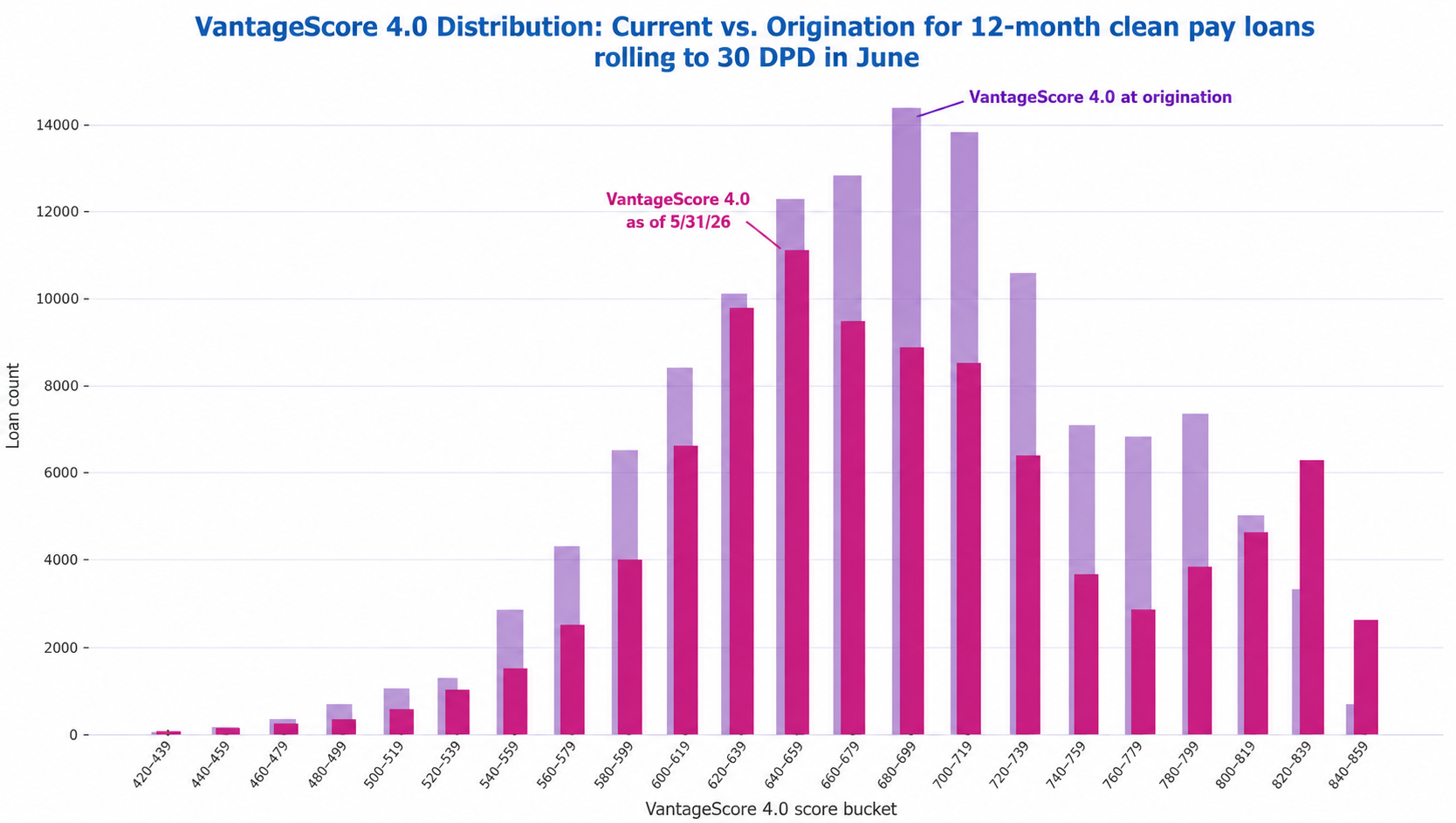
In a previous post, we described how every mortgage borrower’s financial situation and credit profile evolve over time.  After a borrower opens a loan, their financial status evolves—jobs are gained and lost; incomes can rise or fall, and financially stressful situations or windfalls can occur. These effects are often reflected in the consumer’s evolving credit score, which changes with the consumer’s payment behavior on open loans, credit inquiry activity, credit card utilization, and other revolving lines, among other things.    Even though MBS, whole loan, and MSR investors ultimately bear borrower credit risk, they may have access to less current borrower credit information than other participants in the mortgage ecosystem.   In securitized markets (both agency MBS and private-label MBS), updated scores are not provided in disclosure to bondholders, even as loans age year over year.  In whole loan and MSR markets, a single origination credit score is often provided at the time of bid, and after a successful bid, the investor may have a permissible purpose to pull individual scores on an owned portfolio. But until recently, there was no single loan-level dataset that included continuously refreshed credit scores across the U.S. mortgage market—the type of foundational dataset needed to build and tune credit and prepayment models.  A monthly-refreshed Current Credit Score field meets our three-pronged materiality standard for new data delivery to MBS markets:  New: Provides information not available in existing datasets (i.e., orthogonal to currently available data). Neither private-label MBS nor agency MBS standard market data includes a monthly-refreshed borrower credit score.  Material: Impacts a sizeable portion of the MBS universe. For the vast majority of loans in MBS, borrowers credit scores are available.  Significant: Differentiates collateral performance by a large enough margin to influence trading and risk management decisions.  A current credit score wraps all of a borrower’s credit-related behaviors into a single numerical value and has historically been associated with a borrower’s likelihood of becoming 60+ days past due on any obligation within the subsequent 24 months.    In fact, a current credit score is among the most informative indicators of near-term mortgage default risk, as shown in the image below, which depicts 30+ DPD rates by current credit score bands for the entire U.S. mortgage market, controlling for origination score <=650.    Without access to current credit scores, investors are limited to the score at origination—causing the four distinct performance trends shown here to appear as a single averaged line. In reality, score migration since origination reveals significant divergence in credit risk, with the lowest current-score bucket exhibiting a nearly 10 times higher 30+ DPD rate than the highest-score bucket in the latest period shown.  Source:  Experian Mortgage Loan Performance (MLP) dataset hosted on IVolatility DataDriven Platform  In this article, we’ll take a quick look at how score migration acts as an early predictor of a performing loan’s first roll into 30-day delinquent status.    MBS Investors’ Current Credit Score Blindspot: Solved   An MBS investor relying on standard market data and securitization remittance reports sees no sign of borrower stress until the subject mortgage loan in the securitization misses a payment and is reported at 30 days delinquent. Of course, in the vast majority of cases, a borrower begins struggling financially well before missing a mortgage payment:  The borrower may miss payments on other types of loans (credit card, auto loan, personal unsecured, or payday loans) as they prioritize their home and mortgage.  Outstanding balances on credit cards may grow as the borrower begins to make only minimum payments on revolvers.  The borrower may apply for additional credit cards, personal or payday loans   The borrower may apply to increase limits on existing credit cards as outstanding balance nears spending limit  All these stress-indicative behaviors result in a decreasing credit score, many months before the borrower misses their first mortgage payment. An MBS investor with access to each borrower’s current credit score, refreshed each month, can predict increased likelihood of default many months before the first missed mortgage payment—and is therefore at a major information advantage relative to the market generally.  Experian’s Mortgage Loan Performance (MLP) dataset contains thousands of fields describing mortgage performance from each borrower, loan, and property perspective, all refreshed monthly (including, amongst other things, new credit scores and refinance inquiry activity, loan performance on all types of debt, filed junior liens, and AVM values).   MLP is much more comprehensive than loan-level data provided by Freddie Mac, Fannie Mae, Ginnie Mae, and PLS data vendors in several ways:   Standard market datasets may not contain certain data elements that some market participants consider useful when evaluating mortgage prepayment or credit performance. Basic, critical fields such as the borrower’s current credit score and the current junior lien balance on the property are missing.    MLP contains borrower, loan, and property data fields spanning a broad portion of the mortgage universe, including Agency, Non-Agency, and Esoteric mortgage products (CES, HELOC, Reverse), including both securitized and non-securitized loans.   MLP enables full three-dimensional (borrower + loan + property) tracking with persistent keys for borrower (before and after refinancing), loan (in securities/deals even after exit due to payoffs or buyouts, including before and after MSR sales), and property.  This enables end-to-end analysis of each borrower’s (and property’s) mortgage experience throughout their credit lifecycle.  Is Downward-Trending Credit Score a Signal for Impending Delinquency?  MLP contains thousands of fields describing each loan, borrower, and property across all U.S. mortgages.  It allows for virtually unlimited segmentation and granular analysis.   For purposes of this illustrative article, we’ll take a high-level look at the entire U.S. mortgage market and perform a quick analysis to confirm intuition that a declining credit score provides a signal for higher likelihood of near-term mortgage delinquency.  Figure 1 illustrates the current pay status (as of 6/30) for the entire U.S. mortgage market, as contained in the MLP dataset, along with count, UPB and UPB-weighted Vantage 4.0 credit score for each bucket.  Figure 1  Source:  Experian Mortgage Loan Performance dataset  As illustrated in Figure 1, approximately 772,000 individual mortgage loans were reported to Experian as 30 days delinquent as of 6/30/2026.  Of the 772,000 30d delinquent loans in the June snapshot, approximately 426,000 were current in the prior (May) snapshot.  Some of these 426,000 loans were reperformers which had been bouncing from 30 DPD to current over the prior few snapshots. To remove reperformance score noise, we further parsed out the population which: 1) had rolled from current to 30 DPD from May to June; and 2) was consistently current for a full year prior to the 6/30 missed payment.  The population meeting both conditions totaled approximately 123,000 loans.  Figure 2 below shows, for this population of 123,000 “clean current” loans, the UPB-weighted average Vantage4 credit score for each of the 12 months leading up to the June missed payment, as well as the impact of the missed payment on the 6/30 score.  Figure 2  Source:  Experian Mortgage Loan Performance Dataset  Figure 2 reveals a rather slow and steady ~20-point deterioration of score in the 12 months prior to first missed payment – as well as the 80-point drop once the missed payment hits.  When we compare this cohort’s Vantage 4.0 score trend to the broader Current population across the entire dataset in Figure 3, we see a marked difference in both absolute value and trend:  Figure 3  Source:  Experian Mortgage Loan Performance Dataset  Not only is the cohort’s starting Vantage 4.0 score lower than the broader current population, but it also displays a dropping trend (with a notable 2 to 3x acceleration in monthly score drop the month before the first missed mortgage payment) while the broader Current population’s score (of which the isolated cohort is a subset) remains rock steady.  Lastly, we present Figure 4, a histogram comparing the distribution of at-origination and as-of 5/30 (i.e., the period just before the missed June mortgage payment) credit scores for the clean current population. The distribution appears to shift toward lower credit scores. To the extent credit scores are correlated with credit risk, this shift may indicate elevated credit risk relative to origination. Since this degradation occurs during a period of perfect mortgage pay performance, it is invisible to MBS investors who lack access to current borrower credit scores. Experian MLP provides monthly refreshed credit scores for mortgage borrowers contained within the MLP database.  Figure 4  Source:  Experian Mortgage Loan Performance Dataset 

September 22, 2026 by Michael Pyatski, Perry DeFelice
Ask the Expert: The Future of Lending Starts With Identity With Shawn Rife and Brian Cardona

Identity intelligence and alternative data can help lenders validate consumers and support more informed decisions across the customer lifecycle.

September 16, 2026 by Julie Lee

Subscribe to our Newsletter

Enter your name and email for the latest updates.

This site is protected by reCAPTCHA and the Google Privacy Policy and Terms of Service apply.

Subscribe to our Newsletter

Don't miss out on the latest industry trends and insights!
Subscribe