At A Glance
Automated health insurance discovery can help healthcare organizations find active coverage, identify payer responsibility and correct insurance information earlier in the revenue cycle. When those checks are built into patient access workflows, providers can reduce manual research, support more accurate claims and give patients clearer information about coverage.
Key takeaways:
- Health insurance discovery goes beyond confirming that a known plan is active by searching for missing coverage and helping determine payer order.
- Experian Health’s Patient Access Curator™ (PAC) uses AI to combine insurance discovery with eligibility, coordination of benefits, demographic and Medicare Beneficiary Identifier checks in one automated workflow.
- The Total Economic Impact™ of Experian Health Patient Access Curator, a Forrester study commissioned by Experian Health, modeled fewer coverage-related denials and less manual discovery work for a composite health system when using Patient Access Curator.
Coverage accuracy remains a front-end priority. In Experian Health’s State of Patient Access 2026 survey, 44% of providers said delivering a faster, more comprehensive review of coverage was urgent. The same survey found that improving the speed, accuracy and completeness of patient insurance searches was providers’ top patient access challenge. Changes in payer policies or a patient’s coverage can leave benefit information out of date and create additional work to identify the appropriate payment source. Automated health insurance discovery can help providers find missing coverage and catch outdated policy information earlier.
This article examines how automating health insurance discovery with AI-powered solutions like Patient Access Curator can help healthcare organizations address common challenges in the revenue cycle.
What is health insurance discovery?
When a patient comes in for care, one of the first jobs is to figure out exactly what insurance they have — if any — and what it covers. Health insurance discovery searches for active coverage that may be missing or incomplete in the patient record. Eligibility verification can then confirm whether known coverage is active and what benefits apply, while coordination of benefits determines payer order when a patient has multiple active plans. Together, these checks help providers identify the payer information needed before billing.
How does it work?
Ideally, coverage discovery occurs preservice, but it can occur later if a claim is denied, and alternative coverage sources must be found.
| The main steps in the process include: |
| – Collecting insurance details when patients schedule or check in |
| – Checking with insurance companies to confirm that coverage is active and reviewing available benefit information for planned services |
| – Cross-checking payer databases to look for additional coverage |
| – Considering a patient’s eligibility for Medicaid or other financial assistance |
| – Coordinating benefits for accurate billing |
What are the benefits of automated health insurance discovery for providers?
Providers report growing confidence in insurance verification, even as claims challenges persist. Experian Health’s State of Patient Access 2026 survey found that 74% of providers rated their insurance verification process as effective, up from 54% a year earlier. At the same time, 68% of respondents to the State of Claims 2025 survey said submitting clean claims had become more challenging than a year earlier. Automation can help connect front-end coverage checks with downstream claims workflows.
Here are a few ways automated health insurance discovery can support claims accuracy and revenue cycle workflows:
1. Find missing coverage earlier
Challenge: Patients may not provide complete insurance information, which can delay or limit reimbursement when billable coverage is missing from the record.
How automation helps: Automated health insurance discovery can search for coverage that may be missing from the patient record without relying solely on manual staff research. Experian Health’s Patient Access Curator uses AI to combine insurance discovery with eligibility verification, coordination of benefits (COB), Medicare Beneficiary Identifier (MBI) checks and demographic validation in a single workflow. It can identify active and additional coverage, determine payer primacy and update coverage information before claims are submitted.
In The Total Economic Impact™ Of Experian Health Patient Access Curator, a commissioned study conducted by Forrester Consulting on behalf of Experian Health, Forrester modeled a composite U.S.-based integrated health system using data from interviews with five decision-makers at organizations using Patient Access Curator. The composite organization protected $50.4 million in revenue over three years through reduced COB, eligibility and registration denials.
2. Reduce the manual workload
Challenge: Manual coverage research can require staff to call payers, log in to various portals and enter patient data across multiple systems.
How automation helps: Automation can handle repeatable insurance verification and coverage research tasks, allowing staff to focus on exceptions and more complex work. PAC automates eligibility verification, insurance discovery, payer coordination of benefits and coverage updates across patient access and revenue cycle workflows. In the Forrester Consulting Total Economic Impact™ study, the composite organization reduced the time back-end revenue cycle teams spent on insurance discovery activities by 80% by Year 3.
Reducing avoidable manual work can help teams use staff time and resources more effectively.
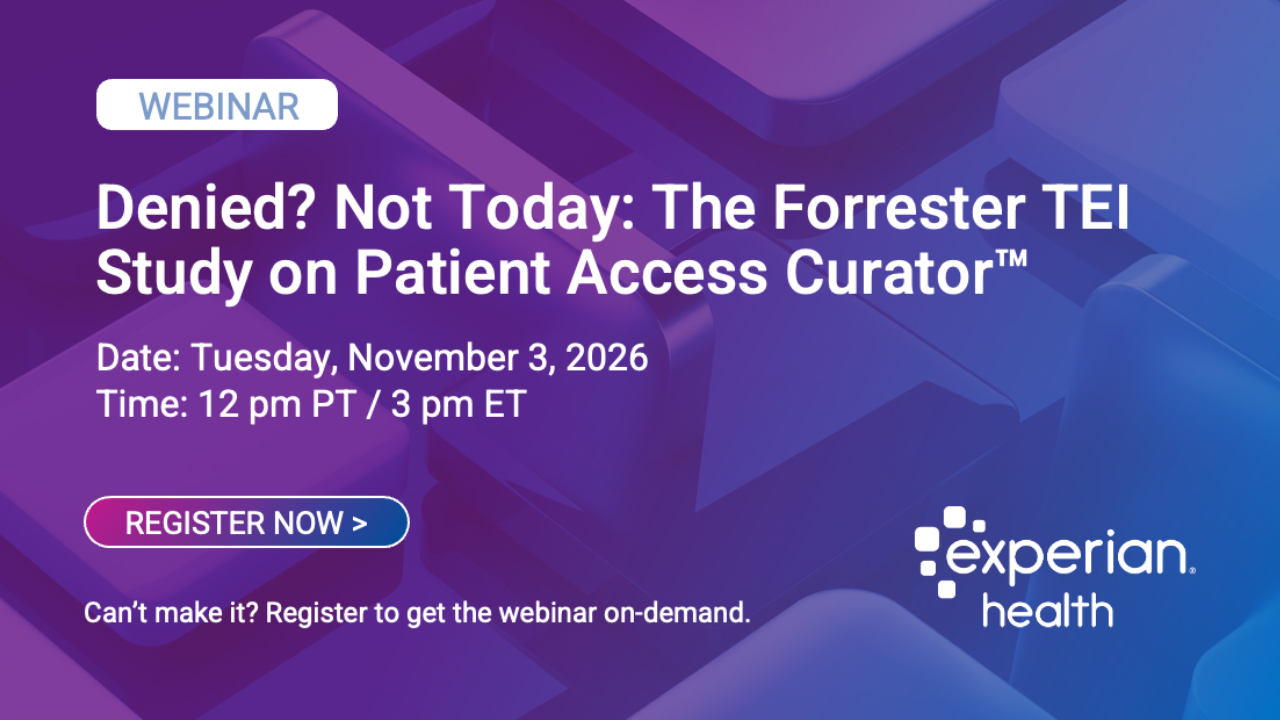
Join Experian Health and guest Forrester Consulting behind the study for a live walkthrough of the full findings: methodology, cost savings and benefits enabled by Patient Access Curator.
3. Catch eligibility issues earlier
Challenge: If eligibility information is not rechecked, coverage changes may not be identified until after a claim is submitted. In a 2026 Experian Health survey of 200 healthcare leaders, 55% of providers said re-running an eligibility check takes at least 10 minutes of staff time.
How automation helps: Automated real-time eligibility checks with tools like Patient Access Curator can help providers catch coverage changes earlier and reduce the risk of denials tied to outdated information. PAC uses AI-driven decisioning to identify active coverage, sequence payers and write corrected information into the host system before the claim is created.
4. Reduce coverage-related claim denials
Challenge: Incorrect or incomplete insurance information can lead to errors on claim forms or claims sent to the wrong payer, causing denials, delays and rework.
How automation helps: Patient Access Curator uses AI to perform real-time routine eligibility and coverage checks, while surfacing cases that need additional review. That can help patient access teams focus their attention where it is most useful.
Columbus Regional Health took this approach after moving coverage checks into an automated workflow within Patient Access Curator. After implementation, Columbus Regional Health reported a 41% reduction in eligibility denials, a 37% reduction in COB and registration denials, while coverage accuracy reached 97%.
5. Improve the patient experience
Challenge: Coverage uncertainty and billing discrepancies can create confusion for patients. When coverage or payer information is wrong or incomplete, patients may need to clarify insurance details after care is delivered.
How automation helps: By identifying coverage and verifying eligibility earlier, automation can help providers give patients clearer information about how insurance may apply to their care. The Forrester Consulting Total Economic Impact™ study listed improved patient satisfaction as an unquantified benefit for the composite organization, based on interviewees’ reports of fewer billing discrepancies and fewer situations in which patients had to clarify insurance information after services.
Other automated patient financial tools can then support the financial experience by routing patients to additional assistance and payment options if needed. For example, Patient Financial Clearance can help connect patients who qualify for financial assistance with relevant programs and payment pathways.
Case studies: See Patient Access Curator in practice
Frequently asked questions
No. Eligibility verification confirms whether a known insurance plan is active and what benefits apply. Health insurance discovery searches for coverage that is missing or not recorded. The two processes work together, especially when a patient has multiple plans or when payer primacy is unclear.
Coordination of benefits determines which active plan should pay first when a patient has more than one payer. Establishing payer primacy before the claim is created can help the provider bill insurers in the correct order and reduce avoidable COB-related rework.
Learn more about how Patient Access Curator can support coverage accuracy, denial prevention and patient access workflows.
Contact Experian Health
Complete the form below to be connected with a member of our Sales team. For Customer Support, including password resets, please visit our Support page.
This site is protected by reCAPTCHA and the Google Privacy Policy and Terms of Service apply.