Credit Management

Stagflation can impact your commercial portfolio performance. We explore options credit departments can take to identify high-risk accounts.

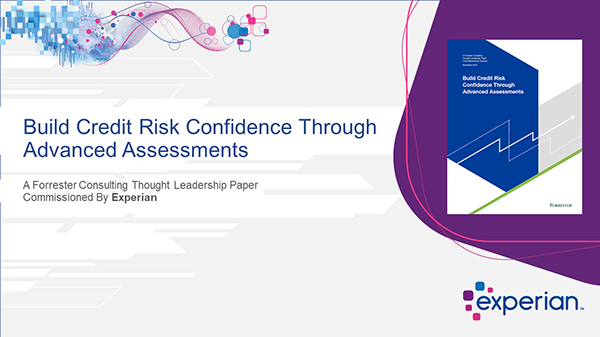
Michael Myers, Experian's Vice President of Products, assembled an impromptu roundtable discussion in March 2020 to discuss some of the key findings in a Forrester Study titled "Build Credit Risk Confidence Through Advanced Assessments." Mike is joined by Ann Skibicki, Sr. Director of Product Management and Brodie Oldham, Director of Analytics Consulting. What follows is a lightly edited transcription of their discussion. Build Credit Risk Confidence Through Advanced Assessments [Mike]: Hi everyone. I'm Michael Myers. I am the Vice President of Products here at Experian Business Information Services and looking forward to talking to you today. We're going to share a number of findings from our most recent Forrester Research project entitled “Build Credit Risk Confidence Through Advanced Assessments”, and I'm joined today by Ann Skibicki, a Senior Director on our Product Management team. We're also joined by Mr. Brodie Oldham all the way from Texas. He is a Director of Analytics Consulting here at Experian. [Mike]: All right guys, let's jump into it. We recently commissioned Forrester and ended up with our most recent study and what we want to do is share some of the key findings. Really the goal of the overall project was to get a sense of risk-based decisioning and what some of the firms in the industry's plans are around the future of their credit risk assessment practices. I'll start at a high level discussing some of the key findings and then with Ann and Brodie's help, we're going to dig into each one. [Mike]: So, finding number one, only half of decision-makers are very confident in their businesses, current approaches to risk management. The second finding, businesses struggle to deploy advanced analytics or automate account reviews, and last but not least, our third finding we're going to discuss today is most businesses are looking to a credit risk evaluation partner to evolve their risk solutions. [Mike]: Okay so, before we jump into those, let me just give you a little bit of background about who we talked to and their background firmographics. We certainly wanted to talk to decision-makers, so we went after those at the C level down through Vice President, Director Management. We certainly want to make sure they were part of this conversation and had an active role in it. So, we talked to everyone that was just considering starting this journey, those that were mid-flight of the journey, and those that had actually implemented some more automated analytic approaches. [Mike]: One more slide on the background. We needed to make sure we had a wide variety across the spectrum of company sizes. You'll see on this graph on the left, you know, really the sweet spot in that mid to large size company. But we also covered the small business micro-business even as well as some of the larger firms out there. And with that comes really a wide array of industry verticalization. Everything from what you see here on the top right, financial services down to the agricultural food and beverage industry. [Mike]: Okay. So let's jump into it guys. Finding number one only of decision-makers are very confident in their business’s current approaches to risk management. Ann let's start with you. Give us your, take some of your thoughts. [Ann]: Uh, sure. Mike. Yeah, I think that that is interesting. But I think you do have to dig in a little bit further by the client's evolution as to where they're at in the adoption of advanced analytics and decisioning to really make meaning of that stat. You'll find that the folks that are actually adopting advanced analytics and decisioning are already on their path, are much more confident, almost twice as confident as the folks that have not implemented or have no plans at this point to implement. [Ann]: So I think there is something interesting to be said there about the level of competence that folks are having with their processes and advanced analytics, particularly with the folks that are already adopting. Brodie anything to add? [Brodie]: Well, sure Ann. As I've looked at this and we've talked to clients and part of the engagements that we've had, we find that a lot of times that confidence that they have has pulled back a little bit because they lack some of the automation there. We look behind the curtain, and we see it. What they end up with are inconsistent decisions. And so, what we're trying to do is give them a pathway or a framework to work with, and Forrester really showed us that they needed that. Some of the things that they need are a strong benchmark to start, you know, where they're really going to start their path. Those advanced analytics that you talked about are important, we have new methodologies that we can deploy and then a place to deploy them. Really that decisioning platform is super important for their confidence. [Brodie]: So when they come out for that progression and for the performance to be there, they really need to have that confidence to progress their sales cycle, and we see that those that don't have that plan to implement. Only 12% of those folks really, they're not planning to grow. 12% of those that are planning to grow in the near future really aren't going to grow. So we found that in the Forrester study, it's very exciting to see. [Brodie]: But when we look at those that are really having some success. I know Mike in the Forrester study some of the things, there were some key points that we found that were helping some of those that are really pushing forward and pushing that limit to overcome. What are some of the challenges that they might be facing? [Mike]: Yeah, got it. Couldn't agree more Brodie and thank you both. Great insights on that first finding. Tell you what, let's jump into the second one. Finding number two, businesses struggle to deploy advanced analytics or automate account reviews. Let’s start with you Brodie, but I'll add a little bit of my insight on this one too. [Mike]: In my experience with our prospects, and with our clients, you know, account reviews are often overlooked, especially when the economy is doing as well as it is. You know, everyone's focused on origination, opening accounts, but they tend to forget the need to really focus on account reviews and really managing those accounts. So, Brodie give me some of your thoughts. [Brodie]: When we're looking at the Forrester study it really highlights what we've been seeing with our clients. We know that some of the strategies that we've been taking are implementing some of these more mature methodologies, more advanced cutting-edge methodologies for Machine Learning, and in our processes for an account review, even originations, but account review especially. We've seen lift over those tried and true logistic regression type models with our new Machine Learning models — 12% 15%,17% plus percent. So really some great value that's being added in these Machine Learning type models. [Brodie]: The hardest thing that we see with our clients is being able to install what we have here in this new methodology into the process, so into their account review process. With some of the new microservices that we have in place, we can deploy those. We have sub-second turnaround times with the new methodologies that we have. Which is really industry-leading, and it takes us into a place where our clients can deploy either models that we've built for them or models that they've built themselves and deploy it here at a significantly lower cost and they can really do it themselves. I know Ann, some of these, when we talk about implementing a key to that is data. Do you have some points that you want to make on that? [Ann]: Yeah, I was going to kind of bring it back to the fundamentals because when I read the study and looked at the results for me, a couple of things stood out. Not only were our clients and their survey respondents struggling with IT budget and system constraints, which I think we would all agree is a challenge across the board. What I thought was interesting was that they're having data quality challenges and that was across the board. Whether they were just starting to implement or if they were on the path of implementation. Everybody seemed to have really the same challenge with standardizing the data, finding good fill rates of the information of where the data's not complete or even the data privacy issues. I'll say in working with some clients recently, I would definitely agree with this. You know, data standardization, data quality, especially with data and multiple systems becomes pretty challenging. And then you really want to leverage that information, right? Unlock the power of the data to be used in the advanced analytics portion, whether it's for portfolio management or new account acquisition. It can be a definite challenge for sure. [Mike]: Great job guys. You know, I just want to add to that too. I think you both hit on some key points. ML, Machine Learning, A.I. buzzwords, right? Really hot in this space right now. It’s really important not to forget what problem are you trying to solve, what are you trying to accomplish, and then how can you go about doing that? I think Brodie, you outlined some really good points of hey double-digit lift. That's no joke. How can we at Experian possibly help you implement that? And we do have a number of ways and a number of analysts that are really experienced in just that. [Mike]: So, bringing it back to your point too, Ann, it's easy to forget some of the basics, tie that together and you really have a compelling proposition. All right guys let's go to the third and final finding from our Forrester study. Most businesses are looking to a credit risk evaluation partner to evolve their risk solutions. Ann why don't we start with you. Talk to me about this finding. [Ann]: Yeah, I thought this was interesting as well. A very strong call to action for me. I saw that with our clients and respondents, this is not necessarily an emerging need. About 75% of the respondents are taking immediate action within the next 12 months. So, I'm happy to see that folks are definitely starting to adopt these new methodologies, are really looking at ways to transform their business. And that is happening right now at the present time. I'm sure Brodie, you're probably hearing a lot from clients working in the analytics space of folks that are looking to us maybe want to share some of your insight. [Brodie]: Well, they certainly are Ann, the way that we're really drawing this in to show the value they're there, they get the feeling that they're on the cutting edge and we really want them to see that, and as our clients move forward with us in partnership, to build out their account management and even their origination systems, as they're including some of these Machine Learning and advanced techniques into their processes. It's not just the performance that they're getting here, as far as their numbers and the dollars that they're earning, but their sales teams are getting that lift as well. And I like to call it the swagger factor. So, you mentioned a little bit earlier, you know, in this Forrester study what you're going to see is that swagger factor, which is up about a 200% increase in that confidence level that our clients are really feeling here. [Brodie]: When we look at those in this study that didn't feel like they had a good onboarding process, about 28% didn't in the group that wasn't going to implement in the next two years. So there are groups that are waiting to implement or looking out in the future to take these next steps into Machine Learning. The ones that are doing it more quickly in the next six months or so, 85% of them feel like they're really on the cutting edge. They're moving forward, they're going to have great sales and growth in the next six to 12 months. That's where the swagger factor comes in. This really reinforces the good value that we're seeing in a partnership with Experian. And Mike, can you tell us a little bit about how to get some of this information? [Mike]: Yeah, you got it. Brodie, thank you so much. We can help you. Let us help you increase your swagger factor, but first I just want to say thank you, Brodie, thank you Ann for joining us today. Really what we have available is a copy for download of this Forrester research study. It's available over on experian.com so please join us there and we'd love to talk to you further. We do have quite a bit of experience as you heard from Ann, Brodie, and myself today, and we'd love to help you on this journey. Thanks so much for joining us today. If you would like to download a copy of the full report visit our credit risk assessment page. Forrester Credit Risk Assessment

Making fast, accurate decisions on businesses is critical, especially during uncertain times. Having an edge on your competition matters, from productivity to profitable growth. For risk managers and data analysts, the stakes could not be higher. In response to that market need, Experian Business Information Services recently announced the availability of the Ascend Commercial Suite, a data and analytics platform which currently enables the following three capabilities: Commercial Analytical Sandbox - enables immediate access to multiple data sets, including our commercial, premier consumer attributes, and SBFE data, with new data snapshots automatically added monthly. Experian built Commercial Analytics Sandbox on the same OneExperian Technology Platform that won a FinTech Breakthrough Award for Best Overall Analytics Platform in 2019. It is compatible with multiple leading analytics packages and cutting-edge tools, including RStudio, R, Python, H2O, and SAS Viya. Benchmarking Dashboard - Small Business Financial Exchange members can tap into powerful portfolio views using Tableau. The Benchmarking Dashboard offers access to all data and multiple data sets so clients can compare their portfolios against peer populations, and analyze new market segments for potential expansion. Ascend Data Services - For clients who want to run analytics using their software tools. Ascend Data Services offers a delivery method that enables the flow of linked data into a client-owned environment, making Ascend Commercial Suite extremely flexible to whatever tools clients are using. Eliminate barriers to data and analytics while holding down IT costs Our clients have often mentioned the time and labor-consuming process of appending archive data. They also describe lengthy procurement processes to acquire additional data. With on-demand access to the freshest data, clients can focus on customers and be more responsive to market changes by providing KPI’s to key stakeholders, all while holding down IT costs. Manage your portfolio more effectively You can create Tableau-enabled dashboards to monitor portfolio performance and quickly identify areas of strength or concern without running custom reports every month. Spotting shifts in risk profiles or identifying cross-sell and up-sell opportunities helps you to maximize portfolio performance. Model development Perhaps the most potent aspect of Ascend Commercial Suite is the modeling tools. Here you can design, develop, and validate models (including marketing, risk, collections, 3rd party) and scorecards to find, approve, and manage new and renewal accounts. Run retroactive analyses on the fly to establish risk-based credit loans or loan amounts to better control through-the-door risk and prevent loan losses. We are incredibly excited about the possibilities Ascend Commercial Suite unlocks for our clients. If you would like to learn more or schedule a demo, please reach out to Experian today.

As business delinquencies rise in response to COVID-19, credit departments are becoming increasingly challenged. In our August 13th Sip and Solve webinar, John Krickus and Andrew Moore will be on hand to share some strategies for maximizing receivables amid rising delinquencies. Managing receivables has never been more important or more challenging. Traditional approaches may no longer apply. In this 15-minute Sip and Solve session, we discuss some solutions for effectively and efficiently handling the increase in receivables many companies are facing. After watching this talk you will learn three key takeaways: Prioritizing receivable management in today's environment Analytic tools for managing receivables Flexing receivables strategies to meet your company's priorities Click to view full slides and transcripts from this session.

In a favorable economic climate, business resilience is often treated as an afterthought. Success is measured in rapid growth and leaps of progress, while failure is little more than a tempering of that expansion. It’s only when things slow down - like during a global pandemic - that companies are forced to take stock of the ground they stand on. As the economy slows to a crawl and entire industries feel the squeeze, business resilience will determine which organizations make it through to the other side. Whether you’re on the supply side or the demand side, chances are your organization is being tested right now. Here are some practical strategies to stay resilient in the time of Covid-19. Gerard Smith, President of Global Risk Management Solutions (GRMS), works with companies who are either on-boarding new suppliers or evaluating current suppliers. When the Covid-19 pandemic disrupted supply chains in most industries, many of these companies started scrambling to find replacement suppliers. Finding a reliable supplier is always a challenge, but it’s even more difficult during a global pandemic and economic crisis. The best practice here is still to vet new suppliers carefully. Smith’s company creates a risk assessment program for Experian clients that analyzes 50 different financial and legal components, including the following: If they’re on the OFAC sanctions list If they’re financially stable If they actually have the certifications they claim to have If they have insurance If they’ve received negative press Many companies fail to do their due diligence when it comes to suppliers, especially if they’re trying to fulfill orders quickly. More often than not, this leads to bigger problems down the line. If you hire a supplier that’s hemorrhaging money, for instance, they may file for bankruptcy right after you pay them for a major shipment. Companies that use GRMS will be notified regularly if a supplier’s financial or legal status changes. If a supplier cancels their insurance coverage, for example, that could indicate financial struggles. Staying abreast of information like this allows businesses to be proactive with suppliers and avoid being blindsided. Make Sure Clients Are Financially Healthy On the flip side of the buyer-supplier relationship, suppliers are now being asked to extend due dates. Deciding how to comply with these requests can be tricky. Most want to be understanding and reasonable, but there is often legitimate concern over whether they’ll receive payment. Brodie Oldham, Senior Director of Analytic Consultancy for Experian, said Experian offers several services for suppliers who need to gauge how reliable their customers are in this moment. Experian has a special Covid-19 risk index that suppliers can overlay on top of existing credit models. This tool can help determine whether or not a client is in an unstable financial position. If the company operates in a highly impacted part of the country or industry, the supplier can use that information to change the terms. For example, they can sell fewer items to minimize the risk of an unpaid invoice. Experian also monitors credit utilization for business credit cards and other lines of credit. If a company’s credit utilization surpasses a certain threshold, they can alert the supplier who can halt future shipments until the utilization decreases. Find Faster Ways to Evaluate Creditworthiness Many suppliers depend on a company’s credit information to determine its reliability as a buyer. Likewise, credit bureaus are being forced to reevaluate their models in response to the changing business landscape brought on by Covid-19. Enter the agile credit function. The term agile has traditionally been used in the context of software development to describe an iterative approach where requirements and solutions evolve through collaboration between cross-functional teams. It allows companies to adapt to new requests quickly and improve time-to-market. Agile is all about being nimble and responsive - something credit bureaus are prioritizing in today’s uncertain economy. Agile credit means finding new, faster ways of evaluating customers and determining their ability to pay, in a time when that information can change daily. “When everything shut down in March, credit people got thrown for a loop,” said Dan Meder, Vice President of Consulting, Product Marketing and Alliances for Experian Business Information Services. “They needed a way to manage that change very quickly.” That’s where having an agile credit approach comes in. “It’s about using agile principles in your credit function to respond more quickly to changing market needs,” Meder said. Using an agile credit system helps suppliers decide what kind of terms to offer their customers. Many companies are asking suppliers to extend their terms and due dates, often switching from net-30 to net-60. Suppliers then have to decide if they can trust these companies to repay them within that longer time frame, Meder said. If companies in this position use an agile credit function, they can be more responsive and confident in the terms they set out because they’re basing their credit policies on the current state of their customer environment. This requires operating with the latest possible information on how current economic conditions are affecting their customers. Meder said that making credit function more agile requires direction from the head of the credit department and other members of that department. They can also utilize software programmers if the automatic process needs to be updated or any outside consultants for specific analytical expertise. “The idea is to bring together a team of people with direct involvement in managing the credit function to assess how best to manage the customer experience given the current state of the customer environment,” he said. “This includes setting policies around risk assessment as well as credit terms and collection processes.” Meder said companies should have technology that allows them to tinker with their credit function so they can make changes quickly. “This is especially true in a fast-changing or uncertain environment such as what we are seeing with COVID-19 and the uncertain effect it is having on our economy’s future,” he said. “In fact, it is turbulent times such as these where being “agile” is most important since the credit department needs to be able to alter course quickly if the customer environment changes for better or for worse.” Consider Being Flexible With Clients While delayed payments from clients is upsetting, avoid taking your current client relationships for granted. While a more stringent approach from suppliers is understandable right now, Meder cautions companies to remember that the pandemic will end at some point. At that time, companies will remember which suppliers were flexible about payments, due dates and terms - and which companies weren’t. “If you weren’t good to them while they were struggling, they’re going to forget about you when things turn around,” Meder said. To find out how fine-tuning your company’s credit function can help it weather the current economic crisis, reach out to your Experian representative.

This year, Experian business information services released some major enhancements to our BusinessIQ product. The project was completed by a highly skilled team here at Experian and heavily driven by customer feedback. Today we'll speak with Casey Hald. one of our lead software developers as he takes us through some of the enhancements to BusinessIQ. The transcription of our interview with Casey has been lightly edited to improve readability. What was the main goal of this redesign on BusinessIQ? CH: The goal of the redesign project was to not only improve BIQ user experience and design but also update the overall framework as well. We wanted to bring BIQ into 2020 strong and I feel like we did that. Maybe you could talk a little bit about how that process worked in this case. CH: So first I dug up the existing research material when BIQ was first being developed and used that as sort of a baseline for what BusinessIQ is all about. Since coming into Experian, I was brand new to the credit space. So having that research material was very important to me to have empathy for our users. So, I was lucky that in the first month of joining the team I traveling across the U.S. visiting our biggest clients, well both big and small and mom and pop companies and basically discovering why they use BIQ and you know, why it was important to them. So, they sent you out on the road to meet face to face. It wasn't just a conference calls? CH: Yeah, face to face. So we went from the West Coast to the Midwest, to the East coast and we visited companies, big and small. It was a treat. It was over 27 different participants across 16 different companies. So we got to talk to a lot of people. What were their struggles with BusinessIQ? CH: Yeah, so they love BusinessIQ for the speed and accuracy of pulling credit reports. They choose us over our competitors because of that speed. So we wanted to make sure that with this redesign that wasn't compromised at all. And that was something that they love with the existing design. However, with the existing design, unless you are already privy to how BusinessIQ is structured, a new credit analyst coming into this pace could be somewhat confused. So we used that as sort of a baseline to decide how we wanted the redesign to go. CH: So the first thing we did was we simplified the forgot password workflow. A lot of the challenges that our customers ran into was updating their credentials, managing their credentials. With BusinessIQ, it's security first. So we require that they log in. They can't just log in and walk away, the system will just be open for people to compromise security. It refreshes every 15, 20 minutes, so sometimes they forget to log in. So we wanted to simplify that workflow by adding a remember me functionality. So that way they can plug in their credentials and can log in. We also modified the look and feel and the design to a more modern look and feel. And so that would involve what the site navigation? CH: Yeah, the sign navigation. With that we updated the layout, moving it to the side to more of a modern dashboard, which you see a lot of times with modern applications. They have navigation right here and then the content takes up the majority of the space, which is something that we wanted. We removed search from the navigation since, it's now in the header searches, the meat, and potatoes of BusinessIQ. What our customers use and love is search. So we wanted to take that out of the body, and give that its own container and put that right above the navigation. So it's something that becomes the focal point of the application. We also reordered the search elements based on the order of importance based on customer feedback. So it's not just alphanumeric. We reordered it based on the importance of what we learned from our users. What about pulling reports? Because I mean, our customers love to pull reports and they pull a lot of them, right? CH: Absolutely. So, when they pull the reports, it's arguably the most important workflow to BusinessIQ. They use BusinessIQ to view a credit report. So if a customer wanted to pull a new report in the old design, they would need to first search a company, view an old report, click on pull report, and then view the report configuration options, which aren't exactly super organized, and then click to view the report. So with the new design, the user searches a company views the company information alongside the report configuration options and then clicks on the report. So we've lessened the number of clicks by one or two and organized it to a step by step process. So a new credit analyst coming into space doesn't get confused about what configurations he or she needs to make. The old design requires potentially 26 form inputs while the new design contains only six. Our goal made pulling a report easier by making the configuration options into a series of steps, as opposed to just a random configuration. What are the other big improvements? Did you do anything in credit configuration? CH: Yeah. So 85% of our users stated that they never changed the report type because they simply didn't understand what each report type contained. They didn't understand the benefits of a Premiere Profile versus a business report. So we added a summary for each report type. So any new credit analysts that come in, they can simply read the summary and understand what each report type means to them, and why they need to pull it. Since users often pull the same report, we added a separate card for past pulled reports. So it uses a one-two, three-step approach, making it super easy for a new user to use. And there's only one call out with all the options already default selected. So there are a lot fewer form inputs. So this has got to be saving our customers a ton of time. Right? It's all about productivity and making your business more efficient. Is that really how those improvements have been received? CH: Totally, and a lot of our credit analysts, when they use BusinessIQ, they're in and out in five minutes. They go in, search a company, pull a report, log out, get on with the rest of their workday. So we wanted to keep that, you know, save their time because time is the most important asset you have right? So we wanted to make sure that that was first and foremost. What about the management of reports if they're pulling a lot of reports, is the management of that been fixed or improved? CH: Absolutely. So we added a quick search filter to find exactly the report you're looking for. For a new credit analyst, we rolled up all the filters into a simple selector delimited by date. So they always see the freshest report at the top, which is super important. The user now has control over how many reports that they can view at once with our new paginated system, which is utilizing Google materials design documentation. So we took kind of what they learned, through their research and utilize that into our cards and components as well. The business name is now the focal point instead of the date, which is super important. And we removed the reference code as it wasn't being used among users. It was a big sequence of numbers that kind of got in the way. And one of the goals of our redesign is to cut away the things that our users don't use and create focal points for the things that were most important to them. So that's how we improved managing reports. What has the response from our clients been? CH: luckily for me and my job, they love it. they love the new visual direction. They say that it's pretty, which is a compliment. But they also say that it is much easier for them to use. One of the things that we improved, in terms of cutting things away was that the old dashboard contained 10 to 15 different cards with newsreels tasks, some charts, portfolio charts, things that our customers didn't necessarily use first and foremost on the dashboard. They kind of just went straight to search. And when I asked them if you had a Wishlist on what you would like to see on the dashboard, what would it be? And the first thing that they said was recent reports. If you could put recent reports at the top, so that way I can always see the last report that I pulled. So I don't make a mistake of pulling that same report. That would be lovely. So, that was one of the major things that we did. And we're seeing a lot of positive feedback, from just that simple improvement alone, let alone the other improvements that we've made. So, the reports have been positive and we're continuing to keep our ears open. We have a lot of empathy for our users and the way that they use BusinessIQ. So we're going to continue to listen to them and, and continue to iterate on the design since the design is a very fluid solution, right? Design changes over time. So we're keeping that first and foremost for our users. What was your biggest learning? CH: So the thing that I learned the most was how quickly our customers use the application. They go in, they search, find what they're looking for, they use it as a confirmation of address and phone number. For our credit analysts, the phone number is super important alongside address information when they're pulling a credit report. Since a lot of companies have ambiguous locations that could look like one another. So I learned that differentiating those elements was super important to them. It actually sped up their workflow. So we use that in conjunction with some of the other design decisions that we made to improve the overall user experience. So for me, being in the credit space and having the opportunity to redesign the experience I really learned from our users, that has been a privilege.
During the great recession of 2008, the recovery of the U.S. economy hinged on the idea that certain institutions were just too big to fail. Bailouts ensued and the recovery effort was long and arduous. Today, the COVID-19 pandemic poses a different kind of threat to the U.S. economy, grinding the wheels of commerce to a crawl, forcing millions of businesses to temporarily close and lay off workers. The Federal Government passed the CARES act, including the $349 billion Paycheck Protection Program. These bold relief efforts, while helpful to many, came too late as a flood of businesses sought bankruptcy protection through the courts. With only a few states planning to loosen social distancing and safe at home restrictions, the courts are being forced to improvise. So in this post, we spoke to an attorney, Scott Blakely about a couple of unique cases involving iconic American retail brands. The first Tent Sale Over 60 years ago, Michigan entrepreneur Art Van Elsander opened the first of seven Art Van furniture outlets. By the time they opened their seventh store, cash flow was an issue. On the brink of bankruptcy they came up with a novel idea — erecting a huge tent in the parking lots of the stores to attract crowds of shoppers, and drive-up cash flow, hatching the first-ever “Tent Sale.” Art Van Furniture ran tv ads all the time and were a major sponsor of America’s Thanksgiving Parade. In the 1990s when the parade organizers ran into financial difficulty Art Van Elsander wrote a $250,000 personal check so that the parade could go on. Art Van Elsander passed away in 2018. Fast forward to early March 2020, Art Van Furniture had grown to become a $1.4 billion retail juggernaut with 141 stores and 3,700 employees. By March 8th, battered by tariffs on Chinese furniture imports, Art Van Furniture filed for Chapter 11. Under Chapter 11 bankruptcy, debtors are left in control of the business and provided an injunction that prevents creditors from collecting debts or recovering collateral. Three days after filing, the World Health Organization declared the novel coronavirus to be a pandemic, and on March 13th the Trump administration declared a national emergency, forcing non-essential businesses to close. 🚨 BREAKING 🚨 "We have therefore made the assessment that #COVID19 can be characterized as a pandemic"-@DrTedros #coronavirus pic.twitter.com/JqdsM2051A — World Health Organization (WHO) (@WHO) March 11, 2020 The two announcements crippled Art Van’s ability to conduct a tent sale so they filed a request of the court to convert their case from Chapter 11 to Chapter 7. Under Chapter 7, the management of the company loses control and a trustee is appointed by the court. Under Chapter 7 the chances of debt recovery are greatly reduced. In Art Van Furniture’s case, remaining shut down during the COVID-19 pandemic would result in expenses eclipsing any potential revenues generated for creditors. Their hand was forced, and the courts took action. We asked our legal expert Scott Blakeley to give us his take and here’s what he said: “In Art Van’s case, the pandemic destroyed a strategy to operate to prepare for the sale of all its assets as a going concern to Levin Furniture’s former owner, so as to capture that value to distribute to unsecured creditors. Art Van’s alternate strategy to pause the Chapter 11 proceedings until the pandemic passed was not workable as it could not meet the accruing administrative expenses. Rather, Art Van was forced to implement a going out of business strategy for all of its stores. In the initial days of the store closing sales, deposits from inventory sales dropped from $23 million to just $8 million in their final week." "Continued negotiations with creditors to pause Chapter 11 proceedings and conserve cash to meet fee obligations and pay former employees also fell through. In the middle of proceedings, the Judge ordered Art Van to freeze any spending in order to have the company declare amounts owed to employees. By then, however, employees joined in suing the retailer. With no revenue coming in and no amounts to cover employee pay and health care, the Judge declared that Art Van could not choose to pay employees at the expense of other creditors without a court order. With no other options, Art Van filed their request to convert the case to a Chapter 7, handing over the decision to the Trustee and Bankruptcy Court. In Art Van’s case, the Trustee is hoping to open stores again, but that pathway is unclear given the stay-at-home orders of states. Unsecured creditors are not expected to receive a distribution.” Landlords cry foul over Modell’s bankruptcy pause Morris A. Modell opened the first Modell’s Sporting Goods on Cortland Street in Lower Manhattan in 1889. On March 11th, 2020 that run ended when they filed for Chapter 11 bankruptcy protection, announcing they would be closing all 134 stores, citing declining interest in sporting apparel. They had planned an orderly liquidation to proceed through the month of April and sell a portion of their stores. But the Government imposed closure of non-essential businesses hampered those efforts so on March 23rd Modell’s requested and were granted a period of suspense in their bankruptcy case until April 30th, citing a rarely used Section 305 provision. Ordinarily, rent must be paid to the landlord post-bankruptcy, with the exception of a limited grace period for cause, and COVID-19 would be such a case. So landlords in this case got the short end of the stick, they cannot collect rent or evict. Scott Blakeley offers the following assessment of what happened with Modell’s: “With its chapter 11 filing, Modell’s was forced to liquidate its assets through going–out–of–business (GOB) sales at its retail locations. However, COVID-19 restrictions shuttered the GOB sales. Modell’s motioned the bankruptcy court to suspend the GOB sales given the COVID crisis and the resulting stay-at-home orders. The court order allowed Modell’s to suspend payments to landlords for post-petition rent since the retailer could not conduct their GOB sales at the stores. Other retailers in chapter 11 are likely to follow Modell’s strategy to suspend post-petition payments to landlords as social isolation orders continue. Given Covid-19 and stay at home orders, debtors and even creditors may benefit at some level (other than landlords) from the suspension of chapter 11 as debtors can preserve the value of their business as it stays in place, lenders can preserve the value of their collateral by not being forced to seek a premature sale or liquidation, and unsecured creditors may increase the likelihood of a distribution through enhanced values of GOB sales. The chapter 11 case suspension is expected to extend through May 30th, but landlords are expected to oppose.” Scott Blakeley is the founder of Blakeley, LLP, a noted expert in the field of creditors’ rights, commercial law, e-commerce, and bankruptcy law. Scott regularly speaks to industry groups around the country and via monthly webcasts on the topics of creditors' rights and bankruptcy.
We recently sat down with Kyle Blanchard, Product Manager with Business Information Services to ask him a few questions about Experian's improved OneSearch technology. What is OneSearch? OneSearch is a lot of things at its core. OneSearch is the ability for a customer to find a business, but the story of OneSearch is much bigger than that. OneSearch is Experian's technological advancement and journey on how we're bringing all of our innovations to drive improvements for our customers. So, our customers can find businesses today, but at Experian we had to ask the question, how can we make this better? And with OneSearch, we're providing the ability for our customers to find businesses faster, and for them to find a more exact match and a more precise business every single time. What should Experian clients expect? Our clients can expect a variety of changes. Those changes won't come in terms of the products or services you're using today, but more about the experience you're having. So whether you're using BusinessIQ, or you're getting files in batch, the only experience difference you're going to feel is you're going to get better match results, more match results, and you're going to get them at a faster speed. So your experience is going to improve. This is going to be free of charge. This is just an internal improvement that we're making for you. But, every way you interface with our applications or your services will not change at all. Why does OneSearch matter to our clients? This matters a lot to our clients. Their first experience and every experience they have with us starts with finding the right business. So, we stepped back and we asked ourselves, how can we improve this experience for our customers and how can we make it better? And so, we looked at all technologies available and we did an evaluation, and what we had was a deterministic solution but where we really needed to be was a probabilistic one. But the investment that the company or that we needed to make to get there is significant. But we saw that this is an important investment to make because of the improvements that it can drive for our customers, and the improvements it could drive for our customers are wide and varied. Whether it be an improved ROI because you're finding more businesses, or a faster processing time so you can do more jobs even quicker. Why is Experian investing in innovation and technology? Experian is investing in innovation and technology for two reasons. One, it's part of our culture, we're always investing in innovation and technology, whether it be this probabilistic search match algorithm, whether it be machine learning or whether it be A.I. We're always trying to innovate and always trying to drive new best practices in technology. Finally, we know the importance from our customer perspective. This is fundamental to their experience. And not only that, we recently partnered with Forrester to do a research study and found that over 85% of risk managers are looking to improve their risk management practices. 75% of those are willing to invest and purchase a solution within the next year. So we know how important this is to our customers, and the only way to get there is to innovate and always drive new technology. Learn More About OneSearch

This weeks guest post is by Katie Keitch, VP of Commercial Services at InsideARM. InsideARM is a media company who specializes in training for credit management professionals. To receive future articles, sign up to the InsideARM newsletter. Katie Keich, V.P. Commercial Services InsideARM It's 2019, we have IVR systems that sound like you are talking to a human. We have AI technology that can analyze and form collections treatment. We can process payment via SMS messaging. Is it silly to think that the "right" letter strategy could possibly outperform a live collector? A letter series is delivered most commonly today using e-mail and/or through the customer's account portal. Let's dig in. In my travels and conversations, a very succinct theme is the question, "Who collected the money? Did my collector's efforts bring in the cash? Or was it something else?" Often businesses can't be 100% sure if it was a collector's efforts that brought the money in or not. Did the customer just pay the bill on their own because they suddenly could afford to? How much of the money was recovered by no one making a call? Could a letter strategy replace a collector, or should it enhance the collector's efforts? These questions are normal things to consider. As a credit and collections leader, I think it's always important to give your collectors the ability to utilize as many resources and tools to enhance their efforts. Step One: Is your current letter strategy set up to aid the collector's efforts or compete with the collector? Are you using the letter strategy in tandem with a collector's dials or instead of their dials? You must decide if a letter series is going to replace the collector's efforts or if it is going to be assisting there collection efforts. Quick Exercise: If you'd like to put your collectors' efforts to the test, discontinue the use of customer touches via letter strategy. Create an escalated letter series that runs without a collector making a phone call. I would measure it for 60, 90, and 120 days and measure the collector's recovery rate. Is the collector performing at lower, higher or the same rate of recovery? How did the customers that never got phone calls and only got the letter series perform? How much cash came in without a collector calling? Step Two: Is your current letter strategy saying the same thing each time or does it have escalated intent in the verbiage? If you want to make the most of your letter series, they should look and sound different. Letter 1- Should be sent about a week before the invoice is due and include a copy of the invoice. This way, if they lost or didn't receive, the invoice for the first time, you are automatically re-sending. Letter 2- Should be sent a week after the invoice is due, notifying the customer you haven't received payment. If they want to avoid late fees, maximize discounts with you, etc. they should process payment immediately online. If you are sending this via email or pop-up message on their portal, the link should be included to process payment. Automatically offer the customer the discounted rate if they process payment before end of business day. If you don't have a payment portal, honor the discounted pricing with payment process via phone that day. Letter 3- Should be sent approximately 10 business days after letter 2 if payment still hasn't been received. You should be mentioning possible service interruption, loss of discounts and/or late fees if unresolved. You want it to be clear that the account is in jeopardy of service interruption if not resolved within 5 business days. Step Three: Does your letter strategy have dates and accountability? You want to ensure that urgency can be read in the tone and verbiage chosen. It shouldn't be open ended, and it should always offer the customer the ability to resolve the delinquency. If they haven't filed an invoice dispute with you by now, that's a problem. If you don't receive the payment be prepared to temporarily disrupt service. Letter 4- Should be sent approximately 5 business days after letter 3 if payment hasn't been received. You should include a date for service interruption, loss of discounts and/or late fees, and mention reporting the delinquency to the credit bureaus. Quick tip: If you want the customer to make you a priority than you should be reporting your delinquent customers monthly. You can set up to automatically send an aging report to the credit report providers. This is a great tool to help the customer in making you a priority for payment. Step Four: Does your letter series clearly communicate the penalties if payment is delinquent after service interruption? Does the customer understand if you have to send them to a third-party collection agency that they will incur additional costs? Letter 5- Should be sent 5 business days after letter 4. It should include an incentive to pay you immediately. However, it should clearly state if payment isn't received the incurred actions taken and fees associated. This should be your final demand for payment. My recommendation is for the letter strategy to be used in addition to collector calls. If you want to maximize the efforts of your collectors than you should use a dual strategy. Many organizations use a dual strategy today but don't sleep on the fact that you could have a very effective letter series, if developed and executed properly. Business Chat | LIVE Watch the interview we did with Katie Keich of InsideARM on best practices in planning your first collections call with your delinquent customer.