Financial Services

Loading...

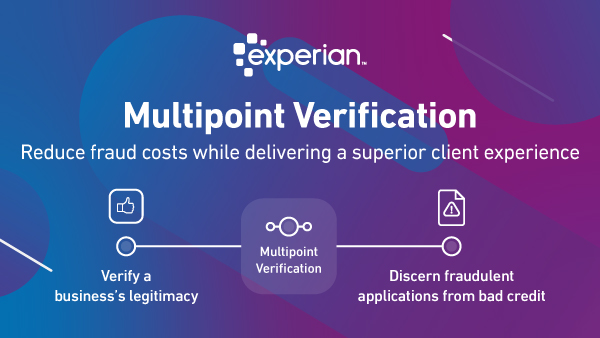
Experian is very excited to unleash game-changing commercial fraud detection capabilities with Multipoint Verification, a key component in our commercial fraud suite. Innovations in digital consumer experiences mean your commercial customers have new expectations. They want personalized, digital, secure faceless experiences, and fast decisions. But faster digital experiences without proper checks can often open the door to commercial fraud.  Manual application reviews can slow things down, and cut into your bottom line. Experian can help you control costs and protect you from the high price of commercial fraud, and labor-intensive manual review processes. Multipoint Verification facilitates fraud detection at the point of application, so your lower-risk good customers can continue to enjoy a frictionless experience while you mitigate fraudulent applications. Introducing Experian Multipoint Verification Multipoint Verification helps you verify a business's legitimacy. In addition, it enables you to discern fraudulent applications from bad credit through comprehensive data sets. Single-sourced verification products can be limited in their capability and often prone to false positives. Multipoint Verification arms you with practical intelligence, so you can confirm the linkage between the applicant and claimed business, state filings, email issuance, or identify potential corporate linkage to other entities at the point of application. Experian is transforming the commercial fraud screening landscape, let’s start a conversation. Learn more about Experian Multipoint Verification

Published: November 18, 2021 by Gary Stockton

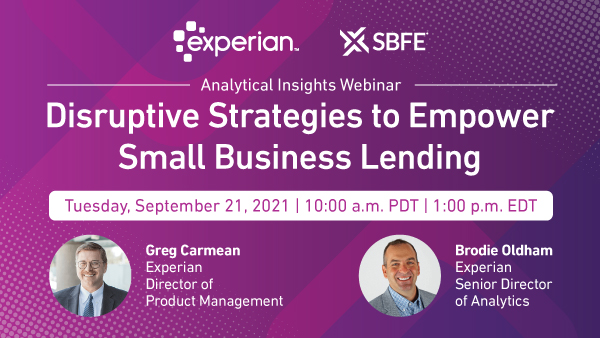
  Gain the ability to identify the most stable and profitable small business clients Join our webinar, in partnership with the Small Business Financial Exchange (SBFE): Disruptive Strategies to Empower Small Business Lending Tuesday, September 21, 2021, 10:00 a.m. PDT | 1:00 p.m. EDT Learn how to target small business growth opportunities and enhance the customer experience through automated credit-risk decisioning, with special focus on: Advanced methodologies for developing and leveraging new data attributes Advantages to having explainable, machine-learned models Effortless data visualization to conceptualize growth opportunities Ability to target populations and product mix for financial inclusion Register for Webinar

Published: September 8, 2021 by Gary Stockton

The concept of machine learning has been around for 50+ years in analytic circles. But machine learning methods have created a stir in the last few years as their popularity and visibility increased in the U.S. consumer and commercial credit industry. The use of these advanced methodologies has been constrained to mainly fraud/identity and collections. Machine Learning techniques are now available for credit decisioning. Our upcoming Sip and Solve session will provide insights to help your regulator feel more comfortable with the methodology you are using. We will share how Experian is making machine learning explainable to regulators and boosting model performance. During this session you will learn three take-aways: Current model governance basics How machine learning methods are boosting performance Best practices in deployment and documentation to help regulators feel comfortable with this more powerful solution

Published: October 5, 2020 by Gary Stockton

As business delinquencies rise in response to COVID-19, credit departments are becoming increasingly challenged.  In our August 13th Sip and Solve webinar, John Krickus and Andrew Moore will be on hand to share some strategies for maximizing receivables amid rising delinquencies. Managing receivables has never been more important or more challenging. Traditional approaches may no longer apply. In this 15-minute Sip and Solve session, we discuss some solutions for effectively and efficiently handling the increase in receivables many companies are facing. After watching this talk you will learn three key takeaways: Prioritizing receivable management in today's environment Analytic tools for managing receivables Flexing receivables strategies to meet your company's priorities Click to view full slides and transcripts from this session.

Published: July 28, 2020 by Gary Stockton

In a favorable economic climate, business resilience is often treated as an afterthought. Success is measured in rapid growth and leaps of progress, while failure is little more than a tempering of that expansion. It’s only when things slow down - like during a global pandemic - that companies are forced to take stock of the ground they stand on. As the economy slows to a crawl and entire industries feel the squeeze, business resilience will determine which organizations make it through to the other side. Whether you’re on the supply side or the demand side, chances are your organization is being tested right now. Here are some practical strategies to stay resilient in the time of Covid-19. Gerard Smith, President of Global Risk Management Solutions (GRMS), works with companies who are either on-boarding new suppliers or evaluating current suppliers. When the Covid-19 pandemic disrupted supply chains in most industries, many of these companies started scrambling to find replacement suppliers. Finding a reliable supplier is always a challenge, but it’s even more difficult during a global pandemic and economic crisis.     The best practice here is still to vet new suppliers carefully. Smith’s company creates a risk assessment program for Experian clients that analyzes 50 different financial and legal components, including the following: If they’re on the OFAC sanctions list If they’re financially stable If they actually have the certifications they claim to have If they have insurance If they’ve received negative press Many companies fail to do their due diligence when it comes to suppliers, especially if they’re trying to fulfill orders quickly. More often than not, this leads to bigger problems down the line. If you hire a supplier that’s hemorrhaging money, for instance, they may file for bankruptcy right after you pay them for a major shipment. Companies that use GRMS will be notified regularly if a supplier’s financial or legal status changes. If a supplier cancels their insurance coverage, for example, that could indicate financial struggles. Staying abreast of information like this allows businesses to be proactive with suppliers and avoid being blindsided. Make Sure Clients Are Financially Healthy On the flip side of the buyer-supplier relationship, suppliers are now being asked to extend due dates. Deciding how to comply with these requests can be tricky. Most want to be understanding and reasonable, but there is often legitimate concern over whether they’ll receive payment. Brodie Oldham, Senior Director of Analytic Consultancy for Experian, said Experian offers several services for suppliers who need to gauge how reliable their customers are in this moment. Experian has a special Covid-19 risk index that suppliers can overlay on top of existing credit models. This tool can help determine whether or not a client is in an unstable financial position. If the company operates in a highly impacted part of the country or industry, the supplier can use that information to change the terms. For example, they can sell fewer items to minimize the risk of an unpaid invoice. Experian also monitors credit utilization for business credit cards and other lines of credit. If a company’s credit utilization surpasses a certain threshold, they can alert the supplier who can halt future shipments until the utilization decreases. Find Faster Ways to Evaluate Creditworthiness Many suppliers depend on a company’s credit information to determine its reliability as a buyer. Likewise, credit bureaus are being forced to reevaluate their models in response to the changing business landscape brought on by Covid-19. Enter the agile credit function. The term agile has traditionally been used in the context of software development to describe an iterative approach where requirements and solutions evolve through collaboration between cross-functional teams. It allows companies to adapt to new requests quickly and improve time-to-market. Agile is all about being nimble and responsive - something credit bureaus are prioritizing in today’s uncertain economy.   Agile credit means finding new, faster ways of evaluating customers and determining their ability to pay, in a time when that information can change daily. “When everything shut down in March, credit people got thrown for a loop,” said Dan Meder, Vice President of Consulting, Product Marketing and Alliances for Experian Business Information Services. “They needed a way to manage that change very quickly.” That’s where having an agile credit approach comes in. “It’s about using agile principles in your credit function to respond more quickly to changing market needs,” Meder said. Using an agile credit system helps suppliers decide what kind of terms to offer their customers. Many companies are asking suppliers to extend their terms and due dates, often switching from net-30 to net-60. Suppliers then have to decide if they can trust these companies to repay them within that longer time frame, Meder said. If companies in this position use an agile credit function, they can be more responsive and confident in the terms they set out because they’re basing their credit policies on the current state of their customer environment. This requires operating with the latest possible information on how current economic conditions are affecting their customers. Meder said that making credit function more agile requires direction from the head of the credit department and other members of that department. They can also utilize software programmers if the automatic process needs to be updated or any outside consultants for specific analytical expertise. “The idea is to bring together a team of people with direct involvement in managing the credit function to assess how best to manage the customer experience given the current state of the customer environment,” he said. “This includes setting policies around risk assessment as well as credit terms and collection processes.” Meder said companies should have technology that allows them to tinker with their credit function so they can make changes quickly. “This is especially true in a fast-changing or uncertain environment such as what we are seeing with COVID-19 and the uncertain effect it is having on our economy’s future,” he said. “In fact, it is turbulent times such as these where being “agile” is most important since the credit department needs to be able to alter course quickly if the customer environment changes for better or for worse.” Consider Being Flexible With Clients While delayed payments from clients is upsetting, avoid taking your current client relationships for granted. While a more stringent approach from suppliers is understandable right now, Meder cautions companies to remember that the pandemic will end at some point. At that time, companies will remember which suppliers were flexible about payments, due dates and terms - and which companies weren’t. “If you weren’t good to them while they were struggling, they’re going to forget about you when things turn around,” Meder said. To find out how fine-tuning your company’s credit function can help it weather the current economic crisis, reach out to your Experian representative.
Published: July 20, 2020 by Gary Stockton

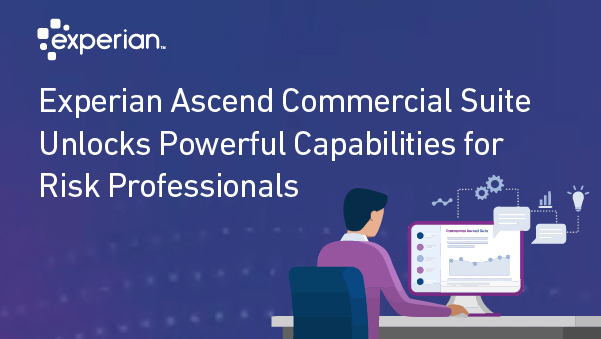
Experian® today announced Ascend Commercial Suite™ for financial institutions specializing in commercial lending as well as insurance carriers to drive growth while reducing risk. The suite includes Experian’s Ascend Analytical Sandbox™ configurations and a new Ascend Commercial Benchmarking Dashboard™ that provides access to industry-leading data on small and midsize businesses. “Experian is committed to creating opportunities for businesses to succeed,” said Hiq Lee, president of Experian’s Business Information Services. “During uncertain times, making fast, accurate decisions is critical for lenders so they can continue to extend credit responsibly to the businesses that need it most. Experian’s Ascend Commercial Suite enables clients to access world-class advanced analytics, AI, machine learning, and benchmarking tools so they can make real-time decisions that can ultimately help businesses on the road to recovery ahead.” Experian’s Ascend Analytical Sandbox is an industry-leading cloud-based data and analytics solution that offers flexibility in addressing lenders’ needs and offers instant access to up to 19 years of data. The secure hybrid-cloud environment allows users to combine their own data sets with Experian’s exclusive data assets, including consumer credit, commercial credit, nontraditional, auto, and more. Small and midsize business lenders, as well as insurance carriers, can seamlessly blend commercial and consumer small business data to get a 360-degree view of their overall small business portfolio to more easily identify risks and opportunities. It’s a one-stop-shop for insights, model development, and results measurement. The Ascend Commercial Benchmarking Dashboard delivers a comprehensive visual dashboard view of credit risk data and Small Business Financial Exchange™ (SBFE) Data exclusively for SBFE members. Clients can compare their portfolios against industry performance and analyze new market segments for potential growth and expansion. The insights available through the Ascend Commercial Suite can be viewed and shared through interactive dashboards and customizable reports. Additional use cases include: Portfolio performance and monitoring: Lenders can harness the power of Experian data to better monitor performance and quickly identify areas of strength or concern on visual dashboards without having to run custom reports every month. Model development and validation: Clients can monitor existing models and develop new models in order to improve risk profiles of new accounts and improve existing accounts. Blended analysis: Small business lenders relying on personal guarantees can use both consumer and business data to determine a customer or potential customer’s overall risk. Marketing analytics and acquisition: Lenders’ campaign information and results combined with Experian’s Credit Risk Database help them understand performance and improve marketing and segmentation. Decisioning for risk assessment and segmentation: Lenders and insurance carriers can optimize risk decisioning and segmentation strategies using analytical tools on one platform, which provides quick and efficient access to multiple integrated data sets. Reject inferencing: Lenders can load application data and use SBFE trade-level data to understand how declines performed if customers obtained credit elsewhere. Custom attributes to better analyze portfolios: With SBFE Data, lenders can create their own custom attributes or use Experian’s highly predictive set of attributes. Experian’s Ascend Commercial Suite is built on the Experian Ascend Technology Platform™. Launched in 2017, the Experian Ascend Technology Platform is recognized as one of the most successful launches in Experian’s history. It’s currently being used by the top financial institutions globally including the United Kingdom, South Africa, Brazil and Asia Pacific. Experian’s Ascend Analytical Sandbox was also selected in 2019 as the winner of the “Best Overall Analytics Platform” award by FinTech Breakthrough, an independent organization that recognizes the top companies, technologies and products in the global fintech market. To learn more about Experian’s Ascend Commercial Suite, please visit: https://www.experian.com/business-information/ascend-commercial-suite.

Published: April 27, 2020 by Gary Stockton

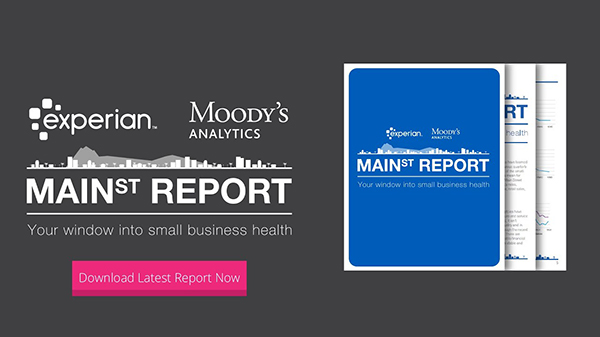
Experian and Moody’s Analytics have just released the Q1 2019 Main Street Report. The report brings deep insight into the overall financial well-being of the small-business landscape, as well as providing commentary on what certain trends mean for lenders and small businesses. In Q1 U.S. small businesses brushed off a government shutdown as stock markets recovered and income gains remained steady. Delinquency rates remained mostly stable, with pockets of weakness spread out among regions and industries, notably agriculture in the Great Lakes and manufacturing in the Southwest. Small firms seem to have simply shrugged off the headwinds of the first quarter and kept on with business as usual. Despite a fresh escalation in trade tensions,  the year is starting off well with positive news coming from the areas presenting risks to the outlook. A dovish stance on interest rates from the Federal Reserve and room to grow in our housing market — 2019 is off to a strong start. Watch Webinar Recording -  Q1 2019 Quarterly Business Credit Review Listen to the experts from Experian and Moody's Analytics go in-depth on insights revealed in the Q1 2019 Experian/Moody's Analytics Main Street Report.  

Published: May 14, 2019 by Gary Stockton

I have been on the road meeting with clients at advisory events, forums, and industry thought leadership conferences, and what I continue to hear is a concern about the upcoming recession. The drivers of the next recession are up for debate but the consensus is that it is inevitable. The U.S. Economy is complex and the signals are mixed as to where the greatest impact will be felt. Protecting your business, whether consumer or commercial focused, is dependent on the stability and strength of your lending criteria and customer engagement practices. You want to protect your customers as well as your business in the case of a market stumble. You are laser-focused on making the best possible decision when reviewing credit applications and setting loan terms, however, financial situations change over time for both individuals and companies. This is especially true when a recession hits and unemployment begins to rise, consumers stop spending, and commercial delinquencies begin to rise. When these macroeconomic changes occur, the credit you have extended to your portfolio might be at under market stresses and at a stronger risk of nonpayment, and this can affect your business’s health and sustainability. By stress testing your portfolio, you can determine what may happen, when stresses are exerted, by a receding economy, on your portfolio. You can use credit information, macroeconomic data, and alternative data to build models that forecast what is likely to happen in the future and how stresses, will affect the ability for people or businesses to pay their bills. While larger regulated companies may be required to perform forecasting and stress testing, lenders of all size can benefit from the process. Gathering the Right Data for Accurate Stress Testing The accuracy of your stress test depends on the type and quality of data used for forecasting. Recessions are cyclical and likely to re-occur every few years, it is recommended that companies use historical data from the 2008 recession for analysis and to make accurate predictions. Young businesses may not have complete historical data going back to the 2008 recessionary time period. A partner like Experian can create look-alike business samples, from the vast holistic data, to simulate the likely impact of macroeconomic scenarios. For example, a financial services firm has been providing small business loans between $50,000 and $100,000 for the past three years and wants to predict future losses. To gather the data for loss forecasting, you need to create a business and product profile identifying loans or businesses with similar characteristics, to stress and forecast performance. These profiles are used to build a look-alike sample of businesses and loan products that look and perform like your current portfolio and will add the sample size and retro time periods needed to create a statistically viable analysis sample. Selecting a Forecasting Strategy Once you have the historic credit, macroeconomic, and alternative data on your portfolio or look-alike retro sample for modeling, you need to stress test the data. Most stress test analyses start with a vintage based analysis. This type of analysis looks at the performance of a portfolio across different time periods (Example: March 2007, March 2008, March 2009, etc..) to evaluate the change in performance and the level of impact environmental stresses have on the portfolio's performance. Once you have this high-level performance, you can extrapolate into the future performance of the portfolio and set capitalization strategies and lending policies. Identifying Loss Forecasting Outcomes Regulators and investors want to know the business is solvent and healthy. Loss forecasting demonstrates that your company is thoughtful in its business processes and planning for future stresses. For regional lenders that are not regulated as closely as large national or global lenders, forecasting shows investors that they are following the same rules as larger regulated lenders, which strengthens investor confidence. It also demonstrates effective management of capital adequacy and puts you on a level playing field with larger lenders. Companies with limited data can start with credit data for look-alike sample development and add historical data and alternative type data as they grow for a holistic portfolio view. Setting up Governance Business policies and macroeconomic stresses change over time, it’s essential to set up a governance schedule to review forecasting processes and documentation. Your stress testing and forecasting will not be accurate if you design it once and do not update it. Most companies use an annual schedule, but others review more frequency because of specific circumstances. Effectively Documenting Loss Forecasting The key element of loss forecasting is effectively documenting both sample and strategy taken in the evaluation of your portfolio. A scenario you might face is when a regulator looks at the analysis performed and you have selected sample data at the business level instead of the loan level, documentation should capture the explanation of why you made the decision and the understood impacts of that decision. While the goal is to have complete data, many companies do not have access to high-quality data. Instead of foregoing loss forecasting, the use of documentation to note the gaps and build a road-map for the data can be of great value. Here are additional key points to include in the documentation: • Data sources • Product names • Credit policies • Analysis strategy • Result summary • Road-map and governance schedule By creating a stress-test analysis strategy for forecasting loss, your company can make sure its portfolio and financial status remain as healthy tomorrow as they are today while maintaining transparency and investor confidence. The next recession is out there, this is a great time to strengthen processes for future successes.  

Published: November 26, 2018 by Brodie Oldham

We sat down with John Krickus, Senior Product Manager for Experian's Scoring solutions to ask about the new Social Media Insight, and how this data and score are being used to help businesses strengthen scoring models, and create opportunities for emerging small businesses with limited credit history but strong social media profiles.  What is Social Media Insight? We're very excited to bring what we consider a breakthrough capability. Social Media Insight is an expansion, a use of new information beyond traditional credit data, that both improves the performance of our scores, provides attributes to our clients, and is directly sourced from the social media providers - no screen scraping. What type of social media data is used? So the social media data comes from sources that, like with our other data sources, we are not allowed to publicly disclose, but we are focused on business social media sites. So we're not going after consumer social media data, but social media data from business-oriented sites, so that we can better evaluate small and midsize businesses. What steps are taken to prevent artificially boosting the ratings of a business? So that's a question that we often receive about artificially boosting ratings. We work with social media companies, they have many techniques to identify where the reviews are coming from and to prevent someone gaming the system. Is it 100 percent full proof? No, but it is very effective. How effective has social media data been in predicting risk? As we've seen with using the data in our scoring solutions, we've seen a tremendous boost in score performance. There have been two real gains from using social media data. First is, we've developed about 70 social media attributes. We can now include those attributes and make these attributes available to our clients to improve the performance of risk scores. The second area really devolved from client feedback as we piloted the data. They indicated to us that there were social media data elements that are very helpful. So, we've been able to attain information such as pricing, parking situation, hours of operation, and those additional data elements have also helped our clients in improving their risk performance scores. What type of data do our clients get with Social Media Insight? We're able to provide our clients one of three types of data. First, we can provide a social media IntelliScore. That's our normal IntelliScore with commercial data, and now social media data. So, you get a higher performance. We've boosted performance by 37 percent with our IntelliScore. Second, we can provide those same social media attributes to our clients. So, they can incorporate those social media attributes into their scoring models. And third, we have the descriptive data. I mentioned hours of operation for example, social media data also provides a better description of the business. So, you just don't get an Exercise Gym, you get whether that gym is kickboxing or whether that's just exercise equipment. Can I target specific kinds of businesses? Can it be used for Marketing? We do have the ability to use social media data for identifying better businesses to do business with. Our initial focus though is in developing the attributes and the score for risk management. So that's really the focus for this first phase of Social Media Insight. How might Social Media Insight help an Insurance company? Insurance companies have been very anxious for this data, and they're getting a different view of the business. We're going beyond traditional trade, public record, background information, and now we're able to provide a view of how long has that business been rated? How are the ratings? What's the trend in the number of ratings? So, it's not just your level rating, but are you getting reviews over time? All that information provides a really unique view of the business that we've never seen before. How can Experian clients access Social Media Insight? Our clients can access the data one of two ways. We can provide a batch file. So, if you have a portfolio and you want to add social media attributes and a social media score to that you can provide us a file in batch. We also have our new API access, and we're very excited about that. So that allows you online real-time access to obtain the social media insight data, and it's very easy to program to. Can Social Media Insight help emerging businesses gain access to capital? Yeah that's an excellent area for Social Media Insight. It's really the newer smaller businesses that don't have a very deep credit history, that Social Media Insight now provides a view that previously it may have lacked information, therefore, credit may not have been extended. Now by having a social media site data available. We're adding depth of information to that business. We've actually found that businesses with social media data, as a group, are less risky than businesses without. How does Social Media Insight help improve risk model performance? So, the view that the social media data provides, we have found has boosted model performance, more than doubling model performance for those new emerging businesses. But even for established businesses we've seen double-digit gains in the measure of performance for models such as KS, and again you're getting a view of a business, number of reviews, and we normalized that. So, if you're in an area that's very active with social media data we take that into account. So, if you have 10 reviews in your history, which are in a very active area, you may not get as much of a positive as if you had 10 reviews and a less active social media area. So that combination really boosts performance and predictiveness of the data. How do Social Media Insight help our clients reduce risk? And really that's been one of the biggest breakthroughs with the social media data. Is by being able to boost the performance as I discussed earlier on KS, those new to the world businesses. They now are able to more confidently make decisions in their portfolio, because there is now a wealth of information. They're able to improve their models with this new additional information and have a very good performance improvement with it before and after. So, there's an across the board performance improvement. How does Social Media Insight help to automate the decisioning process? When you have an automated system, you want to have a higher level of confidence. The higher level of confidence you have, the stronger you can, for example, having automatic approve and automatic reject areas. By adding social media data we're able to get a stronger KS performance, which means you have more confidence in the models, and you can now increase the percentage your portfolios that you're putting through either automated or highly automated decision making. It's a significant boost in performance however you cut it. We're very excited about this unique new information source. Social media data is totally different from any other business credit information that's available, and when it's utilized in a model, in a decisioning system, the gain in performance are dramatic, and we're very excited to bring this capability to our clients. Learn about Social Media Insight  

Published: October 15, 2018 by Gary Stockton

Commercial Insights Hub

Follow Us!

Subscribe to our blog

Enter your name and email for the latest updates.

This site is protected by reCAPTCHA and the Google Privacy Policy and Terms of Service apply.

About this blog

The latest insight, tips, and trends on all things related to commercial risk by the team at Experian Business Information Services. Please follow us on social media.

Stay informed by subscribing to this blog

Sign up for email notifications when new content has been published by Experian Business Information Services.
Sign Up