At A Glance
This week's report takes a deep look at the factors driving this trend, with a particular focus on the businesses most at risk: small, young, and low-revenue firms. It also offers insight into the types of bankruptcies occurring, the rise of Subchapter 5 filings, and early credit warning signs that may help lenders identify distress before it results in a court filing.Bankruptcy isn’t just a back-page story anymore, it’s becoming the postscript to the startup surge.
The January 27th Experian Commercial Pulse Report reveals a sharp contrast in the small business economy: while business formation remains historically elevated, bankruptcy filings are climbing to levels not seen in a decade. The data points to a critical inflection point—where entrepreneurial growth meets growing financial fragility.
Watch The Commercial Pulse Update
A Two-Sided Story: Formation and Failure
The numbers we see highlighted in the news show a business ecosystem in flux. In December 2025, 497,000 new businesses were launched, a slight dip from November but still 53% above pre-pandemic averages. Since July 2020, an average of 446,000 new businesses have formed each month, underscoring an entrepreneurial surge that has become a defining feature of the post-COVID economy.
However, this wave of new businesses comes with significant exposure. Many are lean operations, often led by first-time founders with limited access to capital and minimal financial buffers. These structural vulnerabilities are reflected in rising failure rates.
In Q3 2025, business bankruptcy filings hit 24,039—the highest quarterly total since 2016. While some of this activity reflects larger firms restructuring through Chapter 11, a growing share involves smaller, younger businesses taking advantage of Subchapter 5, a newer option tailored for small business reorganization.
Understanding Bankruptcy Types: Chapter 7, 9, 11, 12, 13, 15 and Subchapter 5
To better interpret the data, it helps to understand the bankruptcy options available to businesses:
- Chapter 7 – Liquidation: This is the most straightforward and final form of bankruptcy. Businesses cease operations and a court-appointed trustee sells off assets to repay creditors.
- Chapter 9 – Municipal Bankruptcy: Exclusively municipalities ( i.e. cities, counties, school districts.) Municipality retains control. No liquidation allowed. No need for disclosure statements.
- Chapter 11 – Reorganization: This allows a business to continue operating while restructuring its debt under court supervision. Often used by larger or financially complex companies.
- Chapter 12 – Family Farmer & Fisherman Reorganization: Exclusively for agriculture and fishing operations. Lower cost compared to Chapter 11. Owners keep farm/fishing operation. No need for disclosure statements or creditor committees.
- Chapter 13 – Individual Reorganization: Primarily for individuals but sometimes used for sole proprietors. Establishes 3 to 5-year repayment plan. Debtor keeps assets and continues operations. Debt limits apply.
- Chapter 15 – Cross-Border Insolvency: For businesses with assets and creditors in multiple countries. Facilitates cooperation between U.S. courts and foreign courts. Helps protect U.S. assets during international restructuring
Subchapter 5 (of Chapter 11): Introduced by the Small Business Reorganization Act of 2019, Subchapter 5 simplifies and lowers the cost of reorganization for small businesses with less than $3 million in debt.
Key advantages of Subchapter 5 include:
- No creditor committee or disclosure statement required
- Faster court timelines and higher plan confirmation rates
- Owners can often retain equity
Subchapter 5 filings have more than doubled since 2020 and now account for a growing share of all Chapter 11 activity.
Who’s Filing—and Why It Matters
The report highlights a shift in the types of businesses filing for bankruptcy. These firms are:
- Small – fewer than five employees
- Young – under 10 years in operation
- Low-revenue – earning under $1 million annually
These groups now represent the majority of business bankruptcies, showing that financial fragility is highest among the newest and smallest entrants in the market.
Early Warning Signs: Commercial Credit Behavior
Experian’s commercial credit database reveals clear behavioral patterns among at-risk firms:
- Higher credit seeking activity: These businesses are 3–4 times more likely to apply for credit before filing.
- Elevated commercial credit balances: They carry significantly higher balances than non-filing peers.
- Signs of financial stress: Increased delinquencies and utilization often appear months before a bankruptcy event.
This creates an opportunity for lenders to proactively monitor portfolios and identify risk earlier, especially among firms that fit the high-risk profile.
What This Means for the Small Business Economy
The data paints a complicated picture. New business creation remains strong, driven by structural changes and a resilient entrepreneurial spirit. But these new firms are operating in an increasingly challenging environment, facing inflation, tighter credit conditions, and weakening demand.
Subchapter 5 is helping many small businesses stay afloat by making reorganization more accessible. However, rising filings among small and young firms signal that financial strain is becoming more common at the foundational level of the economy.
For lenders and risk professionals, the takeaway is clear: track not just the volume of small business activity, but the quality and sustainability behind it. Credit signals remain a powerful early indicator of distress and can help institutions support their small business clients more strategically.
Learn More
- ✔ Visit our Commercial Insights Hub for in-depth reports and expert analysis.
- ✔ Subscribe to our YouTube channel for regular updates on small business trends.
- ✔ Connect with your Experian account team to explore how data-driven insights can help your business grow.
Related Posts
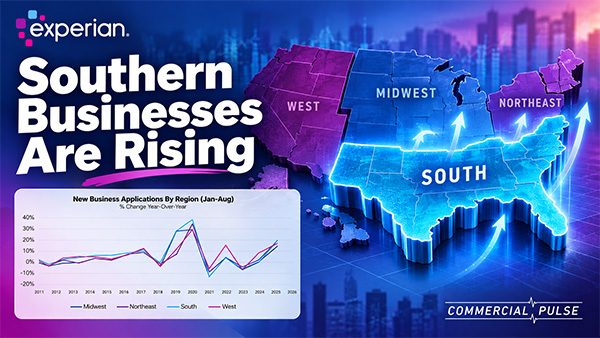
Small business formation remains one of the more notable trends in the U.S. economy. In August 532,000 new businesses launched across the country. While that was down from July, it remained well above historical averages. Since July 2020, an average of 455,000 new businesses have opened each month—56% higher than the pre-pandemic monthly average in 2018 and 2019. But the national numbers only tell part of the story. Watch The Commercial Pulse Update Experian’s latest Commercial Pulse report analysis examines where this growth is occurring and what it means for the commercial credit market. The data show that the South has emerged as an important center of small-business growth. And the businesses driving that expansion tend to have a different profile from their counterparts in other regions. For commercial lenders, understanding those differences can provide valuable context when evaluating new opportunities, credit demand and portfolio risk. Business growth is shifting geographically New business formation has increased across all U.S. regions, but the pace has not been uniform. Prior to 2018, regional differences in growth were relatively modest. During the pandemic years of 2020 and 2021, the South led the country in new business application growth. Since 2022, the West has posted the strongest growth, while the South continues to account for the greatest volume of new business openings. One factor providing context for that growth is population. The population of the South has grown more than 7% since 2019. Since 2020 alone, the region has added more than 3.6 million residents, outpacing every other U.S. region. Meanwhile, populations in other parts of the country declined between 2020 and 2022 before beginning to recover. Business formation and population movement do not necessarily have a simple cause-and-effect relationship. But their parallel growth highlights how the geographic makeup of both consumers and businesses has been changing. Credit-active businesses are growing even faster in the South The shift becomes even clearer when looking at businesses using commercial credit. Experian data shows the number of credit-active businesses in the United States has increased 55% since 2018. Every region participated in that expansion, but the South experienced the greatest growth at 70%, followed by the North at 52%, West at 50% and Midwest at 36%. The South now represents approximately 39% of U.S. credit-active businesses. It also accounted for more than 40% of newly opened commercial accounts in 2026, compared with 37% in 2019. For commercial credit organizations, that means the South represents not just a growing population of businesses, but an increasingly significant share of businesses participating in the commercial credit ecosystem. Southern businesses tend to be smaller and younger The composition of this growth is just as important as its scale. Credit-active businesses in the South and West tend to skew smaller and younger than those in the North and Midwest. In the South, 53% of businesses generate less than $500,000 in annual revenue, while 59% have fewer than five employees. Only 36% have been operating for more than 10 years, compared with 43% in the Midwest. Those characteristics can influence how businesses interact with credit. A younger business, for example, may have had less time to establish multiple commercial credit relationships. That pattern appears in Experian’s data. Across the United States, the average number of commercial credit accounts per business has declined from approximately 1.8 in 2018 to 1.5 in 2026. The South experienced the steepest decline and currently has the fewest accounts per business. At the same time, commercial credit inquiries have increased since 2023, most recently peaking in early 2026. Inquiry rates have typically been higher in the Midwest and South. The combination of fewer existing accounts and elevated inquiry activity provides useful context for lenders seeking to understand the credit needs of a growing population of younger businesses. Credit utilization tells another part of the story Regional differences also appear after businesses establish credit relationships. Businesses in the Midwest and North opening new commercial accounts tend to receive higher lines than businesses in the South and West. At the same time, businesses in the South show higher commercial card utilization despite carrying somewhat lower average balances. Experian’s analysis points to lower credit lines as an important factor behind that relationship. These trends reinforce why looking beyond a single credit metric can be important. Higher utilization, for example, can take on additional context when considered alongside credit-line size, business age, balances and regional business formation. Growth brings opportunities—and risk factors to monitor Despite significant growth and changes in business composition, regional credit performance has remained relatively steady. Commercial delinquencies across all regions are near pre-pandemic levels, while commercial credit risk scores have been relatively stable. There are regional differences worth monitoring, however. Businesses in the South have lower average commercial credit scores than businesses in the other regions analyzed, and delinquency rates tend to be higher in the North and South than in the Midwest and West. The broader takeaway is not simply that there are more small businesses in the South. It is that the composition of the commercial market is evolving alongside that growth. The South represents a growing share of credit-active businesses and new commercial accounts. Many of those businesses are younger, smaller and have fewer established commercial credit relationships. Their credit needs and behaviors may therefore differ from those of more mature businesses in other parts of the country. For commercial lenders and risk leaders, understanding those distinctions can help provide greater context around acquisition, underwriting and portfolio management decisions. As small business formation continues, Experian will continue monitoring where that growth is occurring—and how the changing business landscape is showing up in commercial credit behavior. Learn more ✔ Visit our Commercial Insights Hub for in-depth reports and expert analysis. ✔ Subscribe to our YouTube channel for regular updates on small business trends. ✔ Connect with your Experian account team to explore how data-driven insights can help your business grow. Download the Commercial Pulse Report Visit Commercial Insights Hub Where are small businesses growing in the U.S.? Experian data points to significant growth in the South. While new business formation has increased across the country, the South has consistently recorded the highest volume of new business openings and has seen the number of credit-active businesses grow 70% since 2018—compared with 55% nationally. Where are small businesses growing the most? The South has consistently had the largest volume of new business openings. The South led application growth during 2020–2021, while the West has posted the strongest growth rates since 2022. That distinction is important because it prevents the SEO headline from overstating what the data shows. Why has small business growth been so strong in the southern U.S.? The South has added more than 3.6 million residents since 2020, substantially outpacing other regions. Our report establishes a correlation rather than causation. Related Posts

Explore Experian insights on U.S. manufacturing investment, AI and automation adoption, employment trends, and commercial credit performance.

Experian’s latest Commercial Pulse analysis examines these trends using retail spending data alongside Experian commercial credit data.