At A Glance
This week's report takes a deep look at the factors driving this trend, with a particular focus on the businesses most at risk: small, young, and low-revenue firms. It also offers insight into the types of bankruptcies occurring, the rise of Subchapter 5 filings, and early credit warning signs that may help lenders identify distress before it results in a court filing.Bankruptcy isn’t just a back-page story anymore, it’s becoming the postscript to the startup surge.
The January 27th Experian Commercial Pulse Report reveals a sharp contrast in the small business economy: while business formation remains historically elevated, bankruptcy filings are climbing to levels not seen in a decade. The data points to a critical inflection point—where entrepreneurial growth meets growing financial fragility.
Watch The Commercial Pulse Update
A Two-Sided Story: Formation and Failure
The numbers we see highlighted in the news show a business ecosystem in flux. In December 2025, 497,000 new businesses were launched, a slight dip from November but still 53% above pre-pandemic averages. Since July 2020, an average of 446,000 new businesses have formed each month, underscoring an entrepreneurial surge that has become a defining feature of the post-COVID economy.
However, this wave of new businesses comes with significant exposure. Many are lean operations, often led by first-time founders with limited access to capital and minimal financial buffers. These structural vulnerabilities are reflected in rising failure rates.
In Q3 2025, business bankruptcy filings hit 24,039—the highest quarterly total since 2016. While some of this activity reflects larger firms restructuring through Chapter 11, a growing share involves smaller, younger businesses taking advantage of Subchapter 5, a newer option tailored for small business reorganization.
Understanding Bankruptcy Types: Chapter 7, 9, 11, 12, 13, 15 and Subchapter 5
To better interpret the data, it helps to understand the bankruptcy options available to businesses:
- Chapter 7 – Liquidation: This is the most straightforward and final form of bankruptcy. Businesses cease operations and a court-appointed trustee sells off assets to repay creditors.
- Chapter 9 – Municipal Bankruptcy: Exclusively municipalities ( i.e. cities, counties, school districts.) Municipality retains control. No liquidation allowed. No need for disclosure statements.
- Chapter 11 – Reorganization: This allows a business to continue operating while restructuring its debt under court supervision. Often used by larger or financially complex companies.
- Chapter 12 – Family Farmer & Fisherman Reorganization: Exclusively for agriculture and fishing operations. Lower cost compared to Chapter 11. Owners keep farm/fishing operation. No need for disclosure statements or creditor committees.
- Chapter 13 – Individual Reorganization: Primarily for individuals but sometimes used for sole proprietors. Establishes 3 to 5-year repayment plan. Debtor keeps assets and continues operations. Debt limits apply.
- Chapter 15 – Cross-Border Insolvency: For businesses with assets and creditors in multiple countries. Facilitates cooperation between U.S. courts and foreign courts. Helps protect U.S. assets during international restructuring
Subchapter 5 (of Chapter 11): Introduced by the Small Business Reorganization Act of 2019, Subchapter 5 simplifies and lowers the cost of reorganization for small businesses with less than $3 million in debt.
Key advantages of Subchapter 5 include:
- No creditor committee or disclosure statement required
- Faster court timelines and higher plan confirmation rates
- Owners can often retain equity
Subchapter 5 filings have more than doubled since 2020 and now account for a growing share of all Chapter 11 activity.
Who’s Filing—and Why It Matters
The report highlights a shift in the types of businesses filing for bankruptcy. These firms are:
- Small – fewer than five employees
- Young – under 10 years in operation
- Low-revenue – earning under $1 million annually
These groups now represent the majority of business bankruptcies, showing that financial fragility is highest among the newest and smallest entrants in the market.
Early Warning Signs: Commercial Credit Behavior
Experian’s commercial credit database reveals clear behavioral patterns among at-risk firms:
- Higher credit seeking activity: These businesses are 3–4 times more likely to apply for credit before filing.
- Elevated commercial credit balances: They carry significantly higher balances than non-filing peers.
- Signs of financial stress: Increased delinquencies and utilization often appear months before a bankruptcy event.
This creates an opportunity for lenders to proactively monitor portfolios and identify risk earlier, especially among firms that fit the high-risk profile.
What This Means for the Small Business Economy
The data paints a complicated picture. New business creation remains strong, driven by structural changes and a resilient entrepreneurial spirit. But these new firms are operating in an increasingly challenging environment, facing inflation, tighter credit conditions, and weakening demand.
Subchapter 5 is helping many small businesses stay afloat by making reorganization more accessible. However, rising filings among small and young firms signal that financial strain is becoming more common at the foundational level of the economy.
For lenders and risk professionals, the takeaway is clear: track not just the volume of small business activity, but the quality and sustainability behind it. Credit signals remain a powerful early indicator of distress and can help institutions support their small business clients more strategically.
Learn More
- ✔ Visit our Commercial Insights Hub for in-depth reports and expert analysis.
- ✔ Subscribe to our YouTube channel for regular updates on small business trends.
- ✔ Connect with your Experian account team to explore how data-driven insights can help your business grow.
Related Posts
Experian Commercial Pulse explores how AI is changing credit risk with a fascinating study of high-impact AI industries.
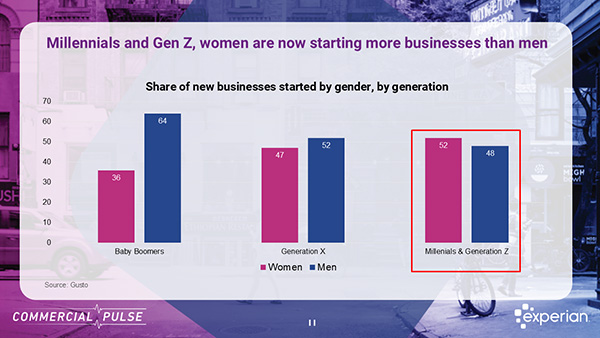
Understand the credit dynamics of women-owned small businesses and their critical role in the growth of the U.S. economy.
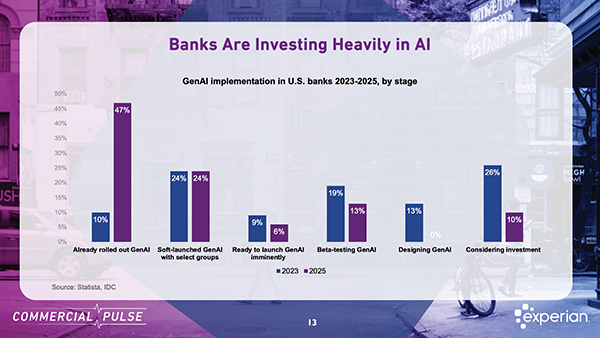
Banking transformation is accelerating through consolidation, digital adoption, and AI innovation. What must CROs prepare for next?