At A Glance
Women-owned businesses are rapidly expanding—now driving nearly half of all new business formation in the U.S. Their distinct credit behaviors and capital access challenges are reshaping risk assessment and lending strategies.Women-Owned Small Businesses: Growth, Credit Behavior, and Risk Implications for Lenders

A fast-growing segment, women-owned businesses bring unique credit dynamics shaped by size, lifecycle, and access to capital. Understanding these differences is key to improving risk accuracy and capturing growth.
This week, the Commercial Pulse Report takes a closer look at Women-owned small businesses, and there’s a lot to be excited about.
Watch The Commercial Pulse Update
Women-owned businesses are no longer a niche segment—they are a defining force in the evolution of the U.S. small business landscape. Today, they account for nearly half of all new business formations and generate approximately $2.7 trillion in annual revenue.
For Chief Risk Officers and credit risk teams, this growth presents both opportunity and complexity. The structural and behavioral differences of women-owned businesses introduce new considerations for underwriting, portfolio management, and long-term risk strategy.
A Rapidly Expanding—but Structurally Distinct—Segment
The growth trajectory of women-owned businesses is undeniable. In 2025 alone, women owned more than 14 million businesses in the U.S.—nearly double the total from two decades ago.
However, this expansion is not simply a scaled version of traditional small business growth. Women-owned firms tend to be:
- More concentrated in service-oriented industries
- Smaller in size, with lower average revenue
- Earlier in their business lifecycle
These characteristics matter from a risk perspective. Younger businesses inherently carry higher uncertainty, shorter credit histories, and less established operating resilience. For underwriting teams, this means traditional risk models—often calibrated on more mature firms—may underrepresent or misclassify risk in this segment.
Credit Access and Capital Structure: A Different Funding Model
One of the most important distinctions lies in how women-owned businesses access capital.
Compared to male-owned businesses, women entrepreneurs:
- Seek less commercial credit overall
- Rely more heavily on personal networks such as friends and family
- Utilize credit cards and online lenders more frequently than traditional bank financing
They also tend to have fewer commercial trade lines and lower credit limits.
At first glance, this could be interpreted as weaker credit demand. In reality, it often reflects structural barriers to access, differences in borrowing preferences, and earlier-stage business profiles.
For CROs, this raises a critical question:
Are current underwriting frameworks capturing true risk—or simply reflecting historical access inequalities?
Utilization and Discipline: A More Nuanced Risk Signal
Despite lower credit limits and fewer trade lines, women-owned businesses exhibit similar credit utilization rates compared to male-owned businesses.
This is a crucial insight.
Equivalent utilization, despite constrained access to credit, suggests:
- Strong credit discipline
- Efficient use of available capital
- Potential unmet demand for additional financing
From a risk modeling perspective, utilization alone may not be a sufficient differentiator. Instead, it should be evaluated alongside capacity constraints and growth intent.
This creates an opportunity for lenders to refine segmentation strategies—identifying businesses that are not overextended, but rather underserved.
Delinquency and Credit Performance: Stability with Key Gaps
From a performance standpoint, the data offers a more balanced view.
Delinquency rates between women- and male-owned businesses are comparable, indicating similar repayment behavior across segments.
However, average commercial credit scores for women-owned businesses remain slightly lower. This gap is largely driven by:
- Shorter credit histories
- Fewer active trade lines
- Lower overall credit exposure
Encouragingly, the credit score gap has begun to narrow in recent months.
For risk leaders, this suggests that observed differences in credit scoring are less about elevated risk and more about data depth and credit maturity. This distinction is critical when designing underwriting policies that balance inclusion with risk controls.
Generational Momentum and Future Portfolio Impact
Another dynamic shaping this segment is generational.
Among Millennials and Gen Z, women are now starting more businesses than men.
This shift is driven by motivations such as:
- Flexibility and autonomy
- Desire for control over work schedules
- Pursuit of entrepreneurial independence
For lenders, this signals that the influence of women-owned businesses will not only persist—but accelerate.
As these younger businesses mature, they will transition into larger credit exposures, more complex financing needs, and deeper integration into commercial credit ecosystems.
The decisions made today around underwriting, access, and segmentation will directly shape the future risk profile of portfolios.
Implications for Risk Strategy and Underwriting
For Chief Risk Officers and their teams, the rise of women-owned businesses presents a clear mandate: evolve risk frameworks to reflect a changing borrower base.
Key considerations include:
- Reassessing underwriting models to account for thinner credit files and shorter business histories
- Incorporating alternative data to better evaluate early-stage businesses
- Differentiating between constrained access and true risk exposure
- Monitoring portfolio diversification as this segment grows in share
Importantly, this is not simply a question of expanding access. It is about improving risk accuracy.
Misinterpreting structural differences as elevated risk can lead to missed growth opportunities, while failing to account for lifecycle dynamics can introduce unintended exposure.
Balancing Growth and Risk in a Changing Landscape
Women-owned businesses represent a fast-growing, resilient, and evolving segment of the economy. They are reshaping patterns of credit demand, challenging traditional assumptions, and creating new opportunities for lenders.
At the same time, they require a more nuanced approach to risk assessment—one that recognizes the interplay between business maturity, access to capital, and credit behavior.
For CROs, the path forward is clear: leverage data, refine models, and align risk strategy with the realities of today’s small business landscape.
Learn more
- ✔ Visit our Commercial Insights Hub for in-depth reports and expert analysis.
- ✔ Subscribe to our YouTube channel for regular updates on small business trends.
- ✔ Connect with your Experian account team to explore how data-driven insights can help your business grow.
Related Posts
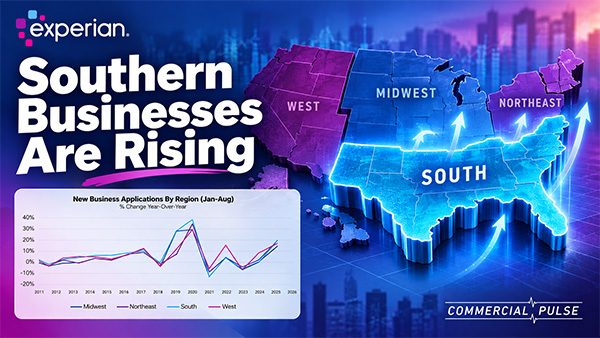
Small business formation remains one of the more notable trends in the U.S. economy. In August 532,000 new businesses launched across the country. While that was down from July, it remained well above historical averages. Since July 2020, an average of 455,000 new businesses have opened each month—56% higher than the pre-pandemic monthly average in 2018 and 2019. But the national numbers only tell part of the story. Watch The Commercial Pulse Update Experian’s latest Commercial Pulse report analysis examines where this growth is occurring and what it means for the commercial credit market. The data show that the South has emerged as an important center of small-business growth. And the businesses driving that expansion tend to have a different profile from their counterparts in other regions. For commercial lenders, understanding those differences can provide valuable context when evaluating new opportunities, credit demand and portfolio risk. Business growth is shifting geographically New business formation has increased across all U.S. regions, but the pace has not been uniform. Prior to 2018, regional differences in growth were relatively modest. During the pandemic years of 2020 and 2021, the South led the country in new business application growth. Since 2022, the West has posted the strongest growth, while the South continues to account for the greatest volume of new business openings. One factor providing context for that growth is population. The population of the South has grown more than 7% since 2019. Since 2020 alone, the region has added more than 3.6 million residents, outpacing every other U.S. region. Meanwhile, populations in other parts of the country declined between 2020 and 2022 before beginning to recover. Business formation and population movement do not necessarily have a simple cause-and-effect relationship. But their parallel growth highlights how the geographic makeup of both consumers and businesses has been changing. Credit-active businesses are growing even faster in the South The shift becomes even clearer when looking at businesses using commercial credit. Experian data shows the number of credit-active businesses in the United States has increased 55% since 2018. Every region participated in that expansion, but the South experienced the greatest growth at 70%, followed by the North at 52%, West at 50% and Midwest at 36%. The South now represents approximately 39% of U.S. credit-active businesses. It also accounted for more than 40% of newly opened commercial accounts in 2026, compared with 37% in 2019. For commercial credit organizations, that means the South represents not just a growing population of businesses, but an increasingly significant share of businesses participating in the commercial credit ecosystem. Southern businesses tend to be smaller and younger The composition of this growth is just as important as its scale. Credit-active businesses in the South and West tend to skew smaller and younger than those in the North and Midwest. In the South, 53% of businesses generate less than $500,000 in annual revenue, while 59% have fewer than five employees. Only 36% have been operating for more than 10 years, compared with 43% in the Midwest. Those characteristics can influence how businesses interact with credit. A younger business, for example, may have had less time to establish multiple commercial credit relationships. That pattern appears in Experian’s data. Across the United States, the average number of commercial credit accounts per business has declined from approximately 1.8 in 2018 to 1.5 in 2026. The South experienced the steepest decline and currently has the fewest accounts per business. At the same time, commercial credit inquiries have increased since 2023, most recently peaking in early 2026. Inquiry rates have typically been higher in the Midwest and South. The combination of fewer existing accounts and elevated inquiry activity provides useful context for lenders seeking to understand the credit needs of a growing population of younger businesses. Credit utilization tells another part of the story Regional differences also appear after businesses establish credit relationships. Businesses in the Midwest and North opening new commercial accounts tend to receive higher lines than businesses in the South and West. At the same time, businesses in the South show higher commercial card utilization despite carrying somewhat lower average balances. Experian’s analysis points to lower credit lines as an important factor behind that relationship. These trends reinforce why looking beyond a single credit metric can be important. Higher utilization, for example, can take on additional context when considered alongside credit-line size, business age, balances and regional business formation. Growth brings opportunities—and risk factors to monitor Despite significant growth and changes in business composition, regional credit performance has remained relatively steady. Commercial delinquencies across all regions are near pre-pandemic levels, while commercial credit risk scores have been relatively stable. There are regional differences worth monitoring, however. Businesses in the South have lower average commercial credit scores than businesses in the other regions analyzed, and delinquency rates tend to be higher in the North and South than in the Midwest and West. The broader takeaway is not simply that there are more small businesses in the South. It is that the composition of the commercial market is evolving alongside that growth. The South represents a growing share of credit-active businesses and new commercial accounts. Many of those businesses are younger, smaller and have fewer established commercial credit relationships. Their credit needs and behaviors may therefore differ from those of more mature businesses in other parts of the country. For commercial lenders and risk leaders, understanding those distinctions can help provide greater context around acquisition, underwriting and portfolio management decisions. As small business formation continues, Experian will continue monitoring where that growth is occurring—and how the changing business landscape is showing up in commercial credit behavior. Learn more ✔ Visit our Commercial Insights Hub for in-depth reports and expert analysis. ✔ Subscribe to our YouTube channel for regular updates on small business trends. ✔ Connect with your Experian account team to explore how data-driven insights can help your business grow. Download the Commercial Pulse Report Visit Commercial Insights Hub Where are small businesses growing in the U.S.? Experian data points to significant growth in the South. While new business formation has increased across the country, the South has consistently recorded the highest volume of new business openings and has seen the number of credit-active businesses grow 70% since 2018—compared with 55% nationally. Where are small businesses growing the most? The South has consistently had the largest volume of new business openings. The South led application growth during 2020–2021, while the West has posted the strongest growth rates since 2022. That distinction is important because it prevents the SEO headline from overstating what the data shows. Why has small business growth been so strong in the southern U.S.? The South has added more than 3.6 million residents since 2020, substantially outpacing other regions. Our report establishes a correlation rather than causation. Related Posts

Explore Experian insights on U.S. manufacturing investment, AI and automation adoption, employment trends, and commercial credit performance.

Experian’s latest Commercial Pulse analysis examines these trends using retail spending data alongside Experian commercial credit data.