At A Glance
Commercial banking is undergoing structural change — marked by consolidation, digital acceleration, and rapid AI investment. For risk leaders, the mandate is clear: protect portfolio stability while modernizing the risk framework for a technology-driven future.How Structural Shifts in Scale, Technology, and Customer Behavior Are Redefining Risk Leadership

This week’s Experian Commercial Pulse report includes great insights on the banking industry, a sector that is not simply evolving, it’s structurally transforming. The implications of banking transformation extend well beyond portfolio performance. Consolidation, digital acceleration, and aggressive investment in artificial intelligence are reshaping the competitive landscape and redefining risk management itself.
Watch The Commercial Pulse Update
While commercial credit performance remains relatively stable, the operating model of banking is changing quickly. The institutions that thrive in this environment will be those that modernize risk frameworks in parallel with ongoing structural change. This week’s Pulse identified four major trends CRO’s and risk teams should be watching closely.
1. Consolidation in the Banking Industry: Fewer Banks, Fewer Branches
The number of FDIC-insured banks has declined to less than half of what it was in 2000. Decades of mergers and acquisitions, including several of the largest transactions occurring in just the past five years, have materially reshaped the competitive environment.
At the same time, the physical footprint of banking has contracted. Total branch counts have fallen significantly from their 2008 peak, and branch availability continues to decline across many regions. For risk leaders, consolidation creates both opportunity and exposure. On one hand, scale can improve capital efficiency, risk diversification, and investment capacity in advanced analytics. Larger institutions may also benefit from deeper data pools and stronger enterprise risk infrastructures.
On the other hand, concentration risk becomes more pronounced, geographically, sectorally, and operationally. As institutions grow through acquisition, integration risk, model harmonization challenges, and cultural alignment issues must be carefully managed.
For CROs, consolidation is not just an industry headline, it is a structural variable influencing counterparty exposure, competitive pressure, and systemic interdependencies.
2. The Acceleration of Online Banking
As physical branches decline, digital engagement has accelerated dramatically. In 2019, just over half of U.S. consumers used online banking. By 2025, that number rose to roughly 71%, and projections suggest it could approach 80% by 2029. Younger demographics in particular show a strong preference for online-only banking relationships, while older customers continue to rely more heavily on traditional channels.
For small businesses, digital onboarding, online treasury management, mobile payments, and remote lending processes are no longer differentiators — they are expectations.
For CROs, increased digital penetration changes the risk equation in several ways:
- Fraud vectors expand as digital interactions multiply.
- Identity verification and authentication controls become mission-critical.
- Real-time monitoring replaces periodic review.
- Data velocity increases, requiring scalable analytics infrastructure.
Operational resilience also becomes more important. As customer engagement concentrates in digital channels, system uptime, cybersecurity, and third-party risk management move to the forefront of enterprise risk oversight. Digital adoption is not merely a distribution channel shift. It is a transformation in how risk manifests and must be measured.
3. Technology Trends: AI, Automation, and Real-Time Risk Intelligence
Technology modernization has become central to competitive strategy across commercial banking.
Artificial intelligence, machine learning, real-time fraud detection, and automated underwriting are moving from pilot programs into core production environments. Generative AI adoption in particular has accelerated rapidly, with nearly half of commercial banks now operating some form of GenAI solution in production.
For a CRO, the opportunity is substantial. Advanced analytics can:
- Enhance early warning systems for credit deterioration.
- Improve fraud detection accuracy while reducing false positives.
- Refine borrower segmentation and pricing precision.
- Optimize collections prioritization and recovery strategies.
- Strengthen stress testing and scenario modeling capabilities.
However, innovation introduces new forms of model risk.
AI-driven decisioning must be explainable, auditable, and compliant with regulatory expectations. Governance frameworks must evolve to ensure transparency, fairness, and mitigating bias. Data lineage and model validation processes must remain rigorous even as deployment speeds increase. The challenge for risk leaders is achieving balance, leveraging technological advantage without compromising control discipline.
4. Investment in AI: Strategic Imperative, Not Experimentation
AI investment in commercial banking is accelerating at a notable pace. Industry forecasts indicate that AI spending in the Americas banking sector could exceed $54 billion by 2028 — nearly tripling from 2024 levels.
This level of capital allocation signals a fundamental shift: AI is no longer viewed as an incremental enhancement. It is considered foundational infrastructure.
Executives report that AI initiatives are focused on:
- Cybersecurity enhancement
- Fraud detection and prevention
- Operational efficiency
- Customer engagement personalization
- Credit risk modeling improvement
For CROs, this scale of investment demands disciplined oversight.
Key considerations include:
- Are AI initiatives aligned with defined risk appetite statements?
- Is governance keeping pace with deployment velocity?
- Are internal teams sufficiently trained to interpret AI outputs?
- Is the institution prepared for heightened regulatory scrutiny around automated decisioning?
The strategic sweet spot lies in controlled acceleration — modernizing the risk stack while reinforcing control frameworks.
Final Perspective for CROs
Commercial credit performance today remains relatively stable. Yet the true story in banking is not short-term performance, it is long-term transformation. We are operating in an environment defined by structural consolidation, digital-first customer behavior, rapid AI adoption, expanding data ecosystems, and increasing regulatory complexity.
For Chief Risk Officers, the mandate is clear: safeguard portfolio quality while modernizing risk infrastructure. The institutions best positioned for sustainable growth will not simply extend capital efficiently, they will integrate advanced analytics, strengthen governance, and proactively manage emerging digital risks.
Transformation is underway. The question is not whether it will continue. The question is whether risk organizations will lead it — or react to it.
Learn more
- ✔ Visit our Commercial Insights Hub for in-depth reports and expert analysis.
- ✔ Subscribe to our YouTube channel for regular updates on small business trends.
- ✔ Connect with your Experian account team to explore how data-driven insights can help your business grow.
Related Posts
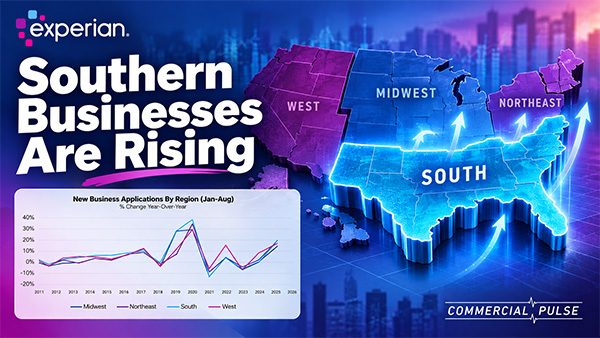
Small business formation remains one of the more notable trends in the U.S. economy. In August 532,000 new businesses launched across the country. While that was down from July, it remained well above historical averages. Since July 2020, an average of 455,000 new businesses have opened each month—56% higher than the pre-pandemic monthly average in 2018 and 2019. But the national numbers only tell part of the story. Watch The Commercial Pulse Update Experian’s latest Commercial Pulse report analysis examines where this growth is occurring and what it means for the commercial credit market. The data show that the South has emerged as an important center of small-business growth. And the businesses driving that expansion tend to have a different profile from their counterparts in other regions. For commercial lenders, understanding those differences can provide valuable context when evaluating new opportunities, credit demand and portfolio risk. Business growth is shifting geographically New business formation has increased across all U.S. regions, but the pace has not been uniform. Prior to 2018, regional differences in growth were relatively modest. During the pandemic years of 2020 and 2021, the South led the country in new business application growth. Since 2022, the West has posted the strongest growth, while the South continues to account for the greatest volume of new business openings. One factor providing context for that growth is population. The population of the South has grown more than 7% since 2019. Since 2020 alone, the region has added more than 3.6 million residents, outpacing every other U.S. region. Meanwhile, populations in other parts of the country declined between 2020 and 2022 before beginning to recover. Business formation and population movement do not necessarily have a simple cause-and-effect relationship. But their parallel growth highlights how the geographic makeup of both consumers and businesses has been changing. Credit-active businesses are growing even faster in the South The shift becomes even clearer when looking at businesses using commercial credit. Experian data shows the number of credit-active businesses in the United States has increased 55% since 2018. Every region participated in that expansion, but the South experienced the greatest growth at 70%, followed by the North at 52%, West at 50% and Midwest at 36%. The South now represents approximately 39% of U.S. credit-active businesses. It also accounted for more than 40% of newly opened commercial accounts in 2026, compared with 37% in 2019. For commercial credit organizations, that means the South represents not just a growing population of businesses, but an increasingly significant share of businesses participating in the commercial credit ecosystem. Southern businesses tend to be smaller and younger The composition of this growth is just as important as its scale. Credit-active businesses in the South and West tend to skew smaller and younger than those in the North and Midwest. In the South, 53% of businesses generate less than $500,000 in annual revenue, while 59% have fewer than five employees. Only 36% have been operating for more than 10 years, compared with 43% in the Midwest. Those characteristics can influence how businesses interact with credit. A younger business, for example, may have had less time to establish multiple commercial credit relationships. That pattern appears in Experian’s data. Across the United States, the average number of commercial credit accounts per business has declined from approximately 1.8 in 2018 to 1.5 in 2026. The South experienced the steepest decline and currently has the fewest accounts per business. At the same time, commercial credit inquiries have increased since 2023, most recently peaking in early 2026. Inquiry rates have typically been higher in the Midwest and South. The combination of fewer existing accounts and elevated inquiry activity provides useful context for lenders seeking to understand the credit needs of a growing population of younger businesses. Credit utilization tells another part of the story Regional differences also appear after businesses establish credit relationships. Businesses in the Midwest and North opening new commercial accounts tend to receive higher lines than businesses in the South and West. At the same time, businesses in the South show higher commercial card utilization despite carrying somewhat lower average balances. Experian’s analysis points to lower credit lines as an important factor behind that relationship. These trends reinforce why looking beyond a single credit metric can be important. Higher utilization, for example, can take on additional context when considered alongside credit-line size, business age, balances and regional business formation. Growth brings opportunities—and risk factors to monitor Despite significant growth and changes in business composition, regional credit performance has remained relatively steady. Commercial delinquencies across all regions are near pre-pandemic levels, while commercial credit risk scores have been relatively stable. There are regional differences worth monitoring, however. Businesses in the South have lower average commercial credit scores than businesses in the other regions analyzed, and delinquency rates tend to be higher in the North and South than in the Midwest and West. The broader takeaway is not simply that there are more small businesses in the South. It is that the composition of the commercial market is evolving alongside that growth. The South represents a growing share of credit-active businesses and new commercial accounts. Many of those businesses are younger, smaller and have fewer established commercial credit relationships. Their credit needs and behaviors may therefore differ from those of more mature businesses in other parts of the country. For commercial lenders and risk leaders, understanding those distinctions can help provide greater context around acquisition, underwriting and portfolio management decisions. As small business formation continues, Experian will continue monitoring where that growth is occurring—and how the changing business landscape is showing up in commercial credit behavior. Learn more ✔ Visit our Commercial Insights Hub for in-depth reports and expert analysis. ✔ Subscribe to our YouTube channel for regular updates on small business trends. ✔ Connect with your Experian account team to explore how data-driven insights can help your business grow. Download the Commercial Pulse Report Visit Commercial Insights Hub Where are small businesses growing in the U.S.? Experian data points to significant growth in the South. While new business formation has increased across the country, the South has consistently recorded the highest volume of new business openings and has seen the number of credit-active businesses grow 70% since 2018—compared with 55% nationally. Where are small businesses growing the most? The South has consistently had the largest volume of new business openings. The South led application growth during 2020–2021, while the West has posted the strongest growth rates since 2022. That distinction is important because it prevents the SEO headline from overstating what the data shows. Why has small business growth been so strong in the southern U.S.? The South has added more than 3.6 million residents since 2020, substantially outpacing other regions. Our report establishes a correlation rather than causation. Related Posts

Explore Experian insights on U.S. manufacturing investment, AI and automation adoption, employment trends, and commercial credit performance.

Experian’s latest Commercial Pulse analysis examines these trends using retail spending data alongside Experian commercial credit data.