As the automotive sector adapts to rising vehicle prices, shifting consumer behavior, and persistent inflation, the ripple effects are clearly visible in commercial credit activity. Experian’s latest Commercial Pulse Report (July 22, 2025) dives deep into the evolving credit dynamics within the auto industry—and one trend is clear: credit access is contracting across nearly every segment.
Used Cars Rise, But Credit Lines Fall
With the average new vehicle price exceeding \$47,000, many consumers are opting for used cars, priced more affordably at just over \$28,000. This shift has helped drive consistent growth in the used-car market, accompanied by an uptick in business activity and a growing demand for commercial credit.
In fact, used-vehicle and aftermarket service providers have seen commercial credit inquiries jump approximately 20% above January 2021 levels. Their credit utilization rate now sits at 32%, reflecting the costs of managing larger inventories and higher parts prices. But unlike traditional signs of financial distress, this trend appears tied more to operational needs than liquidity crunches.
Despite the increased appetite for credit, credit limits are shrinking.
A Cross-Sector Credit Contraction
Across the entire automotive supply chain, from OEMs to aftermarket shops, businesses are receiving smaller commercial credit lines on new originations than in previous years. The declines are significant:
- OEMs and New-Vehicle Dealers: Average commercial card limits have dropped by \$7.6K, now sitting at \$9.7K compared to \$17.4K in 2022–2023.
- Used-Vehicle Dealers and Aftermarket Services: Limits have fallen by \$5.8K, from \$13.6K to \$7.8K.
- Vehicle and Parts Wholesalers: These businesses faced the steepest cut—\$8.9K on average, down from \$18.5K to just \$9.6K.
All subsectors experienced over a 40% reduction in average credit lines, signaling tighter lending conditions despite robust business activity in several parts of the industry.
Why Are Credit Lines Shrinking?
This broad contraction is not purely about borrower risk. In fact, many used-car and aftermarket businesses have maintained steady commercial risk scores, and delinquency rates remain relatively flat.
A few critical factors include:
- Elevated Interest Rates: High financing costs are squeezing margins, especially for OEMs and franchised new-car dealers, where delinquencies are rising. Lenders may be proactively managing exposure.
- Segment-Specific Risk Trends: OEMs and dealers are facing mounting late-stage delinquencies—91+ DPD rates have nearly doubled since 2022—and their average risk scores are down ~4 points.
- Economic Uncertainty: Despite stable employment and wage growth, inflation, Fed policy, and geopolitical risk (like tariffs) are prompting more conservative credit practices.
- Portfolio Diversification: Lenders may be redistributing credit availability to less volatile sectors or industries with higher recovery potential.
The Middle Squeeze: Wholesale Distribution
Among the three major segments—OEM/New-Car Dealers, Used-Vehicle & Aftermarket, and Wholesale Distribution—wholesalers are caught in the middle. Their delinquency and risk score trends resemble those of OEMs, but their growing credit utilization and inquiry rates mirror the aftermarket segment. This dual exposure to shrinking new car volumes and rising parts demand puts them in a uniquely vulnerable position.
What It Means for Credit Managers and Lenders
These trends underscore the importance of granular credit monitoring. Treating the auto industry as a single credit risk profile is no longer viable. Subsector segmentation—by vehicle type, service focus, or market exposure—is key to understanding which businesses are truly at risk and which remain stable but under credit strain.
For lenders, this is a time to rebalance risk models and align credit policies with real-time sector insights. For businesses, it’s a moment to double down on credit management and strategic planning.
Stay ahead with Experian
- ✔ Visit our Commercial Insights Hub for in-depth reports and expert analysis.
- ✔ Subscribe to our YouTube channel for regular updates on small business trends.
- ✔ Connect with your Experian account team to explore how data-driven insights can help your business grow.
Related Posts
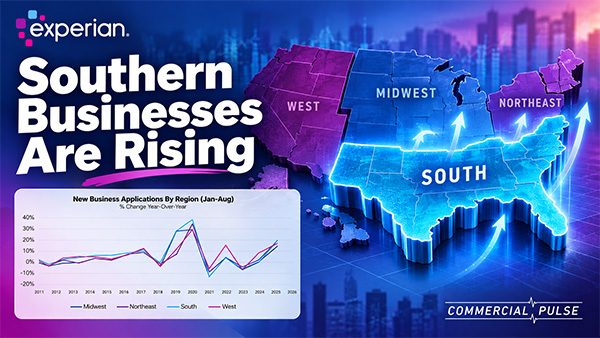
Small business formation remains one of the more notable trends in the U.S. economy. In August 532,000 new businesses launched across the country. While that was down from July, it remained well above historical averages. Since July 2020, an average of 455,000 new businesses have opened each month—56% higher than the pre-pandemic monthly average in 2018 and 2019. But the national numbers only tell part of the story. Watch The Commercial Pulse Update Experian’s latest Commercial Pulse report analysis examines where this growth is occurring and what it means for the commercial credit market. The data show that the South has emerged as an important center of small-business growth. And the businesses driving that expansion tend to have a different profile from their counterparts in other regions. For commercial lenders, understanding those differences can provide valuable context when evaluating new opportunities, credit demand and portfolio risk. Business growth is shifting geographically New business formation has increased across all U.S. regions, but the pace has not been uniform. Prior to 2018, regional differences in growth were relatively modest. During the pandemic years of 2020 and 2021, the South led the country in new business application growth. Since 2022, the West has posted the strongest growth, while the South continues to account for the greatest volume of new business openings. One factor providing context for that growth is population. The population of the South has grown more than 7% since 2019. Since 2020 alone, the region has added more than 3.6 million residents, outpacing every other U.S. region. Meanwhile, populations in other parts of the country declined between 2020 and 2022 before beginning to recover. Business formation and population movement do not necessarily have a simple cause-and-effect relationship. But their parallel growth highlights how the geographic makeup of both consumers and businesses has been changing. Credit-active businesses are growing even faster in the South The shift becomes even clearer when looking at businesses using commercial credit. Experian data shows the number of credit-active businesses in the United States has increased 55% since 2018. Every region participated in that expansion, but the South experienced the greatest growth at 70%, followed by the North at 52%, West at 50% and Midwest at 36%. The South now represents approximately 39% of U.S. credit-active businesses. It also accounted for more than 40% of newly opened commercial accounts in 2026, compared with 37% in 2019. For commercial credit organizations, that means the South represents not just a growing population of businesses, but an increasingly significant share of businesses participating in the commercial credit ecosystem. Southern businesses tend to be smaller and younger The composition of this growth is just as important as its scale. Credit-active businesses in the South and West tend to skew smaller and younger than those in the North and Midwest. In the South, 53% of businesses generate less than $500,000 in annual revenue, while 59% have fewer than five employees. Only 36% have been operating for more than 10 years, compared with 43% in the Midwest. Those characteristics can influence how businesses interact with credit. A younger business, for example, may have had less time to establish multiple commercial credit relationships. That pattern appears in Experian’s data. Across the United States, the average number of commercial credit accounts per business has declined from approximately 1.8 in 2018 to 1.5 in 2026. The South experienced the steepest decline and currently has the fewest accounts per business. At the same time, commercial credit inquiries have increased since 2023, most recently peaking in early 2026. Inquiry rates have typically been higher in the Midwest and South. The combination of fewer existing accounts and elevated inquiry activity provides useful context for lenders seeking to understand the credit needs of a growing population of younger businesses. Credit utilization tells another part of the story Regional differences also appear after businesses establish credit relationships. Businesses in the Midwest and North opening new commercial accounts tend to receive higher lines than businesses in the South and West. At the same time, businesses in the South show higher commercial card utilization despite carrying somewhat lower average balances. Experian’s analysis points to lower credit lines as an important factor behind that relationship. These trends reinforce why looking beyond a single credit metric can be important. Higher utilization, for example, can take on additional context when considered alongside credit-line size, business age, balances and regional business formation. Growth brings opportunities—and risk factors to monitor Despite significant growth and changes in business composition, regional credit performance has remained relatively steady. Commercial delinquencies across all regions are near pre-pandemic levels, while commercial credit risk scores have been relatively stable. There are regional differences worth monitoring, however. Businesses in the South have lower average commercial credit scores than businesses in the other regions analyzed, and delinquency rates tend to be higher in the North and South than in the Midwest and West. The broader takeaway is not simply that there are more small businesses in the South. It is that the composition of the commercial market is evolving alongside that growth. The South represents a growing share of credit-active businesses and new commercial accounts. Many of those businesses are younger, smaller and have fewer established commercial credit relationships. Their credit needs and behaviors may therefore differ from those of more mature businesses in other parts of the country. For commercial lenders and risk leaders, understanding those distinctions can help provide greater context around acquisition, underwriting and portfolio management decisions. As small business formation continues, Experian will continue monitoring where that growth is occurring—and how the changing business landscape is showing up in commercial credit behavior. Learn more ✔ Visit our Commercial Insights Hub for in-depth reports and expert analysis. ✔ Subscribe to our YouTube channel for regular updates on small business trends. ✔ Connect with your Experian account team to explore how data-driven insights can help your business grow. Download the Commercial Pulse Report Visit Commercial Insights Hub Where are small businesses growing in the U.S.? Experian data points to significant growth in the South. While new business formation has increased across the country, the South has consistently recorded the highest volume of new business openings and has seen the number of credit-active businesses grow 70% since 2018—compared with 55% nationally. Where are small businesses growing the most? The South has consistently had the largest volume of new business openings. The South led application growth during 2020–2021, while the West has posted the strongest growth rates since 2022. That distinction is important because it prevents the SEO headline from overstating what the data shows. Why has small business growth been so strong in the southern U.S.? The South has added more than 3.6 million residents since 2020, substantially outpacing other regions. Our report establishes a correlation rather than causation. Related Posts

Explore Experian insights on U.S. manufacturing investment, AI and automation adoption, employment trends, and commercial credit performance.

Experian’s latest Commercial Pulse analysis examines these trends using retail spending data alongside Experian commercial credit data.