Originally appeared on MediaPost
As the digital ecosystem becomes more complex, managing multiple identifiers for consumers has emerged as a significant challenge. From cookies and IP addresses to mobile IDs and universal IDs, marketers and platforms face increasing difficulty in maintaining a unified view of their consumers. Without a coherent identity strategy, campaigns can suffer from poor targeting, limited personalization, and flawed attribution.
Experian understands these challenges and offers solutions to help our partners navigate the complexities of a multi-ID landscape. By utilizing both digital and offline data, we provide the tools to unify fragmented identifiers and maintain a persistent view of consumers. As a result, marketers and platforms get rich insights, accurate cross-device targeting, improved addressability, and measurable advertising.
The shifting identity landscape
For years, the industry has relied on cookies to identify consumers across devices and platforms. However, with ongoing signal loss, including the uncertainty around cookies, and the evolution of privacy regulations, the digital identity landscape has grown more complicated. As consumers hop from one device to another, they are now represented by multiple signals, each tied to a different aspect of their digital behavior.
While this shift brings complexity, it also opens the door for innovation. Marketers and ad platforms now have the opportunity to rethink their identity strategies and adopt more flexible approaches that are not reliant on a single identifier.
This is where Experian comes in.
Connecting the dots: A holistic view of the customer journey
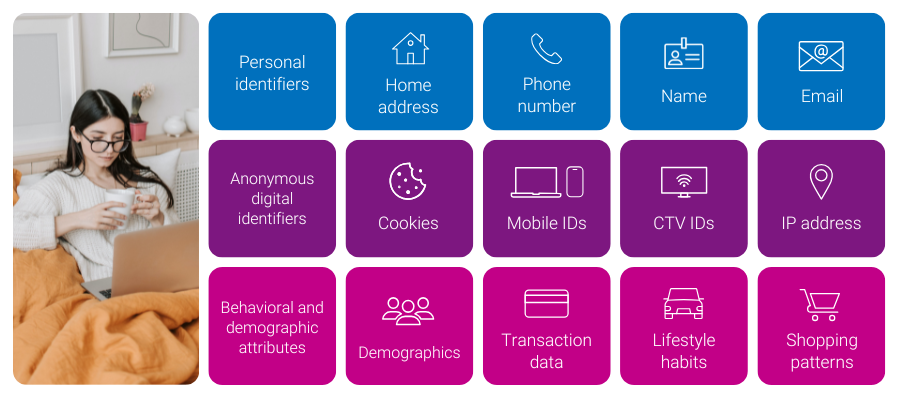
Our identity solutions are designed to help manage today’s multi-ID ecosystem by connecting digital and offline identifiers to a single customer profile. This creates a unified view of the consumer, and when combined with our understanding of customer behavior (e.g. demo, interests, shopping patterns) marketers and platforms get both insights about their customers and the addressability to reach them across channels.
Four examples of what you can do with a strong identity foundation
- If an advertiser wants to make its first-party data more addressable, it can utilize our Digital Graph with universal IDs, hashed emails (HEMs), and connected TV (CTV) IDs to extend its reach.
- A publisher who wants to gain further insights into their audiences and create private marketplaces (PMPs) can achieve this goal with the use of our Digital Graph with hashed emails, universal IDs, mobile ad IDs (MAIDs), CTV IDs, and IPs. The publisher can use this in concert with Marketing Attributes to understand age, gender, household income, buying behavior, and more. The publisher can connect marketing attributes to the Digital Graph via our Living Unit ID (LUID) to understand more about consumers that fall into their segments.
- A demand-side platform (DSP) who wants to extend first-party and third-party audience reach across all digital devices on their platform will use the Digital Graph with all digital IDs to allow users of their platform to select cross-device extension against first-party and third-party audiences.
- A retail media network (RMN) can use our Offline and Digital Graphs to connect in-store and online purchases to a household profile—even when purchases are made by different people. The RMN can then reach that household across digital media platforms and accurately attribute the in-store purchase back to digital ad exposure.
Identity as a strategic asset: Today and in the future
In our paradoxical world where consumers are represented by multiple identifiers, yet marketers and platforms face signal loss, identity is more than a technical issue—it’s a strategic asset. The ability to unify identity data into a single profile provides marketers with the customer intelligence needed to drive growth and stay competitive. Here’s how we do it:
- Deep, persistent customer understanding: With roots in offline, deterministic data like names, addresses, and emails, we provide an accurate and persistent view of identity to our customers. This allows you to maintain a consistent and comprehensive understanding of your customers and their marketing attributes over time.
- Highly accurate and refreshed digital identities: Our signal-agnostic graph is not reliant on any one signal as it includes HEMs, cookies, MAIDs, IPs, Universal IDs, and CTV IDs. Our Digital Graph is updated weekly, ensuring the data is always fresh and addressable. This persistent linkage of individuals and households to their identifiers and devices means your campaigns are always targeting the right people.
- Connected offline and digital graphs for holistic insights: We connect offline and digital identities by following privacy-first best practices, such as preventing re-identification, to allow insights from the offline world to be used in the online world. This integrated approach, enriched with marketing data, gives you better insights, more addressable advertising, and the ability to engage customers across multiple devices while accurately measuring campaign impact.
Transform challenges into opportunities
The rise of the multi-ID landscape presents both challenges and opportunities for the advertising industry. We stand as the trusted partner to navigate this complexity, utilizing insights from the offline world to inform decisions in the online world, enabling personalized marketing and accurate attribution, and helping you achieve your current and future goals.
Get started today
Latest posts
Experian kicks off the AdTech year at CES What better way to jump-start start 2023 than a trip to Las Vegas for the Consumer Electronics Show (CES). Our team was thrilled to participate in this annual kick-off with the AdTech community. The uniqueness of what CES has become for our industry can be defined as the intersection between technology brands, digital, television, and AdTech. CES creates the space necessary for marketing and advertising leaders to collaborate to drive rewarding outcomes for the year ahead. Our goal in attending CES was to connect with our partners, clients, and industry leaders to build relationships, form strategic plans, and listen. The opportunity to learn about our industry’s challenges and goals enables us to develop initiatives, drive success, and support our clients and partners. Keep reading for our 2023 CES AdTech recap. “I have been to CES too many times to mention the number; this year was as energetic, collaborative, engaged, and effective as I can ever recall. Our presence was first-class and meticulously organized, which made our interactions as robust as possible. It's a team effort, and we appreciate all the work that goes into this event. “ – Greg Koerner, Vice President of Digital Advertising Sales Our CES AdTech recap Supporting publishers and advertisers is top of mind for us. Many of our conversations focused on the technologies we deliver or collaborate with our partners to provide. Clean rooms and activation were two common themes throughout our discussions. Clean rooms Consumer privacy, regulatory requirements, and data deprecation are driving the AdTech industry to talk about and explore clean rooms. There’s a need to address data collection, storage, analysis, and sharing. Clean rooms are a potential solution that can standardize data and address interoperability issues. Activation In 2023, we predict that digital activation will increase. We continue to see increased demand for environments where alternative identifiers are being transacted (like demand side platforms and video). Social platforms will continue to experience volatility and advertisers will shift their focus to demand-side, video, and supply-side platforms. Download our 2023 Digital audience trends and predictions report to learn where you should activate your audiences in 2023. We can help plan your 2023 digital activation strategy. How we support clean rooms and activation Our Consumer Sync and Consumer View products support these areas and can help you understand people better–so you and your customers can connect with confidence. What is Consumer Sync? Consumer Sync, our consumer identity product, enables signal agnostic collaboration across marketers and technologies, bringing together digital devices, IDs, households, and attributes. Consumer Sync’s Resolution and Collaboration solutions can help you gain a better understanding of your consumers and make identities actionable in any environment. What is Consumer View? Consumer View, our data discovery product, offers marketers a robust, privacy-first understanding of their customers and prospects. Grounded in consumer identity, Consumer View provides the data foundation to engage consumers where, when, and how they want. Consumer View’s Audience and Attribution solutions provide expansive coverage so that you can fill in the gaps to better understand your prospects. Additionally, our collaborative efforts with strong partnerships across the clean room ecosystem and with our activation partners help our clients serve the best ads, at the best times, to the right audience. “CES is back and was a great way to kick off the new year! We were able to meet with a high volume of clients to eagerly talk about building new solutions for the TV space. We are excited to see where these conversations lead in the next few months.” – Ali Mack, Senior Director of TV Advertising Sales Let’s navigate what’s new in our industry, together We can help you connect with your consumers in innovative, impactful ways. Contact us to continue the conversation and learn more about our Consumer Sync and Consumer View products. We can help you take advantage of the opportunities on the horizon. Get in touch

2022 was a year of adjustment. Consumers adjusted to a post-pandemic world and returned to pre-pandemic shopping behaviors. Consumers adjusted their budgets as the price of goods skyrocketed, as a result of high inflation. To combat inflation, the U.S. Federal Reserve adjusted interest rates. This further restricted consumer buying power. The AdTech ecosystem also experienced adjustments. Google adjusted the date of cookie deprecation. Federal legislation forced technology companies to adjust their consumer privacy practices. Marketers and advertisers adjusted how they address interoperability issues by investing in clean room solutions. This year of adjustment makes it harder to predict where consumers will spend and how marketers should plan their digital audience strategies. What will 2023 bring to AdTech? Download our 2023 AdTech trends and predictions report to access our forecast to help you plan for 2023. Our report will answer: How has digital activation changed over the last four years? What are the top advertising platforms? Which digital audiences are advertisers buying? Do digital audience strategies vary by vertical? Our AdTech trends forecast In 2023, digital activation will increase. Digital audience activation continues to grow at a significant rate despite market shocks like the pandemic, inflation, and higher interest rates. Given the current economic uncertainty, we predict that marketers will look toward tried and true channels where they are confident they will have quality audiences, inventory, and be able to drive ROI. What will digital activation look like in 2023? Between 2018-2021, digital audience activation increased annually by 46%. Using projected 2022 results, between 2018-2022, it will increase annually by 34%. We anticipate continued growth in 2023. Top advertising platforms in 2023 2023 will see increased digital activation, but which platforms will advertisers use to serve their ads? Advertisers will shift their focus to demand-side, video, and supply-side platforms. Social media platforms will continue to experience volatility. Advertisers will place bigger bets on the combination of addressable and CTV. Our report will also reveal which platforms are creating a path toward a post-cookie future and where data-sharing relationships will become the strongest. The most popular advertiser audiences trending now in AdTech Which digital audiences are advertisers buying? Demographics Modeled Lifestyles Behavioral Custom Audiences Traditional targeting methods like Demographics and Modeled Lifestyles are the baseline of many marketing strategies. We predict that we will continue to see marketers activate against these data sets. Digital audience strategies by vertical Digital audience strategies vary by vertical. Download our report to uncover the digital audiences purchased by advertisers in the following industries: Financial Services Health Retail & CPG Technology & Communication Download our new 2025 Digital trends and predictions report Marketers, agencies, and platforms are facing new challenges as privacy regulations evolve, AI technology advances, and consumer behaviors shift. Our latest report highlights actionable strategies for navigating these changes and improving how you connect with audiences, measure impact, and deliver results. What you’ll learn Navigating signal loss: Explore the rise of alternative IDs and contextual targeting as privacy regulations and signal loss reshape data-driven advertising. Connected TV (CTV): Understand the growth of connected TV (CTV), the importance of frequency capping, and strategies for effective audience activation. Omnichannel campaigns: Learn how marketers are moving from channel-specific strategies to audience-led omnichannel campaigns that tell a more cohesive story. Retail media networks: Learn how retail media networks (RMNs) are capitalizing on enriched first-party data to learn more about their customers and reach them across on-site and off-site inventory. Curation: Examine how curation is transforming programmatic campaigns by combining audience, contextual, and supply chain signals to deliver premium inventory packages that maximize addressability, efficiency, and performance. Download now Get in touch

Viewers shift between streaming services, live TV, and on-demand content across multiple devices, making it harder to know exactly who sees your message. Instead of wondering if your ads are reaching the right viewers, it's important to have a clearer understanding of viewing behaviors so you can focus your efforts on the audiences that matter most to your campaign. Experian has collaborated with The Advertising Research Foundation (ARF) to create new opportunities for marketers. By combining data from the ARF’s DASH (Device and Account Sharing) study with Experian Marketing Data, we’ve developed a new way for you to understand and reach modern TV viewers. Instead of estimating who might see your message, you gain a clearer view of viewing behavior and can align activation with the audiences that matter to your campaign. What is the DASH study? The DASH study, developed by the ARF together with the National Opinion Research Center (NORC) and seven industry sponsors, including Experian, provides a detailed picture of how American households consume TV and digital media. This research offers an unbiased and accurate view of media habits, measuring everything from device usage to streaming account sharing. When this viewership data is combined with Experian Marketing Data, it allows for the creation of unique audience segments. These segments are built on real-world media and device usage, providing a more accurate representation of how people watch, share, and engage with TV content. This combination of identity and connectivity helps marketers understand exactly how people engage with media, technology, and their favorite brands. “Television viewing behavior has undergone a massive transformation, making it challenging for advertisers to reach their target audience and optimize frequency. These audiences give advertisers invaluable tools for managing their campaigns in an increasingly fragmented environment.”Doug McLennan, Director of Product Management How do DASH audiences help? By using the DASH study, Experian developed TV audience segments that reflect how people truly interact with content. These audiences provide the insights you need to align your campaigns with actual media consumption habits, helping you reach viewers with more relevant messages. This approach moves beyond basic demographics. It allows you to connect with people based on specific behaviors, such as co-viewing, screen preferences, or household streaming habits. The result is a more focused and efficient advertising strategy that delivers better outcomes. “DASH has established itself as a reliable and unbiased calibration set, a “true North”, for media measurement. Our collaboration with Experian puts the power and precision of DASH in the hands of marketers and advertisers as well.” Paul Donato, Chief Research Officer Which audience segments help you target viewers more effectively? These audience segments make it possible to find specific types of viewers and align your marketing campaigns with their media usage. Whether you’re connecting with people who are receptive to ads, households that enjoy shows together, or individuals who are frequent streamers, you can approach campaigns with greater accuracy and confidence. We’re pleased to introduce these segments and continue our partnership with the ARF, creating new opportunities to help you build effective connections with your target audiences. Explore some of our key audience segments: Ad Acceptors: Viewers who are more open to watching advertisements. Ad Avoiders: People who actively try to skip or block ads. Co-Watchers: Households where multiple people view content together. Solo Watchers: Individuals who typically watch TV by themselves. Paid TV High Spenders: Households that subscribe to multiple paid TV or streaming services. Large Screen Viewers: People who primarily watch content on large television screens. Small Screen Viewers: Individuals who prefer watching on smaller devices like tablets or phones. How can I use these audiences? Experian’s DASH audiences are available in your demand-side platform (DSP) of choice, ready for activation across all offline and online channels. This easy access means you can build more effective campaigns without changing your existing workflow. Using these segments, you can manage your advertising with greater confidence. You gain the tools needed to navigate the fragmented media environment and ensure your campaigns are seen by the right people. This targeted approach helps you maximize the impact of your marketing efforts and achieve your goals. Strengthen your TV planning and activation with DASH audiences. Are you ready to connect with your audience in a more meaningful way? FAQs What is the DASH study? The DASH study, developed by ARF, provides an unbiased view of how American households consume TV and digital media. It measures device usage, streaming habits, and account sharing to create a detailed picture of media consumption. How does Experian help advertisers understand media habits? Experian combines its Marketing Data with insights from studies like DASH to create audience segments based on real-world behaviors. This allows advertisers to align their campaigns with how people actually consume content. What types of audiences can I target with these segments? Audience segments include Ad Acceptors, Co-Watchers, Solo Watchers, Paid TV High Spenders, and Large or Small Screen Viewers, enabling precise targeting based on viewing habits. Why is understanding viewing behavior important for advertisers? By focusing on actual media consumption habits, advertisers can deliver more relevant messages, reduce wasted impressions, and improve the overall effectiveness of their campaigns. Latest posts