Marketers aren’t thinking in channels anymore: they’re thinking in audiences.
As consumer media habits have scattered across devices, platforms and formats, brands have shifted their focus from managing one channel at a time to delivering a connected experience. That’s the core of omnichannel marketing: meeting people where they are and making each touchpoint feel like part of a larger narrative.
However, most brands still encounter the same roadblocks: siloed data, fragmented planning and tools that don’t integrate. And while the industry talks a great deal about omnichannel marketing, few are actually doing it well. The brands that figure it out won’t just reach more people; they’ll improve brand perception while improving the customer journey, achieving better outcomes, and optimizing their media spend more efficiently.
Learn more about this trend in our 2025 Digital trends and predictions report.
Why omnichannel is no longer optional
Omnichannel marketing has long been a goal, but recent shifts in media and technology now make it a necessity. According to Forrester, 21% of global B2C business and tech professionals identified enhancing omnichannel or cross-channel customer experiences as a top priority for their organization today.
Connected TV (CTV) and commerce media networks are emerging as dominant channels, necessitating the coordination of messaging across an expanding ecosystem of streaming, programmatic display, and commerce-driven environments in addition to the multitude of other addressable (and non-addressable) channels. Fortunately, identity solutions continue to evolve, enabling marketers to maintain audience addressability in digital channels even as traditional signals decline and privacy regulations intensify.
Consumers expect this kind of cohesion. They don’t see “channels” – they just see a brand. A member of your loyalty program might browse a product online, see the exact item later on their socials, and then receive an email offer. If those messages feel disconnected or out of sync, this will not be a good customer experience, and a brand risks wasting impressions and losing conversions.
Omnichannel isn’t about showing up in more places. It’s about showing up with a consistent message.
The opportunities inherent in true omnichannel execution
Despite the industry’s movement toward omnichannel marketing strategies, there are a few untapped opportunities brands would benefit from pursuing.
The opportunity? Shift toward integrated media planning and measurement. By aligning teams and KPIs across channels, marketers can optimize frequency, coordinate creative sequencing, and better attribute business outcomes. Breaking down internal silos improves the customer experience and drives more effective performance. With two-thirds of North American CMOs naming siloed data as their biggest obstacle, those who solve it stand to gain a clear advantage.
The opportunity? Invest in interoperable systems that give you control over your data and privacy-safe solutions like clean rooms or universal IDs that enable consistent audience activation across platforms.
The opportunity? Advocate for a centralized, privacy-conscious identity framework that bridges fragmented data sources. This would allow marketers to recognize consumers across platforms and deliver cohesive messaging.
Marketers need solutions that enable connected audience activation while respecting privacy requirements and platform-specific constraints. Without this, omnichannel remains an aspiration rather than a reality.
Data and identity: The tools you need in your toolkit to make omnichannel work
Implementing omnichannel right starts with establishing identity. Brands need a foundation that lets them connect the dots: across data, platforms and channels. Here’s how:
Build a unified identity foundation
“A single view of the customer is the foundation of a successful omnichannel program,” says Forrester in a December 2023 report on omnichannel. This begins by connecting disparate data sources, including persistent offline information, such as addresses, emails, names, and phone numbers, with digital signals, in a privacy compliant way. And this, in turn, creates a strong identity foundation. Solutions that integrate hashed email addresses (HEMs), mobile ad IDs (MAIDs), IP addresses, CTV IDs, and universal IDs enable brands to resolve customer identities across different platforms, ensuring that campaigns remain addressable as users transition between channels.

Activate audiences everywhere, without the hassle
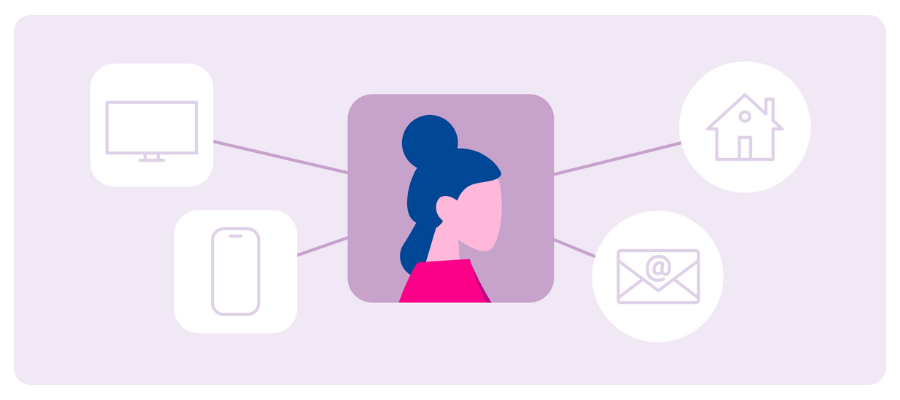
Brands should be able to define an audience once and activate it across all addressable channels without unnecessary complexity. Interoperability between demand-side platforms (DSPs), supply-side platforms (SSPs), clean rooms, and private marketplaces (PMPs) ensures that high-quality audiences are matched with premium inventory in a targeted, transparent, and efficient manner. This connectivity helps maintain consistent audience targeting—even as consumers engage in different environments. By working with a partner that seamlessly integrates with major platforms, marketers ensure that data quality and identity resolution remain intact throughout campaigns, avoiding data loss that occurs when data is transferred between different, disparate platforms.
Measure across channels, and the customer journey
Effective omnichannel marketing isn’t just about reaching audiences—it’s about understanding how different touchpoints contribute to conversions. Advanced attribution models, incrementality testing, and cross-platform frequency management enable brands to use consistent identity across campaign planning, activation and measurement so they connect ad exposures to real-world outcomes. Achieving this requires a strong identity resolution partner—one that can unify audience data across environments and power accurate, privacy-compliant measurement at scale.

The future of omnichannel marketing
Omnichannel is becoming the baseline expectation for modern marketing. The brands that figure out how to connect the dots across the increasingly disparate media landscape will drive better performance and build stronger customer relationships.
By working with a partner that can offer you an end-to-end data and identity solution focused on consumers, not channels, you can better understand your best customers (and your next customers), reach them across channels, and measure cross-channel campaigns more effectively, making true omnichannel execution more achievable.
Get started today
About the author

Kimberley Klevstad
Account Director, Retail, Experian
Kimberley Klevstad is 25-year industry veteran with a wide range of experience driving strategic growth for global accounts across print, online, mobile, location-based and streaming audio platforms. Kimberley is currently a member of the Experian Marketing Services Retail team, advising top retail brands on data and identity strategies that will deepen loyalty and drive acquisition in an increasingly competitive landscape.
Latest posts

Global Engineering Team Staffing Up New Oslo Hub; Nordic Operational Team Also Slated for Q1'17 NEW YORK, Jan. 11, 2017 /PRNewswire/ – Tapad, now a part of Experian, the leader in cross-device marketing technology, is opening an office in downtown Oslo, Norway, effective January 16, 2017. This development reflects Tapad's continued growth following its acquisition by the Telenor Group in early 2016. Tapad Oslo will be comprised of a globally-focused engineering team as well as an upcoming operational headquarters for the region. Jeff Olchovy, a senior Tapad developer and one of its earliest employees, will forge the company's Nordic engineering presence by supporting the build-out of the team. The initial hiring plan of more than 20 open positions includes roles such as Head of Engineering, Senior Software Engineers and Solution Engineers. Plans for Tapad's Nordic Region business line, including its leadership, will be announced within the first quarter of 2017. "Given the caliber of technical talent and our extensive network in the region, Oslowas the logical choice at this stage of our growth," says Dag Liodden, Tapad CTO and co-founder. "This enables us to continue building out our innovative team on a global scale in a region that is close to our hearts and minds." In collaboration with its New York-based developers, Tapad's Oslo-based engineers will continue to advance the company's renowned product portfolio, such as the Tapad Device Graph™. An early adopter of Scala and big data processing technologies, Tapad has long been an influencer in U.S. tech. "As the head of our platform group, which daily processes several petabytes of data and is the foundation for all of our real-time systems, Jeff is a highly respected engineer," said Pål Høye, Tapad's senior vice president of engineering. "Given his experience and skillset, he is ideally suited to find and lead an innovative team focused on building the industry-leading products we are known for." About TapadTapad Inc. is a marketing technology firm renowned for its breakthrough, unified, cross-device solutions. With 91.2% data accuracy confirmed by Nielsen, the company offers the largest in-market opportunity for marketers and technologies to address the ever-evolving reality of media consumption on smartphones, tablets, home computers and smart TVs. Deployed by agency trading desks, publishers and numerous Fortune 500 brands, Tapad provides an accurate, unified approach to connecting with consumers across screens. In 2015, Tapad began aggressively licensing its identity management solution, the Tapad Device Graph™, and swiftly became the established gold-standard throughout the ad tech ecosystem. Tapad is based in New York and has offices in Atlanta, Boston, Chicago, Dallas, Detroit,Frankfurt, London, Los Angeles, Miami, Minneapolis, San Francisco and Toronto. Tapad's numerous awards include: EY Entrepreneur of The Year (East Coast) 2014, among Forbes' Most Promising Companies two year's running, Deloitte's Technology Fast 500, Crain's Fast 50, Entrepreneur 360, Digiday Signal Award, iMedia ASPY Award and a MarCom Gold Award. Contact us today
Are Traasdahl, CEO and founder of Tapad, the leader in cross-device marketing technology and now a part of Experian, has been named Founder of the Year by the Global Startup Awards. The Global Startup Awards' Founder of the Year Award recognizes an individual that has pushed the boundaries of technology to empower new innovations and ideas. The Global Startup Awards places each year's regional category winners against each other to determine whose achievements stand out from the rest of the startup ecosystem through nomination, voting and jury evaluation. In May 2016, the Nordic Startup Awards named Traasdahl Founder of the Year. "Are is a force of nature and his creativity and passion know no boundaries, it seems," said George Tilesch, Global Startup Awards juror and U.S. managing partner of Innomine Group. "Extra kudos for the mentoring work and the Norwegian superfund plans. Are knows giving back is of the utmost importance." "Are is a superstar within the Norwegian startup ecosystem," said Kim Balle, founding partner and CEO of the Global Startup Awards. "From the jury feedback I could see that not only are his impressive achievements the reason for their rating, but also his focus and ability to give back to the startup scene played an important factor in him winning the category." "It is an enormous honor to be named Founder of the Year by the Global Startup Awards," said Traasdahl. "I am so committed to fostering entrepreneurship both at Tapad and throughout the startup space. This win is a remarkable bookend for a stellar year that began with our acquisition by the Telenor Group and continued with best-in-class product innovation, superior solutions for our clients and our Propeller Program that is so dear to my heart." Tapad's Propeller Program hosts five early-stage companies at Tapad's New York headquarters for one year to mentor them through global expansion. The participants of this inaugural program come from Traasdahl's native Norway. For more information on the Global Startup Awards, please visit: http://www.globalstartupawards.com/#gsa. Contact us today

NEW YORK, Nov. 29, 2016 /PRNewswire/ — For the second consecutive year, Tapad, part of Experian, has been listed among Deloitte's Technology Fast 500™, a ranking of the 500 fastest-growing technology, media, telecommunications, life sciences and energy tech companies in North America. Tapad, number 147 on the 2016 Deloitte list, is the leading provider of unified, cross-device marketing technology solutions. "It is an honor to once again be recognized by Deloitte for our growth and momentum, particularly given the stature of the other technology companies on the list," said Are Traasdahl, founder and CEO of Tapad. "Our product innovation, particularly in TV analytics and measurement, is a major contributor to our progress. I'm extremely proud of our hard-working, talented team for continually executing at such a high level." "Today, when every organization can be a tech company, the most effective businesses not only foster the courage to explore change, but also encourage creativity in using and applying existing assets in new ways, as resourcefully as possible," said Sandra Shirai, principal, Deloitte Consulting LLP and U.S. technology, media and telecommunications industry leader. "This ingenious approach to innovation calls for the encouragement of curiosity and collaboration both within and outside the office walls." "This year's Fast 500 winners showcase that when organizations are open to diverse perspectives and insights, they are able to create an environment for their employees and customers to see the possibilities and ingenious solutions that might lie ahead," added Jim Atwell, national managing partner of the emerging growth company practice, Deloitte & Touche LLP. "Entrepreneurial environments foster change and innovation within businesses, and we look forward to watching these companies continue to drive change across all sectors." Contact us today