Loading...

Inside Experian’s solutions for SSPs with Yieldmo

Published: June 25, 2025 by Experian Marketing Services

Experian's solutions for SSPs: A case study with Yieldmo

Supply-side platforms (SSPs) are expected to deliver more than inventory—they’re being asked to support sell-side targeting strategies, campaign results, and proof of performance. To meet that demand, SSPs need more than access to inventory. They need better data, better tools, and a way to bring it all together.

Experian’s solutions for SSPs

We built Experian’s solutions for SSPs with that demand in mind. By combining identity resolution, audience targeting, and third-party measurement, we help platforms move beyond basic transactions. Whether you’re doing sell-side targeting, supporting direct deals, or looking to support campaign validation, our tools make it easier to create value for buyers—and keep them coming back.

Our solutions that help SSPs:

Digital Graph icon

Resolve identity across digital touchpoints using our industry-leading Digital Graph

Audience Engine icon

Build differentiated audiences using over 2,400 Experian Audiences and Partner Audiences in Audience Engine

Partnership icon

Support advertiser-direct relationships with tools to create, activate, and host custom segments

Outcomes icon

Measure real outcomes like in-store visitation and sales through Outcomes, our third-party validated reporting suite

Together, these capabilities allow SSPs to produce data-driven deals, increase addressability, and meet buyer demand for smarter, more measurable media.

Campaign snapshot: Yieldmo + Experian

Yieldmo, an advertising platform known for its creative formats and data-informed approach, has already put this solution to work. Here’s how they built a custom strategy for a major athletic retail client using Experian’s solutions for SSPs.

The challenge: Drive in-store traffic and reach new buyers

Yieldmo supports a leading athletic retailer’s seasonal campaigns focused on in-store traffic. This advertiser wanted to reach new buyers—specifically those who might otherwise shop with a competitor. To do this, they needed access to strong audience segments with reliable data and the flexibility to act quickly across channels.

This was the first time Yieldmo applied Experian Audiences to this retailer’s campaigns. The stakes were high: the client was looking for better in-store outcomes and a more streamlined activation workflow.

The solution: Experian’s activation solution for SSPs

Using Experian’s Audience Engine, which includes our proprietary and third-party data marketplace, Yieldmo built a flexible, high-performing media plan that spanned display inventory and included both conquesting and primary in-store shopper segments.
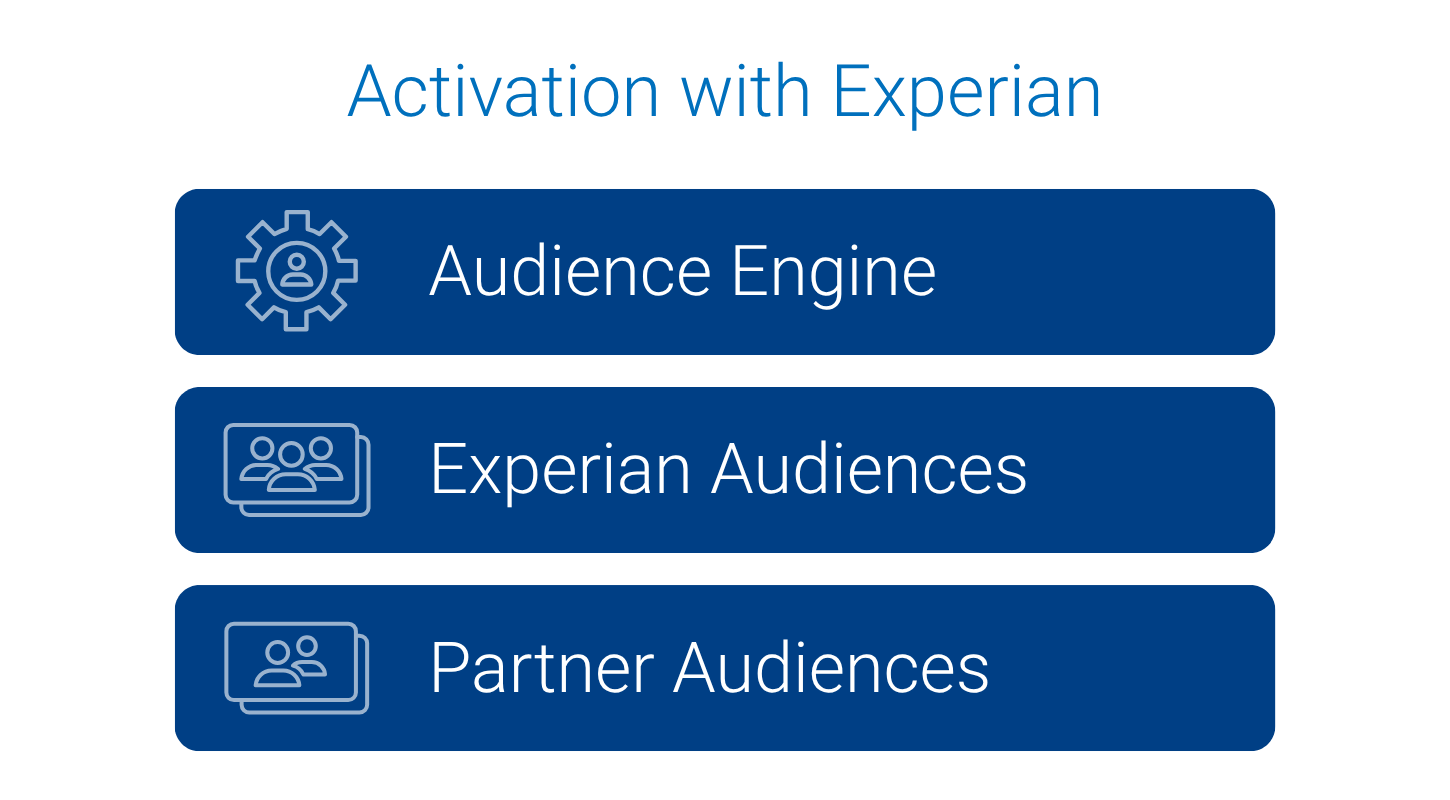
Activation with Experian: Audience Engine, Experian Audiences, Partner Audiences

The team selected and activated:

  • Apparel and footwear audiences built from Experian and partner data providers
  • In-store shopper segments targeting retail behavior signals
  • Competitive purchasers to capture likely buyers from other athletic brands

Our data marketplace allowed Yieldmo to combine Experian Audiences with Partner Audiences from providers like Alliant, Circana, Sports Innovation Lab, and Webbula—all in one place. Manual audience creation used to take days. Now, Yieldmo can build and activate campaigns through a streamlined, self-serve workflow.
Alliant, Circana, Sports Innovation Lab, and Webbula

By working in the Audience Engine platform, Yieldmo was able to avoid multiple contracts and manual requests. They filtered audiences by brand, tailored segments to their goals, and launched without delays.

“Experian’s data marketplace in Audience Engine fills a critical gap—letting us quickly search by brand, build smarter conquest segments, and activate custom audiences fast.”

Abby Littlejohn, Director of Sales Planning, Yieldmo

The results: Expected lift in store visits

While final in-store lift results are pending, the early performance metrics are promising:

  • Click-through rates are at and above historical benchmarks across both conquesting and primary shopper segments.
  • Using Audience Engine’s self-serve tools, Yieldmo created audiences faster and more easily.
  • They reduced their workload by minimizing the need for manual data wrangling.

“We include Experian audience segments in 80% of formal RFPs. Between contract simplicity, data quality, and campaign results, Experian has become our go-to for third-party audience targeting.”

Nelson Montouchet, AVP, Strategic Partnerships, Yieldmo

Bring this to your platform

Whether you’re looking to monetize more effectively, build deeper advertiser relationships, or stand out with sell-side targeting offerings, we designed Experian’s solutions for SSPs to do exactly that.

With our industry-leading Digital Graph, over 2,400 syndicated audiences, partner data, flexible self-serve tools, and outcome-based measurement, SSPs can now move faster and go further—without compromising scale or precision.

Get in touch with our team

This site is protected by reCAPTCHA and the Google Privacy Policy and Terms of Service apply.


Latest posts

Loading…
Helping you navigate Google’s transition to Client Hints

In 2022, Google began changing the availability of the information available in User-Agent strings across their Chromium browsers. The change is to use the set of HTTP request header fields called Client Hints. Through this process, a server can request, and if approved by the client, receive information that would have been previously freely available in the User-Agent string. This change is likely to have an impact on publishers across the open web that may use User-Agent information today. To explain what this change means, how it will impact the AdTech industry, and what you can do to prepare, we spoke with Nate West, our Director of Product. What is the difference between User-Agents and Client Hints? A User-Agent (UA) is a string, or line of text, that identifies information about a web server’s browser and operating system. For example, it can indicate if a device is on Safari on a Mac or Chrome on Windows. Here is an example UA string from a Mac laptop running Chrome: To limit the passive fingerprinting of users, Google is reducing components of the UA strings in their Chromium browsers and introducing Client Hints. When there is a trusted relationship between first-party domain owners and third-party servers, Client Hints can be used to share the same data. This transition began in early 2022 with bigger expected changes beginning in February 2023. You can see in the above example, Chrome/109.0.0.0, where browser version information is already no longer available from the UA string on this desktop Chrome browser. How can you use User-Agent device attributes today? UA string information can be used for a variety of reasons. It is a component in web servers that has been available for decades. In the AdTech space, it can be used in various ad targeting use cases. It can be used by publishers to better understand their audience. The shift to limit access and information shared is to prevent nefarious usage of the data. What are the benefits of Client Hints? By using Client Hints, a domain owner, or publisher, can manage access to data activity that occurs on their web properties. Having that control may be advantageous. The format of the information shared is also cleaner than parsing a string from User-Agents. Although, given that Client Hints are not the norm across all browsers, a long-term solution may be needed to manage UA strings and Client Hints. An advantage of capturing and sharing Client Hint information is to be prepared and understand if there is any impact to your systems and processes. This will help with the currently planned transition by Google, but also should the full UA string become further restricted. Who will be impacted by this change? Publishers across the open web should lean in to understand this change and any potential impact to them. The programmatic ecosystem supporting real-time bidding (RTB) needs to continue pushing for adoption of OpenRTB 2.6, which supports the passing of client hint information in place of data from UA strings. What is Google’s timeline for implementing Client Hints? Source: Google Do businesses have to implement Client Hints? What happens if they don’t? Not capturing and sharing with trusted partners can impact capabilities in place today. Given Chromium browsers account for a sizable portion of web traffic, the impact will vary for each publisher and tech company in the ecosystem. I would assess how UA strings are in use today, where you may have security concerns or not, and look to get more information on how to maintain data sharing with trusted partners. We can help you adopt Client Hints Reach out to our Customer Success team at tapadcustomersuccess@experian.com to explore the best options to handle the User-Agent changes and implement Client Hints. As leaders in the AdTech space, we’re here to help you successfully make this transition. Together we can review the options available to put you and your team on the best path forward. Get in touch About our expert Nate West, Director of Product Nate West joined Experian in 2022 as the Director of Product for our identity graph. Nate focuses on making sure our partners maintain and grow identity resolution solutions today in an ever-changing future state. He has over a decade of experience working for media organizations and AdTech platforms. Latest posts

Jan 31,2023 by Experian Marketing Services

Tapad earns SOC 2 Type 2 certification for third year in a row

Up next in our Ask the Expert series, Ben Rothke, Senior Information Security Manager, reviews two certifications that should be part of your information security strategy: Service Organization Control (SOC) 2 Type 2 and International Organization for Standardization (ISO) 27001. Tapad, a part of Experian, is 27001 and SOC 2 Type 2 compliant. Two information security certifications you can trust Seals from Good Housekeeping and Underwriters Laboratories give consumers confidence that they can trust the product that they’re buying. For IT solutions or service providers, what, or who can you turn to for that seal of approval?  There are many equivalent third-party attestations you can use. But which should you trust? The International Organization for Standardization (ISO) 27001 The American Institute of Certified Public Accountants (AICPA) System and Organization Controls (SOC) International Organization for Standardization (ISO) 27001 is an international standard for information security from the ISO. ISO 27001 is globally acknowledged and sets requirements for controls, maintenance, and certification of an information security management system (ISMS). This international standard provides organizations with a framework to identify, manage and reduce risks related to the security of information System and Organization Controls (SOC) The SOC, as defined by the AICPA, is a set of audit reports. SOC reports, like 27001 certificates, are used by service organizations to give their customers the confidence they have adequate information security controls in place to protect the data that they handle. SOC 2 is an assessment of controls at a service organization regarding security, availability, processing integrity, confidentiality, and privacy. The purpose of the report is to provide extensive information and assurance to a broad range of users about the controls at a service organization that are relevant to the security, availability, and processing integrity of the systems that process user data, as well as the confidentiality and privacy of the information processed by these systems. Why ISO 27001 and SOC 2 are important The value of these third-party attestations is two-fold: Organizations can show they have passed an independent external audit Third-party attestations save organizations the time of having to do their own audits In addition to 27001 and SOC 2 Type 2 compliance, we are also certified with ISO 27017 and 27018, which are add-ons to 27001 that are specific to cloud computing. We take the security and privacy of our customers’ data as seriously as they do. Every cloud service provider (CSP) has a responsibility matrix that details what security and privacy tasks they are responsible for and which ones the customer is responsible for. Any cloud customer that needs to be made aware of what their security tasks are is putting themselves at risk. So, when you want to engage a CSP, ask them for their attestations. They worked hard for them and will be proud to share their compliance. We’re powered by decades of setting standards in marketing services At Experian, we’re a privacy-first business. We’re highly focused on respecting people, their data, and their privacy. We continue to show our dedication to information security by completing these security audits every year. The constant changes to data compliance regulations can be challenging to navigate, but you don’t have to do it alone. Contact us today. We will be your guide so you can ethically and confidently reach your customers. Contact us today Contact us today About our expert Ben Rothke, Senior Information Security Manager Ben Rothke, CISSP, CISA, is a Senior Information Security Manager at Tapad, a part of Experian. He has over 25 years of industry experience in information systems security and privacy. His areas of expertise are in risk management and mitigation, security and privacy regulatory issues, cryptography, and security policy development. Ben is the author of Computer Security – 20 Things Every Employee Should Know (McGraw-Hill), and writes security and privacy book reviews for the RSA Conference Blog and Security Management magazine. Latest posts

Jan 24,2023 by Experian Marketing Services

CES 2023: Clean rooms, activation, and more

Experian kicks off the AdTech year at CES  What better way to jump-start start 2023 than a trip to Las Vegas for the Consumer Electronics Show (CES). Our team was thrilled to participate in this annual kick-off with the AdTech community. The uniqueness of what CES has become for our industry can be defined as the intersection between technology brands, digital, television, and AdTech. CES creates the space necessary for marketing and advertising leaders to collaborate to drive rewarding outcomes for the year ahead.  Our goal in attending CES was to connect with our partners, clients, and industry leaders to build relationships, form strategic plans, and listen. The opportunity to learn about our industry’s challenges and goals enables us to develop initiatives, drive success, and support our clients and partners.  Keep reading for our 2023 CES AdTech recap. “I have been to CES too many times to mention the number; this year was as energetic, collaborative, engaged, and effective as I can ever recall. Our presence was first-class and meticulously organized, which made our interactions as robust as possible. It's a team effort, and we appreciate all the work that goes into this event. “ – Greg Koerner, Vice President of Digital Advertising Sales Our CES AdTech recap  Supporting publishers and advertisers is top of mind for us. Many of our conversations focused on the technologies we deliver or collaborate with our partners to provide.   Clean rooms and activation were two common themes throughout our discussions.  Clean rooms  Consumer privacy, regulatory requirements, and data deprecation are driving the AdTech industry to talk about and explore clean rooms. There’s a need to address data collection, storage, analysis, and sharing. Clean rooms are a potential solution that can standardize data and address interoperability issues.  Activation  In 2023, we predict that digital activation will increase. We continue to see increased demand for environments where alternative identifiers are being transacted (like demand side platforms and video). Social platforms will continue to experience volatility and advertisers will shift their focus to demand-side, video, and supply-side platforms. Download our 2023 Digital audience trends and predictions report to learn where you should activate your audiences in 2023. We can help plan your 2023 digital activation strategy.  How we support clean rooms and activation  Our Consumer Sync and Consumer View products support these areas and can help you understand people better–so you and your customers can connect with confidence.  What is Consumer Sync?  Consumer Sync, our consumer identity product, enables signal agnostic collaboration across marketers and technologies, bringing together digital devices, IDs, households, and attributes. Consumer Sync’s Resolution and Collaboration solutions can help you gain a better understanding of your consumers and make identities actionable in any environment.   What is Consumer View?  Consumer View, our data discovery product, offers marketers a robust, privacy-first understanding of their customers and prospects. Grounded in consumer identity, Consumer View provides the data foundation to engage consumers where, when, and how they want. Consumer View’s Audience and Attribution solutions provide expansive coverage so that you can fill in the gaps to better understand your prospects.  Additionally, our collaborative efforts with strong partnerships across the clean room ecosystem and with our activation partners help our clients serve the best ads, at the best times, to the right audience.     “CES is back and was a great way to kick off the new year! We were able to meet with a high volume of clients to eagerly talk about building new solutions for the TV space. We are excited to see where these conversations lead in the next few months.” – Ali Mack, Senior Director of TV Advertising Sales  Let’s navigate what’s new in our industry, together  We can help you connect with your consumers in innovative, impactful ways. Contact us to continue the conversation and learn more about our Consumer Sync and Consumer View products. We can help you take advantage of the opportunities on the horizon.  Get in touch

Jan 17,2023 by Experian Marketing Services

Subscribe to our newsletter

Enter your name and email for the latest updates

This site is protected by reCAPTCHA and the Google Privacy Policy and Terms of Service apply.

About Experian Marketing Services

At Experian Marketing Services, we use data and insights to help brands have more meaningful interactions with people. As leaders in the evolution of the advertising landscape, Experian Marketing Services can help you identify your customers and the right potential customers, uncover the most appropriate communication channels, develop messages that resonate, and measure the effectiveness of marketing activities and campaigns.

Visit our website

Subscribe to our newsletter

Stay up to date on the latest industry news and receive expert tips from our marketing experts.
Subscribe now!