At A Glance
Identity resolution unifies fragmented IDs into more complete customer profiles, helping you understand your audiences and deliver personalized, privacy-conscious experiences. With Experian’s AI-powered identity resolution solution, you gain the scale, accuracy, and responsible data foundation to compete while making your marketing more human.In this article…
Every marketer has seen it: a customer browses reviews on a laptop, adds items to a cart on mobile, then “disappears.” In reality, they likely switched devices or logged in with a different email. Identity resolution connects these scattered signals into a more complete profile to help you maintain a clear view of the customer journey.
That clearer view can help you deliver more seamless experiences, support increasing privacy expectations, turn first-party data into measurable results, and fuel better customer analytics.
What is identity resolution?
Identity resolution is the process of using privacy-protected methods to connect the different identifiers associated with a customer into a consistent profile. Without it, you’re left with an incomplete picture of the customer — like a cart tied to one email, an app login tied to another device, or a loyalty swipe that never links back to the same person.
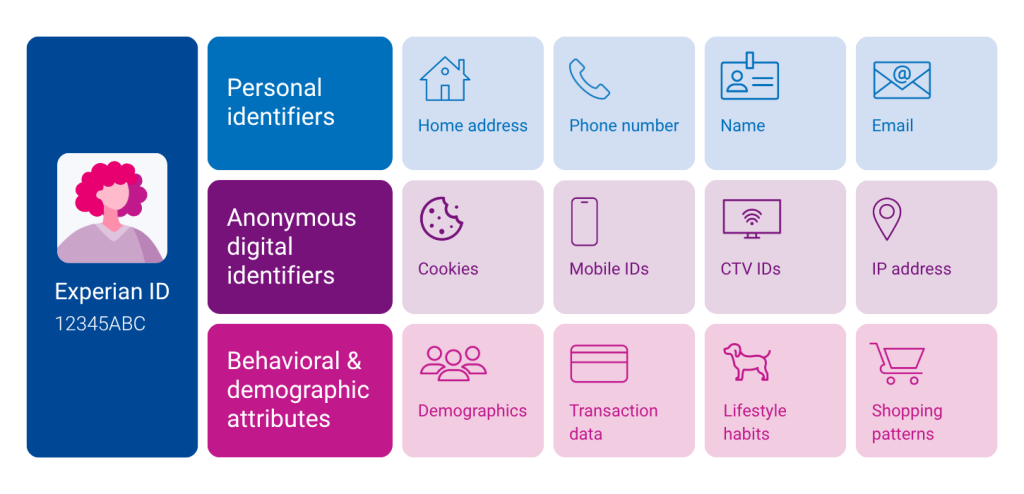
Common identifiers include:
- Cookies: Browser-based identifiers used to recognize activity within a particular browser
- Emails: Plain-text or hashed identifiers that can support identity matching
- Device IDs: Mobile advertising IDs (MAIDs) or app-based identifiers
- Loyalty IDs: Program numbers that tie online and offline activity
- Hashed PII: Personally identifiable information (PII) transformed into privacy-protected strings that can support matching without exposing the original values
Ultimately, identity resolution can help you recognize the same customer wherever they engage while protecting customer data.
Why is identity resolution critical in a privacy-first world?
Even as cookies linger, marketers have already shifted their strategies to rely on first-party data, where choice and transparency are the baseline expectation.
At Experian, our long history as a regulated data steward makes us a uniquely capable and trusted partner for managing modern compliance expectations. Our identity resolution solutions maximize the value of permission-based data while meeting consumer demand for privacy, personalization, and control.
Struggling with scattered customer data? We make identity resolution seamless.
How AI powers modern identity resolution
AI and machine learning strengthen identity resolution by analyzing billions of signals at scale, helping you improve match accuracy and connect recent activity to stable identities. Resolved identity can then provide a stronger foundation for predictive insights and more relevant marketing decisions.
Connect more fragmented identifiers
Deterministic matching connects records using exact identifiers, such as a login, hashed email, or loyalty ID. When those signals are unavailable, machine-learning models can evaluate probabilistic relationships across timestamps, IP addresses, user agents, cookies, and device IDs to determine which identifiers likely belong together.
Our Digital Graph applies advanced machine-learning clustering across more than 4.2 billion digital identifiers. Analyzing patterns at this scale can improve match accuracy and reduce the risk of false positives compared with static rules alone.
Incorporate more recent activity
Activity Feed captures digital events as they occur, resolves them to stable household and individual identities, and delivers event-level records hourly, making fresher resolved activity available for use across your marketing.
Turn resolved data into predictive insight
Identity resolution determines which signals are likely connected. Predictive modeling builds on that resolved identity foundation by analyzing behavioral patterns and other signals to anticipate likely interests or actions.
At Experian, our AI enhanced modeling surfaces combinations of signals associated with outcomes such as purchase, response, retention, or upsell. Our modeling teams review, test, and validate these signals before incorporating them into models. The resulting insights can help you prioritize audiences and inform more relevant messaging, offers, and experiences across personalization, connected TV (CTV), cross-channel targeting, activation, and measurement.
This identity foundation will become even more important as agentic media systems take on a larger role in campaign planning, activation, and optimization. These systems need accurate identity and trustworthy data context to interpret signals, make informed decisions, and act within defined parameters.
What changes for marketers when AI powers identity resolution?
The combination of AI and identity resolution changes how you work with customer data in three practical ways.
1. Respond to recent behavior
Delayed or incomplete customer views can make it harder to recognize changes in intent. With access to recently resolved activity, you can adjust targeting, optimization, and measurement based on newer signals rather than relying solely on periodic data snapshots.
2. Build more useful audiences
Resolved first-party data can be enriched with Experian Marketing Attributes and used alongside our syndicated audiences to help you:
- Understand consumers beyond their direct interactions with your brand
- Build more refined audience segments
- Reduce repetitive data preparation
- Activate audiences more efficiently across channels
3. Prioritize the right opportunities
Broad demographic criteria can show you who belongs to a category, but not necessarily who is more likely to support a particular campaign objective.
Our AI-enhanced modeling can build on resolved and enriched data to identify combinations of signals associated with a particular profile or action. These models can help infer consumer and household attributes when information is limited and identify consumers who may be more likely to act against a given objective.
That gives you a basis for deciding whom to reach, how to engage them, and where to invest while keeping marketing anchored in people.
How does identity resolution help brands?
These operational improvements can translate into broader business benefits, from expanding addressable reach to supporting more relevant customer experiences and more efficient media investment.
Creates a unified customer view
Connecting data from loyalty programs, point-of-sale (POS) systems, customer relationship management (CRM) platforms, digital interactions, and offline sources gives you a clearer picture of each customer across touchpoints.

This can improve match rates, expand your addressable audience, and help you reach more of the right consumers across channels.
Enables more relevant AI-powered customer experiences
Customers constantly switch devices, update their information, and change preferences. A strong AI customer experience depends on recognizing those changes without treating each new interaction as a different person.

When paired with recent activity, a resolved identity foundation gives AI models more consistent context for interpreting changing signals and informing messaging, offers, and timing.
This can support more consistent cross-channel experiences, stronger engagement, and, over time, conversion and customer lifetime value (LTV) goals.

Drives better marketing ROI
A stronger identity foundation helps you direct your budget toward the audiences, channels, and opportunities most relevant to your campaign objectives. With better targeting and prioritization, you can reduce wasted impressions and make more informed investment decisions.

Over time, that efficiency can contribute to lower acquisition costs, stronger return on ad spend (ROAS), and higher overall marketing ROI.
Supports privacy-conscious data use
We apply rigorous data governance standards and provide consumer choice mechanisms such as opt-outs and data correction. This helps you use identity data responsibly while supporting personalization and protecting consumer trust.

See our identity resolution solution in action
What are some identity resolution use cases and examples?
Every industry faces its own unique identity challenges, but identity resolution is the common thread that turns scattered data into connected experiences. Let’s break down how companies in different verticals are putting it to work (and the kinds of results they’re seeing).
Audio
People use audio while commuting, working out, and even folding laundry. It can be one of the hardest channels to track because of how frequently listeners switch between apps, stations, and devices.
Our identity resolution partnerships with Audacy and DAX change the game:
- Audacy helps tie scattered listening into a single view, so you can follow audiences across devices and keep ads relevant in the moment.
- DAX pairs more than 3,500+ Experian syndicated audiences with its audio network, enabling you to target and launch impactful campaigns at scale.
These partnerships turn audio into an accurate channel where ads feel personal, privacy-safe, and measurable.
Financial services
In financial services, identity resolution creates a more consistent foundation for understanding customers across touchpoints and connecting them with relevant audience insights. This can help banks, insurers, and lenders tailor outreach for mortgages and refinancing, credit cards and deposits, personal loans, insurance, and wealth management, while supporting applicable regulatory requirements.
We offer approximately 400 financial audiences, including segments such as:
- In Market First Mortgage
- Refinancing Homeowners
- Credit Seeking Card Switcher
- Deposits Financial Personality
- Investment Financial Personality
- Investable Assets
Through our partnership with FMCG Direct, Consumer Financial Insights® and Financial Personalities® segments provide additional insight into behaviors such as credit card use, deposit balances, and investment habits without exposing sensitive personal details.
These insights help you engage consumers based on relevant financial behaviors, needs, and moments — from building credit and buying a home to managing investments and preparing for retirement.
Read more about how our financial audiences support privacy-safe personalization.
Gaming
Gamers don’t stick to one platform. Player data gets scattered across mobile, console, and PC, so it’s tough to keep track of individuals. We help stitch those signals together so you can finally see the whole picture, personalize gameplay, and keep players coming back.
With enriched profiles, you can deliver offers that resonate and earn fresh revenue by packaging high-value gaming audiences for advertisers outside the industry.
Unity, a leading gaming platform, is tapping into Experian’s syndicated audiences to gain player insights and help advertisers reach gamers across mobile, web, and CTV. For global publishers, unifying player data with Experian has driven higher engagement and stronger ad ROI.
Healthcare and pharma
You can’t afford slip-ups with HIPAA regulations. Identity resolution makes it possible to engage the right patients (DTC) and healthcare professionals (HCP) with de-identified audiences rather than third-party cookies.

AI and machine learning have always been part of how we power identity resolution. In healthcare, that means using AI-enhanced modeling to connect de-identified clinical and claims data with lifestyle insights. The result is a more comprehensive picture of the patient journey that helps close care gaps, reduce wasted spending, and improve outcomes.
By working with partners like Komodo, PurpleLab, and Health Union, we make it possible to activate campaigns at scale that boost engagement and adherence while keeping patient privacy front and center:
- Komodo Health enriches our identity graph with insights from millions of de-identified patient journeys plus lifestyle data, giving you a fuller view of where care gaps exist and how to close them.
- PurpleLab connects clinical and claims data to our platform, letting you activate HIPAA-compliant audiences across CTV, mobile, and social with the ability to measure outcomes like prescription lift and provider engagement.
- Health Union contributes a data set built from 50 million+ patient IDs and 44 billion+ patient-reported data points. Combined with our identity and modeling capabilities, this improves match rates and delivers up to 76% net-new reach, so campaigns reach patients and caregivers in critical health moments.
These capabilities help you launch privacy-first, highly targeted campaigns and connect media exposure to meaningful outcomes.
Explore our pharma playbook to learn how to:
- Reduce governance risk
- Keep patient and healthcare provider identity workflows appropriately separated
- Sequence activation across channels
- Connect media exposure to outcomes
- Evaluate potential workflow partners
Media and TV
Viewers tend to hop around between linear TV, streaming apps, and social feeds. And without identity resolution, every screen looks like a different person. You can accurately plan, activate, and measure campaigns by unifying viewing behaviors into one ID with our AI-powered identity graph.

Curious how identity resolution can power your customer analytics? We can walk you through it.
Retail and e-commerce
Shoppers move between websites, apps, carts, stores, and checkout lines, leaving fragmented signals along the way. In retail, identity resolution connects online and offline activity — such as digital engagement, loyalty transactions, and in-store purchases — to create a more complete view of the customer journey. This supports more relevant targeting, consistent experiences, and clearer measurement across channels.

Experian retail audiences add context based on how consumers engage, where they shop, and what they buy. You can activate and layer audiences to align channel selection, creative, and timing with demonstrated retail behaviors such as:
- Streaming First Cord-Cutter Households
- eCommerce Diehards
- Frequent In-Store Buyer Households
- Category-Specific High Spenders
Identity resolution is also increasingly important as commerce media evolves beyond traditional retail networks. Our 2026 State of advertising report explains how transactional data can give brands a clearer view of the purchase journey, support on-site and off-site activation, and connect upper-funnel investment to measurable outcomes across payment platforms, marketplaces, and merchant ecosystems.
Our 2026 Digital trends and predictions report examines this broader shift, including how commerce media is expanding beyond retail and why stronger connections among data, identity, activation, and measurement will be essential for turning media investment into business outcomes.
Travel and hospitality
Travelers move between devices and channels as they research destinations, compare options, and complete bookings. Identity resolution helps travel and hospitality brands connect loyalty, booking, and other digital and offline signals to create a more consistent view of guest preferences and intent. You can use that understanding to deliver relevant offers, reach high-intent audiences, and determine which marketing efforts drive bookings and repeat visits.
Windstar Cruises put this approach into action when we worked with MMGY to use our identity graph to connect digital media exposure with confirmed bookings. More than 6,500 bookings valued at over $20 million were attributed to MMGY-managed placements.
How should I evaluate identity resolution tools and providers?
When choosing identity resolution tools and providers, evaluate both their underlying identity data and the way they bring AI and identity resolution together. Look for:
- Data scale, quality, and sourcing: Identity resolution is only as reliable as its underlying data. Ask what online and offline sources the provider uses, whether its models are grounded in proprietary and verified data, and how it evaluates the accuracy, permissioning, and recency of outside sources. A broad data set is most valuable when its origins and quality are clearly understood.
- Match methodology, accuracy, and validation: Look for a provider that combines deterministic matching based on exact identifiers with AI-driven probabilistic (pattern-based) matching when exact signals are unavailable. This balance can preserve the accuracy of confirmed connections while extending reach across fragmented identifiers. Ask how the provider validates match quality, measures false positives, sets confidence thresholds, and refreshes identities as consumer signals change.
- AI governance and responsible use: Providers should be transparent about how their AI models are developed, tested, monitored, and governed. Ask whether qualified experts review and validate model outputs, how performance or bias concerns are addressed, and what safeguards support responsible use.
- Privacy and compliance readiness: Compliance can’t be an afterthought. Your identity partner should maintain strong data governance and provide tools that help support applicable privacy requirements, including consumer opt-outs, corrections, and deletions.
- Integration flexibility: A good provider fits into your world, not the other way around. Look for pre-built integrations with your customer data platform (CDP), demand-side platform (DSP), and broader marketing tech (MarTech) stack so you can get up and running without the heavy IT lift.
- Measurement capabilities: Ask how the provider connects resolved identities, media exposure, and customer outcomes. Strong measurement capabilities should help you evaluate campaign performance across channels and use those insights to improve future planning.
How Experian enables enterprise-grade identity resolution
Experian’s identity resolution solutions give you the scale, accuracy, and compliance support required for complex enterprise environments. Our solutions are:
- Built on trust: Backed by 40+ years as a regulated data steward, so you can act with confidence.
- Powered by our proprietary AI-enhanced identity graph: Combining breadth, accuracy, and recency across more than 4.2 billion identifiers, continuously refined by machine learning for maximum accuracy.
- Seamlessly connected: Pre-built data integration with leading CDPs, DSPs, and MarTech platforms for faster time to value.
- Always up to date: Frequent enrichment and near-real-time identity resolution through Experian Activity Feed for timely personalization and more responsive customer engagement.
- Privacy-first by design: Compliance with GLBA, FCRA, and emerging state regulations baked in at every step, supported by rigorous partner vetting.
Turn connected identities into measurable growth
Identity resolution turns fragmented signals into connected, measurable, and compliant experiences. From retail to gaming, brands using it see stronger personalization, engagement, and ROI.
At Experian, we bring AI and identity resolution together with the data, trust, and innovation needed to make those connections work across every channel. Our approach applies AI to connect fragmented identities at scale, while data enrichment and predictive modeling help you understand audiences, prioritize opportunities, and support more relevant personalization.
If you’re ready to turn fragmented data into growth, now’s the time to start.
See how we can support identity resolution at scale
Identity resolution FAQs
The difference between deterministic and probabilistic matching is how they connect identifiers. Deterministic matching uses exact identifiers to create high-confidence connections, while probabilistic matching uses signals and algorithms to identify likely relationships. Leading providers typically combine both methods.
Yes, AI helps identity resolution by connecting identifiers when exact deterministic matches aren’t available. Machine-learning models evaluate patterns across signals and predict which identifiers likely belong together. We apply machine-learning clustering across more than 4.2 billion digital identifiers to resolve fragmented activity at scale.
Identity resolution can improve ROI by creating more complete customer profiles that support better targeting and personalization. Higher match rates can expand addressable audiences, reduce wasted spend, and boost ROAS.
Yes, identity resolution can work without third-party cookies by using first-party data and privacy-protected identifiers, such as hashed email addresses, to support addressability and personalization.
We differ from a CDP in the scale and depth we can add to your existing data. While a CDP primarily unifies data you already own, we can complement it by connecting customer records to our identity graph and providing identity resolution and data enrichment capabilities.
Yes, Experian is GLBA/FCRA compliant, GDPR/CCPA ready, and supports consumer opt-outs and corrections to ensure responsible personalization.
When comparing identity resolution tools, look for a provider that combines deterministic and AI-driven probabilistic matching, uses high-quality data with clear sourcing, validates match quality, and governs its models responsibly. The right tool should also support applicable privacy requirements and integrate flexibly with your existing marketing technology.
Latest posts

The UK digital advertising market is worth £13.44bn, an increase year-on-year of 15%, reveals the 2018 IAB UK & PwC Digital Adspend Study. Report highlights The majority of all growth is coming from smartphone advertising, which has increased by £1.65bn (35%) from 2017. Smartphone advertising now represents 51% of all UK digital ad spend, up from 45% in 2017. Video is now the largest display format (£2307m), overtaking standard display banners (£1486m). Outstream/social in-feed has increased its majority in total video spend, now occupying a share of 57%, up from 52% in 2017. Social revenue now represents 23% of all digital ad spend. Growth is predicted to slow during 2019, with 5% estimated growth (+9% digital, +11% display, +9% search) compared to 15% in 2018. 2018 marks the tipping point towards a mobile-first ecosystem “For the past few years, industry commentators have been hailing the year of mobile. Each January the predictions come and the waiting commences for evidence to mark a tipping point, a shift to a mobile-first digital ad ecosystem. Well, drumroll… it was 2018! The latest Adspend report from IAB UK and PwC reveals that spend on smartphones outstripped spend on desktop for the first time last year. Brands spent 51% of total spend (which stands at £13.44 billion) on smartphones in 2018, up from 45% in 2017 – a significant milestone in the evolution of digital advertising. “This evidence shows that advertisers are increasingly thinking mobile-first. Growth in investment has historically lagged behind the amount of time spent on the device and we expect to see growth continue at a rapid pace to keep up with audience behaviour – two thirds of time spent online is now on mobile, according to UKOM. Other areas of growth highlighted by the report include video, which accounts for 44% of the total display market, while mobile video now makes up 51% of smartphone display. This is no doubt down to bigger mobile screens, better 4G and more readily available WiFi making video ads an increasingly attractive option. “Across the board, advertisers are investing in digital for longer-term brand building as well as short-term activation, with the direct-to-consumer market helping to drive this trend. What’s more, digital continues to be an accessible and popular route to market for businesses of all sizes, from leading advertisers to SMEs.” Tim Elkington, Chief Digital Officer, IAB UK Content & context crucial for attracting audiences “As people spend more and more of their time on mobile, it’s comes as no surprise that advertisers will follow where audiences are with their marketing spend. “Video has been the driving force in this growth, indicating that engaging visual content is still key in helping brands to achieve great results and to capture consumer attention in a vast sea of digital noise. “Video still has a way to go if it is to reach the level of effectiveness of traditional formats like cinema, but it will be interesting to see how the format develops over the next year or so. Ultimately, brilliant content and properly considered context are crucial for advertisers hoping to attract relevant audiences and build strong brands long term.” Kathryn Jacob OBE, CEO, Pearl & Dean Mobile-first approach driving investment in user experience “As a mobile-first approach has become the norm for many businesses, we’ve seen significant innovation and investment in the user experience that has fuelled the rise in mobile commerce. “Yet, for some years, limitations in the technology and formats available have meant that mobile advertising couldn’t always keep pace with changing consumer behaviours – delivering weaker performance when compared to desktop. “Fortunately, mobile has made huge strides in recent years. Mobile advertising affords great targeting opportunities for brands and a more interactive and immersive experience for consumers. “There is no reason to doubt this trend will continue as advertisers design their media, creative, and targeting strategy with mobile at the heart – optimising performance, enhancing the customer experience, and delivering the best results.” James Cragg, UK Managing Director, Tug New technologies to improve investment efficiency “The UK digital ad market has continued to grow despite the various challenges that the market has faced, including the current socioeconomic climate and general changes in the industry. As spend increases, it’s important to look at how media buying can be made as efficient as possible, minimising waste and maximising the return on investment. “Marketers will start to look to new technologies, like AI, to offer an impartial and more efficient approach to media buying, allowing marketers to measure effectiveness of campaigns and allocate spend accordingly.” Carl Erik Kjaersgaard, Chief Executive, Blackwood Seven Industry going from strength to strength “This significant growth in ad spend is great to see and shows that our industry is going from strength to strength. It’s especially good to see that as advertisers invest more and more in digital advertising, they’re becoming more considered in where they’re spending their money – with a large portion of the growth coming from companies that are part of IAB’s Gold Standard. “At The Trade Desk, we’ve long been ambassadors for the importance of transparency. These findings show that it isn’t just the right thing to do, but makes good business sense as advertisers increasingly choose partners who are demonstrating a commitment to best practice.” Anna Forbes, UK General Manager, The Trade Desk Advertisers embracing mobile “As consumers spend more of their time online, it’s no surprise that digital ad spend has continued its rise, up 15% to £13.4bn. With digital, in every sense, becoming further embedded in our daily lives, it is inevitable that this number is set to rise further next year. “Given the vast majority of people using their smartphone as their primary digital device, evident from site traffic stats we see across the board, the IAB report shows that advertisers have started to fully embrace this shift by following with ad spend. Over the last few years, a combination of faster wireless connectivity along with more capable devices has made it the go-to device for consumers to get online. This is set to continue over the next few years with 5G and even faster, more capable smartphones arriving (i.e. foldables) that will further cement ‘mobile’ as the main digital device to reach consumers.” Wajid Ali, Head of Paid Search, ForwardPMX Budgets must go to professionally produced content “In the IAB’s latest ‘Digital Adspend Study’ it is positive to see that outstream continues to dominate video spend, showing close to a 10% year-on-year increase. “Unsurprisingly, the study highlights that mobile is the most important distribution device (76% of all video spend is on the smartphone), and it’s great to see the format we invented dominating that space. “However, it’s now more pertinent than ever that clients and agencies invest their outstream budgets into professionally produced content and not social infeeds. Budgets must go where content is being produced, rather than aggregators and distributors, where the content is read rather than where a click happened. “We must remember how important local, national, and vertical press are to the global digital ecosystem. By unifying the best publishers at scale, delivering mobile-optimised creativity and outcome-orientated distribution, we are fighting to ensure publishers are getting their fair share of revenue in comparison to the social platforms.” Justin Taylor, UK MD, Teads UK market in robust health “The latest IAB digital ad spend report shows encouraging signs that the UK digital advertising market is in robust health, with mobile advertising continuing its upward trend. “The rise of up-and-coming ad formats like Shopping Ads, Google’s Responsive Search Ads, and Facebook Messenger Ads show that advertisers are looking for ways to capture consumer attention in the evolving digital landscape. As a result, the lines across search, social, and e-commerce are more blurred than ever with the introduction of features like Checkout for Instagram and Shopping ads on Google Images. Furthermore, with the rapid growth of Amazon’s ads business, e-commerce has quickly emerged as a third pillar of digital advertising, making it vital for marketers to have a complete view of the customer journey across channels and devices, if they hope to more accurately understand campaign performance and attribution.” Wesley MacLaggan, SVP of Marketing, Marin Software Digital identity resolution essential in understanding customer journey “Last year’s figures show that UK ad spend is starting to mirror the behaviour of consumers who, according to UKOM data, spend two-thirds of their time online on a smartphone. The fact that mobile ad spend now surpasses that of ad spend on desktop highlights marketers’ understanding that digital identity resolution is essential, not a nice-to-have. “Appreciating the cross-device behaviours of consumers allows brands to gain a better understanding of the customer journey and build stronger relationships with their audiences long term.” Tom Rolph, VP EMEA, Tapad, a part of Experian. Contact us today
OpenAudience promises the targeting capabilities of a walled garden but without the restrictionsOpenX has lifted the lid on a targeting solution it claims will offer people-based advertising opportunities outside of the industry’s walled gardens such as Facebook and Google. Dubbed OpenAudience, the supply-side programmatic player claims the new offering is powered by proprietary data assets and is supplemented by data partnerships with partners such as LiveRamp and Tapad, a part of Experian. Initially available in the U.S., OpenAudience has a user graph of 240 million monthly users and is currently being tested with multiple marketers with a general rollout planned for the third quarter of 2019. Speaking with Adweek, OpenX CEO Tim Cadogan said the rollout would help differentiate it among its peers as for the most part ad exchanges have marketed themselves based on their impression count, not necessarily addressable audiences. Compare this with Google and Facebook, both of whom account for almost 60% of U.S. ad spend, although this is disproportionate to the amount of time spent with their properties, according to Cadogan. “The thing that has given Facebook and Google so much power is that they have people-based systems [for ad targeting] that are simple to use and operate with a massive scale that are effective, and programmatic hasn’t kept pace with that,” he said. Cadogan cited the findings of a further study by eMarketer, which indicated that marketers are increasingly reliant on such walled garden players for their online inventory supply with the latest launch geared towards capitalizing on that. The latest launch is the culmination of the California-based company’s recent strategic overhaul, namely its attempts to get to grips with an identity-based solution that provides options outside of the walled gardens. Also speaking with Adweek was Todd Parsons, OpenX’s chief product officer, who offered further insight into how OpenAudience operates including how it uses its recently sealed relationship with Google Cloud Platform and machine learning to ape the efficacy of walled garden advertising solutions. “We had to build a matching technology, which made it possible for us to talk about monthly active users instead of talking about cookies or devices,” he explained. “And it took several quarters of staffing up with the right people from the consumer data and identity space.” OpenAudience’s matching technology works by using the identity and cookie matching capabilities of cross-device specialist Tapad and data onboarder LiveRamp to formulate a persistent, deterministic ID which can then be used to match advertisers with audiences on its ad exchange. “So, the idea isn’t for us as a company to put our future into one provider,” added Parsons. “It is to provide a matching technology that uses the best of several.” OpenAudience will also include involve additional tie-ups to offering further demographic information on the 240 million monthly U.S. users such as location, etc., which is currently in testing. “We felt like we needed to be very different about enabling marketers and publishers to activate against that data,” added Parsons. He further added that OpenX wants to rival Facebook’s levels of service when it comes to helping publishers monetize audiences on the social network, except this time on the open web. “No one has actually pushed identity and consumer data into the hands of publishers in a way that you might unify the view of audiences across many websites.” OpenX’s Cadogan summed up the OpenAudience offering and how it may look to advertisers when he said, “Imagine the open web is one publisher, and this lets buyers look at it as a single entity and market to them accordingly.” Contact us today
Everyone knows that it’s important for businesses to have a clearly defined brand. In the modern world, the personal brand has become just as important, and many professionals are trying to build up their public reputation, expertise and industry authority. In the digital age, there are many different methods and channels you can use to build your personal brand, but some are more efficient than others. According to Forbes Agency Council, here are some of the most effective ways to develop an authentic personal brand.1. Give More Than You Receive Whatever you do, always aim at giving more than you receive. When you build your network, try to bring value to each new person that you meet. When you get featured in some media, see what you can do for them in return. This is the best strategy because actions speak louder than words. People will remember you for what you are, not what your website is. – Solomon Thimothy, OneIMS 2. Define What You Stand For, Then Align Your Actions Define your mission. What is your purpose? What do you want to accomplish, and what is your key message? Once you have answers to those questions, use that mission as a guiding North Star to consistently reinforce your personal brand every day. This will come across in how you lead, how you interact with employees and peers, how you communicate, and how you give back to the community. – Preethy Vaidyanathan, Tapad 3. Develop A Creative Positioning Statement It’s all about positioning your company. You need to have creative positioning statements about who you are and what your company is doing to benefit its clients. Clients want resolutions to their problems, and that’s where you come to the rescue. It’s either sold or ignored. – Cagan Sean Yuksel, GRAFX CO. 4. Speak At An Event Becoming a keynote speaker gives you access to the things you need to elevate your brand: influencer status, large audiences and media profile. But access doesn’t equal attention. While speaking gives you the platform, you need to have something compelling to say. You’ll need a differentiated message, unique presentation style and a great agent to make this strategy successful. – Andrew Au, Intercept Group 5. Focus On A Specific Audience The most effective way to build your personal brand is to create content specifically for a very specific group of people. Create relevant content that details solutions to the unique needs of this audience so that it spreads quickly due to its hyper-relevance. This creates authority and credibility for your personal brand and helps you stand out as being the most relevant expert in your field. – Adam Guild, Placepull 6. Be Ruthlessly Consistent Developing a personal brand requires ruthless consistency in your subject matter and how you present yourself to the world. I go back to the early days of marketing blogs. In those days, some bloggers were all over the map with content. The ones who were consistent with their audience and their goals are the ones who had staying power. They became the authors, speakers and consultants. – Scott Baradell, Idea Grove 7. Follow Through Just like a traditional brand, the quality of your offering helps to build your brand. If you are clear on what you can and cannot deliver and always follow through on your word, your personal brand reputation will precede you and will be lifted by the recommendations of others. – Kieley Taylor, GroupM 8. Build A Solid Reputation “Personal brand” is just a new-age name for reputation. Doing your job exceptionally well, going above and beyond, treating people with respect and kindness, having a point of view—essentially any action that builds a solid professional reputation does the very same for your personal brand. – Jess Cook, TMV Group 9. Define Your Voice Establish your unique voice and personal point of view and stick to it in all you do and all you say. Personal brands must be consistent and have consistency in messaging, attitude and behavior. Express your personal brand through comments on articles, at significant events and important platforms where it can best showcase and support your personal point of view and brand persona. – Pat Fiore, FIORE 10. Create And Share Video Content Video is hard for many people. That’s why it can be your competitive advantage if you do it. Video allows you to be seen, heard and felt emotionally in a way that no other medium can. You may say, “That’s not for me” and that’s fine, but good luck competing with those who embrace it. Barriers to video are so low that building a personal brand without it seems as if you are hiding something. – A. Lee Judge, Content Monsta 11. Share Your Point of View In Everything You Do There are a finite number of topics that make for interesting discussion in our industry, so having a point of view and sharing it through crafted content is vital for building your personal brand. You don’t have to be controversial, necessarily, but considering themes and topics and providing honest commentary that demonstrates experience is the quickest way to build your reputation. – David Harrison, EVINS 12. Stay True To You The most effective way to build your personal brand is to be true to who you are. If you are wildly creative and outgoing, show that in your branding! Don’t hold back in your content; post that crazy Instagram picture that shows the world how you think. If you are conservative, then own that. This passion for who you really are—and what your company really is—authentically shines through. – Katy Boos, Remix Marketing Inc. Contact us today