Healthcare organizations have invested heavily in digital engagement over the past decade. Patient portals. CRM platforms. Campaign automation. Consumer data platforms. And yet, personalization in healthcare still feels stuck.
Outreach is often generic. Preventive care reminders go unopened. Screening campaigns underperform. Value based care programs struggle to engage the very patients they are designed to support.
I hear a version of the same frustration from health system and life sciences leaders. Their engagement stack keeps expanding, but their impact on the patient experience remains limited.
While many healthcare organizations have abundant data, most have an identity and context gap.
Personalization stalls when identity never moves beyond the EHR
A diagnosis tells you what care is needed, but it doesn’t tell you how to reach someone, when they are most receptive, or what barriers might prevent follow-through.

When identity stops at the electronic health record (EHR), engagement becomes a series of educated guesses about a real person’s needs, preferences, and circumstances.
Patients don’t live inside the EHR
Consider how most preventive outreach works today. A patient leaves the hospital with instructions and a recommended follow-up appointment, and the system triggers a standard sequence of reminders.
The intent is right. The execution is usually constrained by missing context.
- Will they see the message in the channel you chose?
- Is a caregiver involved in coordinating next steps?
- Is the barrier logistics, or clarity on what to do next?
These factors determine whether follow-up happens. They also determine whether “personalization” actually feels personal, or just automated.
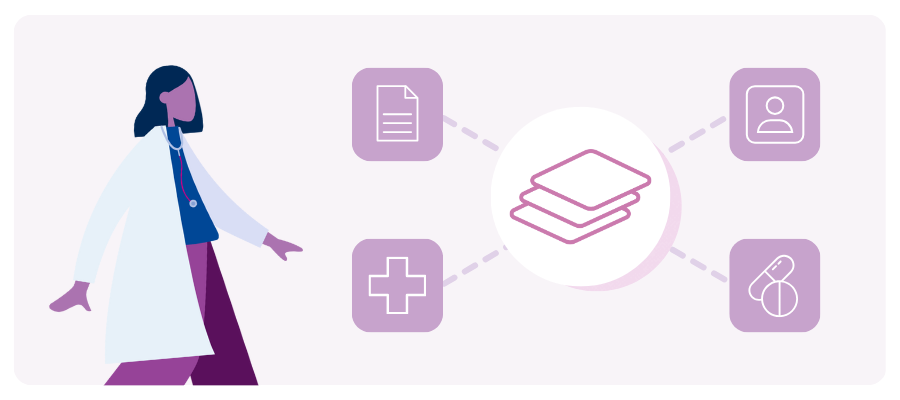
In other industries, personalization advanced by connecting transactional data with behavioral and household context. In healthcare, those signals remain separate to protect patient data, often resulting in a disconnect between strong clinical insights and effective patient engagement.
Connecting the dots is the hard part
There’s a common narrative that healthcare needs more data to improve personalization. In practice, the bigger challenge is connecting what you already have in a way teams can trust. Identity, preference, household context, and engagement history often live in different systems, and they rarely resolve cleanly to a usable profile.
A privacy-safe identity foundation changes that. When organizations can link records across sources with strong match discipline, governance, and tokenization, they can turn fragmented data into more relevant decisions without exposing more than is necessary.
Watch our Q&A with Cristin Liberatore from IQVIA Digital on healthcare marketing
How we approach this at Experian
At Experian, this is the lens we use:
What privacy-safe identity makes possible in regulated patient engagement
In regulated categories, accuracy, governance, and privacy are non-negotiable. That’s why I push teams to think about identity as infrastructure, because people move, households change, and preferences shift.
At Experian, that infrastructure includes:
- Marketing Attributes and Enrichment: Adding context to first-party data so planning and decisioning reflect the person you’re trying to reach.
- Offline and Digital Graphs: Connect identity across touchpoints so experiences stay consistent as people move between channels.
- First-Party Onboarding and data marketplace: Activate consented consumer and patient data across digital environments in a privacy-safe way. Our data marketplace extends that strategy with third-party partner segments, improving your personalization efforts to encourage a more proactive approach to healthcare.
- Curated Deals: Support upper-funnel awareness by aligning audience insight with higher-quality inventory in environments that can improve visibility, context, and campaign efficiency.
Watch our healthcare marketing panel from CES 2026
Identity must come first in healthcare marketing
Healthcare personalization has plateaued because engagement strategies have stayed too narrow and disconnected from the realities that shape follow-through.
The next phase of healthcare engagement will be defined by organizations that treat identity and additional patient context as the foundation for decisioning, activation, and measurement. When identity connects to real-world context through privacy-safe, governed, and tokenized practices, outreach becomes more relevant, easier to receive, and easier to act on.
About the author

Kevin Dunn
Chief Revenue Officer, Experian
Kevin Dunn joins Experian Marketing Services with more than 20 years of leadership experience across marketing and advertising technology, most recently serving as Senior Vice President of Brands and Agencies at LiveRamp. In that role, he led growth across retail, CPG, travel, hospitality, financial services, and healthcare, overseeing new business, account expansion, and channel partnerships.
Kevin is known for building cohesive, accountable teams and leading with optimism, clarity, and a strong sense of shared purpose. His leadership philosophy centers on empowering people, driving positive outcomes for clients and fostering a culture where teams can grow, take smart risks, and succeed together.
Latest posts

Joint solution will enhance accuracy and reach across North America, EMEA and APAC NEW YORK, April 17, 2019 /PRNewswire/ — Tapad, a global marketing technology company and leader in digital identity resolution solutions, today announced a new joint capability with Arm®Treasure DataTM , a leader in enterprise customer data management. The partnership combines The Tapad GraphTM technology with Arm Treasure Data's robust enterprise Customer Data Platform (CDP), enabling advertisers in the Arm Treasure Data marketplace to access Tapad's datasets. With the integration of Tapad's Graph and Arm Treasure Data's existing first party data, marketers will be able to deliver scalable, cross-device messaging with precision. In addition, marketers can benefit from anonymous customer journey analysis, audience expansion and online and offline attribution. Arm Treasure Data's APAC market customers will have access to expanded audience reach by leveraging Tapad's global, proprietary datasets. While Tapad will be able to extend its presence into the APAC region, tapping into Arm Treasure Data's existing footprint. "The Tapad GraphTM is a trusted and established platform with a history of innovation," said Stephen Lee, Senior Director, Business Development, Arm Treasure Data. "Integrating Tapad's technology into the Arm Treasure Data CDP will allow for streamlined experiences across markets, achieving global scalable reach." For more information about The Tapad GraphTM, or to request a demo, visit our identity page. About Tapad Tapad, Inc. is a global marketing technology company and leader in digital identity resolution solutions. The Tapad GraphTM, and related solutions, provide a privacy-safe approach to connecting device identifiers to brand and marketer data, thereby allowing for enhanced measurement, attribution, reach and ROI of marketing campaigns. The Tapad GraphTM enables marketers around the world to maximize campaign effectiveness and drive business results. Tapad is recognized across the industry for its innovation, growth and workplace culture, and has earned numerous awards, including the TMCnet Tech Culture Award. Based in New York, Tapad also has offices in Chicago, London, Oslo, Singapore and Tokyo, and is a wholly owned subsidiary of Telenor Group. About Treasure Data Arm Treasure Data enterprise Customer Data Platform (CDP) unifies data from multiple sources – online, offline, IoT and device generated data – and empowers enterprises to disrupt their markets with superior customer experiences. Our customers are creating transformational customer relationships by connecting the data dots with our CDP. Arm Treasure Data is fully owned by Arm Holdings and has a global customer base of over 300 enterprises including Fortune 500 and Global 2000 companies. Our clients manage over 130 trillion records, resulting in more predictable and profitable business results. Contact us today

Leading global marketing technology company, Tapad, a part of Experian, adopts The Trade Desk’s streamlined cookie ID into its identity resolution solutions to increase global cookie coverage across the internet April 03, 2019 09:00 AM Eastern Daylight Time LOS ANGELES & NEW YORK–(BUSINESS WIRE)–Global marketing technology company, Tapad, a part of Experian, has partnered with The Trade Desk to onboard The Trade Desk’s unified ID solution into its digital identity driven solutions. The Trade Desk’s unified ID solution is free for all parties spanning the digital advertising supply chain, including SSPs, DSPs, DMPs and data providers. With leading players onboarding the unified ID solution, such as Tapad, streamlined cookie syncs make ad viewing experiences better for consumers, increase match rates for all parties, and expand cookie coverage on a global-scale. Adoption of The Trade Desk’s global cookie footprint enables Tapad customers to benefit from greater precision and potentially higher performing digital marketing campaigns. “Identity is critical in the ecosystem and as a long-standing leader in the space, Tapad has shown a strong commitment to building digital identity resolution solutions that help marketers launch more effective campaigns on a global scale,” said Ed Chater, VP of Data Partnerships, The Trade Desk. “We are thrilled for their participation and look forward to solving the digital identity narrative across the industry through this partnership. The continued widespread adoption of the unified ID solution validates our collective mission to improve the effectiveness of digital advertising.” About Tapad Tapad, Inc. is a global marketing technology company and leader in digital identity resolution solutions. The Tapad Graph™, and related solutions, provide a privacy-safe approach to connecting device identifiers to brand and marketer data, thereby allowing for enhanced measurement, attribution, reach and ROI of marketing campaigns. The Tapad Graph™ enables marketers around the world to maximize campaign effectiveness and drive business results. Tapad is recognized across the industry for its innovation, growth and workplace culture, and has earned numerous awards, including the TMCnet Tech Culture Award. Based in New York, Tapad also has offices in Chicago, London, Oslo, Singapore and Tokyo, and is a wholly owned subsidiary of Telenor. About The Trade Desk, Inc. The Trade Desk™ is a technology company that empowers buyers of advertising. Through its self-service, cloud-based platform, ad buyers can create, manage, and optimize more expressive data-driven digital advertising campaigns across ad formats, including display, video, audio, native and, social, on a multitude of devices, such as computers, mobile devices, and connected TV. Integrations with major data, inventory, and publisher partners ensure maximum reach and decisioning capabilities, and enterprise APIs enable custom development on top of the platform. Headquartered in Ventura, CA, The Trade Desk has offices across North America, Europe, and Asia Pacific. To learn more, visit thetradedesk.com or follow us on Facebook, Twitter, and LinkedIn. Contact us today
by AdExchanger // Friday, March 15th, 2019 – 12:06 am “Data-Driven Thinking” is written by members of the media community and contains fresh ideas on the digital revolution in media. Today's column is written by Preethy Vaidyanathan, chief product officer at Tapad, a part of Experian For years marketers asked, “How do we get more data?” Now that they've mastered data mining, marketers want to know what’s next. The time has come for organizations to make their abundance of digital data actionable, increase ROI and reach consumers with consistent, personalized experiences across all touchpoints. A seamless consumer experience can only be achieved by consolidating digital data. Organizations, however, are finding that consolidating data silos is more time-consuming and complicated than initially expected. The challenges One of the most pervasive obstacles companies face in when consolidating data is adopting inefficient and costly tactics that quickly become outdated. For instance, over the last couple of years, many companies turned to enterprise data warehouses to consolidate data silos, but some were too expensive or poorly suited for raw, unstructured and semi-structured data. This led companies to adopt data management initiatives, which bogged down many enterprises. Perception among senior level executives is another challenge. Many still question the need for digital transformation – achieving greater efficiencies through updating business and organizational processes with new technologies. Gartner found that more than half (54%) of senior executives say their digital business objective is transformational, while 46% say their objective is optimization. Digital transformation and data consolidation require time and effort. So, many large organizations work to overcome data silos as part of a multiyear digital transformation versus an immediate action item, delaying the benefits the company sees from taking on this project. All of these challenges make delaying progress in data consolidation easy, but companies should remember the impetus for doing so: creating a seamless customer experience that, in turn, drives business results. Brands with higher quality customer experience grow revenue faster than direct competitors with lower quality customer experience. The approach Many brands go into the digital transformation process assuming they have massive amounts of customer data, and that much of it is valuable or will be in the future. They might spend months aggregating that data in data stores or data lakes – at great expense. The trouble is that their data was scattered across multiple databases, which means it’s highly fragmented. As a result of this fragmentation, marketers can’t activate their data in ways that enhance the customer experience. To do so, companies must ensure their digital data is highly flexible so it can provide a holistic view of the consumer journey across every digital, in-store, in-venue and offline channel. I’d recommend that organizations taking on data centralization initiatives prioritize use cases that offer the company the greatest benefit. This is where organizations should establish a “crawl, walk, run” approach to data centralization to ensure key executives buy into the process. Starting with a subset of use cases, such as customer retention or upsell, or with a campaign, which is an even smaller starting point, allows executives to see the benefits of data consolidation projects relatively quickly. Once they validate these initial benefits, they can expand the range of use cases or campaigns, as well as the marketing ROI for their business. While data centralization is a long-term project that may take several years to complete, it doesn’t mean a business can’t get started now and see measurable results quickly. Break down data consolidation into stages so the organization can experience wins along the way. At the end of the day, data consolidation will help organizations deliver more effective marketing campaigns that drive business growth. Contact us today