At A Glance
Healthcare marketing now runs across mixed-identity conditions, where authenticated data, contextual signals, and aggregated measurement all show up in the same campaign. Pharma brands need infrastructure that keeps DTC and HCP identity separate and still connects fragmented signals across activation, privacy, and measurement. Experian acts as an independent, privacy-first identity, data, and workflow layer for pharma marketers, designed specifically for this operating environment.Originally published in Digiday
Key takeaways
- Pharma campaigns now span environments with very different identity conditions, from strong addressability to contextual only signals, which makes coordination a core infrastructure challenge.
- Privacy and compliance rules require DTC (patient) and HCP (healthcare professional) data to stay in separate, non-overlapping workflows at every stage.
- Experian’s identity and workflow layer governs DTC tokenized matching and HCP deterministic National Provider Identifier (NPI) resolution as two distinct processes, never one merged identity path.
- Partner-enabled measurement connects exposure data to outcomes like script lift and qualified HCP engagement through trusted partners including IQVIA Digital, PurpleLab, and OptimizeRx.
A pharmaceutical brand launching a campaign today might rely on authenticated data in one environment, contextual signals in another, and aggregated measurement somewhere else entirely. That’s the reality of healthcare marketing right now, and most brands are still building the operational model to match it.
In a mixed-identity ecosystem, performance comes from the ability to coordinate multiple signal types across activation, privacy, and measurement workflows. Accuracy and scale depend on knowing which approach fits which environment and having the infrastructure to execute across all of them.
From onboarding to outcomes
Pharma marketing teams need identity workflows that can support accurate audience creation, governed activation, and partner-enabled measurement without combining DTC and HCP identity paths.
Download our pharma marketing playbook to help your team:
- Plan DTC and HCP identity strategies with clearer separation
- Prepare audiences for activation across approved channels and partners
- Evaluate audience quality, usable reach, and governance

Healthcare campaigns run across different signal conditions
Healthcare campaigns now run across environments with very different identity conditions, from fully addressable channels to contextual only placements. Digital advertising has long assumed that better identity leads to better targeting, frequency management, orchestration, and measurement, but healthcare has always operated with more constraints than most categories. Those constraints are becoming impossible to ignore as budgets move into connected TV (CTV), point-of-care, publisher-direct, programmatic and retail media-adjacent environments.
That shift changes the operating model. Marketers now have to manage audience strategy, supply quality and performance across channels that don’t support the same level of addressability, interoperability, or measurement visibility. In some environments, identity is strong and can support targeting and measurement. In others, identity is limited or unavailable, and marketers have to rely on contextual or aggregated signals. Managing across both environments is now a core infrastructure challenge for healthcare marketers, and it’s one that requires a deliberate strategy rather than a channel-by-channel patch.
Privacy risk is a media infrastructure issue
Privacy risk in healthcare marketing now shapes how campaigns get built and run from the ground up, extending well beyond compliance into media infrastructure itself. Tighter privacy and compliance expectations mean audience construction, exposure management, and outcomes analysis all get more complex once tracking is restricted.
Data can’t move freely across partners or workflows, and DTC and HCP data environments need to stay isolated from one another. This is especially true in pharma, where the stakes of a compliance misstep extend well beyond a campaign. This creates a more demanding operating model. Healthcare marketers have to balance identity-based and privacy-forward approaches while maintaining reach, relevance, and accountability. That balance requires governance that’s built into the infrastructure, not layered on top of it after the fact.
Experian acts as an independent, privacy-first identity, data, and workflow layer for pharma marketers, designed specifically for this operating environment:
These workflows are governed separately by design, with governed onboarding connecting fragmented DTC and HCP signals to activation-ready audiences without collapsing the two identity paths.
The mixed-identity playbook starts with matching the approach to the environment
The right mixed-identity approach depends on what each environment can support and what the campaign is needs to achieve. A pharmaceutical team may want more addressability, a publisher may only offer contextual or cohort signals, and a measurement partner may need exposure data, while platforms limit how identifiers can be shared.
Healthcare marketers need an operating model built for multiple identity conditions, with clear rules for how signals can be connected, activated, and measured without increasing privacy or compliance risk. That may include:
Experian’s infrastructure supports all three modes:
The missing layer in pharma marketing. Watch our Q&A
Supply quality is a prerequisite for measurement
Supply quality determines whether measurement in a mixed-identity environment can be trusted. When tracking and addressability vary across channels, advertisers need confidence that impressions ran in the right environments and under the right conditions before they can trust any downstream outcomes.
This is especially true in CTV and programmatic, where campaigns span fragmented supply paths, publishers, devices, and partners. Outcomes like script lift or provider engagement are only meaningful if the underlying exposure is reliable and well understood. In healthcare, this also ties directly to brand suitability and disclosure control. Curated supply, publisher-direct deals and placement-level transparency help campaigns run in appropriate environments and give measurement a more defensible foundation.
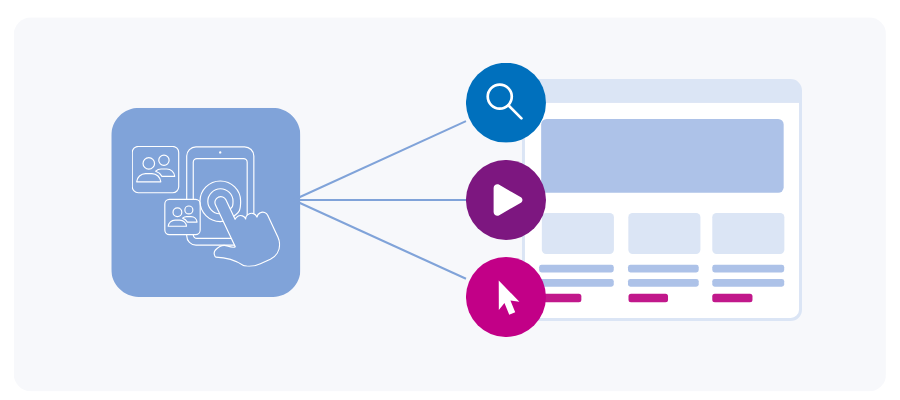
Clean rooms and tokenization support this, but their effectiveness depends on governance, interoperability, and whether insights can move cleanly across partners and workflows. Partner-enabled measurement, connecting exposure data to outcomes through trusted partners including IQVIA Digital, PurpleLab, and OptimizeRx, is structured in two steps:
- Link activation and measurement IDs without collapsing them into an open identity environment
- Produce aggregated, defensible outcomes including script lift, qualified HCP engagement, and verified delivery
Mixed-identity is the operating reality, and infrastructure is how you manage it
Mixed-identity is now the operating reality for healthcare marketing, not a temporary phase to work around. Performance depends on working across environments where identity is sometimes strong and sometimes limited by design. Healthcare marketers don’t need to pick a single identity approach and apply it everywhere. Building infrastructure that connects deterministic identity, tokenized matching, and contextual signals, keeping compliance, operational flexibility, and trust intact at every step, is what separates the brands managing this well from the ones still patching it channel by channel.
Talk to our team about your healthcare identity strategy
Whether you’re running DTC, HCP, or both, our team can help you build an infrastructure that works across identity environments. Let’s connect.
About the author

Kevin Dunn
Chief Revenue Officer, Experian
Kevin Dunn joins Experian Marketing Services with more than 20 years of leadership experience across marketing and advertising technology, most recently serving as Senior Vice President of Brands and Agencies at LiveRamp. In that role, he led growth across retail, CPG, travel, hospitality, financial services, and healthcare, overseeing new business, account expansion, and channel partnerships.
Kevin is known for building cohesive, accountable teams and leading with optimism, clarity, and a strong sense of shared purpose. His leadership philosophy centers on empowering people, driving positive outcomes for clients and fostering a culture where teams can grow, take smart risks, and succeed together.
FAQs
Mixed-identity means a healthcare campaign relies on more than one type of signal at once, such as authenticated data in one channel, contextual data in another, and aggregated measurement in a third. Pharma brands increasingly need infrastructure that coordinates all of these signal types together instead of treating each channel as a separate problem.
Experian keeps DTC and HCP identity in distinct, non-overlapping workflows so patient data and healthcare professional data never combine. DTC activation runs on high-fidelity tokenized matching, and HCP activation relies on deterministic National Provider Identifier (NPI) resolution using verified attributes like specialty and practice location.
Supply quality matters because outcomes like script lift or provider engagement only mean something if the underlying ad exposure is reliable. Curated supply, publisher-direct deals, and placement-level transparency give healthcare marketers a more defensible foundation before they trust any downstream measurement result.
Partner-enabled measurement connects exposure data to outcomes through trusted third parties such as IQVIA Digital, PurpleLab, and OptimizeRx, without merging activation and measurement identifiers into one open identity environment. The result is aggregated, defensible outcomes like script lift, qualified HCP engagement, and verified delivery.
Healthcare marketers don’t have to choose one approach over the other, since most campaigns already run across both conditions at the same time. Building infrastructure that connects deterministic identity, tokenized matching, and contextual signals is what allows a campaign to stay compliant while still reaching the right audience.
Latest posts

Are Traasdahl, CEO and founder of Tapad, the leader in cross-device marketing technology and now a part of Experian, has been named Founder of the Year by the Global Startup Awards. The Global Startup Awards’ Founder of the Year Award recognizes an individual that has pushed the boundaries of technology to empower new innovations and ideas. The Global Startup Awards places each year’s regional category winners against each other to determine whose achievements stand out from the rest of the startup ecosystem through nomination, voting and jury evaluation. In May 2016, the Nordic Startup Awards named Traasdahl Founder of the Year. “Are is a force of nature and his creativity and passion know no boundaries, it seems,” said George Tilesch, Global Startup Awards juror and U.S. managing partner of Innomine Group. “Extra kudos for the mentoring work and the Norwegian superfund plans. Are knows giving back is of the utmost importance.” “Are is a superstar within the Norwegian startup ecosystem,” said Kim Balle, founding partner and CEO of the Global Startup Awards. “From the jury feedback I could see that not only are his impressive achievements the reason for their rating, but also his focus and ability to give back to the startup scene played an important factor in him winning the category.” “It is an enormous honor to be named Founder of the Year by the Global Startup Awards,” said Traasdahl. “I am so committed to fostering entrepreneurship both at Tapad and throughout the startup space. This win is a remarkable bookend for a stellar year that began with our acquisition by the Telenor Group and continued with best-in-class product innovation, superior solutions for our clients and our Propeller Program that is so dear to my heart.” Tapad’s Propeller Program hosts five early-stage companies at Tapad’s New York headquarters for one year to mentor them through global expansion. The participants of this inaugural program come from Traasdahl’s native Norway. For more information on the Global Startup Awards, please visit: http://www.globalstartupawards.com/#gsa. Contact us today

NEW YORK, Nov. 29, 2016 /PRNewswire/ — For the second consecutive year, Tapad, part of Experian, has been listed among Deloitte’s Technology Fast 500™, a ranking of the 500 fastest-growing technology, media, telecommunications, life sciences and energy tech companies in North America. Tapad, number 147 on the 2016 Deloitte list, is the leading provider of unified, cross-device marketing technology solutions. “It is an honor to once again be recognized by Deloitte for our growth and momentum, particularly given the stature of the other technology companies on the list,” said Are Traasdahl, founder and CEO of Tapad. “Our product innovation, particularly in TV analytics and measurement, is a major contributor to our progress. I’m extremely proud of our hard-working, talented team for continually executing at such a high level.” “Today, when every organization can be a tech company, the most effective businesses not only foster the courage to explore change, but also encourage creativity in using and applying existing assets in new ways, as resourcefully as possible,” said Sandra Shirai, principal, Deloitte Consulting LLP and U.S. technology, media and telecommunications industry leader. “This ingenious approach to innovation calls for the encouragement of curiosity and collaboration both within and outside the office walls.” “This year’s Fast 500 winners showcase that when organizations are open to diverse perspectives and insights, they are able to create an environment for their employees and customers to see the possibilities and ingenious solutions that might lie ahead,” added Jim Atwell, national managing partner of the emerging growth company practice, Deloitte & Touche LLP. “Entrepreneurial environments foster change and innovation within businesses, and we look forward to watching these companies continue to drive change across all sectors.” Contact us today
Distribution via LiveRamp enables seamless cross-device customer experiences through more platforms NEW YORK, Nov. 15, 2016 /PRNewswire/ — Tapad, now part of Experian and the leading provider of unified cross-device marketing technology solutions, today announced an expanded partnership with LiveRamp™, an Acxiom® company and leading provider of omnichannel identity resolution, to make the proprietary Tapad Device Graph™ accessible beyond Tapad-hosted direct integrations. Through LiveRamp, Tapad’s Device Graph Access now extends to more than 400 ad tech and mar tech platforms. Tapad’s Device Graph™ enables marketers to understand, monetize and measure consumer engagement across all digital channels, and Tapad’s unified consumer view is recognized as one of the most accurate, scalable cross-device solutions in the market today. Through the expanded partnership with LiveRamp, the Tapad Device Graph can be distributed to the hundreds of platforms used to reach consumers on digital channels and measure campaign performance – even as devices are added daily to Tapad’s extensive graph. “Increasingly, marketers want access to cross-device targeting and measurement capabilities within their preferred platforms,” said Anneka Gupta, chief product officer of LiveRamp. “Our expanded partnership makes it easy for marketers to access Tapad’s graph through the rapidly growing set of integrations available in our partner ecosystem.” This is the latest of several initiatives between the two technology platforms designed to make the integration of cross-screen platforms seamless, privacy-safe and easy to use for dynamic and engaging marketing efforts. “During the past year, Tapad has expanded its global presence and rapidly grown its data business – Tapad Coral – doubling the number of companies integrating our device graph into their platforms and growing our annualized run rate by 210%,” said Pierre Martensson, GM of Tapad Coral and APAC. “Our expanded partnership with LiveRamp positions us to meet the increased demand for Tapad Device Graph Access and enable new platforms to apply our graph with unprecedented speed.” Contact us today