At A Glance
Healthcare marketing now runs across mixed-identity conditions, where authenticated data, contextual signals, and aggregated measurement all show up in the same campaign. Pharma brands need infrastructure that keeps DTC and HCP identity separate and still connects fragmented signals across activation, privacy, and measurement. Experian acts as an independent, privacy-first identity, data, and workflow layer for pharma marketers, designed specifically for this operating environment.Originally published in Digiday
Key takeaways
- Pharma campaigns now span environments with very different identity conditions, from strong addressability to contextual only signals, which makes coordination a core infrastructure challenge.
- Privacy and compliance rules require DTC (patient) and HCP (healthcare professional) data to stay in separate, non-overlapping workflows at every stage.
- Experian’s identity and workflow layer governs DTC tokenized matching and HCP deterministic National Provider Identifier (NPI) resolution as two distinct processes, never one merged identity path.
- Partner-enabled measurement connects exposure data to outcomes like script lift and qualified HCP engagement through trusted partners including IQVIA Digital, PurpleLab, and OptimizeRx.
A pharmaceutical brand launching a campaign today might rely on authenticated data in one environment, contextual signals in another, and aggregated measurement somewhere else entirely. That’s the reality of healthcare marketing right now, and most brands are still building the operational model to match it.
In a mixed-identity ecosystem, performance comes from the ability to coordinate multiple signal types across activation, privacy, and measurement workflows. Accuracy and scale depend on knowing which approach fits which environment and having the infrastructure to execute across all of them.
From onboarding to outcomes
Pharma marketing teams need identity workflows that can support accurate audience creation, governed activation, and partner-enabled measurement without combining DTC and HCP identity paths.
Download our pharma marketing playbook to help your team:
- Plan DTC and HCP identity strategies with clearer separation
- Prepare audiences for activation across approved channels and partners
- Evaluate audience quality, usable reach, and governance

Healthcare campaigns run across different signal conditions
Healthcare campaigns now run across environments with very different identity conditions, from fully addressable channels to contextual only placements. Digital advertising has long assumed that better identity leads to better targeting, frequency management, orchestration, and measurement, but healthcare has always operated with more constraints than most categories. Those constraints are becoming impossible to ignore as budgets move into connected TV (CTV), point-of-care, publisher-direct, programmatic and retail media-adjacent environments.
That shift changes the operating model. Marketers now have to manage audience strategy, supply quality and performance across channels that don’t support the same level of addressability, interoperability, or measurement visibility. In some environments, identity is strong and can support targeting and measurement. In others, identity is limited or unavailable, and marketers have to rely on contextual or aggregated signals. Managing across both environments is now a core infrastructure challenge for healthcare marketers, and it’s one that requires a deliberate strategy rather than a channel-by-channel patch.
Privacy risk is a media infrastructure issue
Privacy risk in healthcare marketing now shapes how campaigns get built and run from the ground up, extending well beyond compliance into media infrastructure itself. Tighter privacy and compliance expectations mean audience construction, exposure management, and outcomes analysis all get more complex once tracking is restricted.
Data can’t move freely across partners or workflows, and DTC and HCP data environments need to stay isolated from one another. This is especially true in pharma, where the stakes of a compliance misstep extend well beyond a campaign. This creates a more demanding operating model. Healthcare marketers have to balance identity-based and privacy-forward approaches while maintaining reach, relevance, and accountability. That balance requires governance that’s built into the infrastructure, not layered on top of it after the fact.
Experian acts as an independent, privacy-first identity, data, and workflow layer for pharma marketers, designed specifically for this operating environment:
These workflows are governed separately by design, with governed onboarding connecting fragmented DTC and HCP signals to activation-ready audiences without collapsing the two identity paths.
The mixed-identity playbook starts with matching the approach to the environment
The right mixed-identity approach depends on what each environment can support and what the campaign is needs to achieve. A pharmaceutical team may want more addressability, a publisher may only offer contextual or cohort signals, and a measurement partner may need exposure data, while platforms limit how identifiers can be shared.
Healthcare marketers need an operating model built for multiple identity conditions, with clear rules for how signals can be connected, activated, and measured without increasing privacy or compliance risk. That may include:
Experian’s infrastructure supports all three modes:
The missing layer in pharma marketing. Watch our Q&A
Supply quality is a prerequisite for measurement
Supply quality determines whether measurement in a mixed-identity environment can be trusted. When tracking and addressability vary across channels, advertisers need confidence that impressions ran in the right environments and under the right conditions before they can trust any downstream outcomes.
This is especially true in CTV and programmatic, where campaigns span fragmented supply paths, publishers, devices, and partners. Outcomes like script lift or provider engagement are only meaningful if the underlying exposure is reliable and well understood. In healthcare, this also ties directly to brand suitability and disclosure control. Curated supply, publisher-direct deals and placement-level transparency help campaigns run in appropriate environments and give measurement a more defensible foundation.
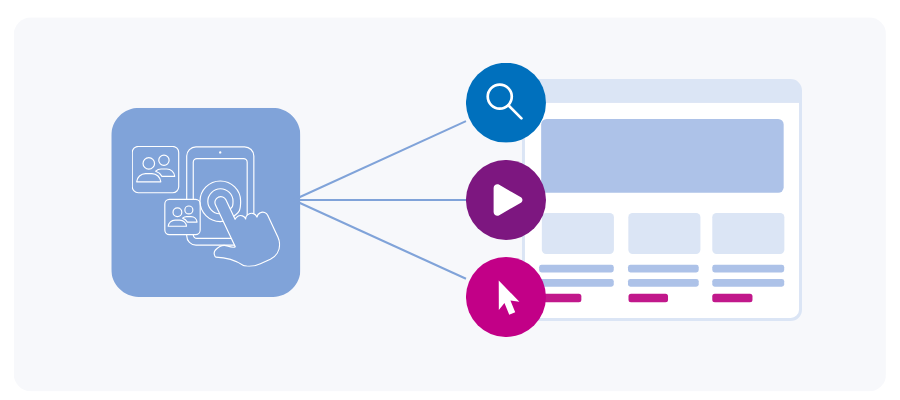
Clean rooms and tokenization support this, but their effectiveness depends on governance, interoperability, and whether insights can move cleanly across partners and workflows. Partner-enabled measurement, connecting exposure data to outcomes through trusted partners including IQVIA Digital, PurpleLab, and OptimizeRx, is structured in two steps:
- Link activation and measurement IDs without collapsing them into an open identity environment
- Produce aggregated, defensible outcomes including script lift, qualified HCP engagement, and verified delivery
Mixed-identity is the operating reality, and infrastructure is how you manage it
Mixed-identity is now the operating reality for healthcare marketing, not a temporary phase to work around. Performance depends on working across environments where identity is sometimes strong and sometimes limited by design. Healthcare marketers don’t need to pick a single identity approach and apply it everywhere. Building infrastructure that connects deterministic identity, tokenized matching, and contextual signals, keeping compliance, operational flexibility, and trust intact at every step, is what separates the brands managing this well from the ones still patching it channel by channel.
Talk to our team about your healthcare identity strategy
Whether you’re running DTC, HCP, or both, our team can help you build an infrastructure that works across identity environments. Let’s connect.
About the author

Kevin Dunn
Chief Revenue Officer, Experian
Kevin Dunn joins Experian Marketing Services with more than 20 years of leadership experience across marketing and advertising technology, most recently serving as Senior Vice President of Brands and Agencies at LiveRamp. In that role, he led growth across retail, CPG, travel, hospitality, financial services, and healthcare, overseeing new business, account expansion, and channel partnerships.
Kevin is known for building cohesive, accountable teams and leading with optimism, clarity, and a strong sense of shared purpose. His leadership philosophy centers on empowering people, driving positive outcomes for clients and fostering a culture where teams can grow, take smart risks, and succeed together.
FAQs
Mixed-identity means a healthcare campaign relies on more than one type of signal at once, such as authenticated data in one channel, contextual data in another, and aggregated measurement in a third. Pharma brands increasingly need infrastructure that coordinates all of these signal types together instead of treating each channel as a separate problem.
Experian keeps DTC and HCP identity in distinct, non-overlapping workflows so patient data and healthcare professional data never combine. DTC activation runs on high-fidelity tokenized matching, and HCP activation relies on deterministic National Provider Identifier (NPI) resolution using verified attributes like specialty and practice location.
Supply quality matters because outcomes like script lift or provider engagement only mean something if the underlying ad exposure is reliable. Curated supply, publisher-direct deals, and placement-level transparency give healthcare marketers a more defensible foundation before they trust any downstream measurement result.
Partner-enabled measurement connects exposure data to outcomes through trusted third parties such as IQVIA Digital, PurpleLab, and OptimizeRx, without merging activation and measurement identifiers into one open identity environment. The result is aggregated, defensible outcomes like script lift, qualified HCP engagement, and verified delivery.
Healthcare marketers don’t have to choose one approach over the other, since most campaigns already run across both conditions at the same time. Building infrastructure that connects deterministic identity, tokenized matching, and contextual signals is what allows a campaign to stay compliant while still reaching the right audience.
Latest posts

Early successes include revenue increases, global partnerships and fundraising NEW YORK, March 16, 2017 /PRNewswire/ — Tapad’s entrepreneurial mentorship initiative, the Propeller Program, has seen extremely positive results since it began in September 2016. The five early-stage startups selected from Norway have gained momentum in establishing a U.S. presence. Tapad, now a part of Experian, is the leader in unified cross-device marketing technology. The company was acquired by the Telenor Group in 2016. Among the successes within Propeller: Xeneta, the leading ocean freight price comparison platform and contracted rate database, has raised an additional $12M in funding since beginning the Propeller Program. Before the end of 2016, the company had exceeded its revenue expectations by nearly 30 percent, proving the European-focused business could succeed in the American market. “Aside from directly impacting our revenue, the Propeller Program has provided us with incredible access to a countless number of external resources, including subject matter experts from the fields of fundraising, public speaking, corporate structuring and immigration law,” said William Di Ieso, GM of North America for Xeneta. “We remain extremely grateful for the opportunity and exposure the program has provided for Xeneta.” Bubbly, an in-store real-time engagement tool for non-buyers, now has clients on four continents. After only a few months in the U.S. market, Bubbly has signed deals with one major retail brand, one major toy manufacturer and a major global consulting firm. The Propeller Program has also opened doors for greater opportunities in Scandinavia and EMEA. After an introduction to Telenor Group’s President and CEO Sigve Brekke, Bubbly is currently piloting its IoT kiosk with the company. “The mentoring sessions have been very valuable and have given us guidance as to how to best enter the U.S. market,” said Marianne Haugland Hindsgaul, Bubbly CEO and co-founder. “Learning to do business in the U.S. is not something you can necessarily learn from a book. The most impactful lessons are based on real-world experience, and that is what the Propeller Program has given us.” BylineMe, a marketplace for freelancers, publishers and brands to connect for content creation and distribution services, has built an extensive network of potential clients and investors. The company has tested its product in the U.S. market and gained valuable feedback for further development. Eventum, a property-sharing group that digitally assists in securing venues for meetings and corporate events, has closed a seed round of funding for nearly $1M. Eventum has also made key hires in the areas of business development and engineering “It is so rewarding to be able to support these Norwegian startups in a meaningful way,” said Are Traasdahl, CEO and founder at Tapad. “Mentor relationships are critical for strategic growth, and I am proud to be able to pay forward the experiences I have gained as an entrepreneur. To me, the Propeller Program is a shining example of the magic that can happen when Norwegian innovation meets American opportunity.” Contact us today
Tapad’s TV analytics solutions now include premium national cable inventory– Travelocity asserts industry need, praises partnership — NEW YORK, February 28, 2017 — Tapad, a part of Experian, has announced its partnership with clypd, the leading audience-based sales platform for television advertising. By integrating clypd’s national cable network inventory, the partnership will expand Tapad’s extensive supply of TV inventory to include premium national cable inventory. Tapad is the leading provider of privacy-safe, cross-screen marketing technology solutions and was first-to-market with a device graph. Clypd’s robust sell-side advertising platform was one of the first built exclusively for the television industry, empowering media owners with solutions that deliver workflow automation, data-enhanced decisioning and, overall, maximize TV campaign performance. Through this partnership, Tapad’s Device Graph-powered TV tools will work in tandem with clypd’s sales platform to enable more precise audience engagement for TV ad buys. This will enable marketers to integrate their customer data or third-party digital segments into Tapad’s TV platform and use them to precisely engage their audience across clypd’s industry-leading footprint of national TV inventory. Campaigns are then optimized using Tapad’s graph-powered TV attribution, ensuring ads are aligned with the best context for each brand’s message. “Clypd is a pioneer in building TV marketplaces,” says Marshall Wong, SVP of TV market development at Tapad. “They were quick to recognize the benefits a device graph could bring to TV so that advertisers can activate linear inventory curated for any digital audience.” “Tapad’s TV activation platform increases the efficiency in which marketers can reach their intended audience on traditional linear TV,” says Doug Hurd, co-founder and EVP of business development at clypd. “Their customized, data-driven campaigns launch with precision and really increase the value marketers can extract from linear TV inventory.” “At Travelocity, we are always looking for ways to more efficiently reach our target audiences,” says Ashley Parker, head of brand marketing at Travelocity. “The combination of traditional linear TV and solutions like this offering from Tapad and clypd are bringing both the tools and the supply to make this vision a reality.” Contact us today
Dextro clients to achieve increased accuracy in cross-device consumer measurement and engagement NEW YORK, Feb. 6, 2017 /PRNewswire/ — Dextro Analytics, a pure play analytics company that harnesses the power of human learning and artificial reasoning to drive more informed and effective consumer marketing, is partnering with Tapad, the leading provider of unified, cross-screen marketing technology solutions and now a part of Experian. The deal is effective immediately and the scope of the partnership covers North America. Additional terms were not disclosed. Leveraging Tapad’s privacy-safe Device Graph™, Dextro Analytics will be able to significantly bolster its insight engine to decode complex customer journeys. Armed with more relevant, actionable insights, marketers can use Dextro’s cross-screen, closed-loop measurement systems to reach and engage the right customer at the right time through the right channel. “Being able to accurately map consumer preferences, behaviors and journeys in a privacy-safe and unified way across devices is still one of the biggest pain points for marketers,” said Ajith Govind, co-founder of Dextro Analytics. “At the same time, this partnership engages customers with the right message at the right time.” “Detecting latent patterns and signals, and tracing backward- and forward-looking behavioral characteristics, are keys to sustaining a competitive advantage in a crowded space,” said Manmit Shrimali, co-founder of Dextro Analytics. “With the proliferation of data and devices, connecting the dots is of paramount importance.” “Dextro is solving some of the biggest challenges in analytics today,” said Pierre Martensson, GM of Tapad’s data division. “Our partners consistently see notable improvements in both budget allocation and device optimizations after integrating with the Tapad Device Graph, and I have every confidence that Dextro will be among them.” For more information about Dextro Analytics’ revolutionary approach to using human learning and artificial intelligence algorithms to solve business and analytical problems, please visit http://dextroanalytics.com/. For more information about Tapad’s cross-platform advertising solutions, please visit https://www.experian.com/marketing/consumer-sync. Contact us today