At A Glance
Experian’s Digital Graph and Marketing Attributes joint solution connects digital identifiers with rich consumer attributes. Our joint solution supports identity resolution, cross-channel media activation, analytics, and measurement, helping marketers unify fragmented signals and drive greater reach and insight.What is Experian’s Digital Graph and Marketing Attributes?
Experian’s Digital Graph and Marketing Attributes joint solution is a unified identity and data framework that connects digital identifiers with rich consumer attributes.
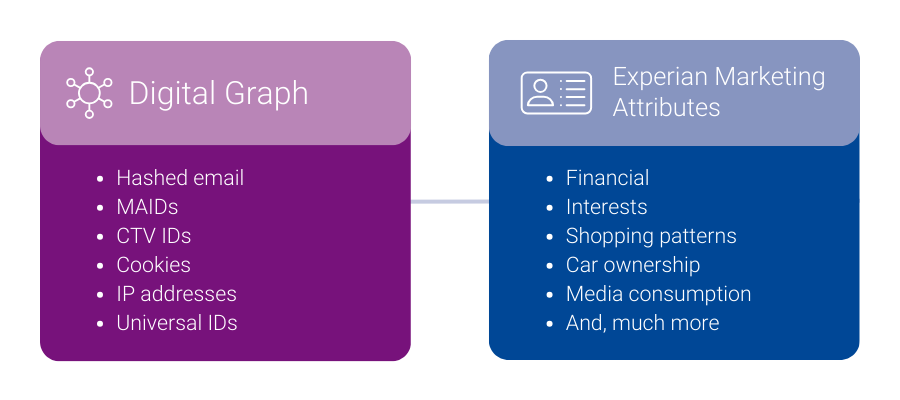
Experian’s Digital Graph connects digital identifiers to people and households, while Experian’s Marketing Attributes add depth, including demographics, interests, shopping behavior, and media preferences. Together, they help marketers and platforms with the insights and connectivity they need to understand who their customers are and reach them across digital channels.
How signal fragmentation and omnichannel are reshaping audience connection
Signal fragmentation and third-party cookie uncertainty are reshaping how our industry reaches consumers. At the same time, omnichannel media consumption spreads engagement across platforms, creating a broader but more complex view of consumer behavior. Together, these shifts are pushing marketers and platforms to rethink how they connect insights, activation, and reach across channels, opening the door to more unified approaches.
How Experian’s joint solution helps marketers and platforms address signal fragmentation and omnichannel behavior
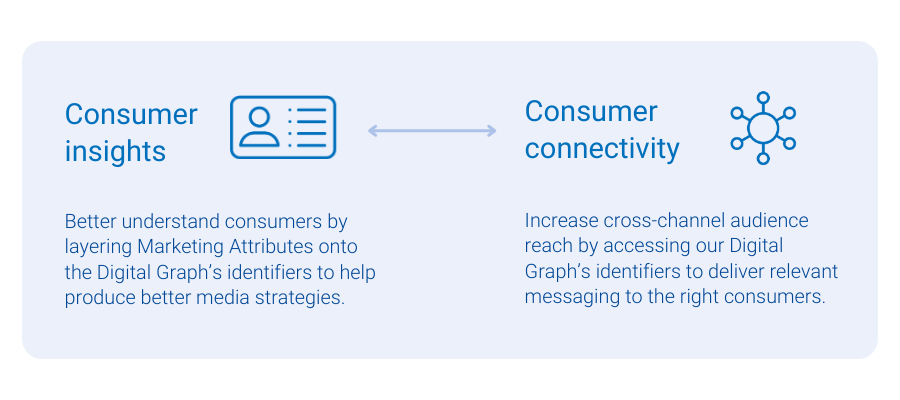
Our Digital Graph and Marketing Attributes joint solution helps marketers and platforms navigate signal fragmentation and omnichannel behavior by providing identifiers for seamless cross-channel engagement. By adding Marketing Attributes to our Digital Graph, like demographic and behavioral data, marketers and platforms can gain a better understanding of their consumers. Our joint solution uses Experian’s identity keys, the Living Unit ID (LUID) and Person ID (PID), to combine offline and digital data, giving you deeper insights into consumer behavior, greater audience reach, and improved cross-channel visibility.
What are the benefits of Experian’s Digital Graph and Marketing Attributes joint solution?
Our Digital Graph and Marketing Attributes joint solution brings identity and insight into a single framework, supporting the following benefits:
Four ways to use Digital Graph and Marketing Attributes
When our Digital Graph and Marketing Attributes come together, you get a 360-degree view of your consumers, powering four critical use cases:
How OpenX uses Experian’s Digital Graph and Marketing Attributes joint solution
OpenX is an independent omni-channel supply-side platform (SSP) focused on audience and identity-based targeting across CTV, mobile, app, and desktop environments.
OpenX licenses Experian’s Digital Graph to support one of the largest independent supply-side identity graphs. The addition of Experian Marketing Attributes enriched this graph with consumer-level insight tied to IPs, MAIDs, and client identifiers.
This approach has supported greater addressability and insight for buyers and improved monetization opportunities for publishers during ongoing signal fragmentation.
“We built on our long-term partnership with Experian to enrich our digital IDs with Experian’s Marketing Attributes, which help provide buyers better insights to audiences, thereby helping our publishers monetize their inventory. With partners like Experian, OpenX effectively facilitates the value exchange between demand and supply, ensuring our partners are able to drive results for their business in the era of signal fragmentation”
OpenXCraig Golaszewski, Sr. Director of Strategic Partnerships
How StackAdapt uses Experian’s Digital Graph and Marketing Attributes joint solution
StackAdapt is the multi-channel programmatic advertising platform used by marketers for campaign execution, insights, and measurement.
StackAdapt licenses Experian’s Digital Graph alongside Experian Audiences, which provides them with the level of information they want. Our Digital Graph supports first-party data onboarding, and Experian Audiences support segmentation for activation.
This product combination supports cross-channel reach, segmentation, and campaign measurement within the StackAdapt platform.
“StackAdapt has been recognized as the most trusted programmatic platform by marketers, and with the integration of Experian’s Digital Graph and Audiences, we are strengthening our leadership in the space. This partnership improves our ability to deliver precise cross-channel segmentation, reach, and measurement, helping advertisers run more successful campaigns. Our collaboration with Experian allows us to offer a differentiated solution in the market and ensure our clients can deliver the most precise and impactful ads to their audiences.”
StackAdaptDenis Loboda, Senior Director of Data
We recently announced a new collaboration with StackAdapt, bringing the power of Experian’s identity graph, syndicated and custom audiences directly to the StackAdapt platform.
How Experian supports cross-channel marketing strategies with our Digital Graph and Marketing Attributes joint solution
Our Digital Graph and Marketing Attributes joint solution helps marketers and platforms connect identity to insight so they can create, activate, and measure cross-channel media campaigns.
Connect with us to learn how our Digital Graph and Marketing Attributes joint solution can support your cross-channel strategy.
Get in touch with us
FAQs
Experian’s Digital Graph and Marketing Attributes joint solution supplies marketers and platforms with the insights and connectivity they need to understand who their customers are and reach them across digital channels.
Experian’s Digital Graph unifies digital identity signals into a single, privacy-safe view of households and individuals.
Experian’s Marketing Attributes are consumer-level descriptors that include demographics, interests, shopping behavior, and media usage.are consumer-level descriptors that include demographics, interests, shopping behavior, and media usage.
Experian’s Digital Graph and Marketing Attributes joint solution links digital identifiers with attribute data, allowing platforms and marketers to understand and engage audiences across channels.
Marketers, publishers, supply-side platforms, and demand-side platforms use Digital Graph and Marketing Attributes joint solution for analytics, activation, and measurement.
Experian’s Digital Graph and Marketing Attributes joint solution addresses signal fragmentation by reducing reliance on a single identifier type by supporting multiple digital identifiers within one identity framework.
Latest posts

Study reveals that brands with more mature identity programs were significantly more likely to be successful in achieving their key objectives Tapad, a part of Experian, a global leader in cross-device digital identity resolution and a part of Experian, has commissioned Forrester Consulting, part of a leading research and advisory firm, to conduct a new study that evaluates the current state of customer data-driven marketing and explores how marketers can use identity solutions to deliver privacy safe and engaging experiences, in an evolving data landscape. The study highlights the changing ground rules for digital marketing and the threat that poses to marketers’ ability to deliver against long standing KPIs and campaign goals. Nearly two-thirds (62%) of respondents said that the forces of data deprecation will have a significant (40%) or critical (21%) impact on their marketing strategies over the next two years. Among those surveyed, identity resolution strategies have surfaced as an opportunity to create more powerful customer experiences, with 66% aiming to have it help improve customer trust and implement more ethical data collection and use practices, while nearly 60% believe it will point the way to more effective personalization and data management practices. Although organizations are eager to implement identity resolution strategies, a complex web of solutions and partners makes execution a challenge. For example, respondents report using at least eight identity solutions on average, across nearly six vendor partners, and they expect that fragmentation to persist in the ‘cookieless’ future. Additionally, brands’ identity resolution technologies typically represent a patchwork of homegrown and commercial solutions. Eighty-one percent of respondents use both in-house and commercial identity resolution tools today, and 47% use a near-equal blend of the two. Despite the challenges, many brands have the foundation for a strong identity resolution strategy in place, and they are thriving as a result. Specifically, more mature brands were 79% more successful at improving privacy safeguards to reduce regulatory and compliance risk, 247% more successful at improving marketing ROI, and over four times more effective at improving customer trust compared to their low-maturity peers. Additional insights include: Marketers Are Increasingly Playing a Key Strategic Role Within the Organization, But There is a Mandate to Demonstrate Value. Nearly three-quarters of respondents in our study agree the marketing function is more strategically important to their organization than it used to be, while almost two-thirds agree there’s more pressure than ever to prove the ROI or business performance of their activities. Consumers Expect Brands to Deliver Engaging Experiences Across Highly Fragmented Journeys: Tapad, a part of Experian found that 72% of respondents agree that customers demand more relevant, personalized experiences at the time and place of their choosing. At the same time, 67% of respondents recognize that customer purchase journeys take place over more touchpoints and channels than ever, and 59% of respondents agree that those journeys are less predictable and linear than they once were. Marketing Runs on Data, But the Rules Governing Customer Data Usage are Ever-Evolving: According to the study, 70% of decision-makers agree that consumer data is the lifeblood of their marketing strategies – fueling the personalized, omnichannel experiences customers demand. At the same time, 69% of respondents recognize that customers are increasingly aware of how their data is being used. At least two-thirds agree that data deprecation, including tighter restrictions on data use (66%), as well as operating system and browser changes impacting third-party cookies (68%) means that legacy marketing strategies are unlikely to remain viable in the long-term.“ Our latest survey findings give us a better understanding of how our customers and other companies around the world are trying to master the relationship between people, their data and their devices,” said Mark Connon, General Manager at Tapad, a part of Experian. “This research shows why it's fundamental for the industry to continuously work to develop solutions that are agnostic. Tapad, a part of Experian has worked tirelessly to deliver on this with our Tapad Graph, and by introducing solutions like Switchboard to help the evolving ecosystem and in turn helping customers reap the benefits of better identity in both short and long-term.” The study is founded on an online survey of over 300 decision-makers at global brands and agencies, which was fielded from March to April, 2021. Data deprecation and identity are fast-developing, moving targets, so this study delivers targeted insights and recommendations for how to prepare for coming shifts in customer data strategies – whether they manifest tomorrow or a year from now. Get in touch

With the recent announcement of delaying third-party cookie deprecation to 2024, the industry has more time to rethink how to identify and communicate with consumers.
As today’s digital landscape gets more and more complicated there are more ways for brands to connect with users and drive purchases and more ways for ad tech to target and measure those touch points. As in-person shopping picks up steam due to the re-normalization of society post-COVID 19; the connection between digital ads and in-person purchases needs to be made once again. With the rise of Connected TV throughout the pandemic there are even more digital opportunities to target a user. But how do you make sure that those brand engagements are captured and correctly attributed to offline purchases and conversions? The answer lies in a holistic identity resolution strategy. Cross-device identity resolution with The Tapad Graph connects the identifiers and devices of individuals within a household to each other; enabling targeting, frequency capping, extension, segmentation and measurement or attribution between devices; including Connected TV and hashed (privacy-protected) email addresses along with Cookies, Mobile Ad Ids and IP Address. Brands can join their first-party data to The Tapad Graph to execute strategies that connect online and offline data for pre, mid and post-campaign efficiencies. Let’s imagine a scenario in which an outdoor retail brand is targeting users watching specific content on a Connected TV device. Powered by identity resolution, they start with a general ad on CTV and continue targeting down individual paths with each user. When one of them converts in store and makes a purchase; the outdoor retailer can connect that action through location and in-store traffic data with the cross-device identity resolution used to execute the digital campaign. Now the actions of the user online and offline are resolved for more accurate measurement and attribution after the campaign ends. But it doesn’t stop there– the brand's CRM data can be reactivated for the next digital campaign and leveraged to capitalize on the most effective media mix for the user who made the purchase previously. These combined insights can be invaluable in shaping up future campaign strategies with geo-contextual ads, recommended additional products and personalization to help drive more conversions and purchases in-store or online. As in-person shopping picks back up and marketers are tasked once again with balancing online and in-store KPIs, the right identity resolution strategy can unlock necessary efficiencies for retailers, ad tech vendors and agencies tasked with supporting these initiatives. Get in touch