At A Glance
Agentic AI is changing programmatic advertising from something you tweak after the fact into something that learns and improves while campaigns are running. Instead of guessing what might work, marketers can use data, identity, and context to reach the right people in the right places and adjust in real time. Experian connects everything behind the scenes, from data and audiences to activation and measurement, so campaigns feel more coordinated, relevant, and easy to manage while staying compliant and grounded in strong data practices.In this article…
Programmatic advertising has become much more sophisticated over the years. As capabilities have expanded, so has complexity. Marketers are now working across more platforms, with more signals and opportunities to optimize. Despite performance improvements, it can take time to fully understand what’s driving results and how to scale them.
Agentic artificial intelligence (AI) is closing that gap. Instead of just automating tasks, it introduces systems that can interpret signals, suggest next steps, and enable action within defined parameters — helping live campaigns adapt, and your marketing feel more human-centered.
In this article, we’ll break down what agentic AI looks like in programmatic advertising, how it’s changing campaign planning and activation, and where it’s delivering the most impact.
What is programmatic advertising in the agentic AI era?
Programmatic advertising is the automated, cross-channel buying and selling of digital media across channels like display, video, and connected TV (CTV). In the age of agentic AI, marketers can identify and act on opportunities while campaigns are live, as agentic AI functions less as a passive tool and more like a dynamic teammate.
With AI-powered programmatic marketing, your team can now proactively anticipate what’s likely to work next, simplify fragmented channels into a more unified strategy, and focus campaigns on outcomes that move your business forward with support from predictive insight and real-time intelligence.
Machine learning now processes and analyzes massive volumes of data in milliseconds, allowing systems to decide which impression to buy, what it’s worth, and where it’ll deliver the most impact in real time.
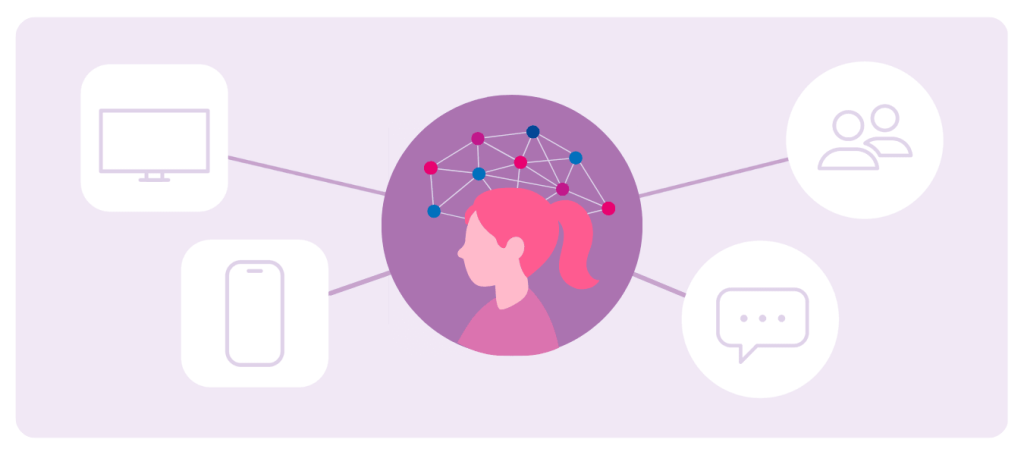
How is agentic AI reshaping programmatic marketing?
Programmatic advertising has always been about automation, but agentic AI is pushing it into something more adaptive. AI-driven processes now analyze the marketplace and enable autonomous media activation with human oversight, grounded in responsible automation.
As you integrate agentic AI into your advertising, it helps automate time-intensive, day-to-day tasks so your team can focus more on strategy, planning, and performance. Marketers still define the goals, set the guardrails, and oversee how AI is applied, which keeps decisions aligned with business objectives, compliance requirements, and overall campaign strategy.

Here’s how marketers can benefit from agentic AI:
- AI accelerates and improves how fragmented signals across identity, behavior, and context are connected into a usable customer view.
- Optimization happens continuously, not in reporting cycles, as bids, audiences, and spend adjust in real time.
- Decisioning moves beyond static rules toward adaptive, data-driven prioritization.
- Predictive models help reduce waste by identifying low-value impressions before allocating spend.
- Personalization becomes more accurate while still grounded in privacy-safe, identity-first data.
How is AI transforming media curation and supply optimization?
Programmatic advertising has traditionally relied on open exchange buying, optimizing across large volumes of inventory. As AI becomes more embedded in programmatic marketing, the focus is shifting toward more intentional activation, prioritizing environments that are more likely to perform from the start.
Dynamic curation and supply optimization
With dynamic curation, AI aligns predictive audiences with contexts where engagement is strongest, using real-time signals to determine who to reach and where they’re most likely to engage. Campaigns are guided toward higher-probability environments upfront, rather than relying on post-impression optimization.
This moves programmatic marketing away from broad open exchange buying and toward more curated, intentional activation, with continuous adjustments as signals evolve.
Emerging agentic workflows
Emerging agentic workflows introduce systems that analyze performance, recommend changes, and activate them within defined guardrails. Instead of waiting for reporting cycles, campaigns continuously evaluate signals and adjust in real time.
AI handles day-to-day decisions like shifting spend or refining audiences, while marketers retain strategic control and accountability.
Generative and analytical AI applications
Not all AI in programmatic advertising is about activation. Many gains are happening behind the scenes, especially in analytics.
Generative and analytical AI support tasks like attribute development, description creation, and insight acceleration. This reduces time spent on reporting and helps teams focus on understanding performance, surfacing patterns, and identifying what to scale.
Experian’s curation capabilities
At Experian, we combine identity-based predictive data with contextual AI models to better align audiences with available supply. With Audigent now part of Experian, audiences are indexed to the live bidstream and contextual signals, helping campaigns activate in environments where they’re more likely to perform.
Experian Curated Deals package high-quality inventory, such as streaming and premium lifestyle content, with predictive audience data. When layered with our #1-ranked data accuracy by Truthset, these deals become predictive and help you activate greater confidence in campaign placement and performance.
Practical use cases of AI in complex and regulated markets
The value of AI in programmatic advertising becomes clearer in environments where complexity is highest, such as industries with strict regulations, fragmented data, and significant financial stakes tied to every impression. Financial services, healthcare, and retail all require approaches that balance accuracy, compliance, and measurable outcomes, built on privacy-first data and human-centered activation.

The following shows how programmatic advertising can come to life in practice.
Financial services
In financial services, performance only matters when it’s compliant. AI helps marketers reach qualified consumers without crossing regulatory lines.
Your team can:
- Activate identity-based audiences for lending, credit, and financial products within defined compliance guardrails.
- Use predictive financial attributes (where permitted) to prioritize prequalified and high-intent consumers.
- Support responsible offer prioritization and budget allocation based on eligibility and likelihood to respond.
- Operate within transparent, auditable environments designed for regulated activation.
Healthcare
Healthcare marketing requires accuracy without ever exposing sensitive data. AI enables more relevant engagement while maintaining strict privacy standards.
With AI-powered programmatic marketing, you can:
- Activate privacy-safe, compliant health-interest segments without relying on protected personal data.
- Deliver campaigns without exposing sensitive identifiers or violating regulatory requirements.
- Optimize delivery based on region, timing, and contextual alignment with patient research behavior.
- Maintain controlled, privacy-forward environments that prioritize trust and compliance.
Commerce media
In commerce media, programmatic performance is measured by its impact on transactions and revenue. AI helps unify signals into a more connected, outcome-driven strategy.
It empowers marketers to:
- Connect household-level insights to activation across CTV, display, and commerce media networks.
- Use AI-powered identity resolution to maintain continuity as consumers move across devices, channels, and purchase journeys.
- Enable dynamic curation by aligning predictive audiences with more effective inventory in real time.
- Adjust spend toward environments and segments that actively drive purchase behavior.
As these use cases expand across industries, so does the need to ensure AI is applied responsibly.
Trust, transparency, and ethical challenges in AI-powered AdTech
As AI takes on a larger role in programmatic advertising, the focus is shifting from what it can do to how it does it. Marketers need to validate results and the data behind them to ensure every decision stands up to regulatory and consumer scrutiny.
AI systems now influence audience selection, media investment, and measurement at scale. But those decisions are only as reliable as the data behind them. Without clear governance, it becomes difficult to answer basic but critical questions, such as, “What data informed this decision? Was it compliant?” Or, “Could bias be influencing the outcome?”
This is why trust in AI starts with the data rather than the model.
AI governance and data stewardship
Rather than governing our clients’ AI systems, Experian helps govern the data those systems depend on. Our guiding principle is simple: responsible automation begins with governed data. We ground our AI approach in strict data governance frameworks, ensuring the data entering any model is compliant, consented to, and accurate before it’s used.
We treat AI and machine learning as advanced modeling technologies operating within contractual and privacy-first guidelines, with controls for data quality, consent validation, and compliance applied upfront. In the end, you’ll have confidence that your AI outputs are not only performant but also explainable, auditable, and aligned with regulatory expectations from the beginning.
Clear usage restrictions
Strong governance only works when it’s paired with clear boundaries. To protect data integrity, privacy, and compliance, Experian enforces strict controls on how data is used across AI and programmatic workflows.
- Data is used only within defined contractual, legal, and regulatory guidelines.
- Sensitive information is protected and restricted from use in unauthorized environments.
- Data access is limited to approved, compliant systems and workflows.
- Data is not shared, exposed, or repurposed beyond its intended use.
- AI processing occurs within controlled environments that meet privacy and security standards.
- AI use cases are subject to appropriate review, governance, and oversight.
These guardrails give you the assurance that innovation moves forward without compromising trust.
Bias mitigation and responsible modeling
As AI plays a larger role in audience creation and activation, models must be continuously monitored for fairness. At Experian, models are continuously reviewed and refined to reduce bias and ensure outputs align with responsible marketing practices and changing regulations.
Consent and consumer control
Consumer consent and control are central to responsible AI usage in programmatic advertising. Data must be sourced through compliant, transparent mechanisms, with controls that allow consumers to access, manage, and opt out of how their data is used.
This aligns with regulatory frameworks such as the California Consumer Privacy Act (CCPA), the General Data Protection Regulation (GDPR), and the Health Insurance Portability and Accountability Act (HIPAA) (where applicable).
How Experian enhances every stage of the agentic AI programmatic workflow
AI in programmatic advertising only works if the system behind it is connected. When data, activation, and measurement are fragmented, optimization lags.
Experian brings those pieces together. By connecting identity, data, activation, and measurement into one workflow, AI can continuously turn first-party data into predictive audiences, help you activate them across channels, and measure outcomes in a single, connected system.
AI-ready data foundation
Everything in AI programmatic advertising starts with the data. Experian transforms first-party data into a predictive asset by onboarding and enriching it with Experian Marketing Data, ranked #1 in accuracy by Truthset, and unifying it through our Digital and Offline Graph.
This creates a high-integrity data layer that improves audience quality, extends reach, and supports activation across channels while maintaining privacy-forward standards.
Predictive intelligence
Predictive intelligence helps you understand what’s likely to work before activation begins. Experian applies behavioral modeling and signal analysis to identify high-potential audiences and generate identity-based lookalikes based on shared characteristics and patterns.
As campaigns run, AI surfaces next-best opportunities so teams can adjust activation strategy in real time.
Audience discovery and creation
Experian simplifies audience creation by bringing everything into one place. First-party data is combined with Experian Audiences and expanded through access to Partner Audiences in our data marketplace. Instead of stitching together multiple inputs, you’re working from a more complete, connected view upfront.
Our platforms and audience teams then help identify, build, and refine segments based on relevant attributes, reducing manual setup, accelerating activation, and enabling scalable, persona-based audience creation.
Identity-rooted activation
After you’ve defined your audiences, identity becomes critical in consistently reaching them across channels.
Partner with Experian for agentic AI-driven programmatic campaigns
Experian helps you turn first-party data into marketing that feels more connected, relevant, and accountable, bringing together identity, AI, and privacy-first data to support better decisions from planning to outcomes. Speak to an Experian expert about enabling agentic AI in your programmatic advertising strategy today.
FAQs
AI in programmatic advertising uses machine learning to improve how media is bought, targeted, and optimized. It enhances audience discovery, activation, and measurement by analyzing large volumes of data in real time, allowing campaigns to adapt continuously instead of relying on static rules.
Experian supports programmatic advertising across the full workflow, from identity resolution and audience development to contextual indexing and outcome-based measurement. Through a combination of Experian’s platforms, data, and audience teams, marketers can turn fragmented signals into more connected, performance-driven campaigns.
Agentic AI in advertising refers to systems that can analyze performance, recommend changes, and activate optimizations within defined guardrails. Unlike traditional automation, these systems adapt in real time while marketers maintain strategic oversight and control.
Experian supports privacy-first AI through strict data governance frameworks, compliant data sourcing, and transparent modeling practices. Identity resolution and activation are designed to meet regulatory requirements while maintaining consumer trust and control.
AI improves audience discovery through predictive modeling, inferred attributes, and lookalike techniques to identify high-potential audiences. It also surfaces next-best segments, reducing manual effort and accelerating time to activation.
AI supports media curation by aligning predictive audiences with high-performing environments in real time. Through dynamic curation and Experian Curated Deals, campaigns activate in more relevant contexts rather than relying on broad open exchange buying.
Latest posts

Identified in The 2021 Digital Advertising Trends Report published by Postclick, marketers are striving to improve and enhance their segmentation and targeting strategies in their digital ad campaigns. Carlos Lopez, SVP of Brand Planning at Digitas Health predicted that in 2021, the challenge will be to overcome the death of third-party cookies and still deliver a personalized advertising experience. It’s fair to say that his prediction will still be impacting marketers past 2021 with the delay of cookie deprecation. These goals along with the constantly changing digital landscape paint a challenging picture for even the most advanced marketers. Marketers can be prepared for the next era of digital marketing by finding the right mix of partners that offer privacy-safe, cookie-free solutions. Smart marketers will employ these solutions and compare these results with data from cookies. The Tapad + Experian Take The Tapad Graph enables brands, agencies, and ad tech platforms to identify and target individuals and households across their digital touchpoints. With this data, they can personalize messages across devices, measure and optimize throughout the customer journey, and then report back on conversions at the individual and household levels. Tapad, now part of Experian, leverages a machine learning algorithm that determines these connections at scale by using probabilistic models with authenticated, privacy-safe, real-time data. There are a myriad of cookieless IDs emerging in the marketplace, and it’s not likely going to be a one size fits all situation. In order to be prepared for the next era of digital marketing, marketers should diversify ID partners and be proactive with testing while the cookie is still around to benchmark against. With Switchboard, a module within The Tapad Graph, we’ve been able to develop connections between traditional digital identifiers (IP Addresses, MAIDs, CTV IDs) and the new wave of cookieless IDs (UID2.0, Panorama ID, ID5 ID) that will be utilized in the future. Here’s an example of what The Tapad Graph and Switchboard looks like at the Household level with various traditional digital identifiers and cookieless IDs. Get in touch
Marketers are under more pressure than ever before to prove ROI and efficiency of marketing activities in relation to business performance. On top of that, there are new privacy regulations and uncertainty around what new technologies will have to be implemented in order to replace the granular level targeting and measurement the industry historically has used third-party cookies for. It’s clear marketers are going to need the right tech stack and partners to continue to prove their team’s efficacy. We recently partnered with Forrester Consulting to evaluate the current state of customer data-driven marketing and surveyed over 300 global marketing decision makers at the brand and agency levels. We found that marketing is facing increased demands today, insights from the study include:Consumers expect brands to deliver engaging experiences across highly fragmented journeys. Seventy-two percent of decision-makers reported that customers demand more relevant, personalized experiences at the time and place of their choosing. Marketing runs on data, but the rules governing customer data usage are changing quickly. More than 70% of study participants stated that consumer data is the lifeblood of their marketing strategies, fueling the personalized, omnichannel experiences customers demand. These demands paint a challenging picture. Just as marketers are poised (and tasked) with delivering greater value to their organizations and customers, the ground rules are changing and threatening their ability to deliver. Indeed, 62% of respondents said that the forces of data deprecation will have either a “Significant” (40%) or “Critical” (21%) impact on their marketing strategies over the next two years. Effective identity resolution can help brands prepare for data deprecation challenges Marketers face a daunting landscape, but they can leverage the data, technology, and processes that comprise identity resolution to address business objectives, combat ecosystem complexity, and future-proof customer engagement efforts. By utilizing identity resolution, marketers will be able to match and connect multiple identifiers across devices and touchpoints. This allows for a cohesive, omnichannel view that enables brands to continue to deliver personalized and contextually relevant messages throughout the customer journey and without the use of cookies. The identity graph is the underlying infrastructure that defines connections between the numerous, fluid, and disparate identifiers created during moments of consumer engagement, turning disparate signals into addressable and actionable steps. These connections enable brands to bolster their ability to gain deeper customer insights and power audience building, attribution, and connected measurement. Identity resolution encompasses a wide range of capabilities that support an equally diverse set of marketing use cases. These include the targeting, personalization, and measurement of both known and pseudonymous audiences in the offline and digital worlds, which enables marketers to improve customer data management, drive more effective personalization, and gain insights and efficiencies through measurement across touchpoints. By taking the time to vet the privacy procedures and data collection processes of identity solutions you can reduce your regulatory risk and maintain customer trust. In an open-ended survey response, a marketer shared, “We’ve found that users are willing to volunteer data when they understand what it’s being used for and are asked for clear consent.” Finding the right partners to help navigate the changes The scramble to find an alternative to third-party cookies has slowed down since Google announced they will be delaying their cookie removal until late 2023. However, this gives marketers a unique opportunity to take advantage of the additional time and feel more prepared and confident in their solutions. With the delay, marketers can now test ID solutions and compare apples to apples with data from the third-party cookie while it’s still active and addressable. Test and find a solution that works now, so there are no surprises once cookies have finally made their way out the door in 2023. At Tapad, a part of Experian, we’ve developed a solution that provides agnostic interoperability for the myriad of cookieless identifiers emerging in the market. As a new module in the Tapad Graph, Switchboard will connect traditional digital identifiers to cookieless IDs to support the entire ad ecosystem with privacy-safe future-proof identity resolution. Get in touch
Email hashing was originally intended to be used as an email security feature that has ended up being a very powerful marketing tool. A hashed email is a cryptographic function that changes an email address to a random code which can be used as an anonymous customer identifier. This code is privacy-safe and cannot be traced back to the customer’s email address. However, this hashed email can function like a digital passport that traces every behavior and action a customer takes when logged into an account that is authenticated with an email, making hashed emails a goldmine for customer data. Today emails are used across traditional publishers and within the CTV ecosystem; tying them to more consumer touch points than ever before. Why the emphasis now? Cookies are on their way out the door and have been the primary way that many marketers have tracked their existing and potential customers. In order to replace this granular level of data, marketers are likely going to need multiple solutions. With so many cookieless solutions and IDs appearing in the marketplace, the mapping of the customer journey is bound to be fragmented. Relying on first-party data, such as hashed email, is just one way to reduce that fragmentation; as it can serve as an authenticated starting point for cross-device identity resolution that can be leveraged for targeting, personalization and measurement. How can Tapad + Experian help? Tapad + Experian’s Hashed Email Onboarding is a privacy-safe way to connect consumer email addresses to their related digital devices and other digital identifiers through high precision probabilistic identity. By onboarding hashed emails and incorporating them within your Tapad Graph file you can: Build a more holistic view of individuals and households and their relationship to email addresses in your first-party data set Leverage these relationships for increased cross-device scale for targeting Employ personalization tactics at the household or individual level across devices Create new audience segments and look-alike models for cross-channel activation Design more inclusive measurement and attribution for customer journey mapping Tapad, a part of Experian has built a hashed email onboarding product feature that works with the existing flexibility of The Tapad Graph to deliver the most holistic consumer view, combined with the attributes you need, in the structure that works best for your business objectives. Get in touch